
If I had to start marketing a roofing company in 2026, here’s exactly what I’d do.
And the thing is, this isn’t hypothetical. I’m doing it right now. We launched Owl Roofing in Minneapolis, and I’m building the marketing from the ground up. That means every principle in this guide is either something I’m actively executing or something I’ve seen work across the hundreds of roofing clients we’ve built campaigns for over the last decade.
Here’s what I’ve figured out about roofing marketing:
- The order matters more than the tactics. Most roofing companies run paid ads before they have a website that converts, or post on social before they have reviews.
- Consistency beats cleverness. The roofing companies pulling ahead in their local markets are doing a handful of things well, every week, without stopping.
- You need to be known for something specific. “Quality and customer service” isn’t positioning. Everyone says that.
This is a complete, channel-by-channel sequence, not a random list of ideas. The steps are in a deliberate order. Start at the beginning even if you’ve been in business for years.
Why Roofing Marketing Works Differently Than Other Trades
Roofing has a trust problem the industry created for itself.
Storm chasers. Fly-by-night contractors. Horror stories about deposits paid and work never completed. Homeowners have been burned enough that they approach every roofing company with baseline skepticism before the first conversation even starts. That’s not fair to the good contractors. But it’s the reality you’re marketing into.
What that means practically:
- Visibility alone doesn’t win jobs. You need to be visible and credible at the same time.
- Trust signals carry more weight in roofing than in almost any other home service category.
- The homeowner who searches for a roofer is not always the one making the final decision. Roughly 70% of first outreach to roofing companies comes from women leading their households. Everything you put out there should be built with that person in mind.
The marketing that works in roofing is the marketing that makes a homeowner feel safe before they ever call. That’s the frame for every step below.
Step 1: Build a Website That Actually Converts
A roofing website that converts is one that makes a homeowner feel confident enough to call. That’s it. Everything else is secondary.
The technical requirements for a converting roofing site:
- Fast load time. Pages with an LCP under 2.5 seconds convert meaningfully better than slow ones, according to roast.page’s page speed conversion research. If your site takes 5 or more seconds, you’re losing a chunk of visitors before they see anything.
- Mobile-first design. Most homeowner research happens on phones.
- A request-estimate or get started button visible on every page without scrolling.
- License, insurance, and warranty information above the fold.
- Real job photos, not stock images. A homeowner deciding to call you wants to see actual work, not a smiling model in a hard hat.
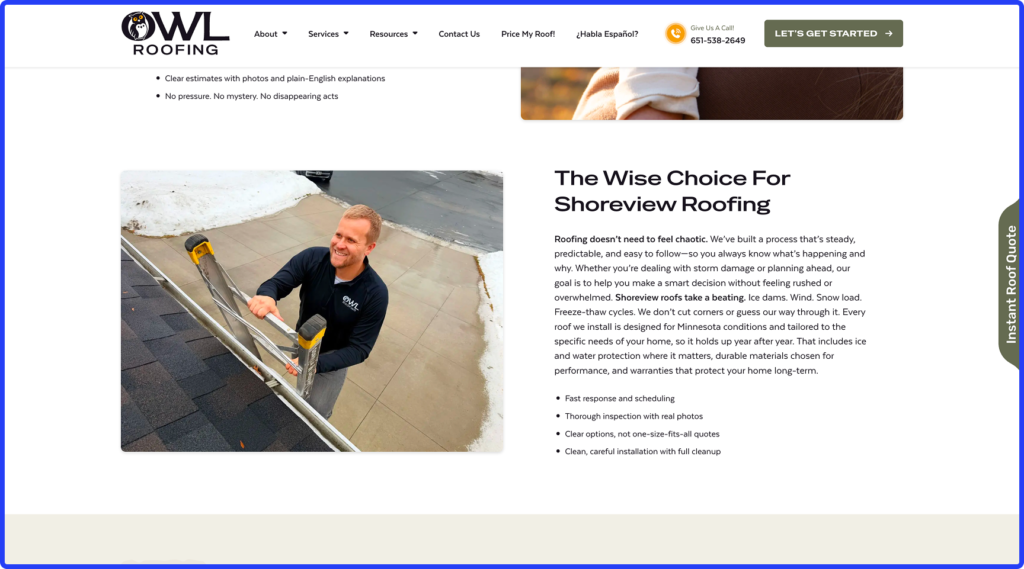
The more important point: headline quality and trust signals matter more than load time for conversion. Getting your site to a good-enough technical baseline (under 2.5 seconds LCP) and then focusing on the emotional experience is the better investment for most contractors.
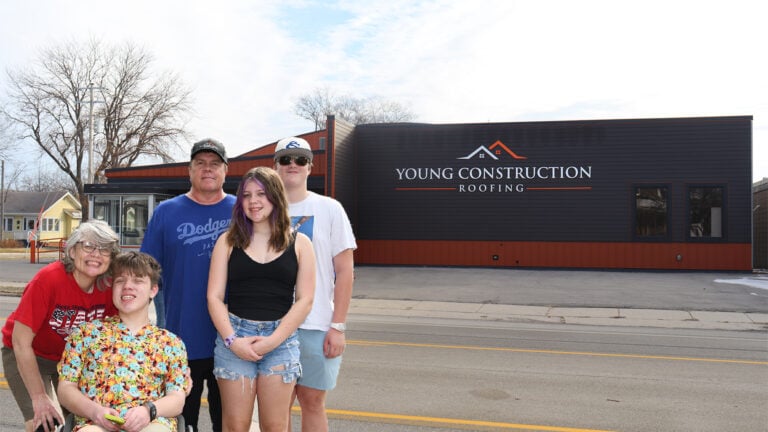
At Owl Roofing, we put real family photos and human emotion throughout the site. Not just finished roofs. Pictures of happy customers. A family with kids on their shoulders. The call to action shows the feeling of relief a homeowner gets after the job is done, not just the job itself. If you’re wondering what actually converts on a roofing website, that emotional angle is what most competitors completely miss.
Step 2: Claim and Fully Optimize Your Google Business Profile
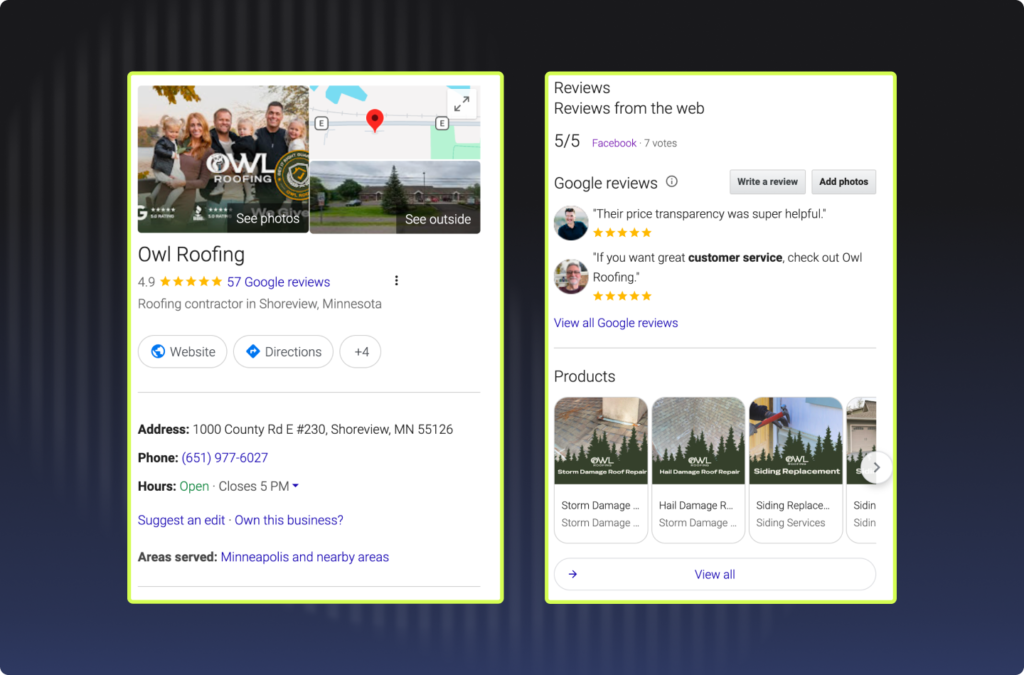
Your Google Business Profile is the single highest-return free asset in roofing marketing. This is where homeowners look first, and it’s what shows up in the local map pack for “roofers near me” searches.
What a complete GBP actually looks like:
- NAP consistency: your name, address, and phone number matching exactly everywhere online
- “Roofing Contractor” as your primary category, with relevant secondary categories added
- Service area defined by the zip codes and cities you actually serve
- Regular posts, at least weekly, showing completed jobs and your team
- Photos of real completed jobs, real crews, and real trucks, updated consistently
A half-filled GBP is nearly as bad as no GBP. It signals to Google that you’re not serious about being found, and it signals to homeowners that you might not be serious about your business.
Step 3: Win the Google Map Pack with Local SEO
Local SEO is the long game. It builds over months, not days. But when it works, it’s the lowest-cost-per-lead channel in roofing, and it’s hard for competitors to take away quickly once you’ve built it.
The core of local SEO for roofing:
- Location-specific service pages for every city and suburb you serve. Google ranks pages, not whole sites. A roofer serving the northeast Twin Cities who builds individual pages for each neighborhood ranks for those searches. One who doesn’t, doesn’t.
- Backlinks from local directories, chamber of commerce listings, and trade associations
- On-page structure using the pattern “[City] Roofing Contractor” in titles and headings
See our guide to roofing SEO and website elements for the full technical setup that supports this. Local SEO compounds. The work you do today pays off six months from now and keeps paying after that.
Step 4: Build a Review and Reputation Engine
Reviews are not optional in roofing. They are the mechanism through which trust is built with homeowners who don’t know you.
According to BrightLocal’s 2026 Local Consumer Review Survey, 85% of consumers are more likely to use a business after reading positive reviews, and 31% will only consider businesses with 4.5 stars or higher, up from 17% just a year ago. That bar is rising every year.
The review system that actually works:
- Ask at the right moment: right after final inspection, while the homeowner is still feeling good about the finished job
- Send a direct one-click link to your Google review page via text. Remove every possible friction point.
- Respond to every review. The same BrightLocal data found that 80% of consumers are more likely to use a business that replies to all reviews. Generic or templated replies put off 50% of consumers, so make each response feel personal.
- Respond to negative reviews especially. A thoughtful response to a bad review can actually build more trust than a sea of generic five-star ones.
One roofing company we worked with had strong crews and good pricing but almost no reviews. When we built a simple review request system into their job close process, they added 40 reviews in 90 days and saw measurable improvement in their map pack ranking within weeks.
Step 5: Run Google Local Services Ads
LSAs sit above everything else in search results, including regular Google Ads. They charge per lead, not per click. Someone contacts you through the ad, you pay. Someone bounces without contacting you, you don’t. Unqualified leads can be disputed for a credit.
The Google Guaranteed badge that comes with approved LSA accounts adds a visible trust signal that no other ad format provides. In a category where trust is the primary conversion barrier, that badge does real work.
For most roofing companies just starting paid marketing, LSAs are the right first paid channel before Google Ads, because:
- You pay for outcomes, not traffic
- The barrier to bad leads is lower since you can dispute unqualified contacts
- The trust signal of the Google Guaranteed badge converts skeptical homeowners at a higher rate
If you’re deciding between LSAs and standard Google Ads as your first move, see our breakdown of LSAs vs Google Ads for roofing.
Step 6: Run Google Search Ads for High-Intent Keywords
Google Search Ads in roofing are not cheap. Average cost per lead ranges from roughly $120 to $300 depending on market and season, per what we see across client accounts. In major markets during storm season, that number goes higher.
The reason roofing contractors get burned on PPC is not the cost. It’s the structure. A campaign that lumps emergency repair searches together with full replacement searches and brand searches into one bucket wastes money because the intent, the urgency, and the right message are completely different for each.
The right structure:
- Emergency and storm damage campaigns: high urgency, fast response messaging, separate budget
- Full replacement campaigns: trust-focused messaging, timeline-oriented, benefit-led
- Brand campaigns: protecting your own name from competitors bidding on it
See our detailed guide to roofing Google Ads costs and structure before running a dollar of spend. The difference between a well-structured roofing campaign and a poorly structured one is often $80 to $100 per lead.
Step 7: Build a Social Media Presence That Supports, Not Replaces, the Above
Social media is not a primary lead channel for roofing. I want to be honest about that because a lot of contractors waste time and money treating it like one.
What social is actually good for in roofing:
- Trust-building before the first call. A homeowner who has been referred to you will check your Instagram before calling. What they find there shapes whether they actually dial.
- Brand visibility in your local market. The more your name shows up in feeds and local groups, the more familiar it feels when a homeowner needs a roofer.
- AI search citation. This is the newer angle most people haven’t considered yet.
On that last point: according to a SE Ranking social media AI study, AI-generated answers referenced social media platforms in 20% of Google AI Overview queries and 36% of AI Mode queries. The most commonly cited platforms were YouTube, Reddit, and LinkedIn. Your social presence is increasingly part of what AI tools pull from when recommending local businesses. An empty Instagram profile is now a gap in your AI visibility, not just a missed social opportunity.
At Owl Roofing, the social strategy started with a simple question I asked our co-founder, who has been selling roofs for over five years: what are the top seven questions homeowners ask during the sales process? We’re shooting videos that answer each one. Not commercials. Not “why choose us” content. Actual answers to what homeowners are already wondering before they talk to a roofer.
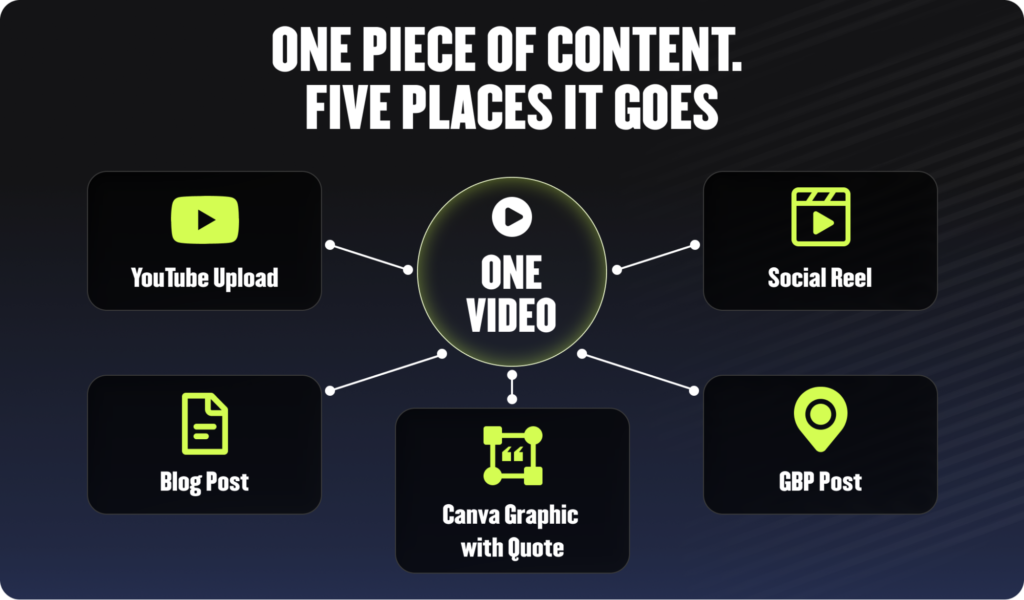
One video becomes five pieces of content: a YouTube upload, a social reel, a blog post, a Google Business Profile post, and a graphic with a quote pulled from it. If you can’t afford to produce a lot of content, this is the framework. One piece, five distribution points. You do that consistently and you start to appear everywhere your ideal customer looks.
For the specific question of whether paid social is worth it, see our breakdown of Facebook Ads for roofers.
Step 8: Publish Content That Also Shows Up in AI Search
This step is getting its own dedicated space because it’s the biggest gap in how most roofing companies think about their marketing right now.
AI tools like ChatGPT, Gemini, and Google’s AI Overviews are now answering homeowner questions directly. “How do I know if I need a new roof?” “What’s the lifespan of an asphalt shingle?” “How much does a roof replacement cost in Minneapolis?” A homeowner asking those questions might never scroll to the blue links at all. They get an AI-generated summary and take action from there.
According to Google’s own guidance on succeeding in AI search, being cited in an AI Overview is now more strategically valuable than ranking first for traditional results, because AI citations generate trust at a point in the journey before the homeowner is even comparing contractors. There is no separate AI index. The same content that ranks in traditional search gets pulled into AI answers. The difference is structure: content with direct answers, clear formatting, and genuine expertise is more likely to be cited.
What to publish:
- Blog posts answering real homeowner questions: roof lifespan by material, storm damage signs, what happens during a roof inspection, insurance claim process
- Location-specific content: “How much does a roof replacement cost in [your city]?”
- Comparison content: asphalt vs metal, different shingle brands, repair vs replace
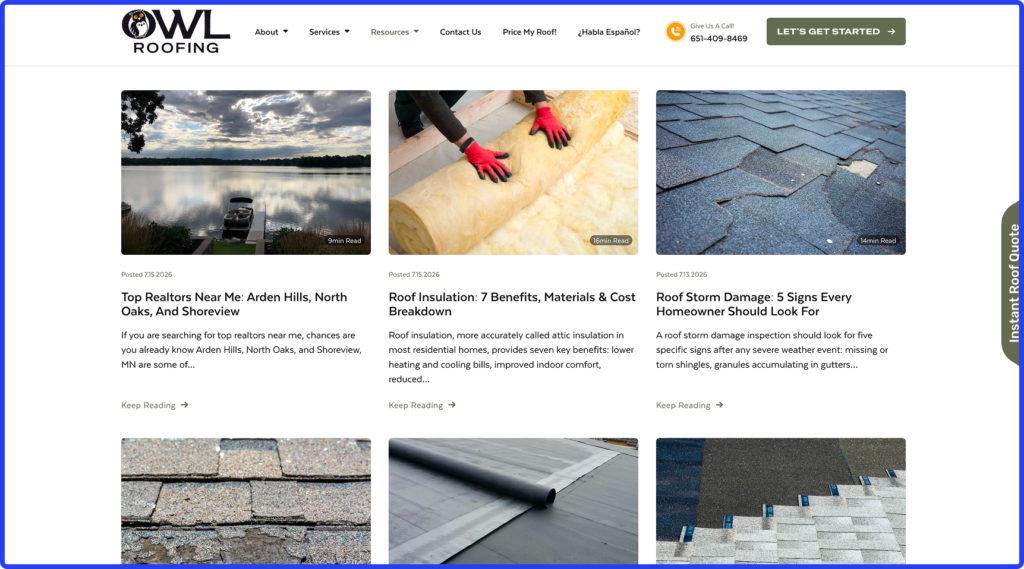
Each of these gives an AI tool something specific and useful to pull from when a homeowner in your area asks a related question. The roofer who has clear, well-structured answers to those questions online is the one that shows up.
See our guide to how AI Overviews affect contractor leads and our overview of answer engine optimization for home services for the full approach.
Step 9: Set Up Email Marketing and a CRM Follow-Up System
Most roofing companies give up on leads too early.
The data is consistent: closing a sale often requires five or more follow-up touches, but most contractors give up after one or two attempts. In roofing, where the decision cycle can run weeks, this is especially costly. A homeowner who got your estimate and didn’t immediately respond is not necessarily not interested. They’re often just not ready yet.
What a basic CRM follow-up system looks like:
- Segment your contacts: current active leads, past customers, cold prospects who never converted
- Automated follow-up sequence for new leads: same-day text, next-day call, three-day email, week two check-in
- Seasonal reactivation for past customers: spring inspection reminders, fall maintenance offers
At Owl Roofing, we’re using Roofle for instant roof quotes on the website, which means leads come in with their address already attached. That makes the first follow-up much more specific and personal. Tools that lower the homeowner’s barrier to entry also lower your response time barrier.
Step 10: Build a Structured Referral Program
Word of mouth is the oldest marketing channel in the trades. The problem is most roofing companies treat it as something that happens on its own rather than something you build a system around.
A formalized referral program turns informal recommendations into something consistent and scalable:
- A small, clear incentive per qualified referral, communicated at the right moment
- Ask right after a five-star review is left: the homeowner is already in a positive mindset
- Strategic partnerships with real estate agents, insurance agents, and property managers who regularly need reliable roofer recommendations
The math on referrals is compelling. Referred customers close at meaningfully higher rates than cold leads and tend to be more loyal and less price-sensitive. A single strong referral partnership with a local real estate agent or insurance adjuster can generate a steady pipeline of pre-qualified leads with no ad spend.
We’ve seen roofing clients who initially came to us entirely dependent on storm leads build a referral program that sustained them through slow seasons. That pipeline takes time to build, but once it’s running it costs almost nothing to maintain.
Step 11: Use Storm and Seasonal Targeting
Storm damage marketing is one of the highest-leverage tactics in roofing and one of the most underused. Hyper-local paid targeting in ZIP codes hit by hail or wind within days of an event reaches homeowners at exactly the moment they’re thinking about their roof. Storm and seasonal roofing marketing requires specific setup to do right, but the cost efficiency compared to standard paid search is significant.
The other tactic here is digital door-knocking: targeting homeowners adjacent to a just-completed job with social ads or direct mail. The neighbor who can literally see your truck two houses down is a far warmer prospect than a cold paid search lead.
One of the first leads we got at Owl Roofing came from Ride the Wave, a service that joins local Facebook groups in your area and posts on your behalf. Heartwarming community content, local stories, things that resonate with the neighborhood. They give people a small form to fill out and those come in as leads. We got a lead from it within the first week. I was literally looking up the address thinking, this is so new and exciting. That kind of community-level outreach costs a fraction of paid search and builds the kind of local presence that compounds over time.
The principle is the same as the yard signs. Get into your community through the channels your ideal customer actually uses, not just the ones that feel most like marketing.

Step 12: Don’t Abandon Offline Marketing
There’s a version of roofing marketing that treats digital as the whole answer. It isn’t.
One of the things I’m doing right now with Owl Roofing that surprised me with how fast it produced results: yard signs. Not randomly placed, mapped. I went out and put 20 yard signs at high-traffic intersections near our target neighborhoods. I’m looking for the connection points around high-traffic commerce. Coming out of a daycare, coming out of a gym, key intersections on the routes my ideal customer actually drives.
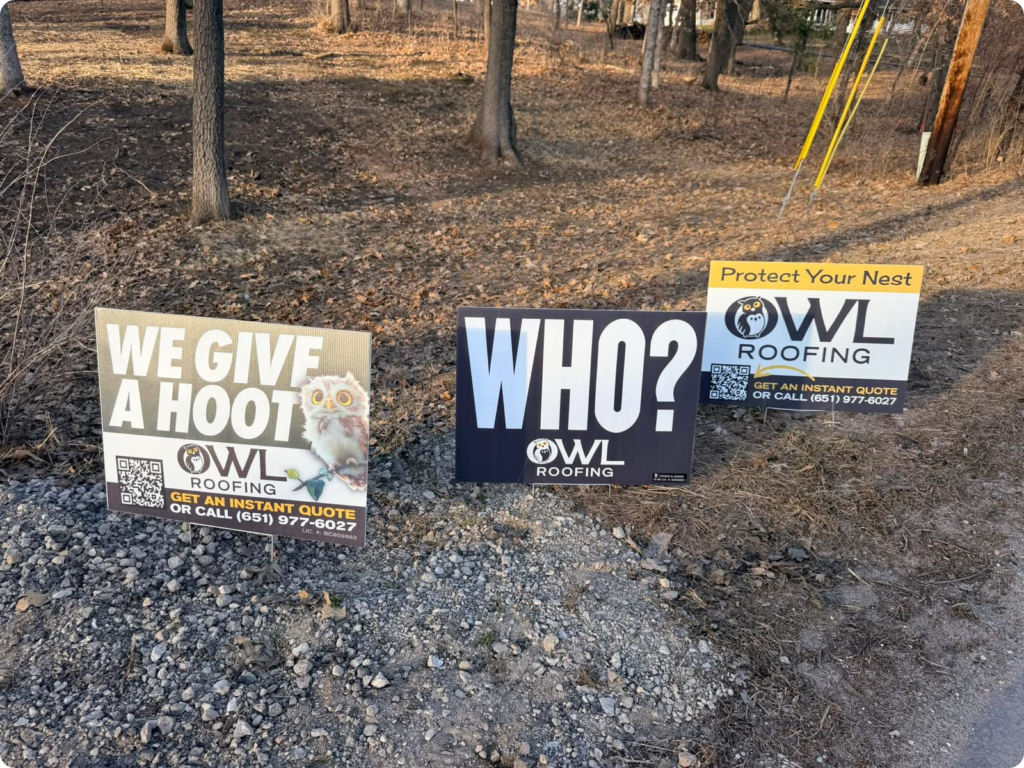
It’s a scrappy upstart move. I’ll be honest about that. But I decided I’m willing to accept the small chance somebody complains about too many yard signs because there’s a certain amount of audacity you need at the beginning of a company, and probably should keep throughout it.
The other offline tactic I borrowed directly from a company I visited: Trust Roofing in Florida. They give homeowners a box of extra shingles after every job, with the company logo on the box, the warranty information inside, and a business card on the outside. It’s a golden rule thing. If you were the homeowner, you’d want the matching shingles there for a small repair later. We’re implementing this at Owl Roofing right now, and I’m already marketing it on our homepage as part of what we do.
The principle I keep coming back to: find what’s working at larger companies and figure out how to do it at your scale. These bigger companies repeat things over and over because they’ve found something that works. Ask why it works, take the principle, adapt it.
- Door hangers near completed jobs. Someone who lives two streets over from your most recent install is a warm prospect. A door hanger drop right after job completion reaches people with demonstrable recent interest in roofing.
- Local business association networking. Being known in your local business community creates referral flows that no ad can replicate.
- Partnerships with real estate agents and property managers. These are repeat sources. One good relationship can mean years of inbound referrals.
For door hangers specifically, see our breakdown of roofing door hangers that convert. The execution details matter more than most people expect.
Step 13: Track Every Lead Back to Cost Per Lead and Cost Per Job
Without this step, every step above is a guess.
Most roofing companies run marketing for months and can’t tell you which channel is actually producing jobs. They know their phone rings. They don’t know which investment made it ring.
The minimum tracking setup for roofing marketing:
- Call tracking numbers by channel: one for Google Ads, one for LSAs, one for your website, one for offline
- Source attribution on every web form: where did this lead come from?
- Cost per lead by channel, updated monthly
- Close rate by channel, not just by lead count
The last point is critical and commonly skipped. A channel with a low cost per lead but a 10% close rate is worse than a channel with a higher cost per lead and a 40% close rate. Referral leads and branded search leads typically close at much higher rates than cold paid search leads. If you’re measuring only cost per lead and not close rate, you’re optimizing for the wrong number.
Step 14: Set and Protect a Real Marketing Budget
Industry practice for roofing companies is to allocate roughly 5 to 10 percent of gross revenue to marketing, spread across website, local SEO, paid ads, and reputation management. A company at $1 million in annual revenue is looking at $4,000 to $8,000 a month across all channels.
If you want a starting number specific to your revenue and goals, our marketing budget calculator walks you through it based on what you’re actually trying to accomplish.
The two most common budget mistakes:
- Spreading a small budget thin across too many channels. A $2,000 monthly budget split across Google Ads, LSAs, SEO, and social doesn’t move any of them. Pick the highest-priority channel and do it properly before layering in others.
- Cutting marketing spend the moment one slow month hits. The slow month is often when competitors pull back, which means your marketing dollar buys more visibility with less competition. Protecting the budget through slow periods is one of the highest-leverage decisions you can make.
At Owl Roofing, we’re not running PPC yet. We started in the off-season focusing on SEO and organic content, building the foundation before we add paid spend when spring hits. That’s a deliberate choice, not a budget constraint. Building the foundation first means paid traffic has somewhere worth going when we turn it on.
If you’re trying to figure out what to outsource and what to keep in-house as your budget grows, see our guide to choosing a roofing marketing consultant.
The Known For Framework: The Mindset Behind Every Tactic
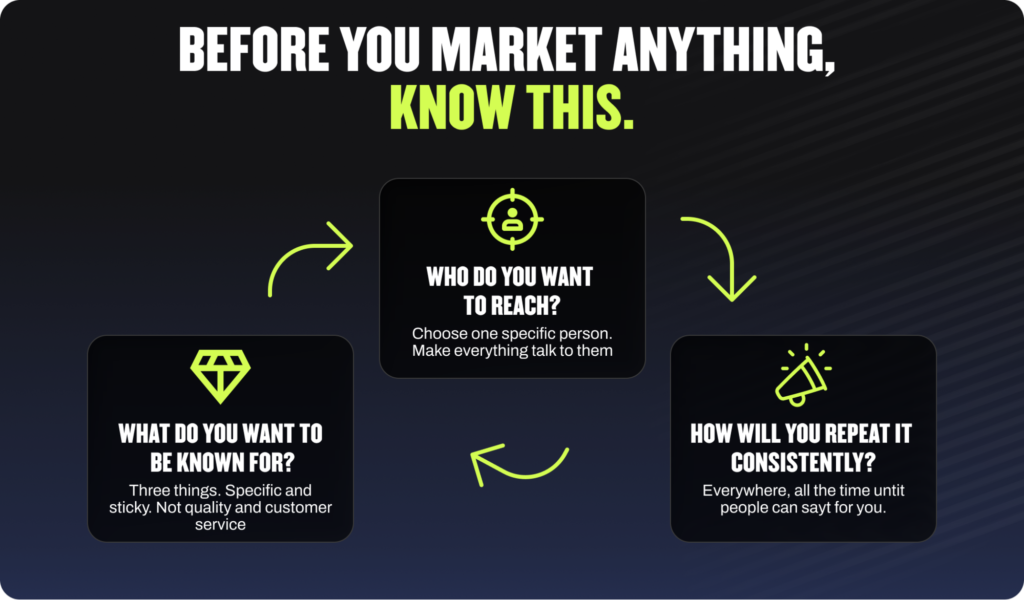
Before you run a single ad or post a single photo, you need to know what you want to be known for.
Most roofing companies want to be known for “quality” and “customer service.” So does everyone else. That’s not differentiation. That’s noise.
At Owl Roofing, I made a specific choice. We want to be known for three things:
- Being overcommunicative: homeowners hear from us at every step, not just when the job is done
- A three-step cleanup: a specific, nameable process that sounds different from “thorough cleanup”
- Insurance specialists: we understand the insurance process and we make it easier
Those three things aren’t particularly revolutionary. But they’re specific, they’re a little sticky, and they’re consistently different from what competitors say.
I also chose a specific ideal customer: a 45-year-old woman who is a working mom in a higher-end neighborhood with a lot going on in her life. Everything about our marketing talks to her. Not because I’m trying to exclude anyone else, but because if you try to speak to everyone you end up speaking to no one. 70% of first outreach to roofing companies comes from women leading households. That made the choice clear.
Something to note: The known for framework is the layer underneath everything else in this guide. The website, the reviews, the social content, the offline marketing, they should all express the same three things you want to be known for. Consistency is how you become the obvious choice. If you can’t explain why you’re different in one sentence, the market won’t remember you.
Common Roofing Marketing Mistakes to Avoid
These are the patterns I see most often when a roofing company comes to us frustrated with their results:
- Relying on one channel entirely. A single algorithm change, a price spike in your ad market, one bad storm season. Any of these can damage a business that’s completely dependent on one lead source.
- Treating reviews as optional. They’re not a nice-to-have. They’re the trust mechanism that determines whether homeowners call you or your competitor.
- Running paid ads with no landing page. Sending ad traffic to your homepage is one of the most common and most expensive roofing marketing mistakes. Homeowners who click a specific ad expect a specific response. A generic homepage does not give them that.
- Ignoring follow-up speed. A lead that doesn’t get a same-day response is a lead that’s probably already called someone else.
- Cutting marketing in a slow month. The slow month is the one where you should hold or increase. Competitors cut, you stay visible, you get more of whatever traffic is there.
Frequently Asked Questions
How much should a roofing company spend on marketing?
Most roofing companies allocate roughly 5 to 10 percent of gross revenue to marketing, spread across website, local SEO, paid ads, and reputation management. A company at $1 million in annual revenue should be looking at $4,000 to $8,000 a month across all channels.
What is the fastest way to get roofing leads?
Google Local Services Ads and Google Search Ads generate the fastest results, though at a real cost, typically $120 to $300 per lead for non-branded search. LSAs are often the better first paid channel because you pay per lead rather than per click. Local SEO and referrals cost less per lead but take longer to build.
Is social media worth it for a roofing company?
Yes, but mainly as a trust-building and brand-support channel rather than a primary lead source. Before-and-after job photos and short video content build credibility that supports every other channel. Social presence also increasingly affects AI search visibility, since AI tools cite social platforms in a growing percentage of local recommendations.
How important are online reviews for roofing companies?
Extremely important. According to BrightLocal’s 2026 data, 85% of consumers are more likely to use a business after reading positive reviews, and 31% will only consider businesses with 4.5 stars or higher. Reviews are the primary trust signal homeowners use before calling any contractor.
Can a roofing company show up in AI search tools like ChatGPT?
Yes. Being cited in AI Overviews and AI Mode answers is now more strategically valuable than ranking first in traditional results. Well-structured blog content with direct answers to real homeowner questions, combined with clean local business data, gives AI platforms something citable to pull from when recommending local contractors.
What is the most important first step for a new roofing company?
A complete Google Business Profile and a consistent review habit. Both are free, both compound over time, and both directly affect how many homeowners find you and whether they call when they do.
Build the Foundation. Then Layer In Everything Else.
The sequence in this guide is deliberate. Skipping steps to get to the channels that feel more exciting is how roofing companies waste money. Paid ads without a converting website. Social media without reviews. Reviews without a GBP to attach them to.
Do the steps in order. Prove each one before you add the next. The compound effect of all 14 working together is what separates roofing companies that dominate their local market from ones that stay stuck.
If you want help building this system for your roofing company, that’s what we do at Hook Agency. We’ve worked with roofing companies across the country for over a decade. We know what moves the needle and what wastes time. Schedule a call with our team and we’ll walk you through exactly what we’d build for your market.