The short answer
Owl Roofing opened January 1, 2026 with no customers, no reviews and no search traffic. By early November it had sold more than $6 million in roofing. Google search drove the biggest share of leads, a loud local brand made those leads easier to close, and the hardest parts were production, cash flow and hiring. Not marketing.
- $6M+ sold by early November 2026
- 19,700+ Google clicks, Jan to Sep, straight from Search Console
- People searching “Owl Roofing” by name went up 3x by July
I have run Hook Agency for 10 years in the trades. I have told hundreds of roofers what to do with their marketing. In late 2025, Noah Bergland asked me to put my money where my mouth is and start a roofing company with him.
I said, “Let me check with my wife.” She said, “Maybe.” Then she said yes.
This is what happened next. Not a highlight reel. Real numbers pulled straight from Owl’s Google Search Console and our CRM, plus the stuff that almost broke us. If you run a roofing company, use it as a playbook. If you are thinking about starting one, read the cautionary parts twice.
Free · instant access
Get the full Owl playbook
This post is the story. The playbook is the plan: the exact numbers, the mistakes and what we would run if we started over tomorrow.
- The 60/40 brand vs. lead gen split (and why most roofers should start at 80/20)
- The yard sign that beat every clever headline
- The 5 zip codes that drove 42% of sold jobs
- Our keep / trim / cut list for 2027
The scoreboard: Owl Roofing’s first 10 months
Every number on this page has a source next to it. Search numbers are real clicks from Owl’s own Search Console, not estimates from a third-party tool.
How it started: a napkin, an emoji and $161,000
Owl started with five meetings around a whiteboard before we did anything else. We wrote a mission, vision and core values using Traction, the same operating system I use at Hook. Then Noah and I sat down with our wives at dinner and set a goal that still makes me gulp: build a company that could do $50 million.
The name came from an absurdly simple process. I pulled up emojis on one side of my screen and GoDaddy on the other and looked for an animal with an available .com. Owl. Owlroofing.com was open. Before we designed anything, we decided who our customer was: a millennial mom around 45, the person who usually makes the call on a roof. She also tends to love owls.
“My biggest fear was just money and income. I was walking away from what essentially had been probably 90% of our yearly income to something that’s definitely not guaranteed.”
Noah drove to Rochester to take his general contractor exam because there was no open test date closer to home. We hung a napkin on the office wall with our first deposit. I put $161,000 of my own money in to get the company off the ground, and that was the whole check. Once it was spent, the company had to fund itself.
The timeline
- Late 2025Noah asks me to start a roofing company. Five whiteboard meetings, a name, a mission.
- January 2026We open. I start putting out yard signs in the middle of winter. The state calls us about them.
- Feb to MarchLots of video views, very little business. Search impressions start to climb.
- April to MayLeads go from a trickle to 10 to 20 a week. Trucks get wrapped. I get an owl tattoo.
- Late JuneHail lands in our backyard, right where our billboards are. 150 to 170 leads the next week.
- JulyNayt Pingry joins and sells $1M in his first three months.
- August386 clean leads in 40 days. A roofing coach comes in and tells us what is broken.
- September$4M sold. Search Console shows 3,769 clicks for the month.
- November$6M+ sold. We are planning a much bigger 2027.
Search: what actually drove 19,700 clicks
The first three months were humbling. We published constantly and got a few hundred clicks a month. Then April hit. Spring demand showed up at the same time our content and links started to mature, and clicks doubled in a single month. By September, Owl was getting 3,769 clicks a month from Google, on 640,000 impressions.
Owl Roofing’s Google clicks by month
Real clicks from Google Search Console. The lime bar is April, when everything turned on.
How we got there was not a secret trick. It was volume plus focus. By August the main site had roughly 1,000 posts and pages, plus about 50 more across 10 small satellite sites. I personally built the keyword map and took Owl from almost nothing to 70 top-three rankings in under 90 days, mostly on service and city pages. Ahrefs now values Owl’s organic traffic at roughly $22,700 a month in equivalent ad spend.
Here is the part most case studies leave out: the single biggest source of Google clicks was not a clever blog post. It was people typing “Owl Roofing.” The homepage and the Google Business Profile link pulled more clicks than every blog post combined, and almost all of it was branded.
How many times people searched for Owl by name
Google impressions for “owl roofing,” “owl roofing mn” and “owlroofing.” Brand marketing creates these searches. SEO catches them.
That is the whole thesis of Owl in one chart. Brand marketing made people curious enough to search our name. SEO made sure we were there when they did. If you only do one of those, you leave money on the table.
The pages that actually got the clicks
Top Owl pages by Google clicks, January 1 to November 5, 2026.
Swipe sideways to see every column →
| Page | Clicks | Impressions | What it tells you |
|---|---|---|---|
| Homepage (plus the Google Business Profile link) | 4,906 | 82,292 | Mostly people searching “Owl Roofing.” The brand is the biggest keyword. |
| Best commercial roofing companies in the US | 338 | 86,446 | Big list posts pull national impressions, not local leads |
| Best shingle colors | 276 | 19,860 | Homeowners shopping looks, not price |
| GAF shingle colors | 240 | 65,817 | Brand plus color is a real buying search |
| Contact page | 192 | 16,219 | People ready to call |
| Bundles of shingles per square | 144 | 136,810 | Huge visibility, almost no clicks. Google answers it for them. |
| Brands and materials | 139 | 9,608 | Proof pages matter to buyers |
A few honest takeaways from that table. Informational posts can rack up enormous impressions without bringing calls, because Google and AI answers now handle a lot of simple questions on the results page. The posts that earned real clicks were about what homeowners are actually choosing: colors, brands and who to hire. And the money pages, the homepage, contact page and quote page, only work if people already know your name.
Leads: where 386 leads in 40 days came from
In August we pulled every lead from the previous 40 days out of ProLine, our CRM, and removed duplicates, spam and job applications. That left 386 clean leads, roughly 58 a week. Here is where they came from.
Owl Roofing leads by source
386 deduplicated leads over 40 days, summer 2026.
Blended across every channel, including door knocking, a lead cost us about $300. We closed somewhere between one in three and one in five, on an average job around $21,000 to $22,500. That puts the true cost to win a customer at roughly 10% to 17% of gross profit. Expensive, but very healthy.
Two fixes made this data trustworthy. First, we got obsessive about lead source: “unknown” went from 67% of leads to 1%. Second, we treated speed to lead like a sales metric. Sara, our ops manager, was answering new leads in about 10 to 15 minutes on her own, and our standard now is five minutes or less.
The door knocking argument
Five days into the company, Noah and I argued about door knocking on camera. My point was that it is not free: a knocker typically keeps around 18% of a deal, versus about 10% when you feed reps leads. Noah’s point was that you should never stop knocking, because it is the one channel you control when the phone is quiet. We did the math out loud and decided it was “about a wash.”
“It’d be dumb not to do it all. Door knocking is really the thing you always fall back on when you don’t have roofs to look at.”
What surprised us: knocking produced less than we expected. The storm we did get was small and concentrated, and homeowners got burned out on knockers within days. Reps who were getting five to ten company leads a week had no time left to knock. We still require 100 doors a week per rep. People laughed at us about that in interviews.
Brand: why we spent 60% on being remembered
Most roofers put almost every dollar into leads. We split Owl’s year one roughly 60/40, brand to lead gen. I would not tell most new roofers to copy that. If you’re starting out, 80/20 toward lead gen is the safer bet. We went brand-heavy because the owl name could carry a campaign, and because we wanted Owl to feel like it had been around for years by the end of the first summer.
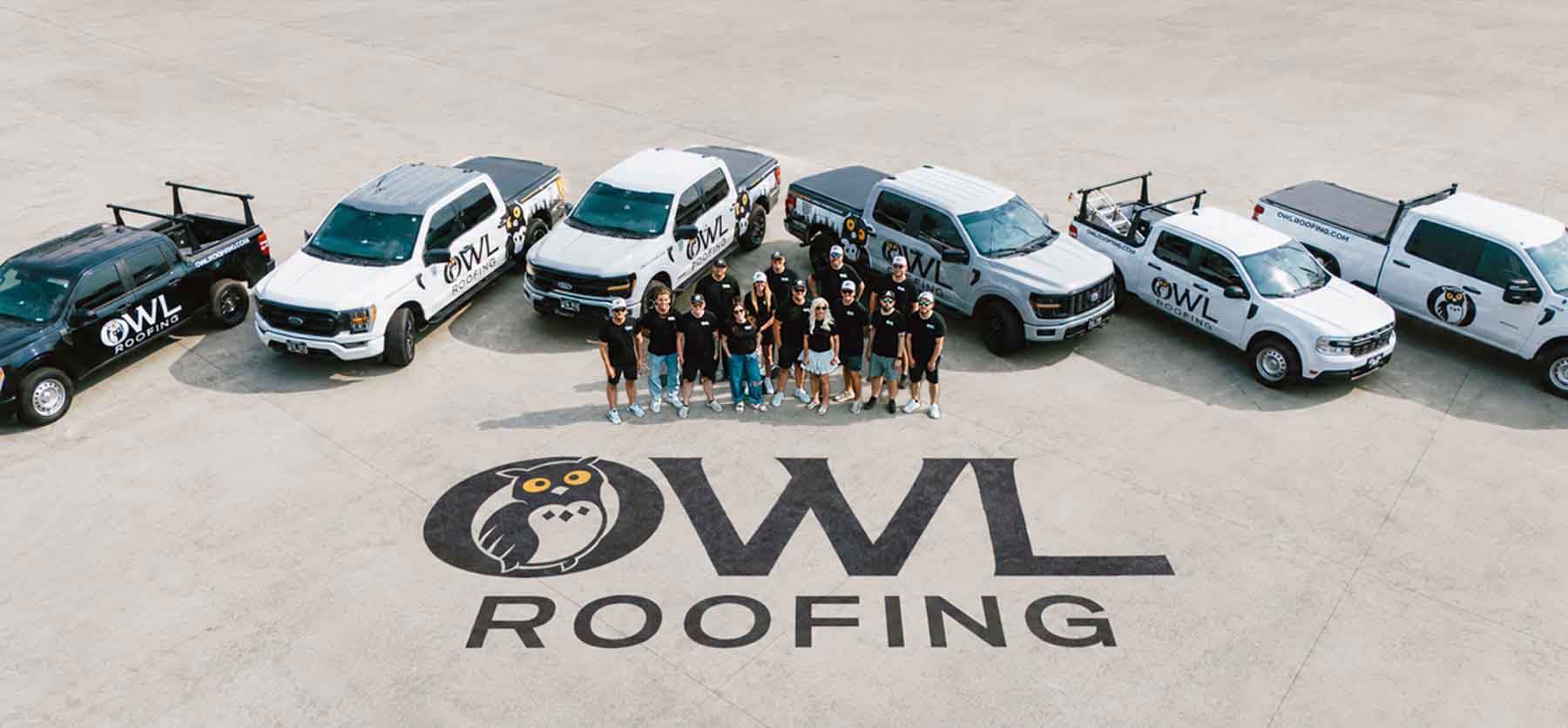
5,000 yard signs, and I put out 2,000 of them myself
We put out about 5,000 yard signs this year. I personally put out around 2,000. My wife will tell you that’s one of my strengths, and in the same breath she’ll tell you my weakness is listening to her on the budgets.
Here’s what we learned about signs:
- Volume is the strategy. If you’re only putting out 100, it isn’t going to be the same thing. Signs work when people see them on every corner for weeks.
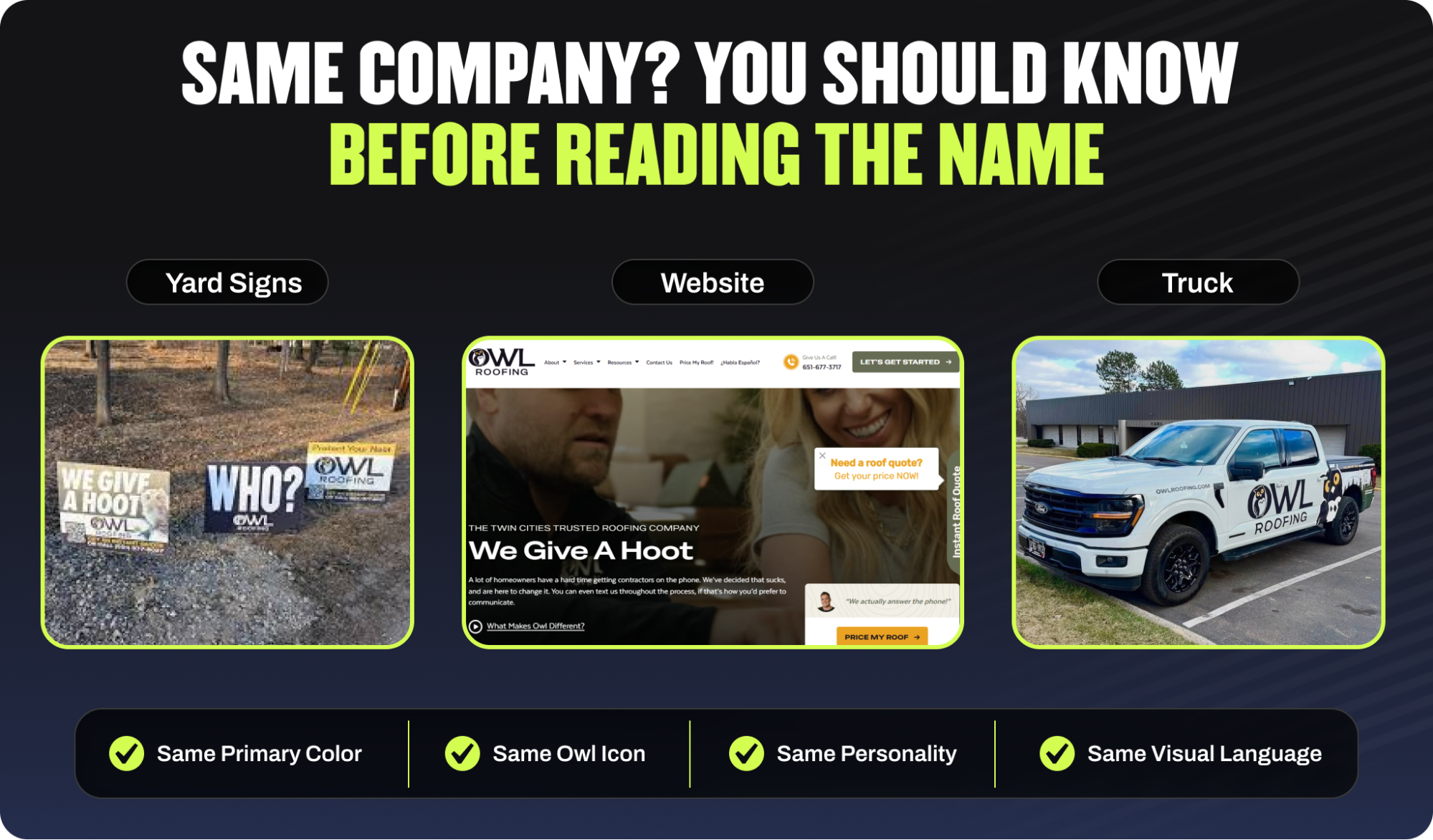
- One or two words that pop. Dad jokes beat clever copy. “We give a hoot” and the “WHO?” sign did more than any headline we wrote.
- Test like an ad. We run 100 to 500 of each sign and watch social listening to see which ones people talk about. We’re competing with the attention economy, not just other roofers.
- Rotate. Cities call and threaten fines. We move to new areas instead of fighting it.
- People ask for them. We had homeowners call to say, “I don’t need a roof but I want your sign in my yard.”
The cautionary tale: in January we put signs out before our license number was on them. Someone reported us to the Department of Labor, and cities and police started calling. The fix was simple: license number on every sign. Do it before you print, not after.
Trucks, billboards, radio and State Fair shirts
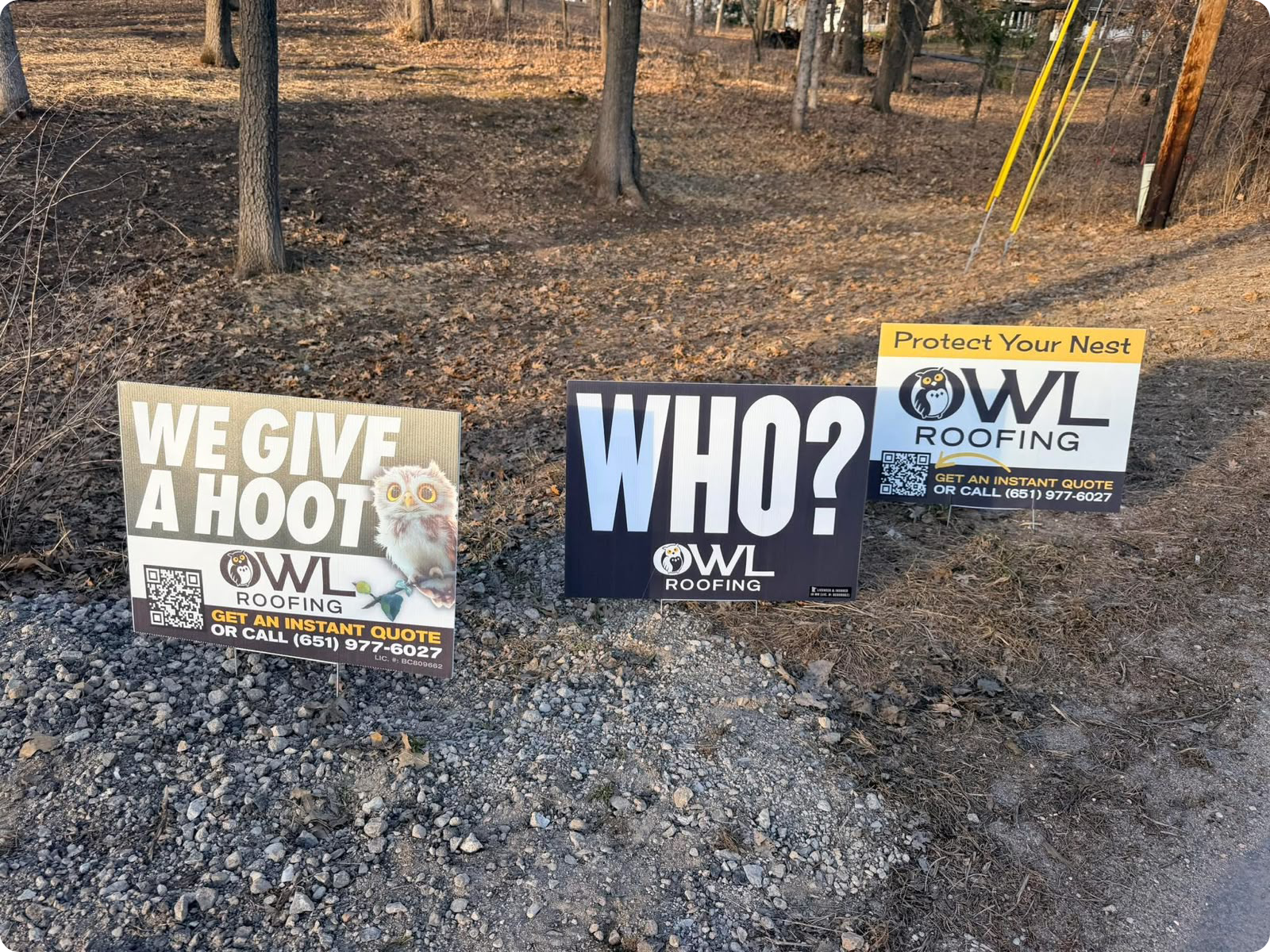
By April and May we had 10 to 20 leads a week, trucks wrapped, billboards up and radio running. I got an owl tattoo. That part is not in the playbook.
The best proof the brand worked didn’t come from a dashboard. It came from the reps at the door.
“I have knocked doors for many companies over the years and I’ve never gotten such a warm welcome. They still come out of the house to ask us about Owl. I see your signs everywhere, heard you on the radio, saw your billboards. People at the State Fair with your shirts on.”
I got pulled over in North Oaks this summer. The officer’s first question: “Are you guys new? I see you all over.” I got a warning.
Not everyone loved it. Competitors said Owl was “a marketing company, not a roofing company.” Frankly, that’s kind of true. We’re a sales and marketing organization that uses subcontractors, which is true about a lot of roofers. We just say it out loud.
One thing we didn’t expect: people asked if Owl was backed by private equity because of how hard we marketed. With PE roll-ups all over the trades, “family-owned” turned into one of our best differentiators, so we lean on it.
Noah and I sat down in September, in a down market, and argued about all of it: signs, door knocking, the storm and why we want cash in the bank going into winter.
- Logos and brand identity built for the trades
- Designed to pop on trucks, signs and Google
- Websites that match the brand
“They captured our vision and who we are as a company.”
Angelica Brager, Young ConstructionNeed the website too? See our Custom Websites
Sales: how Nayt sold $1M in three months
Nayt Pingry spent years as a graphic designer and marketing guy for roofing companies. He got told, more than once, “you’re just the marketing guy.” He started selling for Owl on July 1 and sold about $1 million in roughly three months.
About 80% of his pipeline was retail, in a market where everyone else was waiting on a storm. It was rarely a one-call close. Appointment two, appointment three, options laid out in the driveway. A few of the moves he used:
- Cedar shake homes. Insurers were sending notices to cedar shake homeowners. That’s a retail project waiting to happen.
- Three questions for the insurance company. When a homeowner wants to file, Nayt has them ask their insurer three things: what they’d pay out of pocket if it’s approved, what’s excluded (matching, metals), and what’s actually covered. Then: “Is this still a project you want to consider?”
- Put the deductible on a monthly payment. Younger homeowners think in monthly payments, not totals.
- Stay when there’s no claim. Homeowners told him, “I’ve worked with two other contractors and once they found out I wasn’t going to file a claim they disappeared.” Showing up for a retail job is a differentiator now.
His mix was about one-third self-generated and two-thirds company leads, which is what a brand-heavy budget should buy you. Across the team, close rate went from about 22% to 33% once we added virtual sales help.
One thing I’d change on day one: financing. Homeowners prefer monthly payments, and we probably lost jobs early to competitors who offered them.
“Sharing mistakes and hurdles is the most generous thing you can do.”
What almost broke us
This is the part most case studies leave out. Selling $6M in year one created problems we didn’t have a system for yet.
Production
At our peak we had up to eight builds in a day, and about 20 roofs in one week catching up after rain, with two field production guys. The cracks showed up at the handoff from sales to production. Special instructions like “take care of this plant” didn’t make it to the crew. Documentation and quality control lagged. We now put a supervisor on each job.
Noah was up at 11pm doing reps’ paperwork. He had to stop selling to run the company, and that was harder for him than any storm.
Cash
My $161,000 got Owl started, and then it stopped. After that the company had to fund itself. Retail checks come fast. Insurance money comes late. Sold is not cash.
“It’s not real money unless it’s in the bank. You can’t buy with later money.”
We now run a separate deposit account so we can see what’s real, and our goal was about $1M in cash going into winter.
Leadership
In August we brought in Randy Brothers and the Roofing Academy coaching team for an onsite. They did not go easy on us:
- “Owl is struggling with leadership. There’s too many cooks.”
- The finances weren’t properly posted, “so it’s really hard to see where the business is truly at.”
- The CRM was built without a clear direction, and “the structure of it is just not sound.”
- We hired experienced people from different companies, and everyone did it their own way. They had to be retrained into the Owl Roofing way.
- Extra trades (windows, gutters, siding, decks) add complexity. Be really good at one thing first.
- The biggest risk: putting the cart before the horse. We built structure, including four owner salaries, before the revenue was there. If Owl fails, it’s “mismanagement of funds.”
They also said the brand is “on point” and that Owl became a household name in a short period of time. And if we dial in production and accountability, Owl will be “a force to be reckoned with.” Numbers don’t lie, so that’s the work for winter.
The storm we caught (instead of chased)
This summer hail of about an inch to an inch and a half hit our own backyard, where five of our billboards were already up. The next week we had 150 to 170 leads. RoofNuts set about 40 appointments for us that week. In Noah’s words, “Chaos has broke out.”
That storm was probably another million in sales. The difference was that we were already the name people saw every day when it hit. That’s catching the storm instead of chasing it. Now we keep a $10K to $30K chunk ready for the next one: postcards to neighbors of every job, plus digital billboards for about $15K a month.
The playbook: what to steal and what to skip
If you’re a roofer reading this to copy Owl, here’s the short version.
Steal this
- Put your license number on every sign, truck and ad before it goes out
- Pick a tight radius and own it before you expand
- Test one or two words per sign, in runs of 100 to 500
- Track the lead source on every single lead
- Offer financing from day one
- Coach reps to ask the insurer three questions before filing
- Build the sales to production handoff before you sell big
- Keep a storm budget ready before the storm
- Run a deposit account so you know what cash is real
- Film the whole thing. The videos built trust before the first roof.
Skip this
- Paying four owner salaries before the revenue is there
- Adding windows, gutters and siding before roofing runs clean
- Letting every experienced hire sell their own way
- Counting sold as if it were cash
- Putting out 100 signs and calling it a test
- Assuming door knocking will save a slow month
What’s next for Owl
In January, Noah predicted 10 leads a week by June. He says he was trying to lower the bar. I told him I’d better get to 50 a week. We still have the same argument, it just has new numbers in it.
“He wants me to have 50 leads.” / “I want him to door knock.”
For 2027 the focus shifts from sold to collected, from more trades to better roofing, and from founders doing everything to a team that does it the Owl way. The full keep, trim and cut list for 2027 is in the playbook.
Get the full Owl playbook (free) →
FAQ
Did Owl Roofing really sell $6M in its first year?
Yes. Owl crossed $6M sold by early November 2026, its first full year. Sold is not the same as collected, and collected trails sold, which is why we track both.
How long did SEO take to work for a brand-new roofing company?
Search Console shows 88 clicks in December 2025 and 3,769 in September 2026. Real traction started in April, about four months in, once the site, Google Business Profile and the brand searches were all growing together.
How much did Owl spend on marketing?
About $350K in year one, split roughly 60/40 between brand and lead generation.
Is door knocking worth it for a new roofing company?
Yes, as a floor, not a plan. A knocker typically keeps around 18% of a deal versus about 10% on a fed lead, and once you count the cost of buying leads, it comes out about a wash. In a small, concentrated storm, homeowners burned out on knockers within days. Do it all, but do not count on it.
Should a new roofer go brand-heavy like Owl?
Most should start closer to 80/20 lead gen to brand. Owl went 60/40 because the name could carry a campaign and the founders could fund the runway. If you go brand-heavy, go all the way: volume, consistency and a tight radius.
Sources: Owl Roofing Google Search Console data (via the Ahrefs GSC connection), Ahrefs Site Explorer, Owl’s ProLine CRM, Owl’s Google Business Profile and Hook Agency’s Owl Roofing video series on YouTube. Sales figures are sold, not collected, as of early November 2026.