

Every growing contractor hits the same wall. The HVAC company adds plumbing. The plumber picks up electrical. The roofer folds in gutters, then siding. Each expansion makes operational sense. The marketing, though, starts to buckle under the weight of trying to say everything to everyone.
I work with multi-trade contractors at Hook Agency and I see the same pattern repeatedly: the GBP is a mess because nobody committed to a primary category, the website is ranking for nothing specific because every page is competing with every other page, and the ads are converting weakly because the landing pages serve three audiences instead of one. The business is real. The marketing is blurred.
Getting this right comes down to four structural decisions, in this order:
- Brand architecture: branded house or service line model
- Website structure: one domain with trade-specific sub-folder depth
- GBP strategy: a deliberate primary category decision, not a default
- Cross-sell system: turning completed jobs into leads for the next trade
Skip any one of these and the others underperform. Here is how to build each one correctly.
The Real Problem With Multi-Trade Marketing
The issue is not that homeowners distrust multi-trade companies. It is that trust in a specific service is built on specific signals. When those signals are spread across four services, every individual one gets weaker. A homeowner searching for a plumber wants to feel like they found a plumber. Not a company that also does plumbing.
Why Single-Trade Competitors Have the Upper Hand
Multi-trade contractors rank 30 to 40% lower for individual service searches than single-trade competitors, based on Whitespark’s analysis of map pack positions across 300 multi-service companies cited in PipelineOn’s 2026 multi-trade local SEO research. The reason is not algorithmic bias. It is signal concentration.
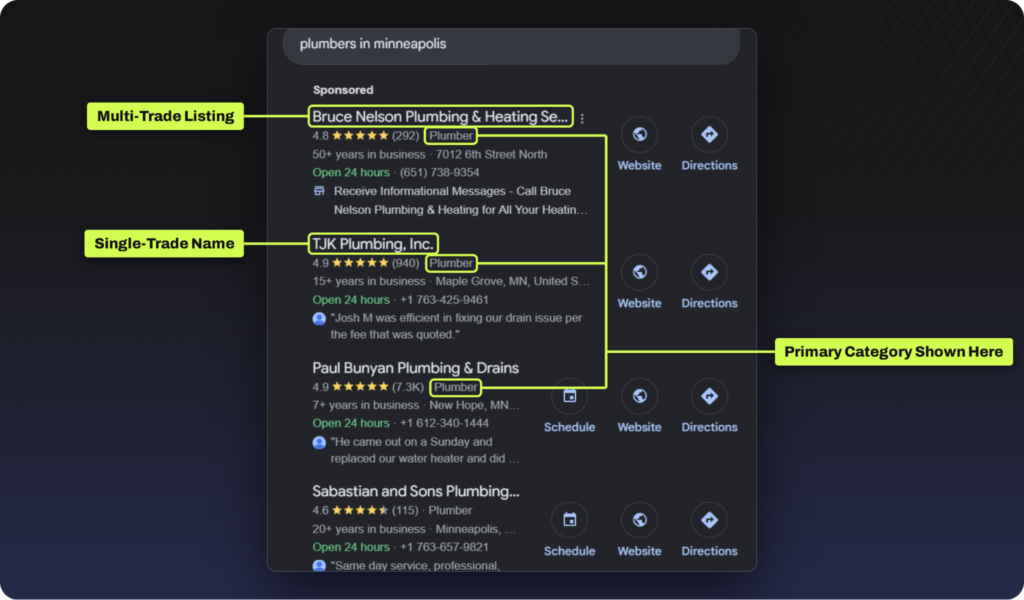
A plumbing company whose entire website, GBP, review profile, and content history points at plumbing sends a denser, more relevant set of signals than the plumbing section of a site whose signals are diluted across four trades. Single-trade competitors get this advantage without trying. Multi-trade companies have to engineer around it. See contractor marketing differentiation for what actually separates strong positioning in this market.
The trust problem also shows up before anyone clicks. According to Harris Williams’ 2025 Home Services Consumer Study, 96% of homeowners say a well-regarded brand matters when hiring a home services provider. Brand recognition does the first round of qualifying. If you read as a generalist, that signal never fires for the specific search.
What Brand Dilution Actually Looks Like in Practice
Brand dilution does not mean the brand becomes bad. It means it becomes vague. When every competitor’s site opens with a list of trades and yours does too, the only visible differentiator left is price. The company that could have commanded a premium on the strength of a clear reputation ends up defending a quote.
The symptom is a homepage that speaks to everyone and closes no one. The homeowner searching for emergency drain work reads about roofing. The homeowner comparing HVAC quotes lands on a paragraph that leads with plumbing. Specificity is what converts, and a multi-trade homepage that tries to cover all bases provides none.
The Brand Architecture Decision You Cannot Skip
Before website structure, GBP strategy, or any campaign decision, you need to decide how the services sit under the brand. That one decision determines everything downstream, and most contractors skip it entirely, which is why the downstream decisions always feel like they are fighting each other.
There are two models. See ways to make your branding iconic for the broader principles behind building a brand that holds as the business grows.
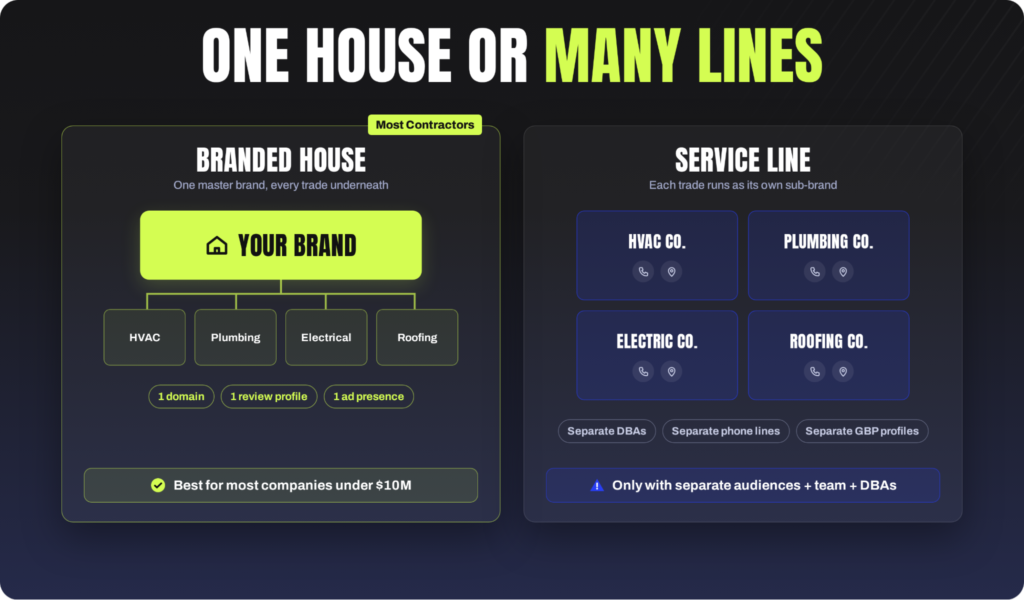
The Branded House Model
One master brand, all services underneath it. This is how A&L Plumbing became Test of Time Plumbing, Heating, Cooling and Electrical, and how Allgood Plumbing became Allgood Home Services. The brand carries the trust and the trades sit as divisions under it.
This works when:
- The homeowner audience is the same across every trade
- Your reputation in one service can legitimately carry trust into another
- You want one domain, one review profile, one advertising presence
The branded house is the right choice for most home service businesses under $10M. It consolidates authority, keeps reputation-building focused, and gives the homeowner one clear name to remember and refer.
The Service Line Model
Each trade gets its own sub-brand identity. Some companies register separate DBAs and run separate phone lines per trade, which can allow separate GBP profiles at the same address if Google approves the setup, as PipelineOn’s 2026 multi-trade local SEO research notes.
This model makes sense when the trades serve genuinely different buying contexts, the business has the team to run separate brand presences with actual discipline, and separate GBP profiles are a strategic priority with the DBA infrastructure to back it up. Without all three, it just splits focus and dilutes effort. For most businesses under $10M, the branded house preserves more signal than this alternative.
How to Build a Website That Ranks for Every Trade
The question is not whether to have one website or several. For almost every multi-trade contractor, the answer is one. The question is how to organize it so each trade gets its own ranking depth without splitting domain authority across multiple domains. See multiple websites vs one website for why consolidation matters for home service businesses specifically.
Sub-Folder Architecture by Trade
One domain, organized with sub-folders per trade: /hvac/, /plumbing/, /electrical/, /roofing/. All domain authority stays consolidated. Each trade section builds its own topical depth. Internal links between sections reinforce the relationship between trades and the parent brand. Separate domains split authority and complicate operations, as Digitaleer’s 2026 home services SEO analysis confirms.
Dedicated Pages per Trade, per City
Dedicated service pages per trade increase map visibility by 45% versus a combined services page, according to PipelineOn’s 2026 multi-trade local SEO research. That number is big enough to build an entire content architecture around.
Each trade needs its own structure:
- Trade hub page: covers the service in depth, answers common questions, establishes the trade’s authority
- Service area pages: one per city, per trade, so the HVAC section ranks in those cities just like the plumbing section does
- Trade-specific content: blog posts and educational articles that link back to the hub and build topical relevance
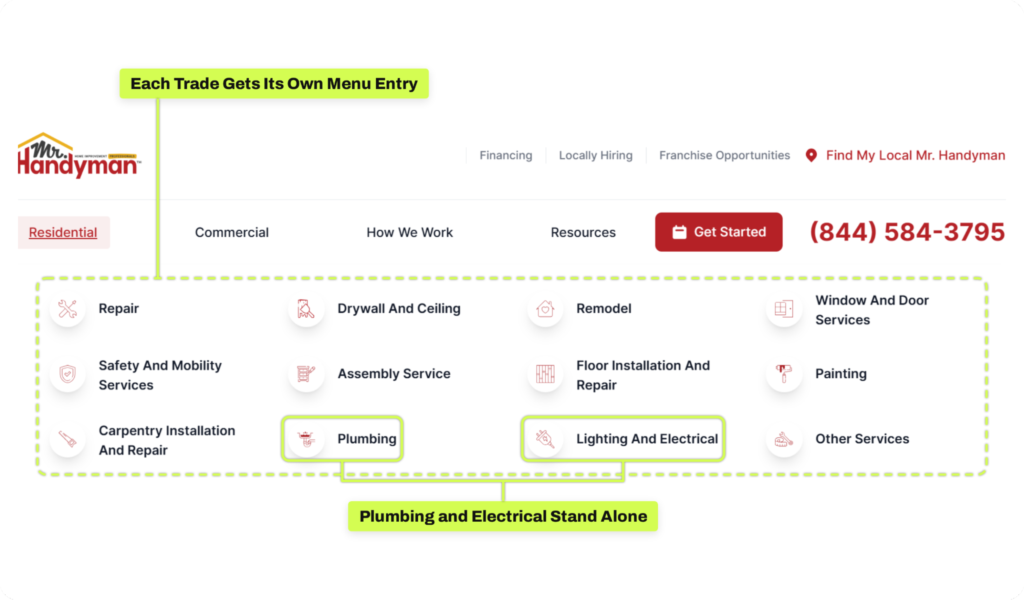
A single ‘services’ page listing all trades ranks reliably for none of them. Three separate trade sections with real depth each function as an independent ranking engine on one domain. See service area pages for contractors for how to structure those city pages so they actually rank.
Trade-Specific Conversion Paths
Every trade needs its own landing page experience. A homeowner searching for emergency plumbing should land on a page that is entirely about plumbing. Phone number visible immediately. No HVAC content in the way. Trust signals specific to plumbing in view. The same logic applies for every trade.
Paid ads for each trade should send traffic to trade-specific pages, not a shared homepage. Organic content for each trade should link to that trade’s conversion path. This is not extra work. It is what turns traffic into calls.
Google Business Profile Strategy for Multi-Trade Companies
One primary GBP category. That is the constraint. For a multi-trade contractor it creates a forced choice with real map pack ranking consequences, and most contractors make it without understanding what they are giving up.
The Primary Category Problem
The primary category is the strongest ranking signal on the GBP profile for the map pack. If you change it from ‘HVAC Contractor’ to ‘Plumber,’ your HVAC map pack rankings decline while plumbing may improve. The reverse is equally true.
The decision should be based on which trade generates the most revenue or which trade has the best map pack opportunity in your specific market. Not on what feels representative. Not on trying to serve all trades equally, because the signal does not work that way. Make the decision once, deliberately, and do not rotate between categories. Every rotation weakens both.
Secondary Categories and Service Listings
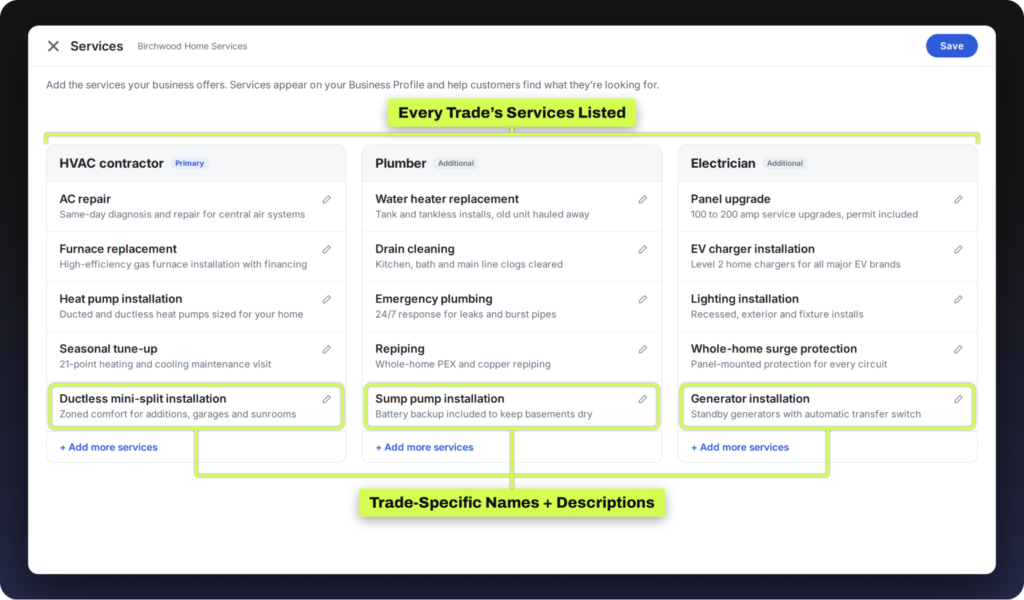
Secondary GBP categories give partial map pack relevance for the remaining trades and they should be used to full capacity. Service listings inside the GBP can enumerate every offering across all trades and contribute to keyword matching within the profile.
The sequence: primary category based on revenue priority, every secondary slot filled with remaining trades, service listings built out with trade-specific names and descriptions. That is the full GBP setup for a multi-trade business.
When Separate GBP Profiles Make Sense
A multi-trade company with genuine separate DBA registrations, separate phone numbers, and verifiably separate operations can maintain separate GBP profiles per trade at the same address if Google approves the setup. This solves the primary category problem cleanly.
The conditions are strict, though. Separate names for the same team under one DBA do not qualify. Google requires real operational separation. Without the infrastructure, attempting separate profiles is a suspension risk, not a strategy.
Marketing Messages That Work Across Multiple Trades
The message problem for a multi-trade contractor is not what to say about each individual service. It is what to say that holds all the services together without sounding like everything to everyone.
What Stays the Same
Brand voice, visual identity, the customer experience promise, responsiveness, transparency, local presence. These stay identical across every trade. A homeowner who called the plumbing team and then calls HVAC should feel like they reached the same company, because they did.
The data shows how much that consistency matters. According to Housecall Pro’s 2025 Customer Service Report, 68% of homeowners would rehire the same business after a good experience, and 73% would refer it to others. That loyalty lives in the brand experience, not in the trade.
What Changes by Trade
Service-specific language, urgency framing, seasonal timing, the specific trust signals each trade requires, and keyword targeting all change by trade. Emergency plumbing and planned HVAC replacement are different campaigns for a reason. A roofing storm-damage ad runs on a different emotional register than an electrical panel upgrade inquiry.
Trade-specific marketing does not need a separate brand. It needs separate campaigns built on consistent brand assets. The brand is the frame. Each trade is a different message inside it.
The Cross-Sell Advantage That Single-Trade Competitors Cannot Buy
There is one thing a multi-trade contractor has that no single-trade competitor can replicate regardless of budget: a customer base that is already qualified for every additional service. The homeowner who called for HVAC service already trusts the company. When the technician mentions the water heater is showing signs of age, that is not a cold lead. That is the warmest lead in the market.
Why the Cross-Sell Works
According to Housecall Pro’s 2025 Customer Service Report, 70% of homeowners value a useful tip or recommendation from the technician, and 43% appreciate maintenance reminders. The cross-sell moment is not an interruption. Homeowners expect it and welcome it when it comes from someone they already trust.
The question is whether the company has the follow-up infrastructure to close it. That is where most multi-trade businesses leave money on the table. See home services social media strategy for how to stay visible to that existing customer base between service visits.
Three Ways to Market Additional Services to Past Customers
Past customers are the highest-converting, lowest-cost channel in a multi-trade business. These are people who already said yes. Making sure they know about the other services is the whole job.
- Segmented email sequences: a customer who had plumbing work gets a seasonal HVAC reminder; a roof inspection customer gets a gutter follow-up in the fall; the trigger is the service history
- Post-job follow-ups with one service mention: not a pitch, an awareness note; one sentence in the follow-up email about a complementary service goes a long way
- Seasonal reminders for unused services: most of your database knows you for one trade; a timed reminder campaign changes that one service at a time
The same Housecall Pro report found 85% of homeowners plan to maintain or increase their home services spend even during economic uncertainty. The demand is there. The question is whether a past customer calls you for the second service or searches from scratch and finds a competitor.
The Bottom Line
Marketing a multi-trade home service company without diluting the brand is not one good decision. It is four structural decisions made in the right order: brand architecture that clarifies how the services relate, a website built with sub-folder depth so each trade can rank independently, a GBP primary category strategy that is deliberate rather than default, and a cross-sell system that turns completed jobs into qualified leads for the next trade.
The gap between contractors who market multiple trades well and those who list services and hope is almost always in which of these they skipped. See the full home services marketing strategy for how this fits into the broader system Hook Agency builds for HVAC, roofing, plumbing, and multi-trade contractors.
Frequently Asked Questions
What is brand dilution in a multi-trade home service company?
Brand dilution happens when adding multiple services makes the marketing too broad to communicate real expertise in any one of them. The result is lower conversion rates, more price-based competition, and weaker SEO because every signal is spread across services rather than concentrated in one. It does not make the brand bad. It makes it forgettable.
Should a multi-trade contractor use one website or separate websites?
One website with sub-folder architecture is the right answer for almost every contractor under $10M. Sub-folders like /hvac/, /plumbing/, and /electrical/ consolidate domain authority while giving each trade its own ranking depth. Separate websites split that authority, require multiple SEO campaigns, and do not produce proportional ranking gains at this scale.
Why do multi-trade contractors rank lower than single-trade competitors?
Because signal concentration matters. A plumbing company whose entire website, GBP, and review history points at one service has denser relevance signals for plumbing searches than the plumbing section of a site spread across four trades. Multi-trade contractors rank 30 to 40% lower for individual service searches as a direct result of this.
How should a multi-trade contractor choose their GBP primary category?
Based on which trade generates the most revenue or has the best map pack opportunity in your market. Only one primary category can be set, and it has the strongest influence on which searches the profile appears for. Make the decision once and do not rotate, because rotating weakens rankings in both the trade you leave and the trade you gain.
What is the branded house model for a home service contractor?
One master brand covers all service lines, with individual trades operating as divisions underneath it. Allgood Plumbing becoming Allgood Home Services is the classic example. This model works when all services serve the same homeowner audience and when reputation in one trade can transfer trust into another.
How does a multi-trade contractor cross-sell without being pushy?
Through technician observations during service visits, post-job follow-up messages that mention one complementary service, and seasonal reminders for services the customer has not used yet. The homeowner does not need to be sold. They need to know the service is available from a company they already trust. The message is informational. The trust foundation already exists.