
At Hook Agency, we handle the website, SEO, paid search, and Meta marketing for Owl Roofing. That gives us a close-up view of what roofing marketing looks like when the strategy has to work in the real world, not just sound good in a report.
I’m doing it. We’re inside it right now. And what we’ve learned from both sides of this is that most roofing companies are either not doing SEO at all, or they’re paying for something that’s producing reports instead of calls.
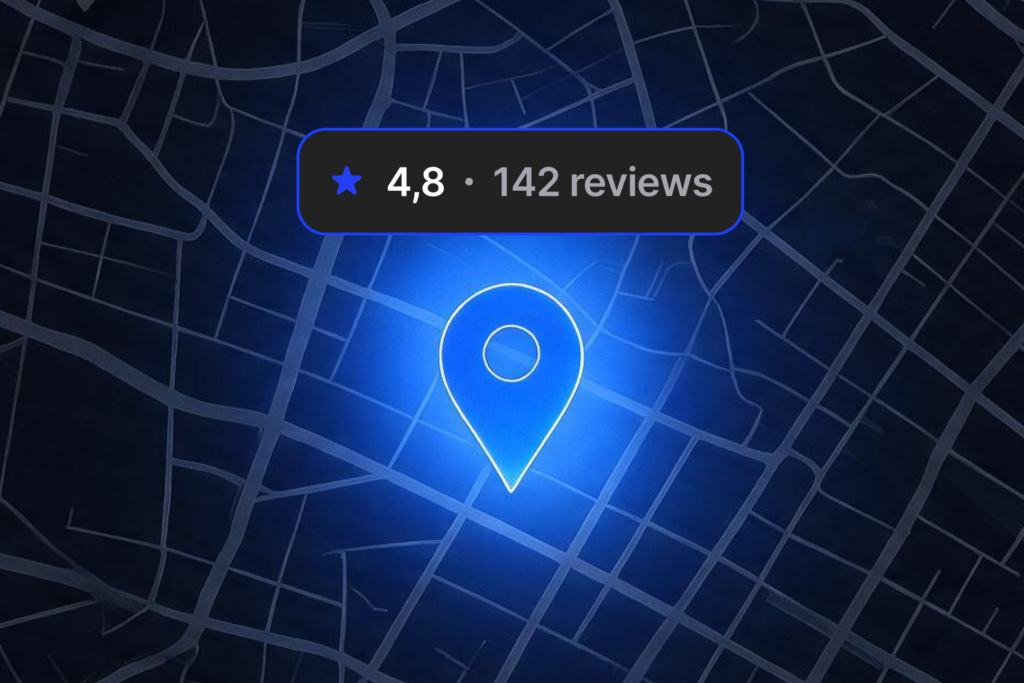
The map pack is where the phone rings. That three-business listing at the top of a Google search is what a homeowner with a leaking roof at 7am is looking at. They’re not reading blog posts. They’re searching ’emergency roof repair near me’ and calling whoever looks legitimate.
Here’s what actually moves the needle:
- The five local signals that determine who gets in the map pack
- Which keywords produce calls and which ones just produce traffic
- The AI search layer most roofing companies don’t know they’re missing
- Tools worth paying for and free ones that do most of the job
- Honest timeline and review benchmarks, not the ones agencies use to win proposals
What Roofing SEO Is and What It Is Not
Here is what I tell contractors who come to us after a bad agency experience: SEO is not a product someone delivers to you once. It is a system you run continuously, and the results compound.
Your GBP determines whether you show up in the map pack. Your city pages determine which search terms your website ranks for. Your reviews affect both where you rank and whether homeowners trust you enough to actually call. Your site speed determines whether Google can parse and trust the site at all.
None of those work in isolation. And none of them produce results in the first two weeks. Month six outperforms month one. Month eighteen outperforms month six. The roofers dominating their local markets got there by doing the boring stuff consistently while their competitors gave up.
The Local Search Signals That Move Roofing Rankings
Five signals do the majority of the work. Get all five right and the others fill in over time.
1. Google Business Profile: Everything Else Sits on Top of This
GBP signals account for approximately 32% of local pack ranking weight according to Whitespark and BrightLocal’s 2026 local ranking factors survey. That’s the largest single factor. Your primary category for a roofing company is ‘Roofing Contractor,’ not ‘General Contractor.’ That one field directly affects map pack relevance and most roofers have it wrong.
Beyond category: upload real job photos consistently. Post weekly GBP updates mentioning the specific cities where work was done. Keep hours accurate including emergency availability. The profile that looks actively managed ranks above the one that was set up two years ago and never touched again.
Tim Brown, who runs Owl Roofing and has been marketing roofing companies for over a decade, put it in a recent video: ‘We’re just doing SEO in the off-season and then as spring hits, we’re going to do PPC.’ The sequencing reflects how the channel actually works GBP and organic foundations first, paid amplification second.

2. Reviews: Volume, Velocity, and What Reviewers Actually Say
In a metro market, a roofing company needs well over 1,000 reviews to hold a strong local pack position. In a smaller market, 50 to 200 reviews with strong recency can be enough to lead. Review velocity matters more than total count.
Velocity beats total count. A roofing company adding five to eight new reviews per month will outrank a stagnant competitor with three times the total count over a six-month window. Building the system that generates that velocity consistently is worth more than any single SEO tactic.
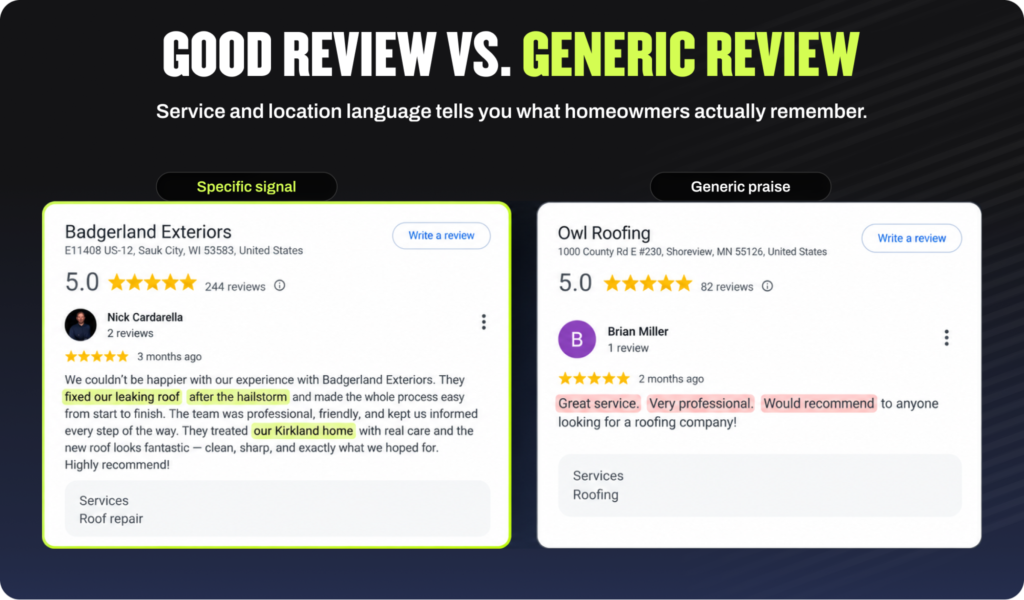
What reviews say matters too. ‘Fixed our leaking roof fast after the hailstorm in Kirkland’ carries more relevance signal than ‘great service.’ Encourage customers to mention the specific service and neighborhood. The full review strategy for contractors covers the ask process that makes velocity something you control instead of something you hope for.
3. Service Area Pages: One Real Page Per City You Want to Win
Each city or service area a roofing company wants to rank in needs its own dedicated page. Not a copied template with the city name swapped a real page with local content, job photos from that area, city-specific FAQ content, and trust signals.
Thin, templated city pages with only the place name swapped are one of the patterns Google’s 2025 and 2026 core updates targeted directly. Each page needs a primary service-city keyword: ‘roof repair Bellevue,’ ‘roof replacement Kirkland,’ ‘roofing contractor Redmond.’ One page per service type. A single services page trying to rank for everything ranks for nothing.
How to win ‘roofer near me’ searches covers the specific page structure that moves these rankings.
4. Citation Consistency Across Directories
NAP consistency business name, address, and phone number across all directories is foundational. Inconsistent information across platforms is one of the primary reasons roofing companies fail to rank in the map pack despite good reviews. Every major directory should match exactly: Google, Yelp, BBB, Angi, Houzz, Nextdoor, Apple Maps, and trade-specific directories. Even minor variations like ‘Roofing Co.’ versus ‘Roofing Company’ create signal confusion.
5. Technical Site Health: Speed Matters More Than Most Roofers Think
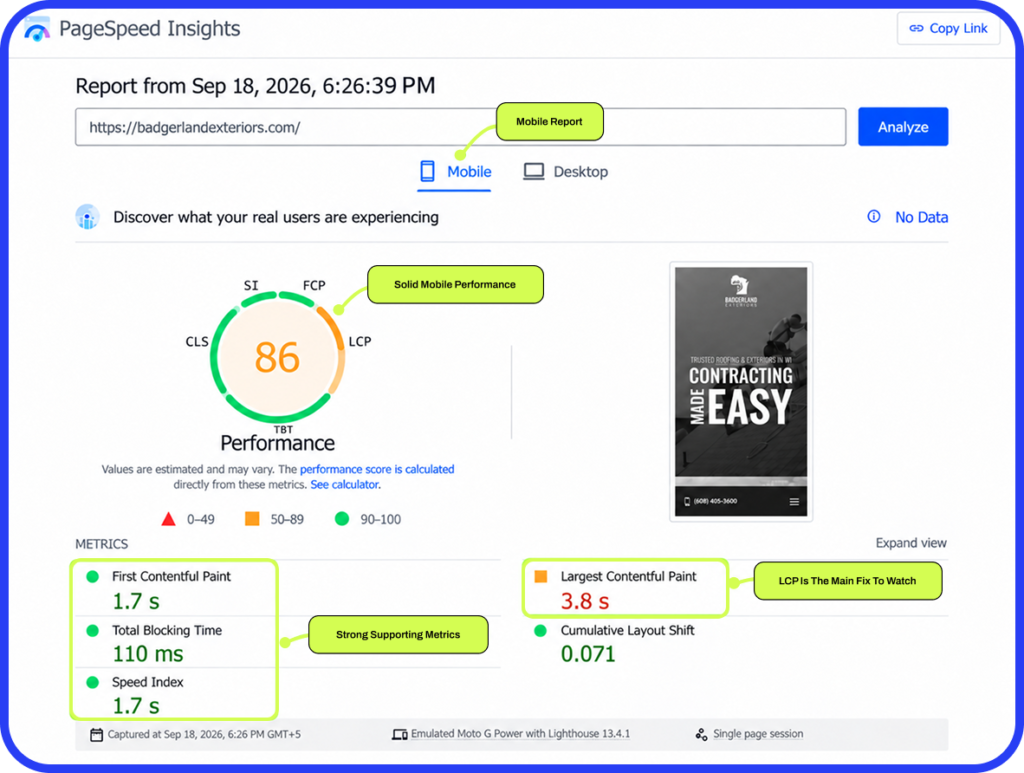
Most roofing websites are slow on mobile and nobody told the owner. Over 60% of contractor website traffic comes from a phone. If it takes five seconds to load, the homeowner is already on to the next result. The technical floor in 2026 is a Largest Contentful Paint under 2.5 seconds on mobile, a phone number visible and clickable without scrolling, and LocalBusiness schema correctly implemented.
Tim made this point about the Owl Roofing website: ‘It’s not about the roof. It’s about trying to give them an emotion about your company.’ A fast site that feels cold doesn’t convert. But a warm site that loads in six seconds doesn’t get the chance to prove itself.
The Roofing Keywords Worth Targeting
I see roofing companies rank for informational keywords and then wonder why the phone isn’t ringing. Traffic and calls are not the same thing. The keywords that produce calls are usually the ones with urgency baked in.
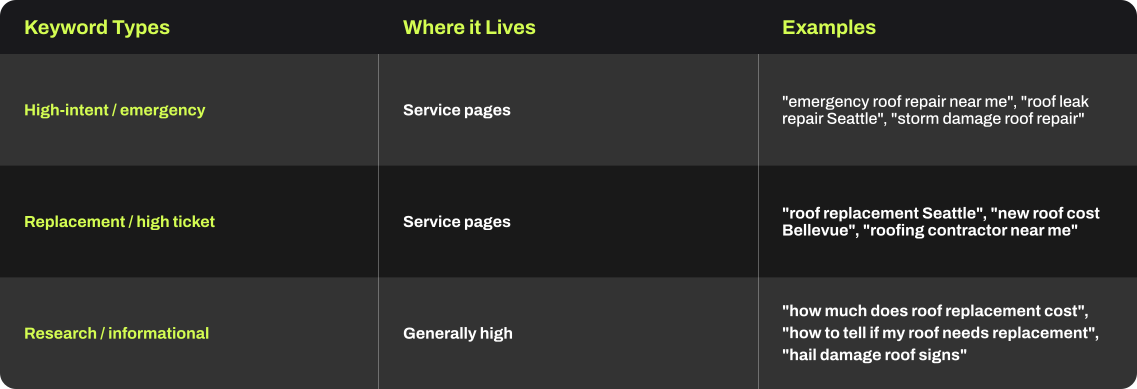
High-Intent Money Keywords
These belong on service pages. They represent a homeowner with an active problem.
- Emergency searches: ’emergency roof repair near me,’ ‘roof leak repair [city],’ ‘storm damage roof repair’
- Replacement searches: ‘roof replacement [city],’ ‘new roof cost [city],’ ‘roofing contractor near me’
- Damage-specific: ‘hail damage roof repair,’ ‘wind damage roof replacement,’ ‘ice dam roof repair’
A homeowner with an active roof leak is not price shopping. They’re calling the first company that looks legitimate. That’s why these keywords are worth a 6 to 12-month SEO fight. The cost per lead from organic on those terms eventually runs circles around paid.
One thing Tim said in the Owl Roofing marketing video that reframes how to think about this: ‘70% of the first reach out to every home service and roofing company right now is from the female leading the household.’ That changes how you write service pages, what trust signals you lead with, and how you talk about your process. How homeowners actually research contractors gets into the specifics of that decision process.
Research-Stage Keywords Worth Owning
These belong on blog posts and FAQ content. They bring homeowners into the top of the funnel before they are ready to call.
- ‘How much does roof replacement cost’
- ‘How long does a new roof take’
- ‘What does hail damage look like on a roof’
- ‘Asphalt vs metal roofing’
- ‘How to tell if my roof needs replacement’
These don’t produce calls this week. What they do is put your company in front of a homeowner who is still deciding. When they’re ready to call, your name is already familiar. The keyword formula is simple: service type plus city or ‘near me.’ Roof repair Seattle, emergency roof leak repair Bellevue, roofing contractor Kirkland. One keyword per service page. Not ten.
The AI Search Layer Most Roofing Companies Are Missing
Here’s the part of roofing SEO in 2026 that most guides don’t cover yet: homeowners are now asking AI tools for contractor recommendations before they ever open Google.
BrightLocal’s 2026 research found AI tool usage for local business recommendations grew from 6% to 45% in a single year. When a homeowner asks ChatGPT ‘who are the most reliable roofers in Seattle,’ the AI gives a direct answer with named businesses. Not a list of links. Names. If yours isn’t one of them, you don’t exist in that conversation. Answer engine optimization for home services covers the full playbook for building this visibility layer on top of your existing SEO.
The Signals That Drive AI Visibility
The good news is you don’t need a separate strategy. Review volume and recency, consistent information across directories, a complete GBP, and service-specific content that answers real homeowner questions. That’s the same list as traditional local SEO, with one addition: structure.
Every service page and FAQ block needs to open with a direct, standalone answer to the question it covers. Not a buildup, not a preamble. The answer first, then the detail. FAQ schema on Q&A content makes it machine-readable and dramatically increases the chance an AI cites it. Do this test right now: open Perplexity and ask ‘What are the most reliable roofing companies in [your city]?’ Whatever comes back tells you exactly where you stand.

Why Roofing SEO Beats Paid Search on Cost Per Lead
According to PipelineOn’s 2026 roofing PPC analysis, Google Ads for roofing averages $124 per non-branded lead nationally. In competitive storm markets, CPCs hit $35 to $65 per click. Some emergency keywords top $54 per click. A mature organic SEO program delivers roofing leads at $25 to $100 each. That gap is why every roofer asks about SEO.
The catch is time. GBP and local pack improvements show up within 30 to 90 days when foundational issues are fixed. Meaningful organic movement takes 3 to 6 months. Competitive positions for ‘roof replacement Seattle’ in a dense metro take 6 to 12 months. That’s not a bug. That’s the reason competitors who give up at month four are still paying $124 a lead.
Tim’s sequencing at Owl Roofing reflects this exactly: build the SEO foundation in the off-season, layer paid on in spring when demand peaks. Organic builds the floor. Paid amplifies the top. Run them backward and you’re paying for traffic a weak site won’t convert.
The Best SEO Tools for Roofing Companies
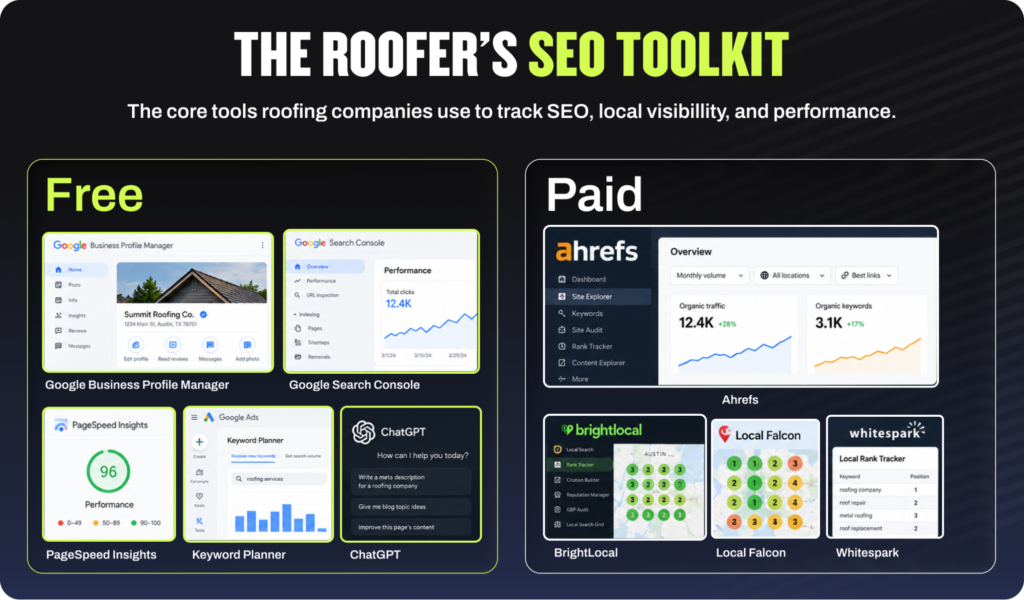
Most of the essential tools are free. People pay for the ones that save time and show competitor gaps. Here’s what’s actually worth having.
Free Tools That Cover the Essentials
- Google Business Profile Manager. The primary interface for managing the profile that drives most local calls. Non-negotiable starting point.
- Google Search Console. Shows which queries drive clicks to the site, which pages are ranking, and what technical issues exist. Essential for tracking whether optimization is working.
- Google PageSpeed Insights. Mobile load time and Core Web Vitals score. Free baseline check for technical performance.
- Google Keyword Planner. Search volume for roofing keyword combinations by city. Requires a Google Ads account but free to use for research.
- ChatGPT and Perplexity. Check whether the business appears when a homeowner asks for a local roofer. Free, five minutes, and the result tells a roofer immediately if they have an AI visibility gap.
Paid Tools Worth the Cost
- Ahrefs ($29/month and up). The strongest tool for keyword research and competitor gap analysis. Enter a competitor’s domain and see every keyword they rank for that yours does not. The single highest-value paid SEO tool for a roofing company doing their own research.
- BrightLocal ($39/month and up). Built specifically for local SEO. Tracks local pack rankings by specific zip code, monitors citation consistency, and provides reputation management for review tracking. The right primary paid tool for a roofing company managing their local SEO seriously.
- Local Falcon. Hyper-local grid rank tracking showing where a business appears across different points in a service area. Useful for roofing companies covering multiple neighborhoods who want to see exactly where local pack presence is strong and where it is weak.
- Whitespark. Specializes in citation discovery and building. Particularly useful for identifying NAP inconsistencies and finding citation opportunities competitors have that you don’t.
What We Have Seen Work for Roofing Clients
I’ll stop giving you frameworks for a second and just tell you what we see.
Every roofing company we work with that has the trifecta, strong GBP, a real review velocity system, and actual city pages with original content, outperforms competitors spending the same budget on paid search alone. Paid traffic stops the minute the spend stops. Organic keeps compounding. That math eventually becomes obvious.
Tim’s update on Owl Roofing at the four-month mark: ‘Five to ten leads a week, now we’re like 25 somehow. That’s just from marketing.’ That’s what happens when you build the foundation before you start paying for traffic, not after.
For the full picture of how SEO fits inside a roofing company’s channel mix, the roofing marketing plan guide covers budget allocation, timing, and how paid and organic work together when sequenced correctly.
Frequently Asked Questions About Roofing SEO
How long does SEO take for a roofing company?
GBP and local pack improvements show within 30 to 90 days. Meaningful keyword movement takes 3 to 6 months. Competitive positions for ‘roof replacement [city]’ in a dense metro take 6 to 12 months. It compounds. Month eighteen is stronger than month six.
How many Google reviews does a roofing company need to rank?
In a competitive metro, over 1,000. In a smaller market, 50 to 200 with strong recency can lead. Velocity matters more than total. Adding 5 to 8 new reviews per month consistently will outrank a stagnant competitor with more total reviews over a 6-month window.
What are the best roofing keywords to target?
High-intent: ’emergency roof repair near me,’ ‘roof replacement [city],’ ‘hail damage roof repair.’ These go on service pages. Research-stage: ‘how much does roof replacement cost,’ ‘what does hail damage look like.’ These go on blog and FAQ content.
Can a roofing company do SEO without hiring an agency?
Yes. Managing the GBP, building a review process, keeping citations consistent, and publishing real city page content are all things an owner or office manager can handle. Where outside help earns its cost: keyword gap analysis, technical audits, link building, and schema implementation.
Local pack ranking vs. organic ranking for roofers?
The local pack is the three-business map listing, driven by GBP, reviews, and proximity. Organic results sit below it. The map pack generates most roofing calls because it includes the phone number and star rating without a click. Both matter, but the map pack is where the phone rings.
Does a roofing company need separate pages for each city it serves?
Yes. A single page listing twenty service areas ranks for none of them. Each city that generates real lead volume gets its own page with real content, local job photos, and city-specific FAQ content.
How does AI search affect roofing SEO in 2026?
Homeowners are now asking AI tools for contractor recommendations before they open Google. A roofing company absent from those answers misses the earliest stage of the research process. The fix is the same foundation as traditional local SEO plus answer-first content structure and FAQ schema on key pages.
The Roofers at the Top Didn’t Do Anything Complicated
They built the GBP. Built the review system. Built real city pages. And they kept going after their competitors got bored and stopped.
Tim’s line on this: ‘If you can’t explain why your company is different in one sentence, the market won’t do it for you.’ That’s true for branding and it’s true for search. A roofing company that looks and sounds like every other roofer in its market gives Google nothing distinctive to rank and gives homeowners nothing to hold onto.
The work isn’t mysterious. It just requires showing up for longer than most people are willing to.
For roofing companies who want help accelerating this or want someone managing it while they focus on running jobs, Hook Agency works specifically with roofing contractors across SEO, PPC, and web design.