The short answer
A good home improvement business card includes your logo, company name, your name and title, phone, website and email, plus a reason to call on the back, like a QR code to your reviews. Keep it clean, on brand and printed at 3.5 by 2 inches with proper bleed.
- Front: who you are and how to reach you
- Back: services, reviews QR code, license number
- Matte or uncoated if you write on cards
Originally published November 14, 2019. Updated November 5, 2026.
A well-designed business card helps people to remember who you are and encourages them to reach out and get in touch with you if they are interested in your services.
Knowing what you should have and what you should leave out helps you to create a card that is both noticeable and balanced.
While it is cool to have fun graphic elements and text on your card, it is important to leave space around for these elements to have more of a balance. Having a clean and organized design shows that you are professional and organized.
Key Items to Include in Your Home Improvement Business Card
It can be really tempting to put down everything in the world on your business card. However, when you do this, you can leave people with an overwhelming amount of information on a tiny space leaving them confused and even turn them away.
Items you should have:
- logo
- company name
- your name
- job title
- website
- contact information
- Any relevant social media handles
Anatomy of a home improvement business card
A fictional example: front for who you are, back for why to call
and recent projects
Stand out From the Others
Having a business card that stands out from the rest is more important than you think. When you attend things like business events, there are going to be a lot of people swapping business cards, which means people are going to leave with a stack full of cards. If you have one that stands out from the rest, they are more likely to come back to yours because it is one they will remember.
Keep It On Brand
Once someone gets your business card, it is more than likely they are going to check out your website, social media, and send you an email or phone call.
This means that you want to be sure that all your colors, fonts, and other items are consistent with each other so they can make quick connections when they research you and your company.
- Leads from Google, Maps and AI search
- Nobody else is buying the same lead
- You own your website and ad accounts
“Hook Agency has been an incredible partner for our digital marketing growth.”
Kristin Sullivan, Bob’s ACFocused on the map? See Google Maps SEO
What to put on the back of your card
Plenty of contractors leave the back blank. That is wasted space. Use it to give people a reason to call you instead of the next card in the stack.
- A QR code to your reviews. Link it to your Google reviews or a project gallery so people see proof right away.
- Your top services. Three or four, not a list of twenty.
- Your license number. Many states require it on advertising, and it builds trust.
- A referral offer. Something simple like a thank-you gift for referrals.
- An appointment line. Room to write the date of the estimate or the next visit.
How contractors get the most out of business cards
Networking events are only one place a card earns its keep. For home improvement companies, the best moments to hand one out happen on the job.
- After every estimate. Leave a card with the written estimate so the homeowner knows exactly who to call with questions.
- On the job site. Give every crew lead a stack. Neighbors walk over and ask who is doing the work more often than you would think.
- With your yard sign. A weatherproof card box on the sign lets people grab your info without knocking.
- At the final walkthrough. Hand over two or three cards and ask the homeowner to pass them to a friend.
- At supply houses and partner businesses. Realtors, designers and property managers refer work. Make it easy for them.
Each of these is a chance to turn one job into the next one. A card that looks sharp and carries a clear reason to call does that job far better than a generic template.
Print specs to get right
A great design can still come back looking wrong if the file is not set up for print. Here are the standard specs for U.S. business cards.
Standard U.S. business card print specs
Send these to your designer or printer
Swipe sideways to see every column →
| Spec | Standard | Why it matters |
|---|---|---|
| Finished size | 3.5 x 2 inches | Fits wallets and card holders |
| Bleed | 0.125 inch on every side | Prevents white slivers after trimming |
| Safe zone | Keep text 0.125 inch inside the trim | Stops text from getting cut off |
| Resolution | 300 DPI | Keeps logos and photos sharp |
| Color mode | CMYK for print | Colors match what you expect on paper |
| File type | Print-ready PDF | What most printers ask for |
Choosing paper and finish
The way a card feels in your hand says a lot about your business. A thin, flimsy card says cheap. A thick, well-finished card says you care about details, which is exactly what homeowners want from a contractor.
Paper and finish options
How each option looks and feels
Swipe sideways to see every column →
| Option | Look and feel | Good for |
|---|---|---|
| Matte | Smooth, no shine, easy to write on | Most contractors |
| Gloss | Shiny, colors pop | Photo-heavy designs |
| Uncoated | Natural, textured | Writing appointment times on the back |
| Soft-touch | Velvety, premium | High-end remodelers |
| Thick or extra-thick stock | Heavier, feels substantial | Making a strong first impression |
Before you hit print
Before you print checklist
Catch the mistakes that cost a reprint
- Phone number tested by calling it
- Website and email spelled right
- License number included if your state requires it on ads
- QR code scanned on two phones
- Logo is a vector or 300 DPI file
- Text inside the safe zone
- Colors match your trucks and website
- Back side has a reason to call
- Proof approved in writing
- Order enough for every crew member
So with those helpful suggestions, here are 11 home improvement business cards for you to check out and get a few cool ideas for your next set of business cards.

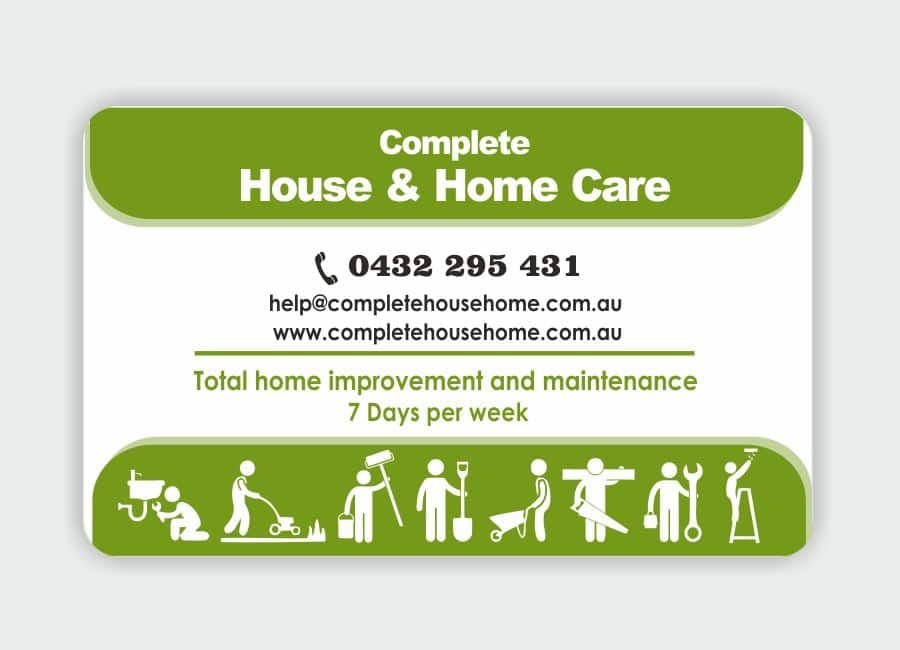


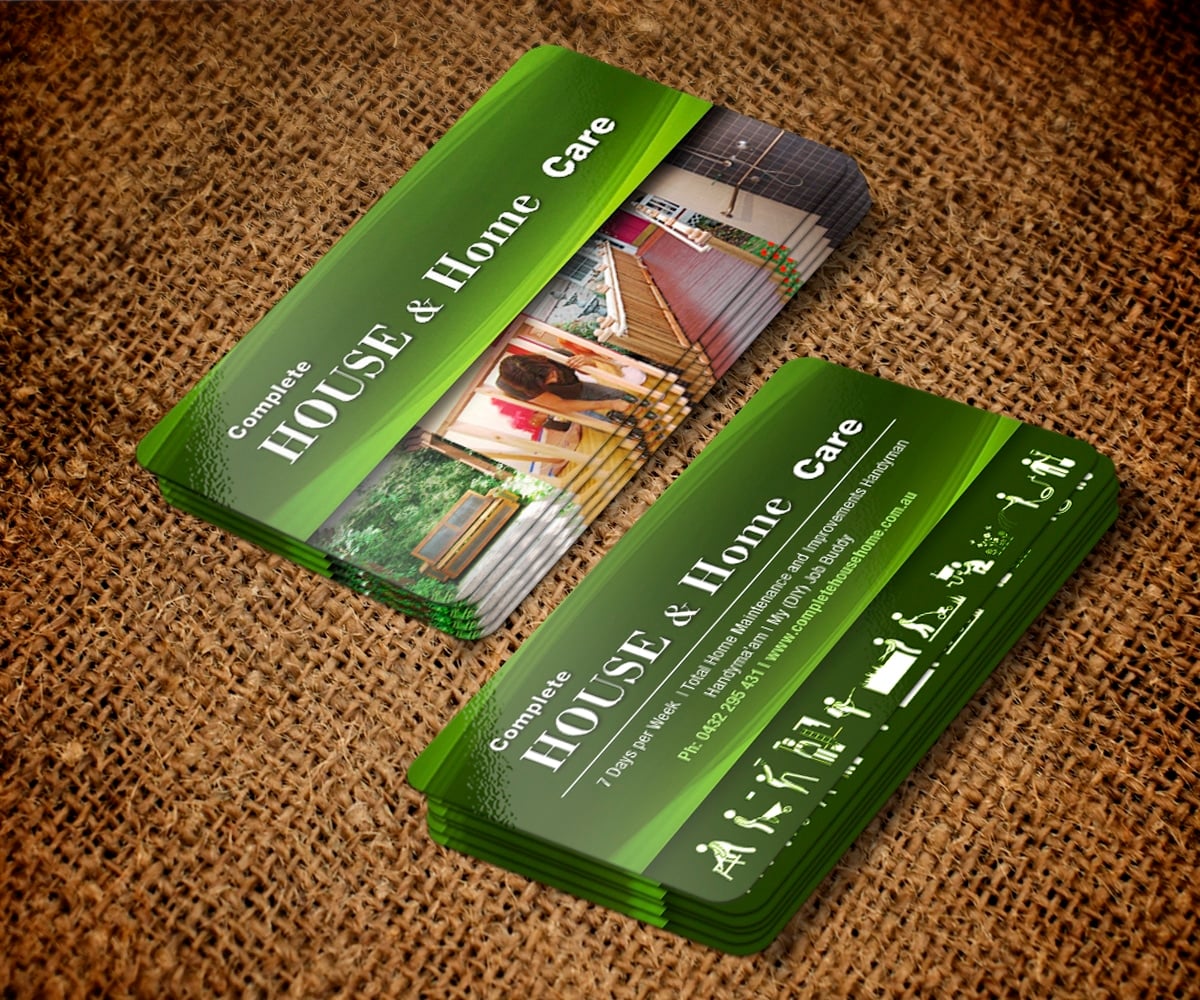


A business card is more than just a piece of paper with your information on it. It is an extension of both you and your business.
People will leave business and networking events loaded to the max with business cards. A lot of which will never even be looked at again.
By having a creative design that catches people’s eyes, you help people to remember you and your business because you stick out from the rest.
Hopefully, this was able to help you come up with some ideas on how you want your next business card to look so you can leave a lasting impression on your recipients.
Frequently Asked Questions
What should be on a contractor business card?
Your logo, company name, your name and title, phone, website, email and license number if your state requires it. Use the back for services and a QR code to your reviews.
What size is a business card?
The standard U.S. business card is 3.5 by 2 inches. Add 0.125 inch of bleed on every side for printing.
Should a contractor business card have a QR code?
It can help. Link it to your Google reviews or a project gallery and test it on more than one phone before printing.
What paper is best for business cards?
Matte or uncoated stock is a safe choice for contractors, especially if you write on cards. Thicker stock feels more premium.