
Meta ads can work really well for home service businesses. They can also be a quiet way to spend a few hundred dollars a month and have nothing to show for it.
The difference is almost never the budget. It is almost always the setup. When a first Meta campaign underperforms, the issue usually traces back to the same three things:
- No tracking pixel properly configured, so Meta is optimizing toward clicks instead of actual leads
- No real customer list to build an audience from, so the targeting is starting from scratch
- One campaign trying to find new buyers, test new creative, and retarget warm visitors all at once, which means it does none of those three jobs well
A winning Meta ad campaign for a home service business starts with three things most first attempts skip entirely: a tracking pixel, a lookalike audience built from real customers, and a campaign built around a lead objective instead of a post-engagement objective.
This is not a step-by-step Ads Manager walkthrough. Those exist everywhere and are not trade-specific. This is the strategic framework for going from zero to a campaign structure that can generate booked jobs, with real cost benchmarks and an honest read on what to expect.
Why Meta Ads Belongs in a Home Service Marketing Mix
Google Ads captures the homeowner already searching. Meta Ads reaches the homeowner who hasn’t started searching yet.
The Demand-Generation vs. Demand-Capture Distinction
A homeowner whose furnace breaks on a Tuesday night is opening Google immediately. Meta has nothing to do with that. But a homeowner who’s been vaguely thinking about their roof for six weeks, who’s noticed a few shingles and keeps putting off the decision, that homeowner is on Facebook every single day.
They see a before-and-after from a local roofer. They file it away. Three weeks later they search.
We saw this with Owl Roofing. Our Meta campaigns generated more than 300,000 impressions, putting the brand in front of local homeowners at scale. Not every impression converts immediately, but that level of exposure builds familiarity before the homeowner ever starts searching.
Your Customers Are Already There
According to Pew Research’s 2025 social media use report, 71% of US adults use Facebook and 50% use Instagram. Adults aged 30 to 49, which closely overlaps with the homeowner demographic most home service businesses target, are the most likely age group to use Facebook daily at 80%. Half of all US adults visit Facebook at least once a day.
Your customers are there whether or not your ads are. The question is whether you are in their feed when they start noticing the problem your trade solves.
In 2026, Creative Does the Targeting
This is the biggest mindset shift required for Meta right now, and it is not obvious if you learned paid social a few years ago.
Meta’s AI is now so good at finding the right buyers that narrowing your audience manually actually hurts performance. When you lock in specific age ranges, income brackets, and mile radii, you are telling Meta to look in a smaller pool than it would find on its own. What works is giving Meta strong creative, a real conversion signal, and enough runway to learn. The creative attracts the right people. Meta’s algorithm figures out who responds and finds more of them.
The performance data backs this up. Per Marketing Brew’s January 2026 reporting on Meta’s Q4 2025 earnings, advertisers using Advantage+ campaigns, Meta’s AI-managed format, are seeing 41% higher blended ROAS and 17% lower new customer acquisition costs compared to manually managed campaigns.
Meta is not a replacement for Google Ads vs Local Service Ads for home services. It is the channel that makes everything else work harder by building recognition before the search happens.
What It Actually Costs to Start Winning on Meta
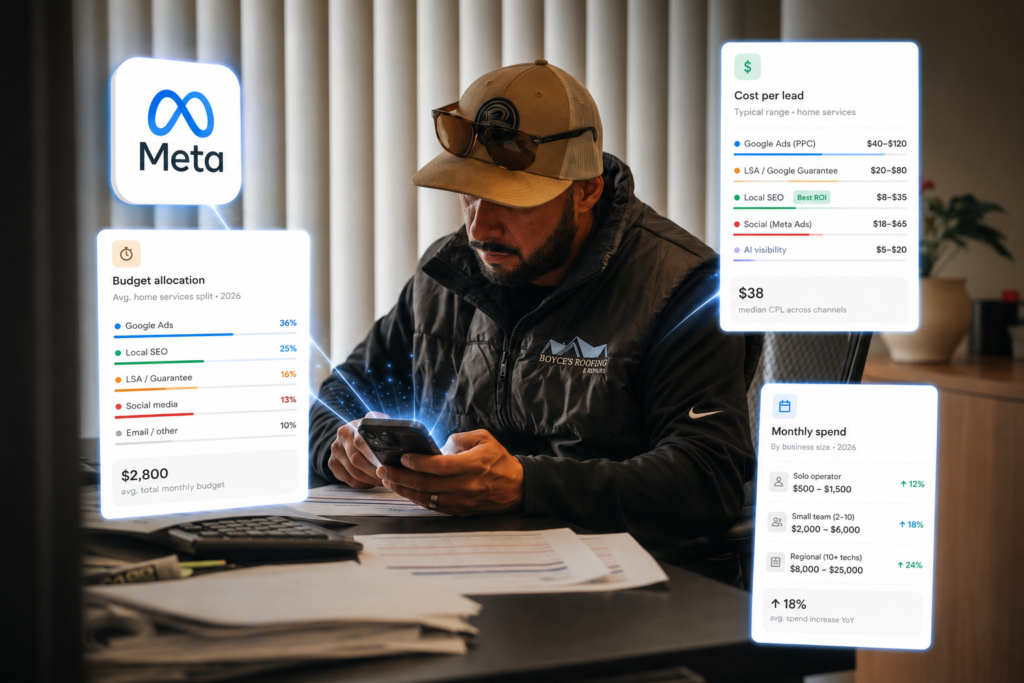
Every source you find on this will give you a different number. That is not because some sources are wrong. It’s because they’re measuring different things.
A raw form-fill from a cold audience costs less than a qualified, ready-to-book lead. A freshly set up account with no conversion history costs more per lead than a mature account that’s been running for six months. A roofing campaign in a competitive metro during storm season costs more than a landscaping campaign in summer.
Here’s what different sources actually report and why the numbers look so different. Every figure is attributed to its source:
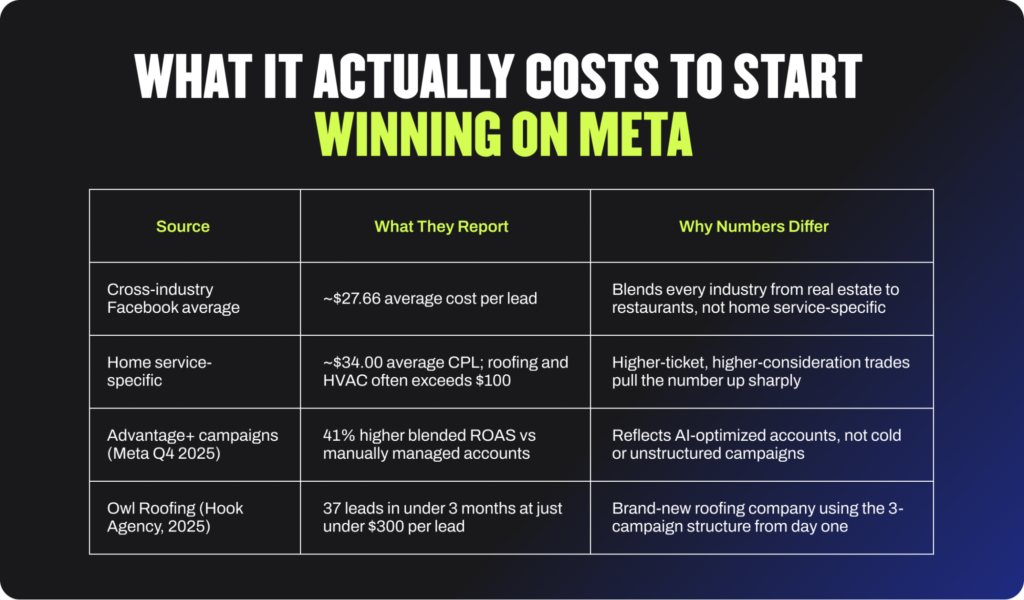
The only benchmark that matters for your business is your own cost per qualified lead tracked over time from your own account. A broader breakdown of what Facebook ads actually cost across different setups covers the factors that move the number most.
One more thing on costs worth saying plainly: Meta’s ad prices are rising. According to the adsuploader.com Meta Ads Updates tracker, Meta Q2 2026 earnings showed the average price per ad up 12% year over year, the second consecutive quarter at that rate. The channel is getting more expensive, which makes campaign structure and creative quality more important, not less.
The 5-Step Framework for Launching a Winning First Campaign
This is the order that matters. Skipping step one undermines every step that comes after it.
Step 1: Install Tracking Before You Spend a Dollar
Without tracking, Meta is flying blind.
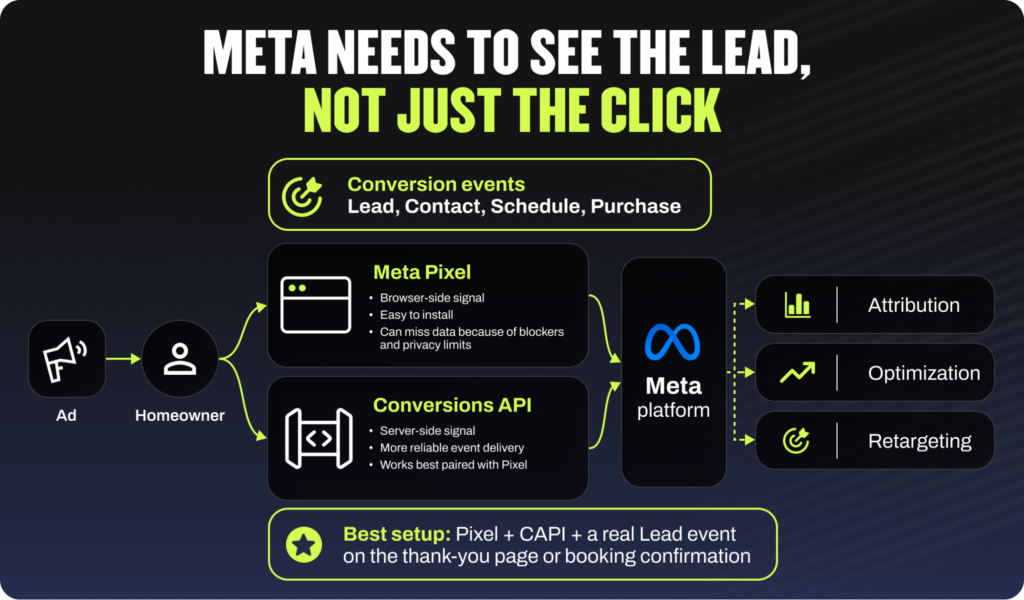
The Meta Pixel fires browser-side events. The Conversions API sends data directly from your server. Both together give Meta the signal it needs to optimize toward real leads rather than cheap clicks. The reason both are necessary: iOS privacy changes in recent years reduced how much the Pixel alone can capture.
The most common mistake: the Pixel is installed on the homepage but no Lead event is configured to fire on the thank-you page after a form submission. If Meta never sees a Lead event, it has nothing to optimize toward. It will deliver the ad to whoever clicks cheapest.
Setting up the Meta Pixel correctly is unglamorous work. It is also the foundation everything else is built on.
Step 2: Build Your Audience Foundation
The most powerful starting point is a lookalike audience built from your real customer list.
Upload your customer list to Meta’s Audience Manager. Meta matches those records to profiles and builds an audience of people who share similar characteristics. A list of 500 real customers will produce a more useful lookalike than generic targeting parameters you set manually.
The most common mistake at this stage: combining cold audiences and warm retargeting audiences in the same ad set. Cold and warm audiences behave differently, convert at different rates, and need different creative. Mixing them produces mediocre results for both.
The targeting homeowners on Facebook guide covers the homeownership and service-radius targeting that layers on top of the lookalike foundation.
Step 3: Structure the Campaign Around Intent, Not One All-Purpose Ad
One campaign cannot do three jobs well. The three-campaign structure:
- Scaling campaign: Broad targeting with Advantage+. Your workhorse. Stable budget, runs every day, leave it alone. You stop micromanaging the audience and let Meta’s AI find buyers on its own. This is the campaign you do not pause because it had a slow Tuesday.
- Testing campaign: Separate budget, completely isolated from scaling. New creative goes here first and proves itself before it touches the scaling campaign. Your workhorse campaign never gets contaminated by unproven ideas.
- Remarketing campaign: Website visitors and people who engaged with your content. These people already know who you are. They need a different message than a cold audience and they convert at a significantly higher rate.
We built this exact structure for Owl Roofing before we ever offered Meta ads as a service. The result: 37 leads in under three months at just under $300 per lead, when most contractors were paying up to $1,000 per lead out of the gate with a less structured setup. The structure is what drove that difference, not a big budget or years of account history.

Step 4: Use Creative That Proves the Work
This is where I am most direct with the home service businesses we work with.
If your ad is a logo on a stock photo with a phone number, it will not generate leads. Not because of the targeting. Because nothing in that image makes a homeowner stop scrolling.
What actually works:
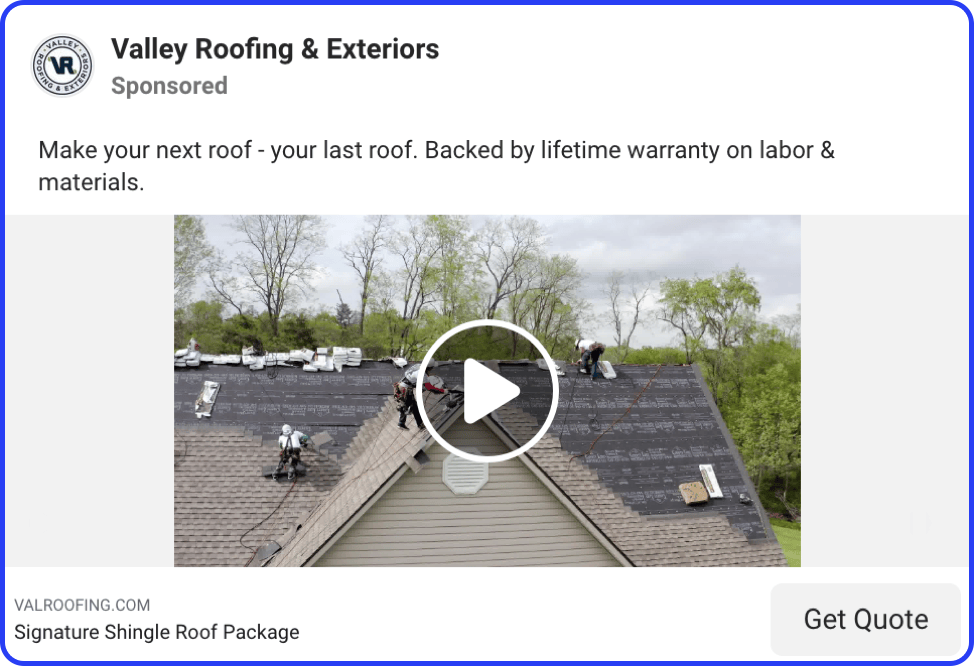
- Real before-and-after photos from actual jobs
- Short video of you or your crew on a real job site
- You on camera talking about the work, the storm that just hit your market, why you do it the way you do it
That last one is the hardest for most owners to do. It feels uncomfortable. It feels like bragging. That discomfort is exactly why it works. Your competitor down the road feels the same way and won’t do it. The contractor who gets on camera becomes the only real face in the market. That is a competitive advantage that money cannot buy directly.
Remember what I said about creative doing the targeting now: the right creative attracts the right people. A video of a real roofer explaining what to look for after a hailstorm will be served to homeowners who just had a storm. Meta’s system is that good at matching signal to audience when the signal is genuinely strong.
Real Facebook ad examples for electricians shows the actual creative approach applied to one trade. The same principles translate across roofing, HVAC, plumbing, and landscaping.
Step 5: Give It a Real Budget and 60 to 90 Days
Meta campaigns have a learning phase.
During the learning phase, Meta is actively gathering data on who responds, which placements work, and when conversions happen. Until the campaign exits learning phase, cost per lead is not a reliable signal. Judging performance at day ten almost always looks worse than the campaign will eventually perform.
The learning phase typically requires around 50 optimization events within a 7-day window. If the budget is too small to generate that volume, the campaign stays in learning phase indefinitely. What this means practically: size the budget to the result you want, not the smallest number you can start with.
Rookie Mistakes That Quietly Burn Meta Ad Budget
These are the patterns that kill most first campaigns before they have a chance to work:
- Skipping the Pixel and Conversions API setup. Without conversion tracking, Meta optimizes for clicks. You pay for traffic that does not convert and have no data to explain why.
- Blending cold and retargeting audiences in the same ad set. They need different creative, different bidding, different optimization signals. Mixing them produces mediocre results for both.
- Judging performance before the campaign exits learning phase. Weeks one and two are almost always misleading. The algorithm is still gathering signal.
- Using generic stock creative. Stock imagery performs generically. Real job photos and real video outperform every time because they prove the work instead of describing it.
- No fast follow-up system for captured leads. A homeowner who fills out a form at 8pm will be contacted by a competitor by 8:15. A great campaign with slow follow-up is still a great way to lose leads you already paid for.

Meta Ads vs. Google Ads: Which Should You Start With?
The honest answer depends on what you sell, not which platform someone tells you is better.
Here is how I think about it:
- Emergency services: burst pipe, dead furnace, roof actively leaking. Google first, every time. The homeowner is already in search mode. Meta had nothing to do with creating that intent and is not what captures it.
- Visual, discretionary projects: roofing replacement, exterior painting, landscaping, remodeling. Meta tends to build stronger pipeline here because the buying decision has a longer runway. The homeowner is not in crisis. They are thinking about it. Meta puts your work in their head during that thinking period.
For businesses with budget to run both, that’s usually the winning combination. Google for today’s demand. Meta for the demand that will exist in 30 to 90 days.
For contractors specifically evaluating whether Meta makes sense for their trade, whether Facebook ads are worth it for roofers covers the trade-specific nuance in depth.
A Simple Readiness Checklist Before You Launch
Most failed Meta campaigns fail before they launch. The setup decisions made before a dollar is spent determine most of the outcome:
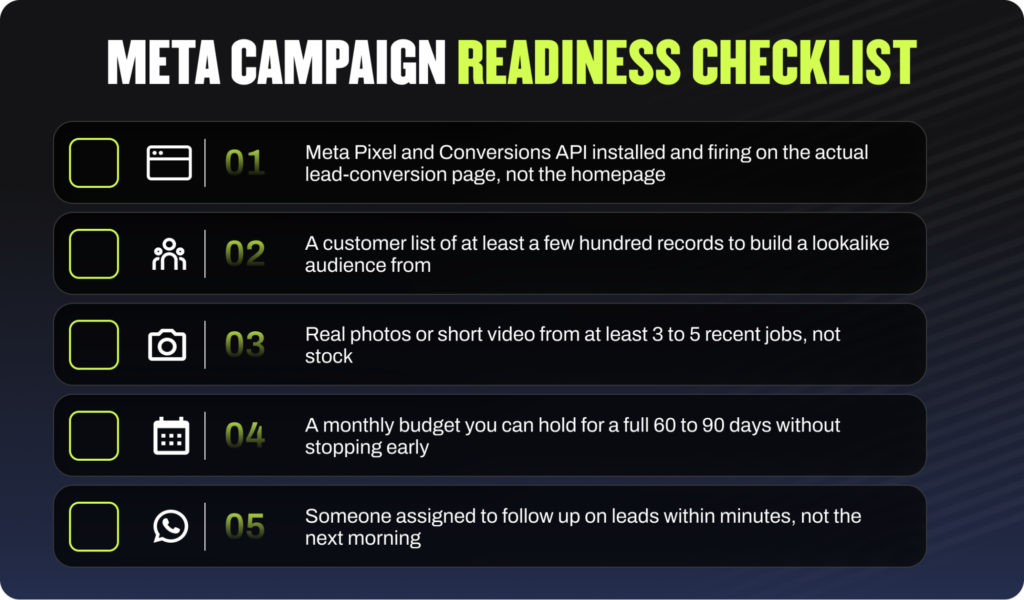
Skipping any one of these doesn’t guarantee failure. It usually means paying more to learn the same lesson the hard way. For a full picture of digital marketing costs for home service businesses across all channels, that guide gives broader context for where Meta fits in the overall budget.
Frequently Asked Questions
What’s a good cost per lead for Meta ads in home services?
It depends on the trade and what counts as a lead. Cross-industry averages sit around $27 to $34. Roofing and HVAC installs often run above $100 even in well-run accounts. Track your own cost per qualified lead over time rather than chasing an outside benchmark.
Should a home service business run Facebook, Instagram, or both?
Both, through one Meta Ads Manager account. Meta’s algorithm distributes budget across placements based on performance. Let it do that rather than splitting manually.
How much budget does a home service business need to start?
Enough to sustain 60 to 90 days without stopping early. A budget too small to generate 50 conversion events per week stays stuck in Meta’s learning phase and never stabilizes.
How long before Meta ads start generating leads?
Some early activity shows up within the first week. Reliable cost-per-lead data doesn’t exist until after the campaign exits the learning phase, which requires enough conversion volume to let the algorithm stabilize. Evaluating at day ten is almost always misleading.
Does running Meta ads count as a full digital marketing strategy?
No. Meta generates awareness and pipeline. It works best alongside Google Ads or Local Services Ads for intent-driven traffic, a strong GBP for local visibility, and reviews that convert skeptical homeowners. Meta alone is a demand-generation channel, not a complete marketing program.
Structure Is What Separates a Campaign That Works From One That Drains Budget
The contractors winning on Meta in 2026 are not spending more. They are structured better.
Real tracking. Audiences built from real customer data. Three campaigns doing three different jobs. Creative that proves the work instead of describing it. A 60 to 90 day commitment to let the algorithm learn.
That is what we proved on Owl Roofing before we built this into a service. Thirty-seven leads in three months at under $300 per lead for a brand-new roofing company. The structure did that. Not a big budget. Not years of account history.
If you want to run the same structure for your business, our Meta Ads services for home service companies page covers what we build and which businesses it works best for.