
I’ve been doing home service marketing for almost a decade.
And the question I get more than almost any other, from solo operators just starting out and from multi-truck operations that have been running ads for years, is some version of: where should I actually be putting my money right now?
It’s a harder question than it sounds. The options keep multiplying:
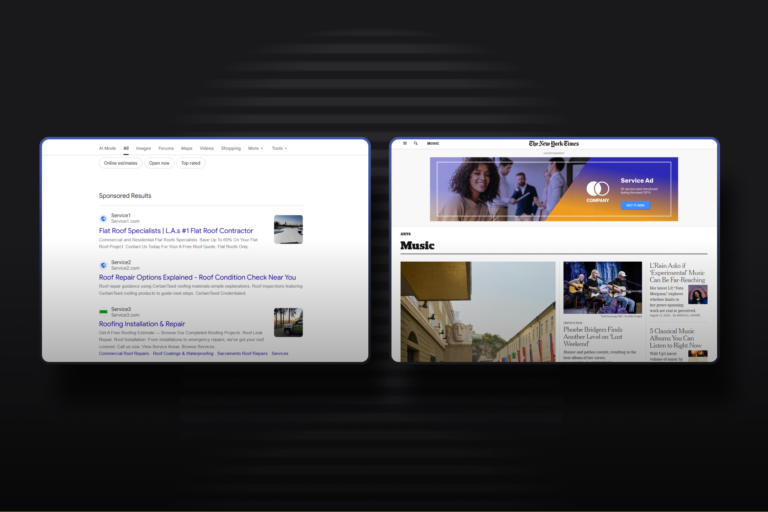
- Google Ads and Local Services Ads competing for the same search results page
- Facebook and Instagram with lower intent but massive reach
- Nextdoor and community platforms that most people set up once and forget
- Directory sites that promise leads and sometimes deliver them
- YouTube and video that builds trust in a way no other channel can
- AI answer engines that are changing how homeowners find contractors
Most owners pick one because a salesperson called, or because a competitor seemed to be using it, or because someone at a trade show mentioned it. That is not a strategy.
Home service businesses should start with a complete Google Business Profile and local SEO since those are free, then add Google Local Services Ads and PPC once the foundation is in place, and layer in social media and video as budget allows.
This guide is the answer I give to that question, sorted by what each channel actually does at each stage of a business, with real numbers from real campaigns behind it.
Why “Where to Advertise” Depends on Your Stage, Not Just Your Budget
Here’s the thing most advertising guides miss completely.
Two businesses can have the same budget and opposite results from the same channel. The difference is almost never the channel. It’s what was already in place before the first dollar got spent.
A business with no reviews, an incomplete Google profile, and a website that loads slowly will waste paid ad spend every time. The homeowner clicks the ad, lands on a weak foundation, and calls someone else. The budget is gone and the owner concludes the channel doesn’t work.
The channel probably works fine. The problem is what it was sending traffic to.
This is why balancing SEO and paid ads is a sequencing question more than a competition between channels. Paid ads can fill the calendar while organic visibility builds. But they can’t substitute for a foundation that isn’t there yet.
The question to answer before picking a channel is: does my foundation hold? Meaning real reviews, a complete GBP, a website that converts. If yes, add paid channels in order. If not, the foundation comes first.
The Free Channels Every Home Service Business Needs First
These cost time, not money. And every paid channel performs better once they are working.
Google Business Profile
This is the single most important free asset for a home service business and the most commonly half-finished one.
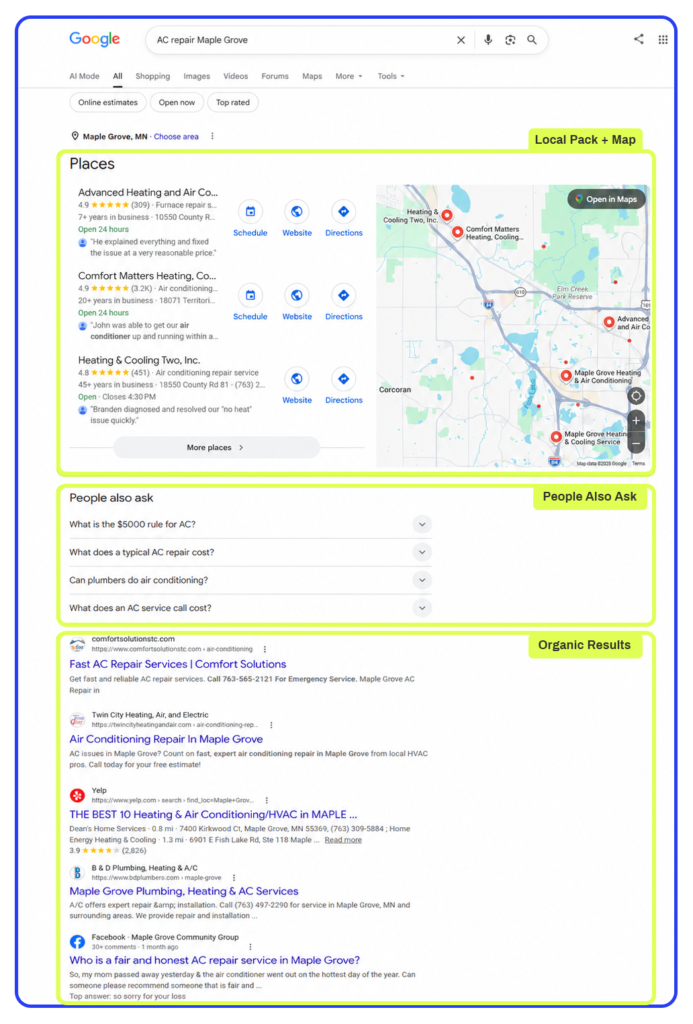
A complete GBP shows up in the local map pack, can support visibility in AI-powered search results, and is almost always the first thing a homeowner checks before calling anyone. What a complete profile actually requires:
- Name, address, and phone number matching exactly everywhere else the business appears online
- Correct primary category with relevant service attributes added, not just the default
- Service area set to the cities, postal codes, or regions the business actually serves, within Google’s 20-area limit
- Current hours updated for holidays and seasonal changes
- Real photos of finished work, trucks, and crew, not stock images
- Weekly posts tied to recent jobs, seasonal offers, or real availability
An incomplete profile doesn’t just rank lower. It tells homeowners the business might not be active. Most of the time, closing the gap between a half-finished and a complete GBP is a couple of hours of work that pays off every month after.
Local SEO and Service Area Pages
Google ranks individual pages, not websites. A plumber serving eight neighborhoods who has one generic homepage is competing against plumbers who have a dedicated page for each neighborhood. Local SEO for home service businesses covers the technical execution in detail, but the core principle is a useful, location-specific page for each real service area, not a stack of near-duplicate city pages, with local details, relevant services and keywords, internal links connecting service and location pages, and consistent NAP across every directory the business appears on.
Local SEO takes months to build and then compounds for years. It’s the lowest cost per lead of any channel over a three to five year window. The catch is you have to start before you need it.
Nextdoor and Community Platforms
Most home service businesses claim a Nextdoor page and never touch it again. That’s a missed opportunity because Nextdoor recommendations carry a different kind of trust than anything paid advertising generates. According to Nextdoor’s vertical trend insights, home services is consistently one of the most recommended categories on the platform, with neighbor-to-neighbor referrals outperforming paid placements for purchase decisions in local service categories.
The free business page takes 20 minutes to set up. Being genuinely helpful in neighborhood threads builds organic credibility that ads cannot replicate. Claim it before spending anything on paid Nextdoor advertising.
Paid Channels That Generate Leads Fast
Once the foundation holds, these are the channels that put a business in front of homeowners actively searching for the service right now. If you are trying to choose between the two main paid search options, the comparison between Google Ads vs Local Service Ads for home services is worth reading before committing budget.
Google Local Services Ads
LSAs can appear prominently in Google Search and now carry the Google Verified badge. They charge per lead rather than per click, so if someone contacts you through the ad you pay, and if they bounce without contacting you, you don’t. Google automatically reviews low-quality leads for credits, and eligible advertisers in the U.S. and Canada can still dispute certain invalid leads.
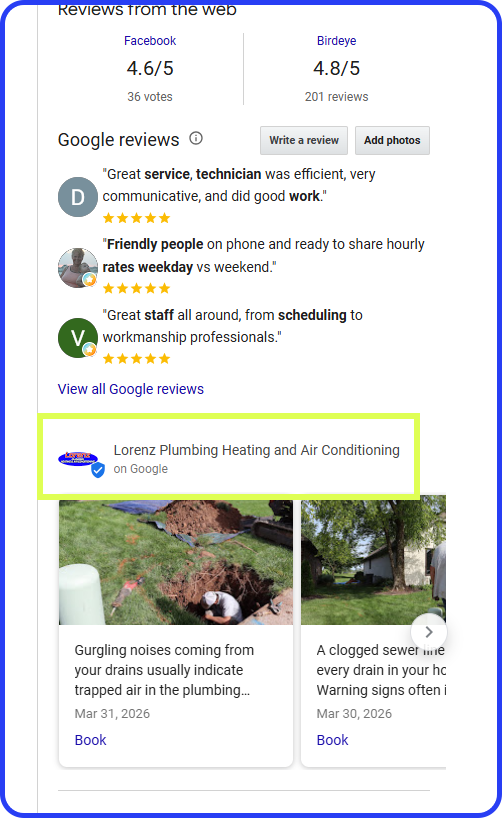
This pay-per-lead model is why LSAs are usually the right first paid channel for a home service business. The risk profile is better than PPC when you’re still figuring out your conversion rates. And the Google Verified badge adds a trust signal that is visible before anyone clicks, which matters in a category where homeowners are already skeptical.
Eligibility depends on the trade and market, and the business has to complete Google’s screening and verification process, which can include business registration or licensing, insurance, and background checks. The LSA vs Google Ads breakdown covers the full tradeoff between the two.

Google Search PPC
PPC still produces real volume for home services but the math has to hold before you run it.
The formula: average revenue per job multiplied by gross margin gives you gross profit per job. Decide what you’re willing to spend to acquire a customer. Multiply that by your lead-to-sale conversion rate and you have your maximum viable cost per lead. If the market’s cost per click and your landing page conversion rate make that math work, PPC is worth running. If it doesn’t, you’re subsidizing Google with margin you don’t have.
The home services PPC handbook covers the full campaign structure and bidding approach.
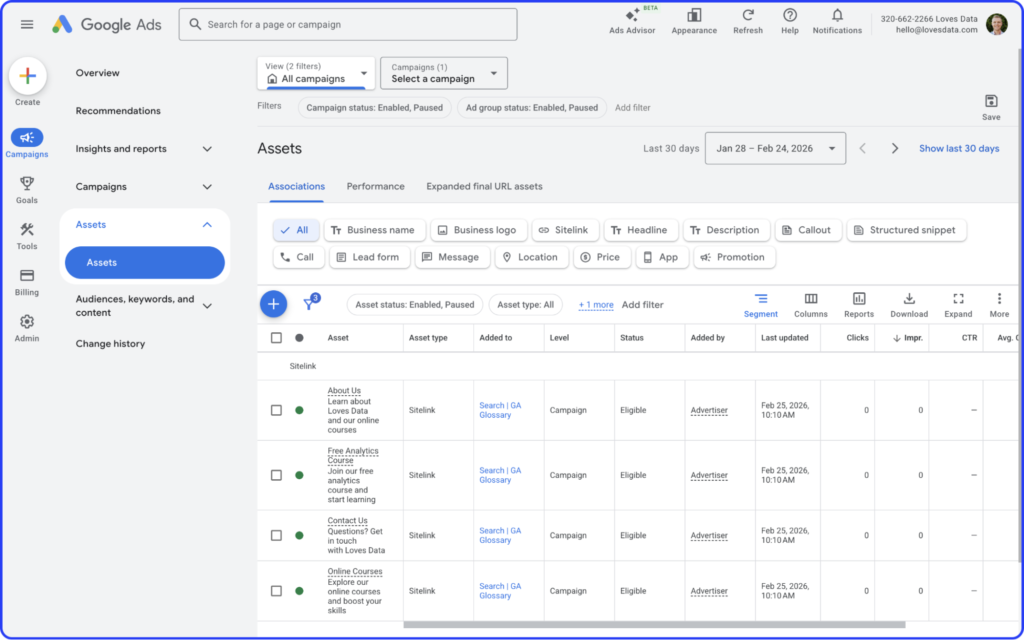
I did a webinar with Joel Enrique breaking down five real Google Ads that each generated over $100,000 in revenue. The patterns that showed up across every winning ad:
- Use every available asset. Headlines, descriptions, callouts, sitelinks, business name, logo, call assets. You pay the same per click whether those fields are filled or not. Leaving them empty is throwing away click-through rate you already paid for.
- Use “you” and “your” language, not “we.” The homeowner is searching because they have a problem. Copy that addresses their situation converts better than copy that talks about the business. Joel put it well: it’s not something homeowners consciously notice, but subconsciously they read “restore your heating and cooling” and picture the problem solved. That’s what triggers the click.
- Use dynamic location-based headlines. Put curly brackets around {city} in the headline and the ad automatically pulls in whatever city the searcher is in. A homeowner in Maple Grove who sees an ad that says “Maple Grove Plumbers” clicks it at a higher rate than one that says “Minneapolis Plumbers,” even if the company serves both. Nearness creates credibility.

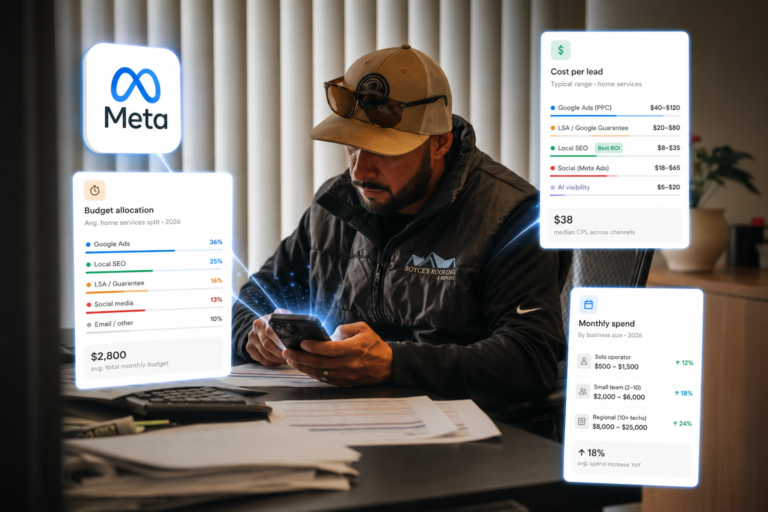
Meta (Facebook and Instagram) Ads
Meta ads work differently from search ads and they’re best used differently.
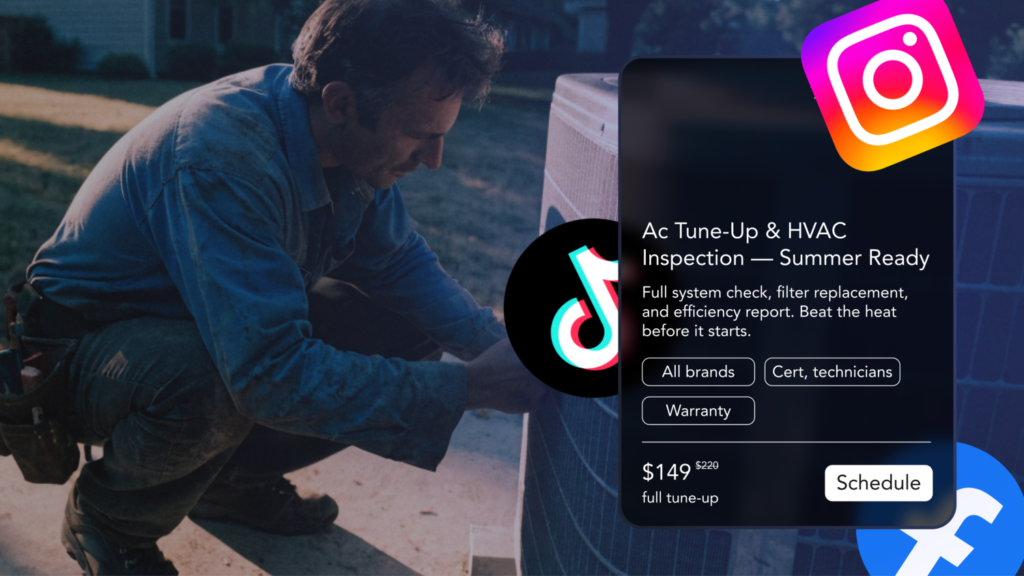
The person seeing a Facebook or Instagram ad wasn’t searching for the service. They were scrolling. That lower intent means Meta ads generate more pipeline than immediate bookings and work better as a second or third touch than a first one. Before-and-after project photos work well for visually strong trades, roofing, landscaping, remodeling. Retargeting people who visited the website but didn’t call is where Meta ad spend tends to have the strongest ROI.
The organic and paid sides of social media for home service businesses work together, and the organic presence makes paid ads perform better when both are running.

Channels Worth Testing Once the Basics Are Profitable
These build long-term visibility and compound over time. They belong after the first two tiers are working, not instead of them.
YouTube and Video
Video is the fastest trust-building format in home services. A homeowner who has watched a plumber explain three things that cause water heater failures before calling feels like they already know that plumber. Real jobs, real trucks, real explanations of common problems on job sites. No production crew required.
The AI visibility angle here is now significant. YouTube citations in Google AI Overviews surged 25.21% in 2025, per BrightEdge research, with instructional content up 35.6% and visual demonstrations up 32.5%. Video content is increasingly being pulled into AI-generated answers, which means a library of well-structured how-to videos is now both a trust asset and an AI visibility play at the same time.
Directory and Lead-Gen Sites (Angi, HomeAdvisor)
The honest take: results vary too much to give a blanket recommendation either way.
Some businesses get profitable leads from directory sites. Others pay for leads that never convert. The platform, the trade, the local market, and how fast the business responds all affect outcomes. The right approach is a small test budget, close tracking of which leads become booked jobs, and no scaling until profitability is proven. The deeper tradeoffs of pay-per-lead services are worth understanding before committing to any directory spend.
AI Answer Engines and Generative Engine Optimization
Homeowners are asking ChatGPT, Gemini, Perplexity, and Google’s AI search experiences for contractor recommendations before they ever work through a traditional list of results. A business with no reviews, thin service content, and inconsistent listings is much less likely to be surfaced regardless of ad spend.
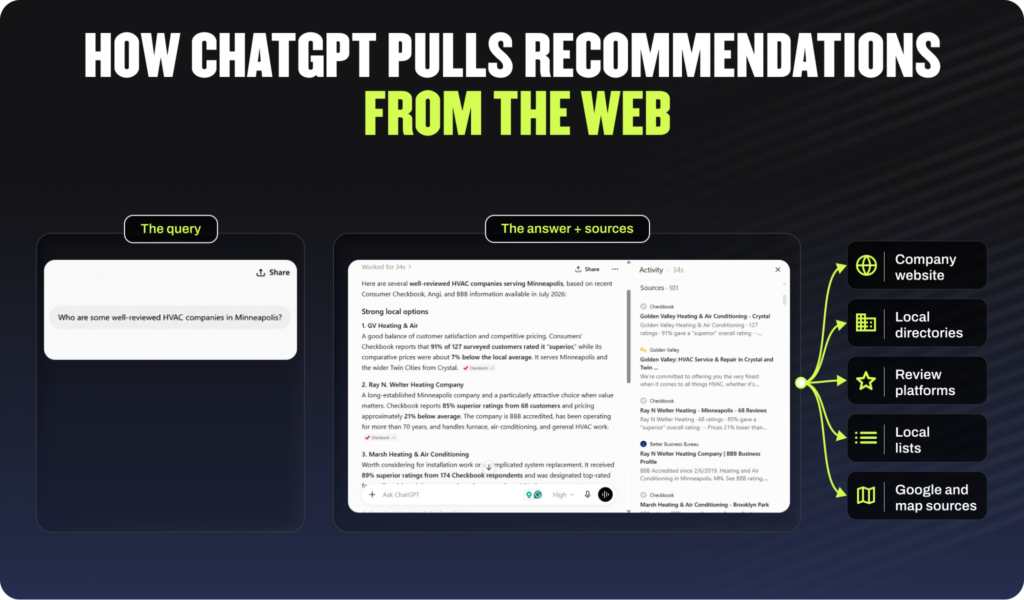
I’ve been going hard on this for our clients over the past year and put out a video specifically on AEO vs SEO and where the real opportunity is right now. The approach that’s working:
- Total brand optimization across the platforms homeowners and AI tools are likely to check. Keep the business details consistent and earn strong reviews where real customers actually use them, not just on Google
- Getting added to legitimate best-of lists, local publications, trade associations, and manufacturer directories in your city. AI tools often cite third-party sources, but the source has to be real and useful, not a thin page built only for rankings
- FAQ content on your website structured around the specific questions homeowners ask, not just keyword variations. Give the direct answer first, then add the detail someone needs to make a decision
- Finding what sources AI is actually pulling from when it answers contractor questions in your market, then improving the genuine information gaps that keep your business out of those sources
Google’s own guidance is less dramatic than the hype: the same SEO fundamentals still apply to AI Overviews and AI Mode. Pages need to be crawlable, useful, accurate, and eligible to appear in Search, and no special AI markup guarantees inclusion. Most contractors still have not built that foundation well, which is why the businesses that do it now have room to compound the advantage.

One significant development: OpenAI is now testing ads in ChatGPT for logged-in adults on Free and Go plans, and Ads Manager Beta has opened self-serve campaign tools to eligible advertisers. Ads appear separately from answers and do not influence the answers themselves. The platform is still in beta, so home service benchmarks are thin and advertiser availability can vary by country.
What this means practically: ChatGPT is becoming both an organic discovery environment and an early paid channel. Contractors should treat the ads as a controlled test, not a replacement for Google, while continuing to build the reviews, content, and listings that support organic visibility.
The full tactical approach to showing up in AI answers is covered in our answer engine optimization for home services guide.
Where to Advertise by Budget: A Decision Table
Budget determines how many channels can run simultaneously, not which channels matter. Start with what the current stage can actually support and execute it well before adding the next layer.
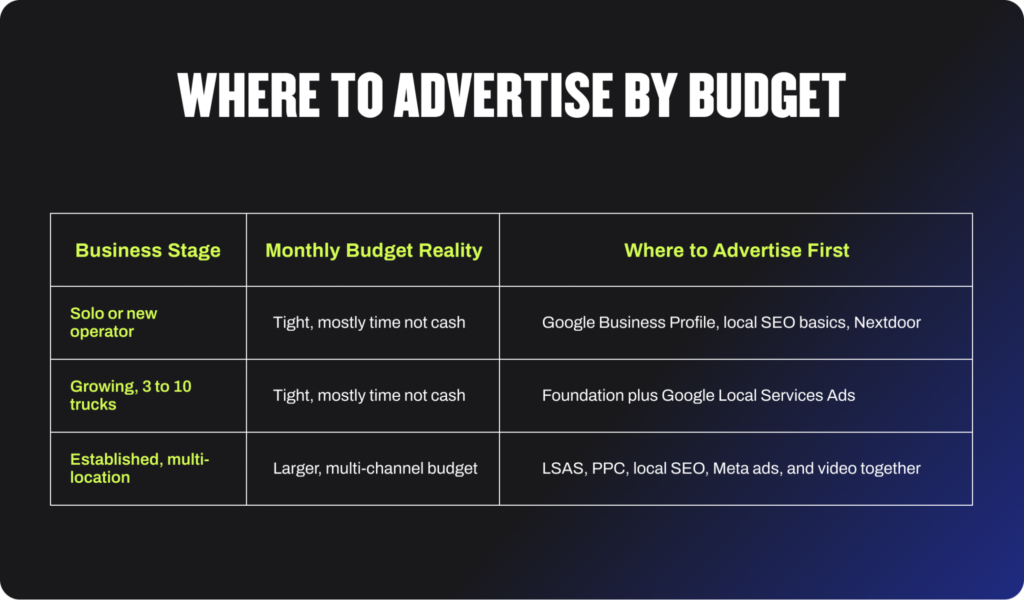
The commonly referenced benchmark for marketing spend is 7 to 12 percent of annual revenue, with businesses in competitive metros or actively expanding leaning toward the higher end. The how much to spend on marketing breakdown goes into trade-specific ranges.
Real Cost-Per-Lead Numbers From Home Service Campaigns
I want to share some real numbers here because I think it makes the point better than any benchmark study can.
- Speedy Water Heaters is a plumbing client we are genuinely proud of. 158 marketing-qualified leads at $136 average cost per conversion on a $3,300 monthly budget. That kind of efficiency on a relatively modest spend only happens when the foundation is already solid.
- Genz-Ryan came through SEO, not paid. 44% increase in local first-page rankings, 197 total qualified organic leads, and a 25% year-over-year increase. This is what happens when the GBP and local SEO are built right and then given time to compound.
- Young Construction ran both SEO and PPC together. 200% year-over-year increase in local first-page rankings and 176 confirmed inbound leads from organic search alone.
The thing these four have in common is not the channel or the budget. It’s that the foundation was working before a dollar of paid spend went in. PPC without a solid GBP and a converting website produces numbers that look nothing like these.
Common Mistakes When Choosing Where to Advertise
After auditing hundreds of home service marketing setups, the same mistakes show up over and over. Most wasted advertising spend isn’t on the wrong channel. It’s on the right channel without the foundation or tracking to make it work.
- Running paid ads before the website or GBP is ready. Paid traffic sent to a weak foundation converts poorly regardless of how the campaign is structured. The ads are not the problem.
- Splitting a small budget across too many channels. A $1,500 monthly budget divided between Google Ads, LSAs, Facebook, and a directory listing does not move any of them. Pick one and do it properly before adding the next.
- Buying directory leads without tracking conversion to booked jobs. The cost per lead can look fine until you discover the close rate is 8%. Track from lead to job, not from lead to inquiry.
- Choosing a channel because a competitor uses it. A competitor’s channel mix reflects their history, their budget, and where they are in their market. None of those are yours.
- Stopping a channel before there’s enough data. PPC and SEO both require time to generate enough data to optimize. Four weeks is not enough to know whether a channel works. Most businesses pull budget right before the point where results would have started compounding.
Frequently Asked Questions
Where should a new home service business advertise first?
Start with a complete Google Business Profile and basic local SEO since both are free and everything paid performs better once they’re in place.
Is Google Local Services Ads or PPC better for home services?
LSAs are often the better first paid channel since they charge per lead, can appear prominently in Search, and carry the Google Verified badge after screening. A strong PPC campaign can outperform LSAs once the business has enough data to optimize it, but LSAs carry lower risk while that data is being gathered.
How much should a home service business spend on advertising?
A commonly cited benchmark is 7 to 12 percent of annual revenue, with businesses in competitive markets or expanding service areas leaning toward the higher end.
Do directory sites like Angi and HomeAdvisor work for home services?
Results are mixed and vary significantly by trade and market. Test a small budget, track which leads convert to booked jobs, and only scale what proves profitable. Do not pay for leads without knowing your close rate on them.
Is social media worth it for home service businesses?
Yes, but mainly for retargeting website visitors and building trust through real project photos and video. Social ads carry lower intent than search-based channels and work better as a second or third touch than a first one.
Should home service businesses be showing up in AI tools like ChatGPT?
Yes. Reviews across multiple platforms, accurate business information, useful service and FAQ content, and mentions in legitimate local sources are the main levers. ChatGPT ads are now in beta as a separate paid placement, but they do not influence answers and should still be treated as an emerging test channel.
The Channel Is Not the Decision. The Sequence Is.
Where a home service business should advertise in 2026 is not a single answer. It’s a sequence. Get the free foundation right. Add paid channels in the right order. Track everything back to booked jobs.
The businesses that dominate their local market in three years are the ones making these decisions deliberately right now, not the ones running whatever their last agency set up.
If you want help figuring out where your next marketing dollar should go, schedule a call with our team and we will walk you through exactly what we would build for your trade and your market.