
Google Ads. Display ads. Local Service Ads. Performance Max.
If you have ever been pitched by a vendor on any one of these and walked away more confused than when you started, you are not alone. These terms get used almost interchangeably by people selling them and very differently by the platform that runs them.
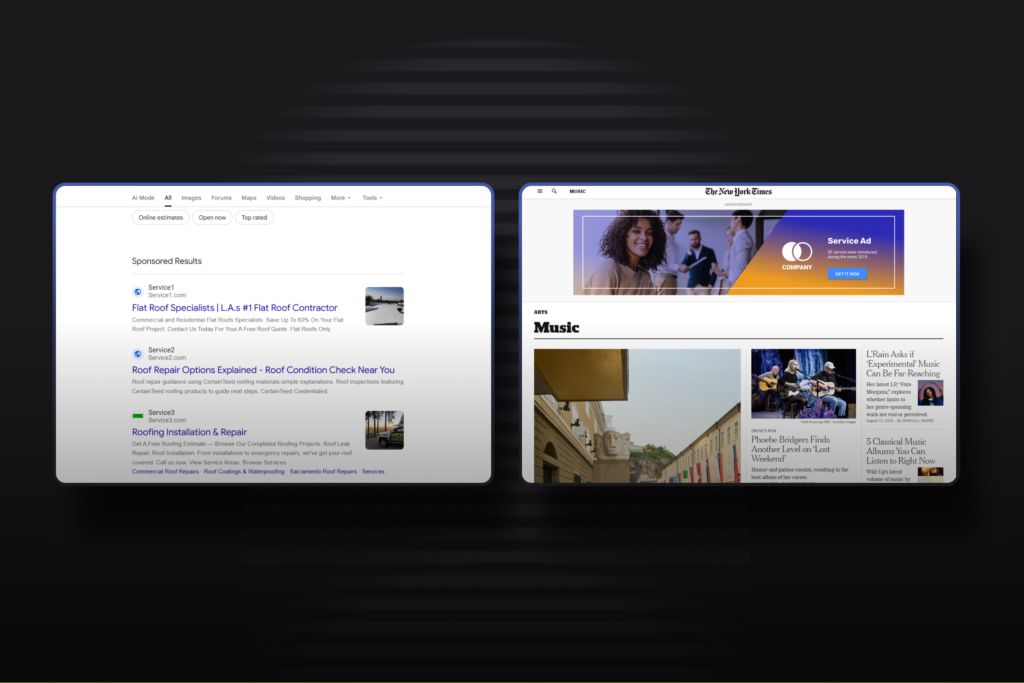
Search ads are text ads triggered by a specific Google search, billed per click. Display ads are visual ads shown across millions of partner websites and apps based on audience targeting rather than a search, typically used to build awareness rather than capture active demand.
This guide answers 14 real questions across three groups:
- The basics: what search and display ads actually are and how they work
- What has changed in 2026: the campaign type migrations, AI shifts, and what to make of Performance Max
- What actually matters for a home service business: which format to use, how LSAs fit in, and what to measure
For the broader PPC strategy behind these formats, the full home services PPC handbook covers the strategic layer. This guide stays focused on answering the foundational questions before budget gets committed to any of them.
The Basics: What Search and Display Ads Actually Are
1. What is a Google Search ad?
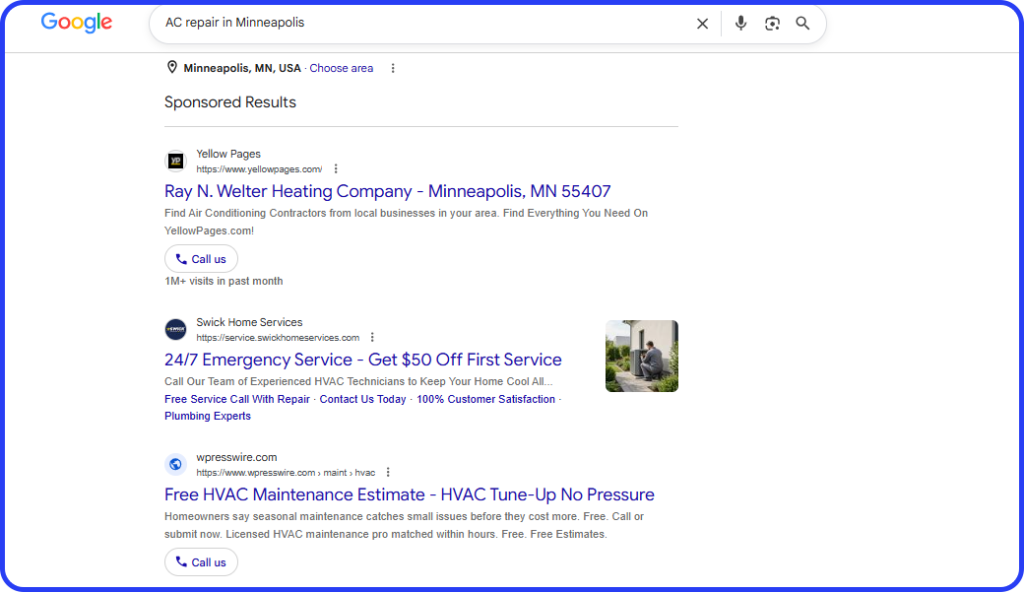
A Google Search ad is a text-based ad that appears on Google’s search results page when someone searches a matching keyword. The ads appear at the top or bottom of the results page, labeled “Sponsored,” and are triggered by the specific words or phrases typed into the search bar.
The key mechanic: the searcher’s intent is already established before the ad appears. Someone searching “emergency plumber near me” has a specific need. The ad meets them at the exact moment that need exists. That is what makes search ads one of the highest-intent forms of paid advertising available for home services.
2. What is a Google Display ad?
A Google Display ad is a visual ad, typically an image, banner, or short video, shown across the Google Display Network. That network includes millions of partner websites, mobile apps, YouTube, and Gmail. Unlike search ads, display ads are not triggered by a search. They are shown to people based on who they are, their interests, demographics, and browsing behavior, rather than what they searched.
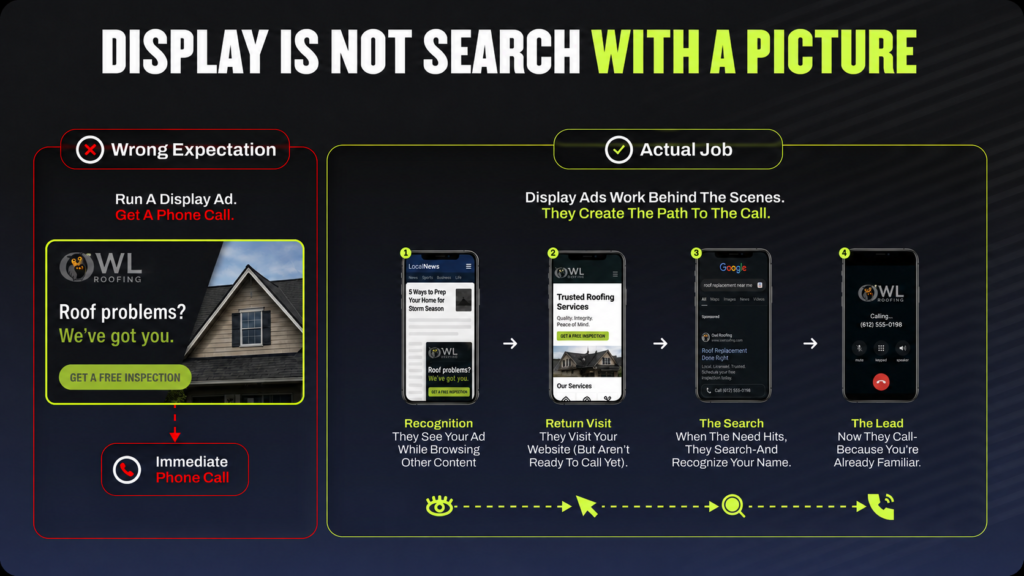
The distinction matters for expectations. Display ads reach homeowners who are not actively looking for the service yet. They work for building recognition before a need arises or retargeting someone who visited the website but didn’t call.
3. What’s the actual difference between search and display ads?
Search ads capture demand that already exists. Display ads build demand that doesn’t exist yet.
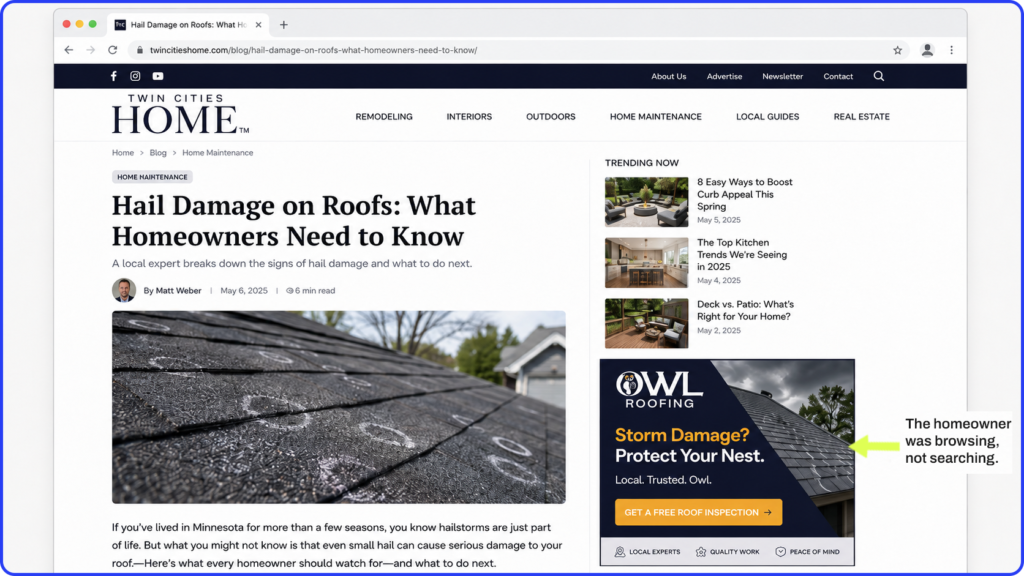
A homeowner searching “roof replacement cost” is already in the decision process. A search ad meets them there. A homeowner scrolling a news site who has been noticing a few damaged shingles for weeks has not searched anything yet. A display ad can put the roofing company’s name in front of them before they do.
One meets an active searcher. The other creates familiarity with a passive browser. Both jobs are real. They require different creative, different targeting, and different expectations for what conversion looks like and how quickly it happens.
4. How does Google decide which ad wins the auction?
Every time a search happens that could trigger an ad, Google runs a real-time auction. The winner isn’t simply the highest bidder.
Google weighs two things together: bid amount and ad quality. Ad quality is typically measured through what Google calls Quality Score, which factors in expected click-through rate, ad relevance to the search, and the quality of the landing page the ad sends traffic to. A highly relevant, well-structured ad can outrank a higher bid from a less relevant one, and at a lower cost per click. This is why campaign structure and landing page quality matter as much as the budget behind them.
Understanding Google Ads settings worth knowing covers the specific account-level controls that affect how this auction works in practice.
5. Do you pay per click or per impression?
It depends on the campaign goal and type.
- Search ads: always billed per click. The ad can appear thousands of times and cost nothing. The charge only happens when someone clicks.
- Display campaigns: can run on either a per-click basis or a cost-per-thousand-impressions basis, depending on what the campaign is optimizing toward. Awareness-focused campaigns often run on impressions. Lead-focused display campaigns typically run on clicks.
6. How does Display Network targeting work if there’s no search happening?
Display targeting uses audience signals instead of keyword matching. The main options:
- Interests and in-market audiences: Google identifies users who have shown interest in home improvement, HVAC services, or similar categories based on their browsing behavior
- Demographics: age, gender, household income, and similar signals
- Retargeting: showing ads specifically to people who visited the website but didn’t call or submit a form. This is often the highest-performing use of display for home services
- Similar audiences: reaching new users who share characteristics with existing customers
What’s Changed in Google Ads for 2026
Google Ads has gone through significant structural changes over the past year. What’s changing in Google Ads for contractors covers the strategic implications in detail. This section addresses the three most common questions about the 2026-specific shifts.
7. Is Standard Display still a thing in 2026?
Less so than it used to be.
Google has been migrating Standard Display campaigns toward Demand Gen campaigns, with the channel controls in those new campaigns restricted to the Display Network. Demand Gen brings newer features including expanded video formats and unified reporting across surfaces, but it gives advertisers less manual placement control than Standard Display did.
The shift is Google pushing toward its AI-managed campaign infrastructure and away from the granular manual control that experienced advertisers used to build highly tuned Display setups.
The practical effect: contractors who have been running Standard Display campaigns on a set-it-and-forget-it basis may not notice much difference. Advertisers who built sophisticated placement exclusion lists or manual bidding strategies will notice the migration most.
8. How much has AI changed how these campaigns actually run?
Significantly, in terms of setup and optimization. Less so in terms of the underlying principles.
Campaign setup in 2026 increasingly relies on automated bidding strategies and AI-assisted targeting. Google’s Smart Bidding uses real-time signals including device, location, time of day, search history, and audience behavior to set individual bid amounts at each auction. The advertiser sets a target goal (target CPA, target ROAS) and the system optimizes toward it. Manual CPC bidding still exists but is increasingly positioned as a starting point rather than a mature strategy.
What hasn’t changed: the intent-versus-awareness distinction between search and display. A homeowner searching for emergency HVAC repair is still in a fundamentally different state from one browsing a home improvement website. AI optimizes within those channels; it doesn’t collapse the distinction between them.
9. What is Performance Max / AI Max, and does it replace search and display?
Performance Max is Google’s fully automated campaign type that serves ads across all of Google’s surfaces, including Search, Display, YouTube, Gmail, Maps, and Discovery, from a single campaign. Instead of choosing keywords and placements, the advertiser provides audience signals, creative assets, and a conversion goal, and Google’s AI decides where, when, and to whom the ads appear.
AI Max is a newer iteration that incorporates more aggressive AI-based audience expansion and creative generation.
Does it replace search and display? Not entirely. Traditional search campaigns still make sense when precise keyword control matters, for example when an HVAC company wants to bid specifically on “furnace repair” and exclude broad awareness traffic.
Performance Max and AI Max augment rather than replace, and for home service businesses with limited budgets, running both is often less efficient than running a well-structured traditional search campaign first and layering in automated campaign types once there is enough conversion data for the AI to optimize toward.
Joel, our Director of Strategy here at Hook Agency, addressed this directly when talking about the August 2026 LSA migration. His point: Google is moving LSAs into the Google Ads platform under a new campaign type called Performance Max for pay per lead, a move that puts the management layer of LSAs inside Google Ads while keeping the pay-per-lead model unchanged.

For Home Service Businesses Specifically
10. Should a home service business run search ads, display ads, or both?
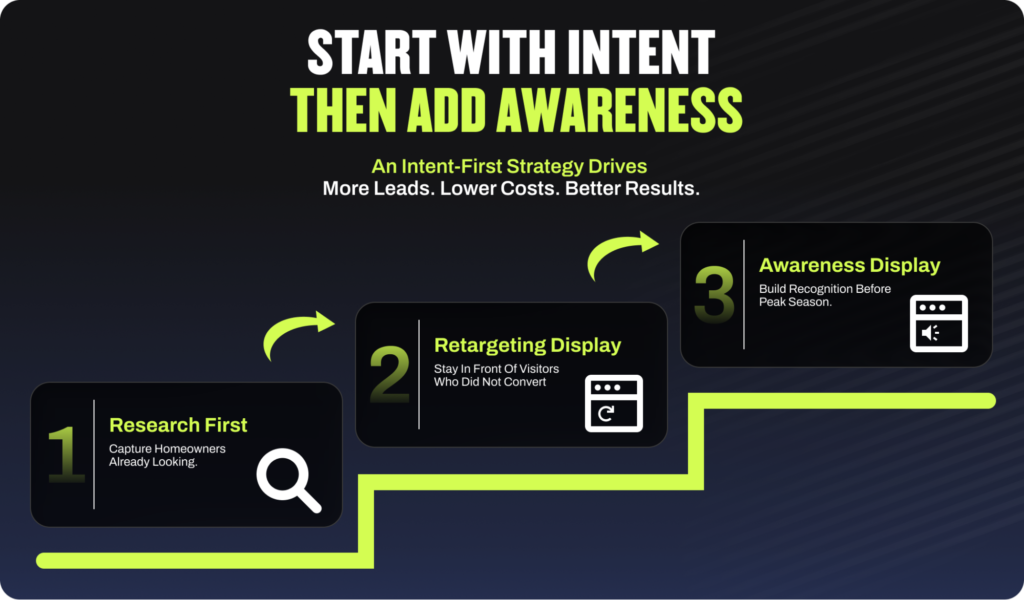
Start with search. Add display as a supporting layer once search is working.
Home service demand is overwhelmingly need-driven. A broken furnace, a leaking roof, a plumbing emergency. The homeowner is searching right now and making a decision quickly. Search ads are built for exactly that moment. Display ads are not. A homeowner who sees a banner ad for an HVAC company while reading an article is not going to call about a non-emergency, at least not today.
Where display earns its place for home services:
- Retargeting website visitors who didn’t convert on the first visit
- Building brand recognition in a specific service area ahead of peak season
- Following up with homeowners who got a quote but didn’t book
Balancing SEO and paid ads covers how organic and paid strategies complement each other, which is the broader question behind this channel decision.
11. How is this different from Local Service Ads?
LSAs are a completely different billing model and a different placement tier from both search ads and display ads.
LSAs charge per lead, meaning a call, a message, or a booking, rather than per click. A homeowner can click an LSA and the business pays nothing. Only a contact generates a charge. Standard search ads charge the moment anyone clicks, regardless of whether that click turns into a lead.
LSAs also appear above standard search ads in the results page and above organic results, carrying the Google Verified badge, which signals background and license checks were passed. That placement and the trust signal it carries are distinct advantages over standard search ads.
As of August 2026, Google is migrating LSAs into the Google Ads platform under Performance Max for pay per lead. The pay-per-lead billing model stays the same. The management interface is changing. The Google Verified badge and the verified search-and-maps placement both carry over with no interruption, per Joel’s walkthrough of the migration.
Google Ads compared to Local Service Ads covers the full comparison in detail, including eligibility requirements and which trades and markets tend to favor one over the other.
12. What’s a realistic cost-per-click or budget to expect?
It depends significantly on the trade and the local market, and any single number presented as universal should be treated skeptically.
Home services is one of the more competitive categories in Google Ads because the revenue per customer is high and the decision to call is urgent. A plumber in a dense metro will pay substantially more per click than a plumber in a rural market. HVAC installs and roofing replacement campaigns tend to carry higher CPCs than maintenance and service calls. Demand spikes seasonally, driving up competition and cost at peak times.
Realistic Google Ads costs for contractors provides actual benchmarks by trade and market type. Use those rather than a single number from this piece, since the real range is wide enough that one figure gives a false sense of certainty.
13. How should success be measured differently for search vs. display?
Hold search campaigns to direct conversion metrics. Hold display campaigns to assisted and brand metrics.
Search campaigns are straightforward to evaluate on direct response: click-through rate, cost per conversion, calls and form fills attributed to the campaign. When search is working, there are enough conversions to see the math clearly within a few weeks of a properly structured campaign.
Display campaigns are being asked to do a different job. Expecting a display banner ad to produce the same direct conversion rate as a search ad triggered by a specific emergency keyword is a category error. Display is better evaluated by reach within the target geography, retargeting conversion lift (did people who saw the display ad convert at a higher rate than those who didn’t?), and assisted conversions (did a touchpoint from display appear in the conversion path before a search-driven conversion happened?)
Building a landing page that actually converts PPC traffic covers the conversion side of this specifically. A well-structured campaign sending traffic to a poorly optimized landing page is a measurement problem and a conversion problem at the same time.
14. What’s the most common mistake home service businesses make with these ad types?
Treating display like search and expecting the same direct-response conversion rate.
A display ad on a home improvement website is not being seen by someone who is ready to call right now. It is being seen by someone who might be thinking about a project. Judging that campaign against a cost-per-lead target built for urgent search intent sets up a comparison that display cannot win, and often causes businesses to abandon display before it has a chance to do the job it is actually suited for.
The second most common mistake: skipping display entirely and then wondering why the search campaign conversion rate is lower than expected. Retargeting is one of the highest-ROI uses of display for home services because it focuses only on people who already showed interest. Without it, a meaningful percentage of visitors leave and are lost entirely.
Lowering cost per lead from Google Ads covers the specific optimizations that improve conversion efficiency, which is where most of the leverage lives once the campaign structure is right.
The Terminology Will Keep Evolving. The Fundamentals Won’t.
Performance Max. AI Max. Demand Gen. Google will keep renaming and restructuring campaign types. The underlying distinction, between ads that capture existing demand and ads that build demand that doesn’t exist yet, is not going anywhere.
For home service businesses specifically, that means starting with search to capture the homeowner already looking, layering in retargeting display to stay in front of the ones who visited but didn’t call, and approaching LSAs as a separate and complementary product rather than a substitute for either.
For trade-specific guidance on building the right campaign structure, Google Ads for roofing companies walks through the exact campaign setup for one of the most competitive home service categories.
And if you want help auditing or building a campaign that matches the format to the goal, schedule a call with our team and we will walk through what the right structure looks like for your trade and market.