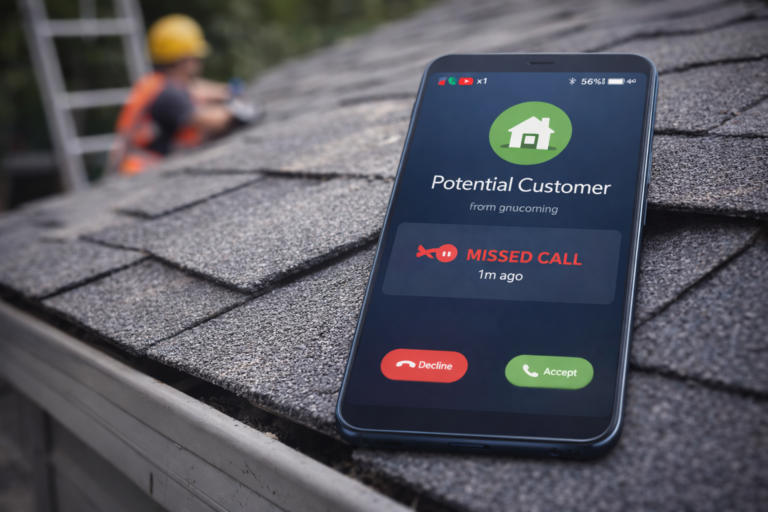
Lower cost per lead from Google Ads isn’t a mystery. It’s a math problem, and most contractors are letting Google solve it for them. That’s how you end up paying $150, $200, even $300 a lead without knowing what’s actually driving the cost.
And the numbers aren’t gentle.
WordStream’s 2025 benchmarks show home services CPC at $12 to $30 and CPL at $100 to $300, but here’s the part most contractors miss, optimized campaigns cut those costs by 20 to 30 percent just by improving Quality Score.
Translation: your leads aren’t expensive because Google Ads is expensive.
They’re expensive because your setup is.
Contractors who win on Google don’t spend blindly. They tighten targeting, sharpen ad relevance, and make Google reward them for doing it right.
Let’s break down how to stop overpaying and start running ads that actually move the needle.
1. Build Campaigns the Right Way: Service + Location Buckets
Most Google Ads costs for contractors skyrocket for one simple reason: Google has no idea what you actually want. When you lump everything into one campaign, your keywords fight each other. Your budget bleeds. Your CPL explodes.
The fix is simple: structure your campaigns so cleanly that Google can’t possibly get confused.
Start with this:
One service per campaign.
Roof repair. AC install. Drain cleaning. Each gets its own bucket. No mixing, no “kitchen-sink contractor” campaigns.
One tight location per ad group.
Google rewards relevance. Group similar zip codes together and avoid blasting ads across an entire state.
Kill the “all services” campaign.
These are the silent CPL killers. Google doesn’t know which service you want to promote… so it picks. And it picks wrong.
Separate emergency intent from research intent.
“24 hour AC repair” is not the same as “best AC brand.” The mindset, and the cost, are totally different.
When your campaigns are structured like this, your performance jumps, your waste drops, and your entire account becomes easier to optimize alongside balancing SEO and paid ads for long-term growth.
2. Negative Keywords: The Contractor’s Secret Weapon
Want the fastest way to slash your CPL?
Stop paying for garbage clicks.
Campaigns using 200+ negative keywords see up to 67 percent lower CPA and nearly 89 percent higher CTR. Why? Because you finally block the junk traffic contractors flush money down the drain on:
- “DIY”
- “jobs”
- “free”
- “template”
- “training”
- “how to”
These queries burn your budget and send nothing back. Add irrelevant cities, product-only searches, and “informational” keywords to the list, and your account tightens up immediately.
Then?
Audit weekly. Yes, weekly. Bad clicks evolve constantly, especially when you’re running demand gen ads alongside search.
If you want to lower your CPL fast, negative keywords are your first lever.

3. Landing Pages Built to Convert, Not Just Look Good
Clicks are expensive. Conversions are priceless.
And most contractor landing pages still look like online brochures instead of sales machines.
Here’s what high-performance pages actually include:
A fast, mobile-first layout
Fifty percent of your traffic is on a phone. Slow pages destroy conversion rates instantly.
A clear headline that matches the exact keyword
If the ad said “Roof Repair Near Me,” the page better say it too. Relevance = trust.
Real trust elements
Reviews. Certifications. Job photos. Team photos. Not stock images of overly happy strangers.
Click-to-call buttons + short quote forms
Friction kills. Make contacting you stupidly easy.
No distractions
No blog links. No full navigation. No “learn more.” One goal: convert.
When your landing pages are tuned like this, your Quality Score jumps and your cost per lead drops, often dramatically.
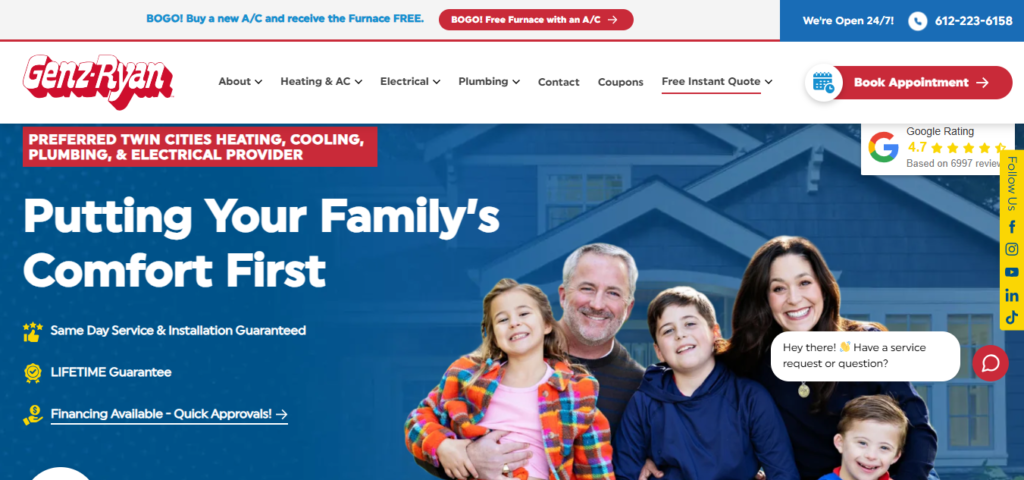
As you can see in this Hook Agency-designed homepage, the CTA buttons are clearly visible above the fold, exactly where a homeowner’s eyes land first.
This visual reinforces everything the section just taught.
4. Call Tracking + Lead Scoring: Know What You’re Actually Paying For
A click isn’t a lead.
A lead isn’t revenue.
And without tracking, you don’t know which keywords are actually making you money.
Contractors who implement unique call tracking numbers and form-level tracking for every campaign regularly see a 25 to 30 percent improvement in ROI because they finally know which ads produce jobs, not noise.
Here’s what this looks like:
- Use a unique tracking number per campaign.
Roof repair, AC tune-ups, drain clearing, each gets its own number.
- Track the full journey of every form submission.
What keyword did they click? Which ad? Which page?
- Score leads based on quality.
Five-second spam calls? Trash.
Booked consultations? Fuel.
- Shift budget toward the keywords that produce revenue.
Not “traffic.” Not “clicks.” Not “interest.”
Revenue.
This is how you turn PPC from guesswork into a predictable machine.

5. Pause Keywords That Don’t Pull Their Weight
The fastest way to lower CPL is brutally simple:
Stop spending money on keywords that don’t convert.
Most contractors cling to bad keywords because “maybe they’ll turn around.” They won’t. Google isn’t sentimental.
Here’s what to cut:
- high-cost keywords with no conversions
- broad match variants that eat half your budget
- vague searches with unclear intent
- any term costing way more than your target CPL
Then shift that money into the keywords with money intent like “repair,” “install,” “near me,” “24 hour,” etc. Paired with monthly pruning, this alone can transform your account.
This isn’t just optimization. It’s discipline.
Trim the dead weight.
Feed the winners.
Watch CPL drop.
6. Use Ad Extensions to Take Up More Real Estate (Without Spending More)
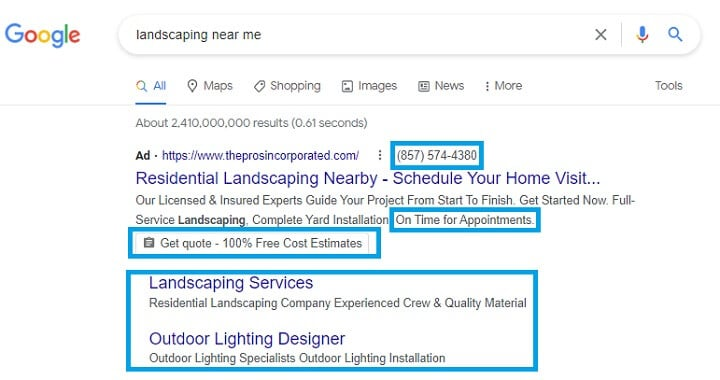
One of the fastest ways to lower CPL doesn’t involve spending a penny more. Ad extensions expand the size of your ad, take over more SERP space, and make you look more relevant than the contractor above or below you. Bigger ads get clicked more and Google rewards higher CTR with cheaper costs.
Extensions turn a basic text ad into a mini billboard. Homeowners see more options. Google sees stronger engagement. You pay less for the same click. It’s one of the rare PPC wins that feels almost unfair.
A few extensions that move the needle:
- Sitelinks that highlight specific services
- Call extensions for instant tap-to-call on mobile
- Location extensions that signal trust
- Callouts and snippets that show credibility at a glance
More visibility. More clicks. Lower cost. And none of it increases your budget.
7. Improve Your Quality Score to Pay Less for the Same Clicks
Quality Score is the hidden lever most contractors never touch, even though it directly determines whether you pay premium rates or contractor rates for the same traffic. When your ad, keyword, and landing page all match tightly, Google sees you as a high-value advertiser and drops your costs.
The problem: most contractors send “roof repair” searches to a general homepage. Or they use slow, cluttered landing pages. Or their ads feel generic. Google punishes all of that with higher CPC.
To flip the script, tighten your relevance:
- Match the keyword to the headline
- Match the headline to the landing page
- Keep the page fast, mobile-first, and distraction-free
- Make the CTA clear and immediate
Stop Letting Google Decide Your Costs for You
Most contractors don’t have a Google Ads problem, they have a control problem. Google spends your budget exactly how it wants unless you step in with structure, relevance, tracking, and discipline. The moment you take control, your CPL drops, your lead quality climbs, and your ads finally start performing the way you always hoped they would.
Lean campaigns.
Cleaner targeting.
Better landing pages.
Smarter pruning.
That’s how contractors win and how your competitors lose.
If you’re ready to stop overpaying for mediocre leads and start running ads that actually move revenue, it’s time to tighten up your strategy. Schedule a call with Hook Agency to tighten your Google Ads targeting and boost lead quality.