
Two proposals. Same scope. One says $3,500 a month. The other says $9,000 a month.
I’ve watched this exact conversation happen with contractors more times than I can count. They’re not sure which one is the rip-off. Sometimes it’s the cheaper one. Sometimes they’re both wrong for completely different reasons. And they have no framework to tell the difference.
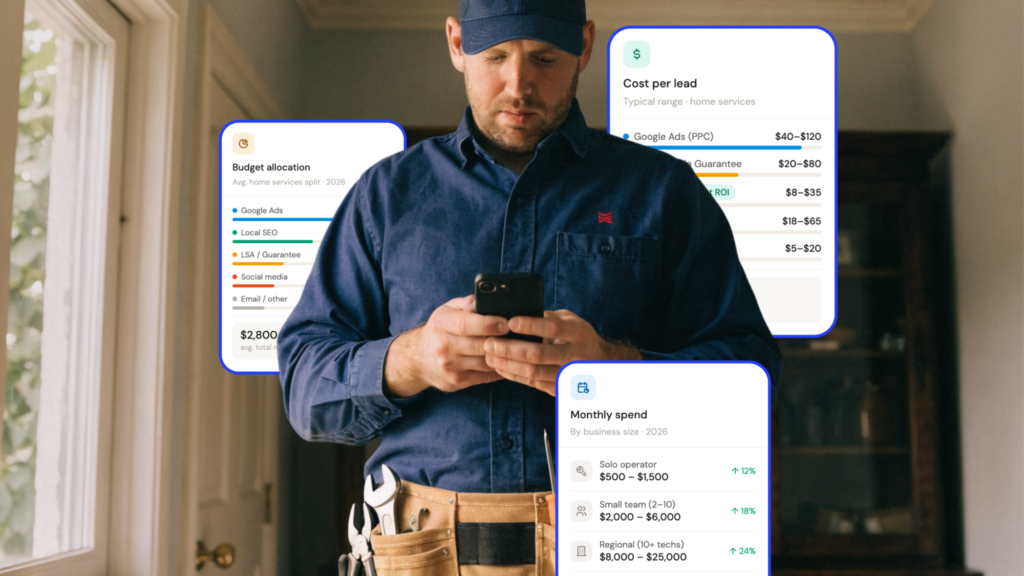
That confusion is not an accident. Most home service businesses pay between $2,500 and $10,000 monthly for a marketing agency retainer in 2026, and that range reflects real differences in scope, market competitiveness, and who’s actually doing the work. A starter marketing budget for a new business sits around $2,500 to $4,000 a month, covering a solid website framework and standard local search ads. A growth budget easily ranges from $8,000 to $15,000 per month when you combine heavy paid ad spend with aggressive organic search strategies.
The problem isn’t the range. The problem is that most proposals don’t explain what’s actually driving the number.
This is our honest breakdown of what digital marketing costs for home service businesses in 2026, based on what we actually price and what we see working for contractors in competitive markets. If you want a real home services marketing strategy behind your budget instead of guesswork, this is where to start.
How Much Does Digital Marketing Cost for Home Service Businesses?
Most home service businesses end up spending somewhere between $2,500 and $10,000 per month once they have a real marketing program running. If you want a number specific to your business size and trade, our marketing budget calculator gives you a starting point based on your revenue and goals.
That range is wide on purpose. It depends on what services you’re running, how competitive your market is, and who you hire. A plumber in a mid-sized Midwest market paying $2,500 a month is not in the same situation as an HVAC company in Phoenix spending $8,000. Both can be completely reasonable. Both can also be completely wrong depending on what’s actually being done with the money.
Home services is one of the most competitive categories in local digital advertising. HVAC, plumbing, and roofing keywords in major markets are expensive because dozens of contractors are bidding for the same customers. That auction pressure pushes costs higher than you’d see in less competitive industries. That’s not something any agency controls. It’s just the market you’re in.
The honest framing: the question isn’t just what does it cost. It’s what should it cost relative to what you get back. We’ll get to that.
Digital Marketing Costs Broken Down by Service
Most home service marketing budgets are a combination of channels. Here’s what each one actually costs and what you’re really buying.
Search Engine Optimization (SEO)
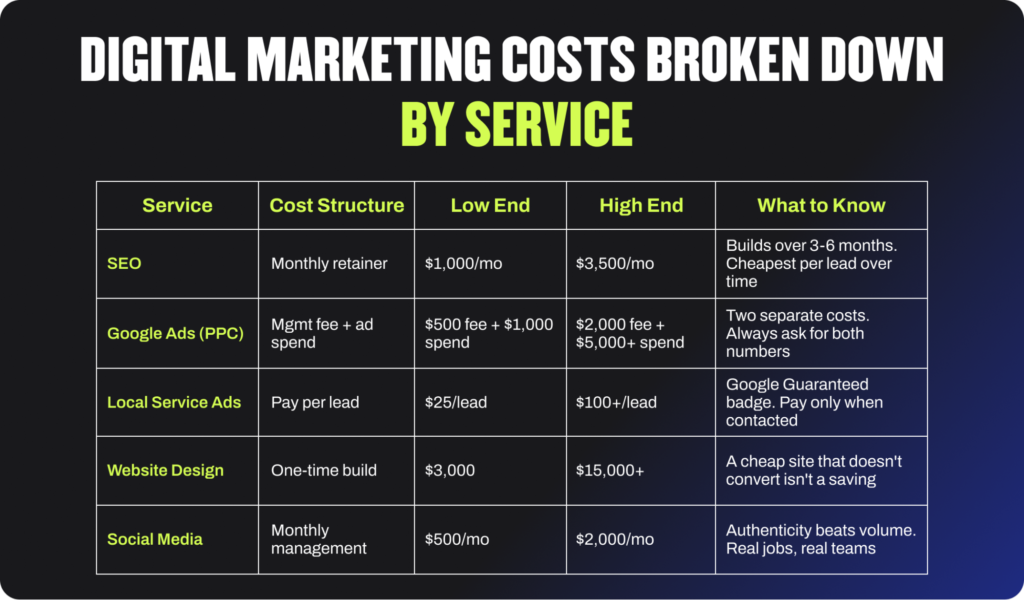
SEO for a home service business typically runs $1,000 to $3,500 per month. Here’s what that should actually include:
- Keyword research built around how local homeowners search, not just generic industry terms
- On-page optimization so your service pages tell Google exactly what you do and where you do it
- Citation building to make sure your name, address, and phone number are consistent everywhere online
- Content that captures local search traffic across your service areas
- A review strategy that actively supports local pack rankings
Local search marketing for contractors is different from general SEO. It’s about being the business that shows up when someone two miles away needs you right now, not just showing up somewhere in the rankings for a generic keyword.
SEO in 2026 also means showing up in AI Overviews and answer engines, not just the blue links. Agencies that understand AEO alongside traditional SEO get your business cited in AI-generated answers, which is a channel that’s growing fast for local searches. If an agency pitches you SEO but can’t explain what they’re doing for your AI visibility, that’s a real gap.
Google Ads (PPC)
This is where the most expensive confusion happens. Google Ads has two separate costs and contractors get burned when agencies don’t explain the difference.
There’s the management fee, which is what you pay the agency to build and run the campaigns. And there’s the ad spend, which is the money that goes directly to Google. Both show up in your bank account. Both need to be in your budget. Some agencies roll them together into one number on a proposal without breaking it out. Always ask.
A reasonable management fee for a home service business runs $500 to $2,500 per month. Ad spend on top of that is typically $1,000 at the low end and $5,000 or more in competitive markets. Here’s what that should include:
- Campaign build and structure across your core services and locations
- Ad copy written for your trade, not generic templates
- Bid management and budget pacing throughout the month
- Conversion tracking tied to actual calls and form fills
- Monthly reporting on leads and cost per lead, not just clicks
Google’s own AI now controls more of the bidding and targeting than it used to. A good agency knows how to use that to your advantage and what guardrails to set. An inexperienced one lets it run loose and burns your budget on the wrong clicks. This is one of those areas where agency experience has a more direct and measurable impact on your return than almost anything else.
Google Local Service Ads (LSAs)
LSAs work differently from everything else on this list. You pay per lead, not per click. Someone contacts you through the ad, you pay. Someone clicks and bounces, you don’t. The Google Guaranteed badge that comes with LSAs adds a layer of credibility that regular search ads don’t. See our comparison of Local Service Ads vs Google Ads for contractors if you’re deciding where to put your first budget. Here’s what a properly managed LSA setup includes:
- Account setup and Google Guaranteed verification
- Budget management and bid adjustments to control cost per lead
- Lead dispute management to credit back unqualified contacts
- Review strategy tied directly to your LSA profile ranking
- Ongoing monitoring as Google expands LSA placement surfaces
AI tools are increasingly surfacing LSA listings in local results beyond the standard search page. The Google Guaranteed badge is showing up in places it didn’t a year ago. If you’re not running LSAs in 2026, there are visible placements you’re simply not in.
Website Design
A contractor website is the single asset that every other marketing dollar eventually sends people to. Basic template builds start around $3,000 to $5,000, but what you get at that price point is a starting point, not a finished marketing tool.
A high-performing contractor website built to rank in local search, convert homeowners who land on it, and actually represent your business in a competitive market is a different product entirely. The price reflects the difference in what it does for your business, not just what it looks like. Here’s what that investment should cover:
- Trade-specific design built around how your customers search and decide
- Dedicated service and location pages for every area you cover
- Mobile-first build with fast load times
- Conversion-focused layout with clear calls to action throughout
- On-page SEO built in from the start, not added later
Social Media Marketing
Social media management runs $500 to $2,000 per month for content, posting, and strategy. That range reflects a real difference in what you’re getting: templated graphics at the low end, original content built around your actual jobs and team at the higher end. Here’s what a real social media management package should include:
- Original content built around your actual jobs and team
- Platform management across the channels your customers use
- Community engagement on comments and messages
- Content calendar planned around your trade’s seasonal patterns
- Performance reporting on reach, engagement, and growth
AI has made it faster and cheaper to produce social posts. Some agencies are using that to produce more volume without producing more value. The home service businesses that actually build audiences on social are the ones leading with real jobs, real team members, and real customer stories. No tool is going to replicate that for you.
What Affects Your Digital Marketing Costs?
The same service can cost very different amounts for two businesses and both quotes can be completely defensible. Here’s what actually drives the number up or down.
Your Trade and Market Competition
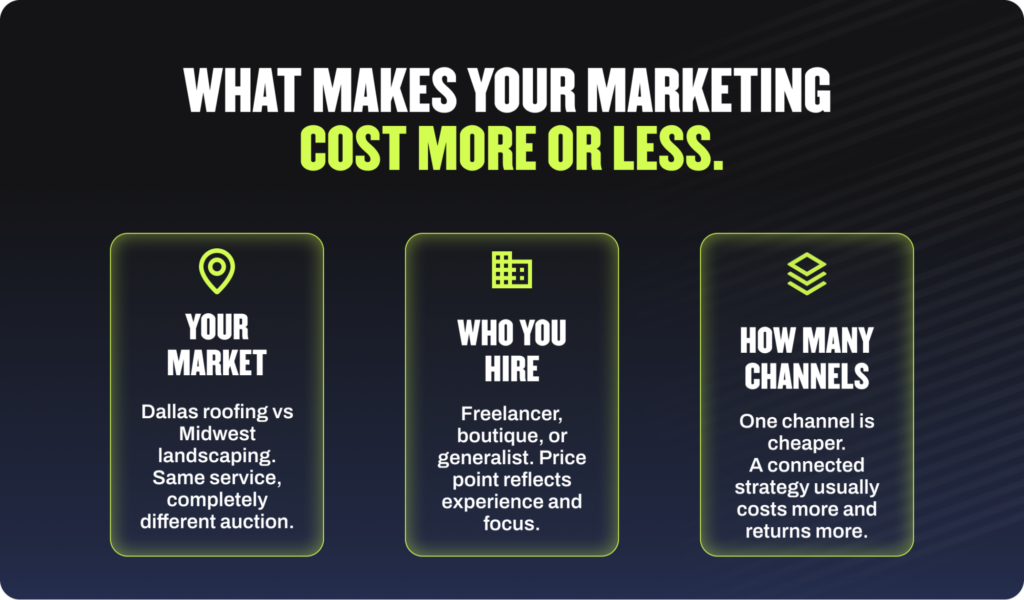
Roofing in Dallas is not the same market as landscaping in a mid-sized Midwest city. Google’s auction-based pricing means the more contractors competing for the same customers in the same area, the more every click costs. That’s not something any agency controls. But it is something a good agency accounts for when setting expectations about what your budget will produce.
Agency Type and Experience
Freelancers, boutique agencies, and large agencies sit at different price points for reasons that actually make sense. Freelancers can be excellent for specific narrow tasks. Boutique agencies that focus on a niche, in our case home service contractors specifically, bring years of relevant experience and the results to back it up. Large generalist agencies often serve your account with junior staff who’ve never worked in your industry.
Very low quotes are a signal. An agency charging $400 a month for SEO is either doing almost nothing or running a model that serves dozens of clients with the same templated work. Neither produces real results for a competitive home service business. I’ve seen contractors waste a year and several thousand dollars finding that out the hard way.
How Many Services You Run at Once
Running SEO, Google Ads, and social together costs more than a single channel but a connected strategy almost always performs better than one channel in isolation. SEO builds long-term visibility. Paid ads fill the schedule while SEO builds. And the online reviews for home service businesses you generate work across all of them simultaneously. When the pieces are connected, the same dollar goes further.
The Hidden Costs Most Contractors Miss
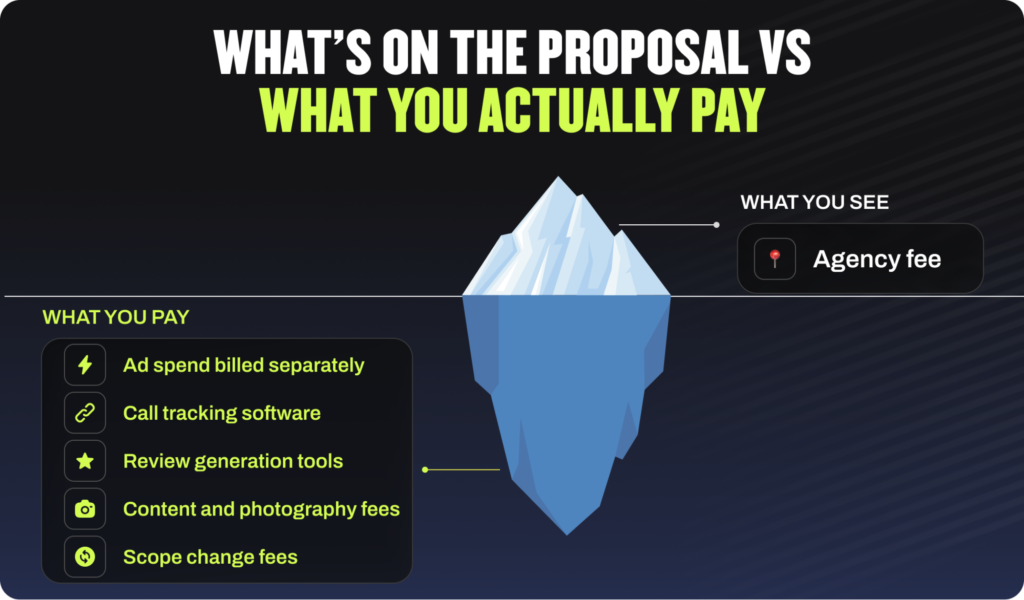
The number on the proposal is almost never the real number. I’ve watched contractors sign a contract, start spending, and end the quarter genuinely confused about where the budget went. Here’s what typically doesn’t make it onto the first proposal.
- Ad spend billed separately. The management fee and the money going to Google are two different line items. Some agencies bill ad spend through your account. Others run it through theirs. Either way, it’s additional money leaving your bank. Always ask for both numbers before you sign.
- Software and tools. Call tracking, rank monitoring, CRM integrations, review generation platforms. These can add $200 to $600 per month in tools that may or may not be included in the agency fee.
- Content and photography. Real job photos, original blog content, video walkthroughs. These either cost extra or they don’t get produced. And when they don’t get produced, results suffer. Find out what content is included and what gets billed additionally before you’re six months in wondering why the work looks generic.
- Revision fees and scope changes. Every agency handles this differently. Some have flexible scopes. Others charge for anything outside the original agreement. Know the terms before you need something changed.
How AI Is Changing What You Pay for Marketing
AI has made some parts of marketing faster and cheaper. Content drafts, ad copy variations, keyword research, basic reporting. Some agencies are passing those savings on to clients. Others are charging the same rates for work that now takes half the time. And some are using AI to produce volume without strategy, which is the version that should concern you.
The data on this is worth knowing. McKinsey’s 2025 State of AI report found that marketing and sales see some of the strongest revenue uplifts from AI adoption, with functions reporting more than 10% revenue increases. The catch McKinsey found is the same one we see with agencies: only about 5.5% of organizations actually capture meaningful ROI from AI. The rest are using it without the strategy to make it work.
A hundred AI-generated blog posts with no local relevance won’t rank for a plumber in Minneapolis. An AI-written Google Ad with no understanding of what makes a homeowner in your market call won’t convert. The cheapest option in 2026 is often the most expensive mistake.

What Does a Lead Actually Cost in 2026?
Cost per lead is one of the most important numbers in your marketing budget, and also one of the most misused. I’ve watched contractors choose agencies based on promised cost per lead numbers that had no grounding in their actual trade, market, or campaign type.
Here’s what the data actually shows in 2026. Branded search leads, meaning someone searched your company name specifically, run around $50 to $100. Non-branded Google Ads leads cost significantly more:
- HVAC: $149 to $200 per lead
- Plumbing: $167 to $250 per lead
- Electrical: $163 to $220 per lead
- Roofing: $124 to $300 per lead
LSAs run cheaper since you pay per lead rather than per click:
- HVAC: $60 to $120 per lead
- Plumbing: $70 to $130 per lead
- Electrical: $50 to $100 per lead
- Roofing: $80 to $160 per lead
In major metros like New York, Dallas, or Phoenix, expect to be at the higher end of every one of those ranges.
We’ve broken down how much roofing leads actually cost in more depth if that’s your trade. The number varies enough by market and campaign type that a blended average can be genuinely misleading.
But here’s the thing: cost per lead is not the number that actually matters. Cost per booked job is. A $40 lead that converts to a $3,000 job is a better outcome than a $15 lead that goes nowhere. Track the whole funnel, not just the top of it.
How Much Should a Home Service Business Budget for Marketing?
There’s no single right number. But there are two frameworks, one that sounds reasonable and usually leads to underinvestment, and one that actually connects spending to outcomes.

Marketing Budget as a Percentage of Revenue
The most common starting point is a percentage of revenue. Gartner’s 2025 CMO Spend Survey found that marketing budgets across industries averaged 7.7% of company revenue in 2025. For home service businesses trying to grow, we typically see the range land between 5% and 15% of revenue, with the lower end for established businesses with strong referral volume and the higher end for businesses actively trying to gain market share.
The problem with a flat percentage approach is that it punishes businesses that most need to invest in growth. A contractor doing $800K who wants to get to $2M needs to spend differently than one trying to protect existing market share at $3M. A low percentage of a small number is still a small number, and a small number spread across marketing channels doesn’t move any of them.
Budgeting Around Cost Per Booked Job
The smarter anchor is working backward from your business goal. If you want 20 additional booked jobs per month and your close rate on leads is 40%, you need 50 leads. If your average cost per lead in your market is $80, that’s $4,000 in spend to generate those leads. Add the agency management fee and you have a real budget tied to a real outcome, not an arbitrary percentage of last year’s revenue.
This is the conversation I try to have with every contractor before we talk about any specific channel. What does a booked job need to cost for the marketing to make sense? Build the budget from that math. Not the other way around.
How to Get the Most From Your Marketing Budget
Spending more doesn’t fix a broken strategy. But spending smart on a working one compounds every month. Here’s what actually makes the difference.
Track cost per lead and cost per booked job. Not impressions. Not clicks. Those tell you the marketing is running. The conversion numbers tell you if it’s working.
Don’t spread a small budget thin. A $2,000 monthly budget split between SEO, Google Ads, and social is not enough for any one of them to perform. Pick the channel that matches your most urgent goal. LSAs or paid ads when you need leads fast. SEO for the long game once cash flow supports it.
Respond to leads fast. This is the most common place I see marketing budgets go to waste. A $100 lead that goes unanswered for four hours in home services is frequently a lost job. The right CRM for home service companies is the one that makes your team respond faster and follow up automatically. If you’re spending on marketing but losing leads after they come in, you’re paying to fill a bucket with a hole in it.
And build your reviews consistently. This is the highest-leverage free activity in local marketing. Fresh, specific reviews lower your cost per lead over time, improve your local pack ranking, and do trust-building that no ad can replicate.

What Happens When Marketing Actually Works
Good marketing doesn’t just fill your calendar. It creates pressure on everything else in your business. We learned this firsthand at Owl Roofing, our own Minneapolis roofing company. In the first real month we hit close to $487K in sold revenue and were generating 25 leads a week from marketing alone.
That volume immediately strained production, the sales-to-job handoff, and the team’s ability to fulfill what marketing was promising. HBR described this dynamic well in early 2026: marketing that actually works creates pressure on the rest of the business. The answer isn’t to spend less on marketing. It’s to build the systems around it fast enough to handle what it generates.
Frequently Asked Questions
How much does digital marketing cost for a home service business in 2026?
Most home service businesses spend between $2,000 and $10,000 per month depending on which services they run, how competitive their market is, and whether they hire a freelancer, a boutique agency, or a larger operation. That range reflects real differences in scope and market, not just agency pricing style.
Is the Google Ads management fee the same as the ad budget?
No. The management fee is what you pay the agency to run the campaigns. The ad spend is the separate money that goes to Google. Both need to be in your budget. The management fee does not include ad costs. Always ask for both numbers before you sign a proposal.
What is a typical cost per lead for HVAC or plumbing in 2026?
It varies by channel and market. Branded search leads run $10 to $30. Non-branded search leads run $80 to $200 in competitive markets. LSA leads for HVAC and plumbing typically fall between $25 and $80. The cost only matters relative to how many of those leads turn into booked jobs at a margin that makes sense for your business.
Why do home service businesses pay more than other industries?
Home services is a competitive category and ad platforms use auction-based bidding. When many contractors target the same keywords and customers in the same area, bids rise. That’s not a marketing problem. That’s the market. A good agency makes sure you’re capturing value from your position in that market rather than just paying what it costs to show up.
Should I budget marketing as a percentage of revenue?
It’s a reasonable starting point but not the full answer. Smaller businesses trying to grow often need to invest more aggressively than a flat low percentage allows. The smarter anchor is budgeting around cost per booked job: how many jobs do you want, what’s your close rate on leads, what should each lead cost given your margin? Build from that math.
Is SEO or paid advertising cheaper for home services?
Paid advertising delivers leads faster but the cost per lead stays steady as long as you keep paying. SEO takes a few months to build but over time usually becomes the lowest cost per lead channel because the traffic compounds without increasing spend. Most contractors running a serious program use both at the same time for different reasons.
Can a home service business do digital marketing on a small budget?
Yes, but a small budget should not be spread across many channels at once. Focusing on one or two high-impact channels, LSAs if you need leads fast, a strong Google Business Profile if you’re starting from scratch, usually produces better results than thin spending spread everywhere.
Marketing Cost Is Really About Return
The sticker price on a proposal doesn’t tell you what you’ll get back. In a market where AI makes it easy to look productive without producing results, the right budget is the one backed by a real strategy built around your trade, your market, and your actual cost per booked job.
At Hook Agency we work exclusively with home service contractors. We’ve built marketing programs for plumbers, roofers, HVAC companies, and electricians for over a decade. We know what digital marketing costs for home service businesses because we price it, run it, and see what it produces every month.
If you want a straight answer on what your marketing should cost and what it should produce, schedule a call with our team. No generic proposals. Just an honest conversation about your specific business.