
Every first call we take with a home service business owner covers the same ground. Leads are inconsistent. The team is stretched. Margins are tighter than they should be. And there is a nagging feeling that competitors are figuring something out that they are not.
These are not one-business problems. The most common ones in 2026:
- Slow lead response losing jobs to whoever answers first
- A labor shortage that has been years in the making and is not improving
- Seasonality that turns a good busy season into a cash flow problem three months later
- Margins that stay thin regardless of how much revenue grows
This FAQ answers those questions directly, grounded in real 2026 industry data. Jump to whatever section matches where you are stuck.
Finding and Keeping Customers
What are the biggest marketing challenges home service companies face?
Inconsistent lead flow, rising ad costs, and not knowing which channel is actually producing booked jobs rank among the most common.
The businesses that struggle most are usually the ones treating marketing as an occasional activity instead of a connected system. They run ads when things are slow, stop when things get busy, and have no idea what the actual cost per booked job is across their different channels.
The digital marketing costs for home service businesses breakdown shows what different channels actually cost in real campaigns, which gives owners a clearer starting point for what to budget and where to start. And for anyone unsure which channel to prioritize first, the how to prioritize LSA, PPC, Maps, and SEO guide works through the sequencing question directly.
Why is speed to lead such a common problem?
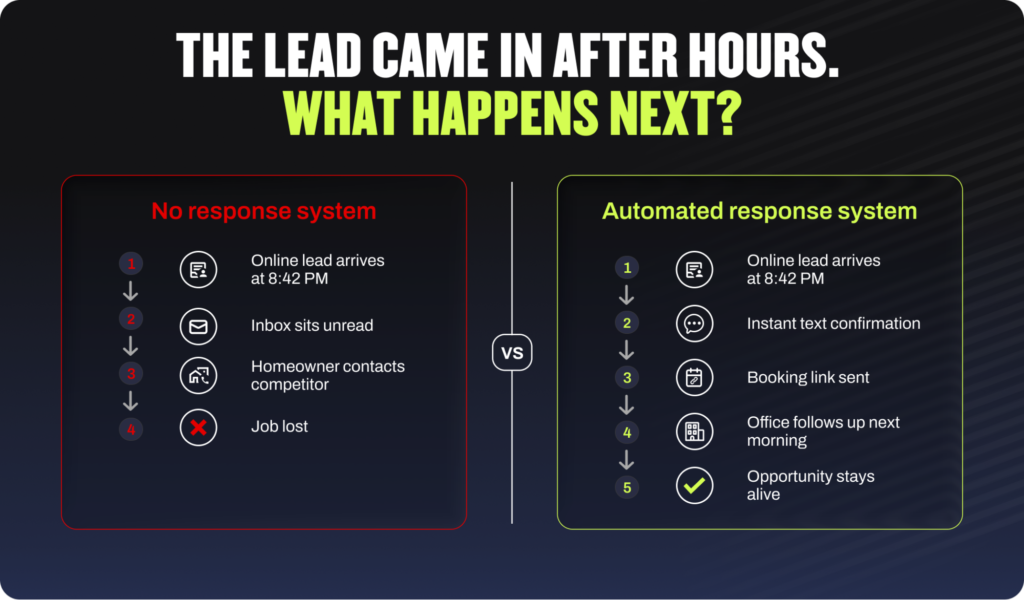
According to Housecall Pro’s 2026 field service trends research, 41% of jobs booked online come in after hours, when most businesses are not actively responding. Even in high-earning trades like HVAC, the response window is narrow: homeowners choose whoever picks up or responds first, and the gap between first and second contact can be minutes, not hours.
Slow response is often a bigger revenue leak than lead volume itself. A business spending $150 per lead that fails to respond within an hour is throwing that money away, not the marketing.
The actual cost of a missed call, in real dollar terms, is something most owners have never sat down and calculated. The guide on what a missed call is worth makes that math concrete.
How does seasonality affect home service marketing?
Jobber’s 2026 research found that 34% of service pros cite weather and seasonality as a top challenge limiting growth, the highest-cited factor in their survey. Businesses that build seasonal campaigns and off-season retention into their marketing plan, rather than reacting month to month, weather these swings better.
Noah Bergland runs Bison Builders in Minnesota, and roofing in that market means living with storm droughts that can last years. He talked about this on our podcast and described watching competitors fold because their overhead was built for a storm market that stopped showing up.
His take on who survives: “I see a lot of people winning that just know how to go smaller when it’s time and then go up when it’s time. The lack of storms really separates the men from the boys.” He described it as contracting down, not panicking, and being ready to move fast when the market comes back.
The principle holds for any seasonal trade. A two-gear model: a growth posture when demand is high, and a lean retention posture in the off-season that keeps the customer base warm without burning cash.

The seasonal marketing for contractors guide covers the specific campaigns and timing that work for different trades during slow periods.
Why is competition increasing for home service companies?
Jobber’s 2026 research found 28% of service pros point to rising competition as a top growth barrier. Part of this is private equity consolidation, which has brought capital, operational sophistication, and aggressive marketing budgets into local markets that used to be dominated by independent operators.
Standing out increasingly comes down to trust signals rather than price: more specific reviews, real photos of real work, fast response, and a local brand presence that feels genuine rather than corporate. The businesses that can hold ground on trust while larger operators compete on reach tend to retain customers at higher rates.
Staffing and Operations
Why is the labor shortage such a persistent challenge in home services?
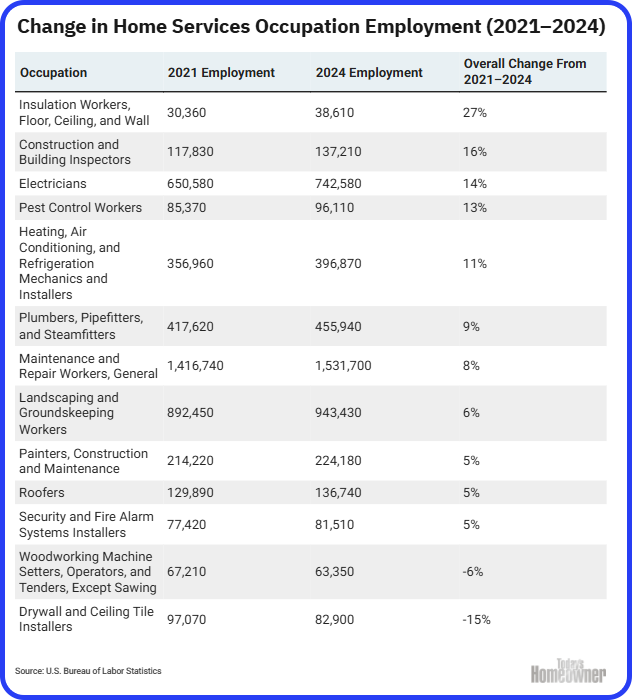
According to Today’s Homeowner’s home service labor shortage analysis, there were more than 456,000 unfilled construction and trades jobs as of early 2024, and the Bureau of Labor Statistics projects over 157,000 annual openings for maintenance and repair workers alone through 2033. Only 37% of US metro areas have above-average labor availability. In most markets, the competition for skilled technicians is as real as the competition for customers.
The structural reason this doesn’t improve quickly:
- For every five tradespeople retiring, roughly two are entering the field
- That gap widens every year as the existing workforce ages out
- Decades of cultural messaging toward college compressed the pipeline of new entrants
Owners who navigate this best treat hiring like a marketing function. Competitive pay that reflects actual market rates, defined career paths, and a culture that a tech would genuinely recommend to a friend. The businesses struggling most are the ones still posting the same job listing they wrote three years ago and wondering why nobody quality is applying.
How does scheduling and crew coordination become a challenge as a business grows?
Jobber’s research found that higher-revenue businesses cite scheduling and coordination as their top operational challenge, particularly general contractors and roofers managing multiple crews and jobsites at once. What works for a solo operator, a notebook and a phone, breaks down fast once a business is running several trucks a day.
The real issue is not that scheduling is hard. It is that the systems most businesses start with were never designed to scale.
- A whiteboard or group text works fine for three jobs
- It becomes chaos for ten
- Adding another truck stops increasing revenue proportionally once coordination overhead starts eating the margin
Gary Singleton scaled and sold two companies, including an eight-figure exit to private equity, and he put it plainly when we talked about building high-performing teams. His whole model was built around putting the right technician on the right type of call, separating maintenance techs from service techs with a clear hierarchy, so coordination was baked into the structure rather than managed on the fly every morning.
His framing on how he learned this: he got Max Air to four million dollars working 14 to 16 hours a day before realizing the structure was wrong. Fired the whole team, went back to just himself, hired one guy on personality, and built the hierarchy correctly from there. The rebuild worked because the structure came before the headcount, not after.

What operational challenges come with adopting new technology like AI?
Housecall Pro’s 2026 field trends research found that over 70% of service pros report using AI tools, with nearly 40% actively using AI in their daily business. The gap is between businesses using AI with a clear plan and those just experimenting without integration into their actual workflows.
The real risk isn’t AI itself. It’s what Housecall Pro calls shadow AI: individual employees using personal AI tools in ways that touch customer data or pricing decisions without any oversight. Three problems this creates:
- Legal exposure if customer data goes through an unapproved tool
- Pricing inconsistency when different techs are using different AI-generated estimates
- No institutional knowledge if the outputs aren’t captured anywhere
The AI tools for home service marketing guide covers the tools that actually add value in a home service operation versus the ones that create more problems than they solve.
Pricing, Margins, and Cash Flow
Why do so many home service businesses struggle with pricing?
Jobber’s 2026 research found 20% of service pros cite margin pressure as a top growth barrier. Underpricing is often less about the market and more about not having a system to track true job cost, including labor burden, overhead allocation, and the real cost of the trucks and tools required to do the work.
John Conway spent six years at NextStar as a business coach and then scaled and sold his own operation at Redwood Services. He has coached hundreds of HVAC and plumbing businesses through pricing conversations and the same objection comes up every time.
His read on why owners underprice: “We have associated the amount we charge with whether a customer says yes or no. And it’s just simply not true. The customer says yes or no based on the value and the experience that you deliver to them during their service experience, not how much you charge.”
On what actually happens when contractors raise prices: “Never ever ever ever ever have I had somebody call me and say I lost my customers because I raised my price.” He ran a plumbing operation in Memphis at $485 an hour flat rate fifteen years ago. His point: if it worked there, it will work in your market.

Knowing what to spend to generate a customer is the other side of this equation. The how much should you spend on marketing guide connects marketing budget discipline to margin management directly.
How does rising material and labor cost affect profitability?
Unpredictable material pricing squeezes margins fastest on lower-ticket work where there’s little room to absorb cost increases without adjusting pricing or vendor relationships. A job that penciled out at 40% gross margin six months ago might be running at 28% now if material costs shifted and the price book didn’t keep up.
The businesses managing this best are the ones that review their price book against actual job costs at least quarterly, not annually. A pricing model built on cost data from two years ago is a liability in a cost environment that’s been moving as fast as this one.
Reputation and Trust
Why do online reviews matter so much for home service companies?
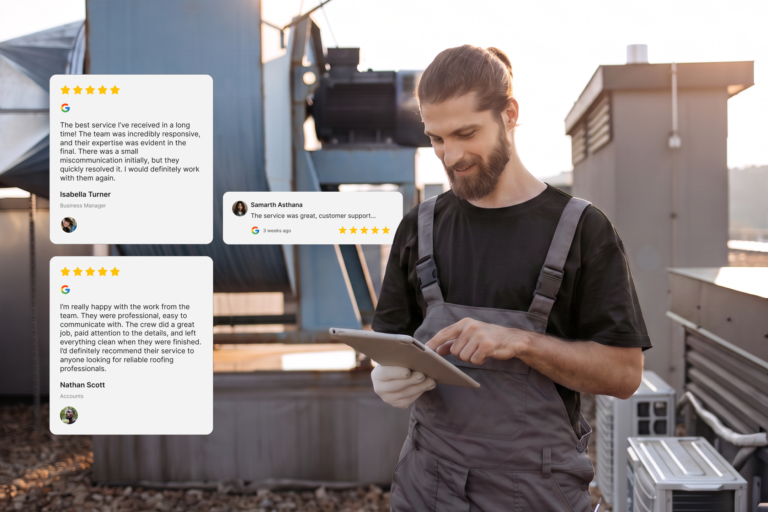
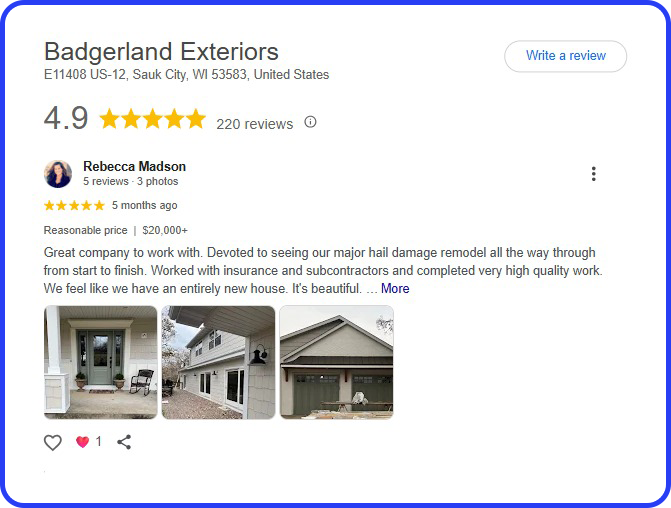
Reviews are one of the fastest ways homeowners judge whether a business is trustworthy before picking up the phone. Inviting a stranger into your home is a different trust calculation than ordering something online.
Two reasons they matter more than ever in 2026:
- Google reviews and local SEO are directly connected. Review volume, recency, and the specific language in reviews all affect local pack ranking.
- Since Google launched Ask Maps in March 2026, review content is what AI reads when matching a conversational query like which plumber near me has good reviews for emergency service. Old or generic reviews risk making a business invisible in those AI answers entirely.’
What happens when a home service company doesn’t respond to leads fast enough?
A slow callback effectively means paying for the same lead twice. Once through the ad or listing that generated the inquiry, and again when the same homeowner calls back after hiring a competitor and the business has to spend to reach them again.
This is one of the most fixable challenges on this list because it’s a process problem, not a demand problem. A contractor follow-up system that routes missed calls into an automatic text response within minutes can capture a significant percentage of leads that would otherwise be lost to whoever answered first.
Is it normal for a home service business to feel behind on marketing and technology?
Yes. Across every trade covered in 2026 industry research, most businesses report feeling behind in at least one area, whether that’s AI adoption, review management, or lead response speed.
The businesses pulling ahead aren’t the ones with zero gaps. They’re the ones addressing gaps one system at a time instead of trying to solve everything at once. Picking the highest-cost gap and fixing that first, whether it’s response time, pricing, or reviews, and then moving to the next one is how most well-run home service businesses actually get ahead.
Most of These Challenges Are Solvable. Some Aren’t. Know the Difference.
Every challenge on this list is well-documented across the industry in 2026, which means none of them are unique to one business.
Some, like the labor shortage and unpredictable material costs, are largely structural forces outside any single owner’s control. Managing around them is the goal, not solving them.
Others, like slow lead response, inconsistent marketing, and underpricing, are fully fixable with the right systems. These are the ones worth focusing energy on because closing those gaps has a direct and measurable impact on revenue.
If you want a clearer picture of what those gaps are costing your business specifically, and what to address first, that’s the kind of work Hook Agency does regularly with home service companies. If you want help figuring out which of these are costing your business the most, schedule a call with our team and we’ll walk through it with you.