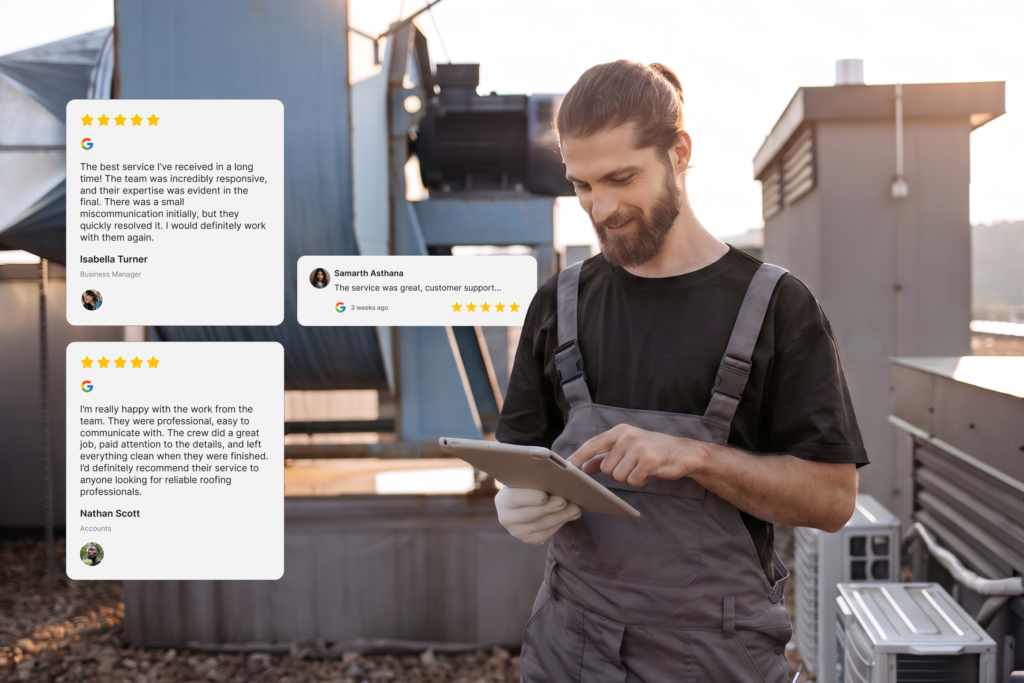

One of the things I notice immediately when we start working with a new client is the review profile. How many, how recent, what rating.
Then I scroll down and look at the responses. And almost every time, there are almost none.
The five-star review from a homeowner who clearly took five minutes to write something thoughtful. Nothing. The two-star review sitting right there at the top of the profile being read by every future customer. Also nothing.
That silence is not neutral. It is read as a signal by everyone who sees it.
Home service companies should respond to every review, positive and negative, because it is a visible trust signal to future customers, a confirmed ranking factor for local search, and one of the few remaining ways to publicly recover from a bad job.
What this piece covers:
- The data on what homeowners actually expect when they leave a review, and how far most businesses fall short
- A simple, repeatable framework for responding to negative reviews without making things worse
- How to build a system so this happens consistently, not just when someone remembers
The Response Gap: What Homeowners Expect vs. What Contractors Actually Do
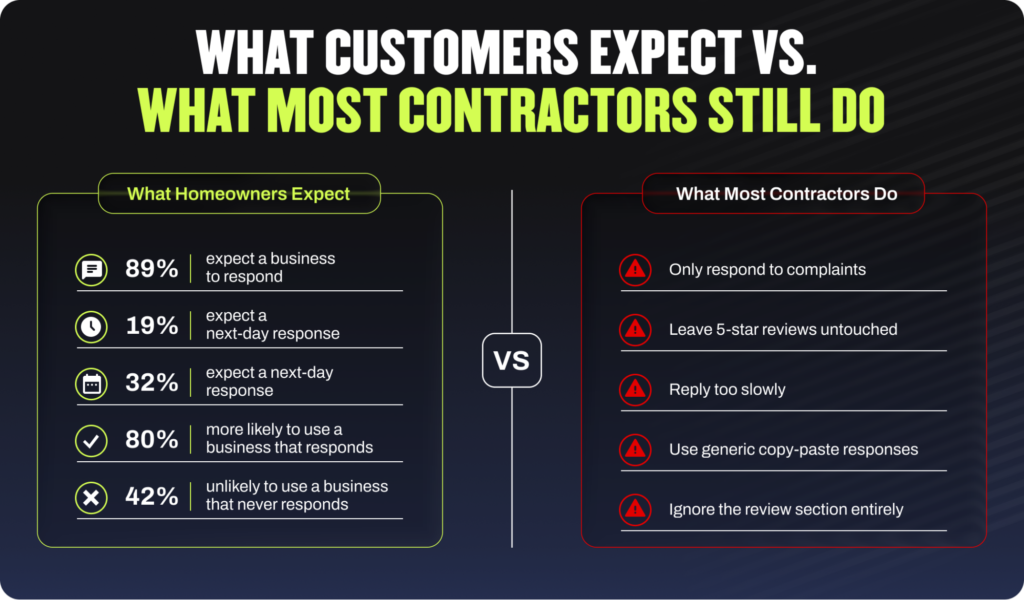
Homeowners increasingly expect a response to their review. Most businesses still don’t give one.
According to BrightLocal’s Local Consumer Review Survey 2026, published February 11, 2026 and based on a survey of 1,002 US consumers:
- 89% of consumers expect a business to respond to their reviews
- 19% now expect a same-day response, up from just 6% the year before
- 32% want a reply by the following day, up from 18% in 2025
- 80% say they are more likely to use a business that responds to all of its reviews
- 42% say they are unlikely to use a business that never responds
The gap between what is expected and what actually happens is wide. The businesses that close it stand out almost by default, because so few competitors bother.
The stakes are rising faster than most owners realize. For more context on what the full review landscape looks like right now, the full breakdown of online review statistics covers the broader picture.
Why Responding Matters Beyond the Review Itself
Responding to a review does three distinct jobs at once, not just one.
It Is a Visible Trust Signal
The same BrightLocal research found that 80% of consumers are more likely to use a business that responds to all of its reviews. Responding to every review, not just the complaints, is what signals active, ongoing engagement.
The flip side is worth noting too: 50% of consumers are put off by generic or templated responses. A copy-pasted “thanks for the five stars!” does not count as engaging. It actually signals the opposite.
Texas runs Medley, an HVAC company with well over a thousand Google reviews. He personally responds to all of them, good and bad, and described the reasoning to Tim on our podcast this way: “If I’m going to sit here and take all the praise for the good, I’ve got to be willing to accept the negative consequences that come along with it as well. It’s our reputation and the buck stops with me.”
He also made a point that most contractors miss: “You’ll see that a lot of competitors have 800 or 900 reviews and maybe 10 negative ones and those are the only ones that are responded to. What about all the people that were kind to you?”

It Is a Confirmed, If Modest, Ranking Signal
Google has confirmed that responding to reviews is a positive signal for local ranking. How Google reviews affect local SEO rankings covers this in detail. The improvement from response behavior alone is incremental and compounding rather than dramatic. It works alongside review volume and recency, not instead of them. Do not chase responses as the primary ranking lever. Do them because they are the right move for every other reason, and the ranking benefit follows.
It Is Free, Public Customer Service Recovery
A single bad job does not have to become permanently damaging. A calm, specific, professional response to a critical review is often read by far more people than the original complaint, and it is frequently more persuasive to a future customer than the review itself.
Future homeowners are not reading a negative review to confirm the business is terrible. They are reading it to see how the business handles things when they go wrong. A thoughtful response shows a business that takes responsibility. No response shows a business that doesn’t.
How to Respond to a Positive Review
Most contractors who do respond to reviews only respond to the bad ones. That is a mistake for two reasons.
First, it signals to future customers that the business only shows up when it is in damage-control mode. Second, it misses the opportunity to reinforce a positive customer relationship at the moment when a homeowner is most engaged.
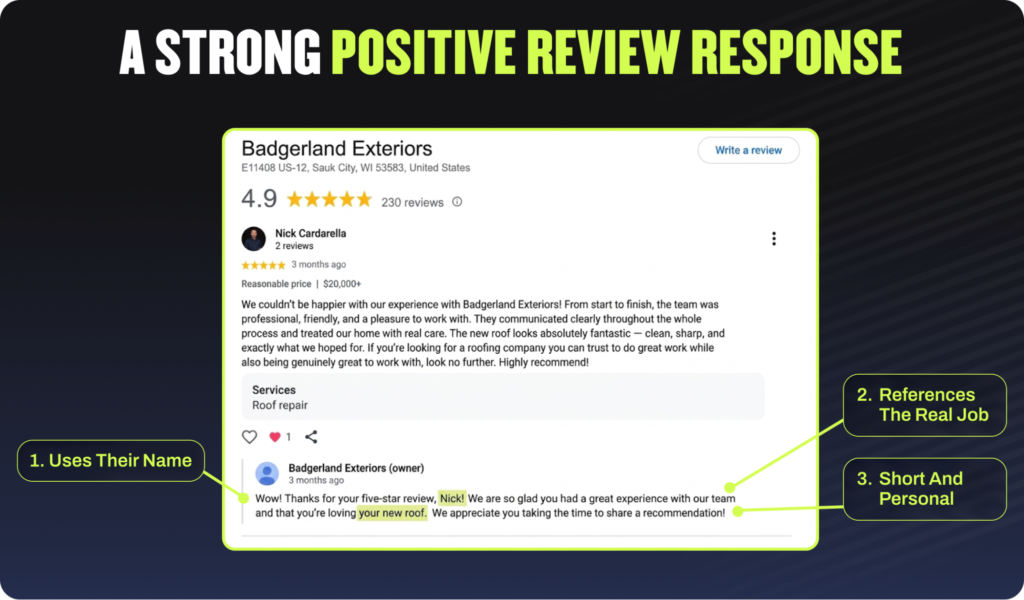
A good response to a positive review:
- Thanks the reviewer by name where visible
- References something specific from their review, not a generic acknowledgment
- Keeps it short, two or three sentences is enough
The biggest mistake: copy-pasting the same response to every five-star review. The BrightLocal data is clear that templated responses actively put customers off. If every response says “We’re so glad you loved working with us!” it reads as automated, which undercuts the authenticity the review itself provided.
Example: Thank you, Sarah. Glad we could get the furnace sorted out before the weekend, and really appreciate you mentioning Jake by name. He’ll be glad to hear it. Thanks for the chance to help.
For roofing-specific context on building review volume that makes these responses worth sending, getting more Google reviews as a roofing contractor covers the ask system in detail.
Dominick Fraser of Fraser Roofing, who has built over 3,000 five-star Google reviews, described why this compounds over time on our podcast: “Customer after customer comes to us and they go, the reason we chose you is your reviews. Reviews are the home field advantage. We have six different territories and if you go to any one of those territories and say roofer near me, Fraser Roofing is going to be top five.”

The volume of reviews that makes responding this meaningful takes a system to build. Getting more reviews consistently covers the ask process and tools that make that happen.
How to Respond to a Negative Review: A Simple Framework
This is the section that matters most and the one most contractors avoid or get wrong. The instinct when a bad review lands is to defend, dispute, or ignore. None of those produce good outcomes.
Here is a repeatable framework that works:
Step 1: Respond Within 24 to 48 Hours
A negative review sitting unanswered for several days is often the first thing a new visitor sees on a profile. Speed itself signals professionalism. The BrightLocal data shows expectations are moving fast, with nearly 1 in 5 reviewers now expecting a same-day response.
Step 2: Open by Acknowledging, Not Defending
A single sentence before anything else. Something like “Thank you for sharing this feedback” or “We appreciate you taking the time to let us know.” This disarms the instinct to argue and signals the response was written by a person, not a policy document.
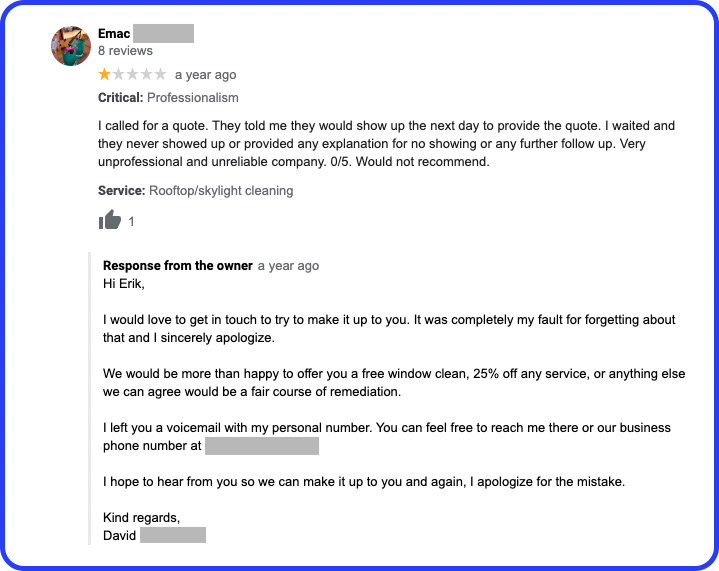
Step 3: Name the Specific Issue
A generic “we’re sorry you feel that way” reads as dismissive and often makes things worse. Naming what actually happened, or what specifically seems to have gone wrong, shows the response was not copy-pasted and that someone actually read the review.
Step 4: Apologize Once, Sincerely, Without Necessarily Admitting Everything
Acknowledging how a customer felt is different from conceding every claim in the review. Both are possible in the same response. “We understand this wasn’t the experience you expected, and we’re sorry for the frustration” is genuine without being a blanket admission of fault.
Step 5: Move the Resolution Offline
Invite a phone call or direct message to sort out the details. The public response does not need to relitigate the whole situation. “Please reach out to us directly at [phone number] and we will make this right” closes the loop without turning the comment section into a dispute thread.
What Never to Do
- Argue publicly with a reviewer
- Share private customer or job details in the response
- Offer a discount or incentive in exchange for changing or removing the review. This violates Google’s policies and the FTC’s rules on reviews, and is worth understanding before anyone on the team responds to a negative review
Training the CSR team on phone communication is worth pairing with this framework, since whoever answers the phone when a homeowner calls after seeing the response needs to be ready for that conversation.
A Full Example Response
Scenario: A homeowner left a three-star review saying the technician arrived outside the promised window and the price came in higher than the estimate.
Response: Thank you for sharing this, and we’re sorry for the appointment window issue and the surprise on the final price. Neither of those should have happened without better communication from us. We’d like to understand what went wrong and make it right. Please give us a call at [phone number] and ask for [manager name] directly.
This response acknowledges both issues without arguing either point, apologizes once, and moves the conversation offline. It takes under a minute to write and is read by every future customer who sees that review.
What About Fake or Unfair Reviews?
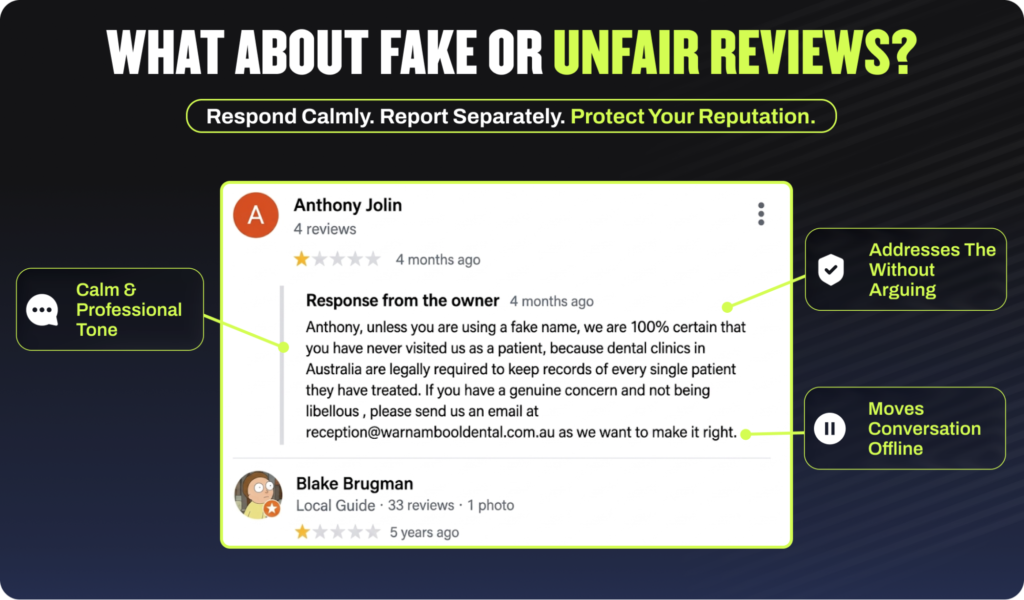
Not every negative review is legitimate. A competitor leaving a review. Someone who was never actually a customer. A review that references a job the business has no record of.
The instinct is to fight it publicly. This is almost always the wrong move.
Future readers are judging the response, not settling the dispute. A calm, professional reply that acknowledges the concern and invites the person to call demonstrates character to every homeowner who reads it afterward. An angry or defensive response demonstrates the opposite, regardless of who is technically right.
The right approach:
- Respond calmly in public using the same framework as any other negative review
- Separately, use Google’s official flagging process to report the review if it clearly violates policy, such as reviews from someone who was never a customer, reviews containing threats, or reviews with content unrelated to the business
- Do not count on removal as the primary strategy. It is not guaranteed and is often slow
How to handle a Google review that shouldn’t be there covers the reporting process in detail. The calm response is the more reliable move either way.
Turning Responses Into a System, Not a One-Off Task
The businesses with strong response records are not the ones where a motivated owner is responding personally every day. They are the ones where responding is a defined part of someone’s job, with a clear schedule and a framework to follow.
What a basic review response system looks like:
- Assign ownership. One person or role is responsible for checking and responding to reviews. If it belongs to everyone, it belongs to no one
- Set an internal target. 24 to 48 hours is a realistic, effective standard. Post it somewhere visible for whoever is responsible
- Train the framework. The person handling responses should understand the negative-review steps above so the response does not depend on one person’s mood or judgment that day
- Use AI for drafts if volume is high. AI-assisted draft responses, edited by a real person before posting, can significantly cut the time this takes without losing the business’s voice. Useful for businesses managing dozens of reviews a month. Less necessary for a handful
Texas described his own version of this system: his techs ask at the door before the job concludes. “If you’re not delivering a five-star service experience, please let them know while they’re in the house so they can course correct.” Getting ahead of dissatisfaction before a review is written is the best version of the system. But the response habit is what handles everything that still comes through.
AI tools in home service marketing covers the broader case for AI-assisted drafting in a home service context.
Frequently Asked Questions
Does responding to Google reviews actually help SEO?
Yes, modestly. Google has confirmed review responses as a positive local ranking signal, though the effect is incremental rather than dramatic. It compounds with review volume and recency rather than moving rankings on its own.
How quickly should a business respond to a review?
Within 24 to 48 hours is a realistic and effective standard. Response expectations are rising fast: 19% of reviewers now expect a same-day response, up from 6% in 2024, per BrightLocal’s 2026 data.
Should you respond to positive reviews, or only negative ones?
Both. Many businesses only reply to criticism and ignore praise, but that signals the business only shows up when it needs to. Responding to every review, including the positive ones, is what signals genuine engagement to both Google and future customers.
Is it okay to offer a discount to get a bad review removed?
No. Offering compensation in exchange for changing or removing a review violates Google’s policies and the FTC’s rules on reviews, regardless of whether the review is fair. The calm public response plus the official flagging process is the right approach.
What if a negative review is fake or from someone who was never a customer?
Respond calmly in public regardless, since future readers are judging the response more than settling the dispute. Separately, report it through Google’s official flagging process. Managing reviews on Angi covers the parallel process for businesses also dealing with reviews on other platforms.
A Response Takes Two Minutes. An Unanswered Review Lasts Forever.
The homeowner who leaves a five-star review and hears nothing back probably will not write the next one.
The homeowner who leaves a three-star review and sees a calm, professional, specific response will often update it or, at minimum, remove some of the negative mental weight it carries for everyone who reads it afterward.
Neither of those outcomes requires a big marketing budget or a complicated platform. They require a clear owner, a consistent schedule, and a framework that takes the anxiety out of responding to criticism.
If you want to build a full reputation management system around this, broader online reputation management for home service businesses is the natural next step.
And if you want help building the complete marketing program that keeps the pipeline full alongside it, schedule a call with our team and we will walk through what we would build for your trade and market.