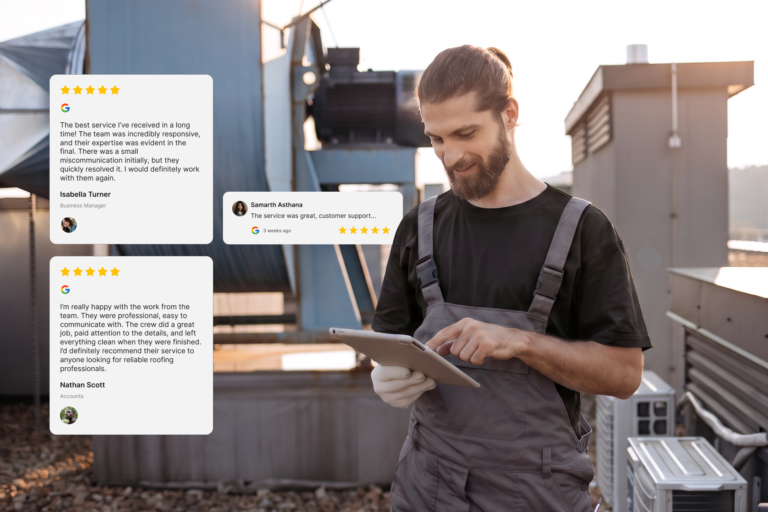

I have spent years watching sharp contractors make expensive marketing decisions based on a partial understanding of what they were buying. Not because they were not smart. Because nobody ever explained what the terms meant in plain English.
This glossary fixes that. Twenty terms, four categories, written for the person running the business. If a word shows up in a proposal or a monthly report and you want to actually know what it means, this is the page.
The four categories covered:
- Search and visibility: GBP, local pack, NAP, citations, AI Overviews, zero-click, AEO, entity signals
- Paid advertising: CPL, cost per booked job, LSA, CPC, retargeting
- Conversion and leads: conversion rate, speed to lead, lead velocity, review velocity
- Content and authority: service area pages, E-E-A-T, content gap
Search and Visibility Terms
These terms describe how homeowners find you before they ever land on your website. How homeowners research contractors has shifted significantly in the last two years. These eight terms are the vocabulary behind that shift.
1. Google Business Profile (GBP)
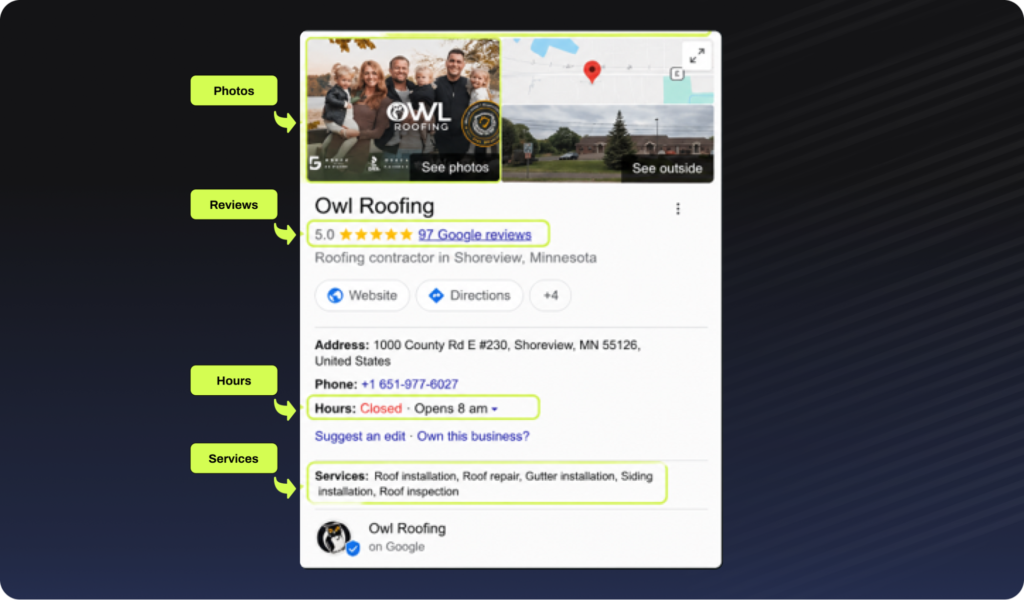
Your Google Business Profile is the listing that surfaces when someone searches your business name or a local service you offer. Name, address, phone number, photos, reviews, hours, a link to your site. For most contractors, a homeowner sees this before they ever visit your website.
A GBP with recent photos, a complete service list, and steady reviews ranks higher in local map results and converts more browsers into callers. A neglected profile with stale photos and no responses to reviews is actively working against you.
2. Local Pack (Map Pack)
When someone searches “HVAC company near me,” the first results are typically three map listings. That is the local pack. The organic website results appear below it. The map pack captures roughly 44% of all clicks on a local results page. Being outside those three spots means the majority of that high-intent traffic goes to whoever is in them.
What drives inclusion:
- A complete, active Google Business Profile
- Consistent business information across the web
- A genuine, growing review count
- A website that clearly signals what you do and where
3. NAP Consistency
NAP stands for Name, Address, Phone number. NAP consistency means this information appears in exactly the same format everywhere your business is listed online. A business listed as “Smith Plumbing LLC” on its website, “Smith Plumbing” on Yelp, and “Smith Plumbing & Heating” on its GBP looks like three separate entities to Google.
This fragmentation is one of the most common reasons a contractor fails to rank in the local pack despite doing everything else right. It is also fixable in an afternoon.
4. Citation
A citation is any mention of your business name, address, and phone number on a site other than your own. Yelp, BBB, Angi, Houzz, Apple Maps, Bing Places. The citation does not need a link to your website to count. Citation volume and accuracy are local ranking signals, especially important for newer websites that do not yet have reviews or backlink authority.
5. AI Overview
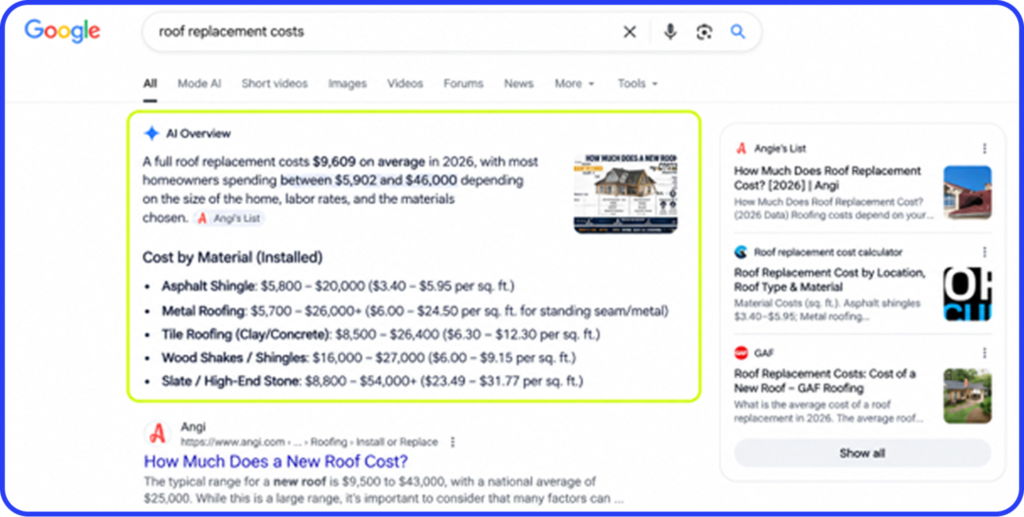
An AI Overview is the AI-generated answer block Google places at the top of certain search results pages before any traditional results appear. Based on third-party tracker data, AI Overviews now appear on somewhere between 43% and 48% of all Google searches, per Similarweb and Semrush data published in mid-2026.
For local service searches, only the businesses mentioned in that overview get top-of-page visibility. The rest are effectively skipped at that stage. Getting included requires the same signals that drive traditional local SEO: strong reviews, a complete GBP, specific content, and consistent entity signals. This is already affecting which contractors get called.
6. Zero-Click Search
A zero-click search is one where the homeowner gets their answer directly from the Google results page without clicking any link. An AI Overview. A map pack result with a visible phone number. A featured snippet. If a homeowner sees your name and dials without visiting your site, that conversion does not show up in analytics. Zero-click is not a problem to solve. It is a behavior to account for when evaluating what your marketing is actually producing.
7. AEO (Answer Engine Optimization)
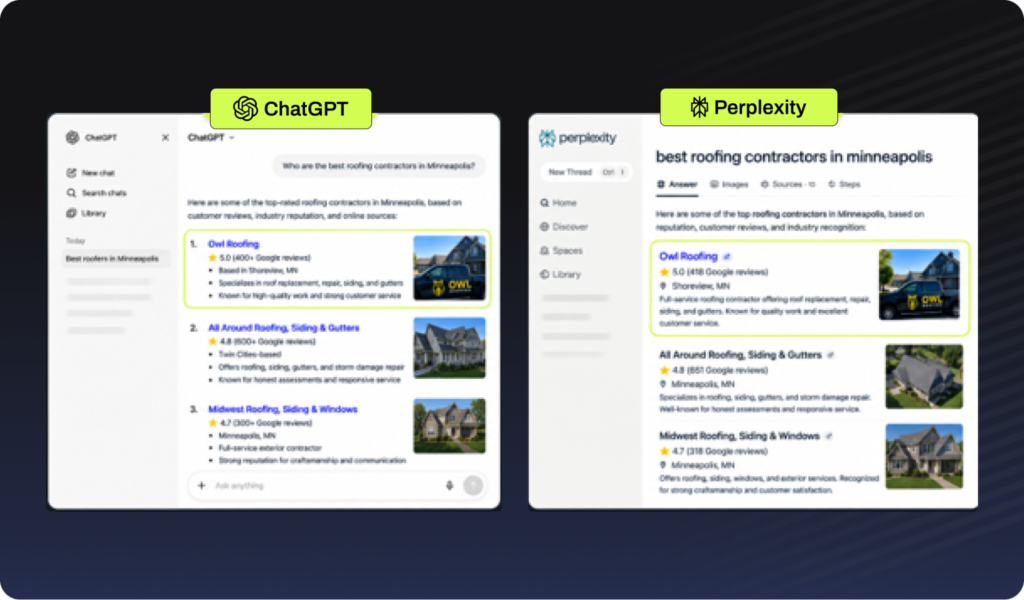
AEO stands for Answer Engine Optimization. It is the practice of structuring content and business signals so that AI tools, specifically ChatGPT, Perplexity, and Google AI Overviews, include your business when a homeowner asks a recommendation question. A contractor not named in that AI answer is invisible at that moment. The AEO vs SEO guide covers how the two overlap, and answer engine optimization for home services goes into the practical steps.
8. Entity Signal
An entity signal is any consistent, verifiable piece of information about your business appearing across multiple trusted platforms. Business name, address, phone, service categories, service area, owner name. AI tools and search engines cross-reference these to determine whether a business is real, local, and credible enough to recommend. Most contractors are not actively managing these. Most of their competitors are not either. That is the opportunity.
Paid Advertising Terms
Paid advertising is where the most money gets spent and the least understood. These five terms let you evaluate whether a campaign is actually working or just producing numbers that look good on paper.
9. CPL (Cost Per Lead)
Cost per lead: total ad spend divided by the number of leads produced. Spend $1,000, generate 10 leads, CPL is $100. This is the starting metric for paid advertising, not the ending one. A $40 CPL with leads that almost never book can produce a worse outcome than a $90 CPL with leads that close at 60%. CPL is the first number your agency reports. Cost per booked job is the one that actually matters.
10. Cost Per Booked Job
Cost per booked job is total marketing spend divided by jobs actually booked from that spend. It goes one step further than CPL by accounting for lead quality and follow-up performance, not just volume.
This is the metric that connects marketing directly to revenue. An agency that reports on CPL without reporting on cost per booked job is measuring the wrong thing. If your current agency does not provide this number, ask for it.
11. LSA (Local Services Ads)
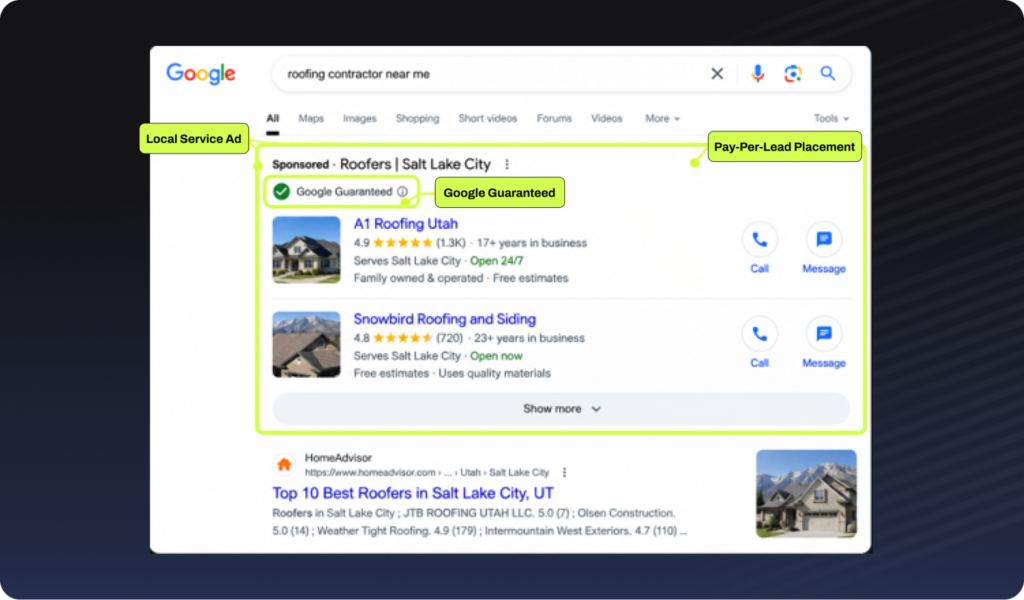
Local Services Ads are Google’s pay-per-lead product for local service businesses. Unlike standard Google Ads where you pay per click regardless of outcome, LSAs charge per verified lead.
They appear above every other result on the page and carry a Google Guaranteed or Google Screened badge. LSA leads for home service businesses typically run $25 to $75 depending on trade and market, among the lowest CPL of any paid channel. For contractors who have not activated LSAs, it is one of the highest-leverage moves available right now.
12. CPC (Cost Per Click)
CPC is what you pay every time someone clicks on one of your ads. It fluctuates by keyword, time of year, and how well your account is set up relative to competitors. Peak-season CPCs for trade keywords in competitive markets can exceed $30 per click. Off-season, the same keywords often run 30 to 50% lower. An agency that runs the same keyword list year-round without adjusting for seasonal demand is consistently overpaying during shoulder months.
13. Retargeting
Retargeting is showing ads to people who previously visited your website but did not contact you. Most homeowners visit three to five contractor sites before making a call. Retargeting keeps your name in front of people who already showed intent at a fraction of the cost of acquiring new traffic. Specificity matters: a generic banner ad does not do much. An ad referencing the specific service they were researching is the one that brings them back.
Conversion and Lead Terms
Traffic and leads only matter if they turn into booked jobs. These four terms describe what happens after a homeowner finds you, and where most contractors have more room to improve than they realize.
14. Conversion Rate
Conversion rate is the percentage of website visitors who call or fill out a contact form. One hundred visitors, three calls: 3% conversion rate. Conversion rate is the multiplier on all other marketing spend. A contractor at 1% who improves to 2% doubles their leads without spending more. Most contractor websites convert below 2%. The fastest improvements usually come from:
- Clearer homepage messaging: what you do, where, and why call you
- Faster mobile load speed
- More visible phone numbers and call-to-action placement
- Trust signals: reviews, license numbers, real job photos
15. Speed to Lead
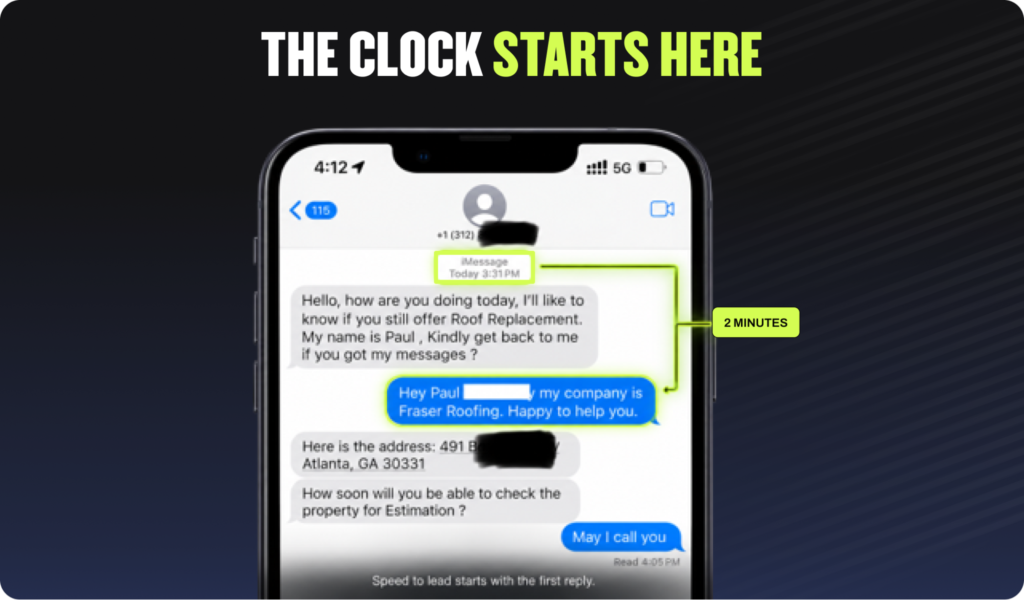
Speed to lead is the time between when a homeowner contacts you and when you respond. The research is clear: responding within five minutes dramatically outperforms a thirty-minute response, and the contractor who responds first credibly tends to get the job.
Hatch’s analysis of over 130,000 home service campaigns found that 88% of businesses take longer than five minutes to reply, with the most common response time exceeding one full day, per Apten AI’s 2026 speed-to-lead benchmark data. An AI answering service, a live receptionist, or a text automation that acknowledges the inquiry within two minutes closes most of the gap. Hook’s piece on slow response times and what they cost contractors breaks down the revenue math.
16. Lead Velocity
Lead velocity is the rate at which new leads are arriving, week over week or month over month. Different from total lead count because it shows direction, not just a snapshot. A contractor with a stable monthly count but declining velocity has an early warning before the total drops.
Lead velocity is a leading indicator of whether changes to SEO, paid ads, or the website are having the intended effect. A monthly report showing totals without trend direction is hiding information you should have.
17. Review Velocity
Review velocity is the rate at which new Google reviews are being added monthly. Google’s local algorithm weights recent reviews more heavily than old ones. A competitor with 80 reviews total and five new ones per month can outrank a business with 400 total reviews and no recent activity.
The only reliable driver of velocity is a systematic post-job request process. Hook’s guide on reviews for contractors walks through what a repeatable outreach process looks like.
Content and Authority Terms
This is the long game. Results take three to six months to show up, which is why most contractors underinvest here. But the equity built in this category is the hardest for a competitor to replicate quickly.
18. Service Area Page
A service area page is a dedicated webpage targeting a specific city or neighborhood. Instead of one generic services page, you build individual pages: “Roof Repair in Bellevue,” “Roof Repair in Kirkland,” “Roof Repair in Redmond.” One page cannot rank for multiple city-specific searches. The contractor with a well-built page for each target city consistently outranks the one with a single page covering the whole region.
The word genuine matters here. Thin, templated pages where only the city name changes are increasingly penalized in Google’s core updates. Pages that rank have real local content: job photos from that area, city-specific FAQs, information a homeowner in that specific place would actually find useful.
19. E-E-A-T
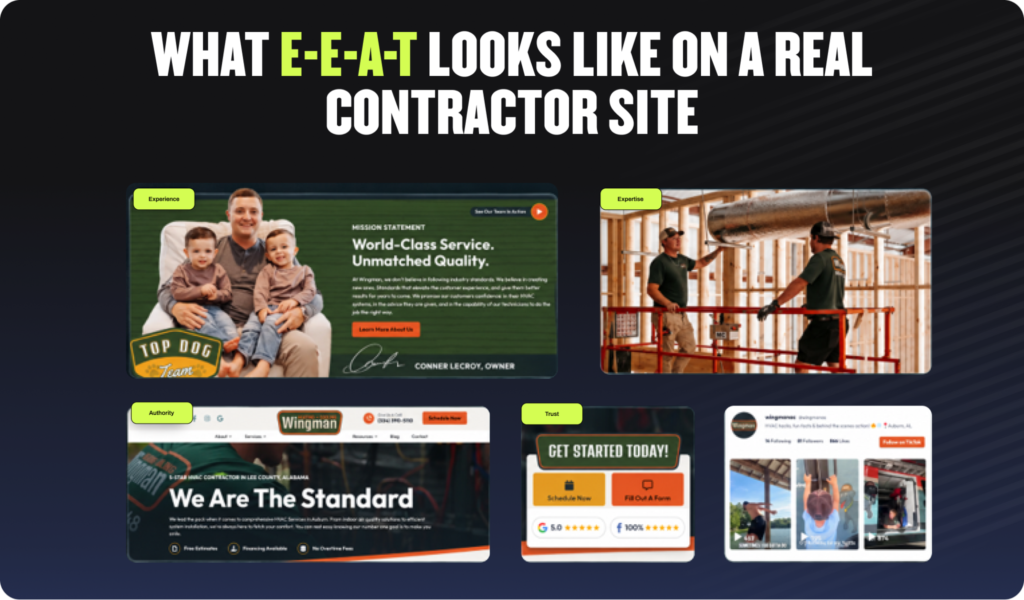
E-E-A-T stands for Experience, Expertise, Authoritativeness, and Trustworthiness. Google’s framework for evaluating whether a website is a credible source. For a contractor site, it is not abstract. It shows up in specific things:
- A named owner with verifiable credentials, not just a company name
- A license number that can be looked up
- Before-and-after photos from real jobs, not stock images
- Customer reviews describing specific work
- Case studies or documented project outcomes
Google applies heightened E-E-A-T scrutiny to home services because a bad recommendation can genuinely harm a homeowner. E-E-A-T is also one of the primary signals AI tools use when deciding which contractors to recommend by name.
20. Content Gap
A content gap is a topic homeowners in your market are actively searching for that no local competitor is covering well. Finding one means looking at keywords your competitors rank for that your site does not, and questions in People Also Ask that no local business has a dedicated page answering.
A content gap is a direct ranking opportunity with no local competition. A roofer who publishes a genuinely useful page on “what to expect during a roof replacement in Seattle” while no local competitor has covered it earns an organic advantage that compounds over years. The content gap audit is where most contractor content strategies start, and the fastest way to find low-competition opportunities a newer site can realistically rank for.
The Vocabulary Is Not the Hard Part
Understanding these terms changes the quality of every conversation you have with an agency, every decision about where to spend, and every question you ask when a report does not add up. The contractors who get the best results are not always the ones with the biggest budgets. They are the ones who understand enough to ask the right questions and recognize when an agency is reporting vanity metrics instead of business outcomes.
For a broader view of how these channels fit together, the home services marketing strategy guide pulls most of them into a full-picture framework. And if you are evaluating whether your current agency is actually delivering, how to choose a digital marketing agency covers what to look for before signing anything.
For contractors who want a marketing partner that explains what they are doing, talk to Hook Agency.
FAQs
What is the most important marketing metric for a home service contractor?
Cost per booked job. It connects marketing spend directly to revenue and accounts for lead quality and follow-up performance. If your agency cannot tell you what a booked job costs across each channel, that is the first thing to ask for.
What is the difference between CPL and cost per booked job?
CPL measures what it costs to get someone to contact you. Cost per booked job measures what it costs to turn that contact into revenue. A $40 CPL with a poor close rate can produce a higher cost per booked job than a $90 CPL with strong follow-up. CPL is the first number. Cost per booked job is the one that tells the full story.
What does AEO mean for home service businesses?
AEO stands for Answer Engine Optimization. It is the practice of building content and business signals so that AI tools like ChatGPT, Perplexity, and Google AI Overviews recommend your business when a homeowner asks for a local contractor. It runs on the same foundations as traditional local SEO but adds content specifically structured to earn an AI citation.
Does review velocity matter more than total review count?
In local ranking terms, often yes. Google’s algorithm weights recent reviews more heavily than historical totals. A competitor with fewer total reviews but consistent recent activity can outrank a business with more total reviews and none added recently. Both matter. Velocity is the one most contractors are not actively managing.
Do I need service area pages if I already have a services page?
Yes. A single services page cannot rank for city-specific searches across multiple markets. If you want to appear when someone in a specific city searches for your service, that city needs its own page with genuine local content.
What is NAP consistency and why does it affect rankings?
NAP stands for Name, Address, Phone number. Consistency means this information is identical across every directory and listing. Inconsistencies make it harder for Google and AI tools to confirm your business, which suppresses local pack rankings and AI citation rates. One of the most common issues on contractor sites and one of the most straightforward to fix.