

I talk to contractors who got burned by agencies more than I’d like to admit.
Same story, different company. They hired someone, paid a retainer for six months, got reports full of numbers, and the phone didn’t ring. Then they came to us. Knowing how to choose a digital marketing agency matters more than most contractors realize until it’s already too late.
It’s not rare, either. Enji’s State of Small Business report surveyed 245 small business owners and found four in five say their marketing is, at best, ‘somewhat’ effective. That’s a vendor problem, not a market problem.
The red flags show up before you sign. So do the right answers. What separates agencies that produce booked jobs from agencies that produce reports about impressions:
- Trade-specific experience, not generalists learning your industry on your budget
- Reporting tied to calls and jobs, not clicks and followers
- Account ownership you keep when you leave
- A contract with a performance clause, not just a long commitment
- Case studies from businesses like yours you can actually verify
Start With the Right Type of Agency, Not the Lowest Quote
The most important decision in how to choose a digital marketing agency is not which one costs the least. It is whether the agency actually knows your industry. For context on what a complete marketing program should look like for a home service business, the home services marketing strategy guide frames that picture before any agency conversation begins.
Generalist vs. Specialist: Why This Matters Specifically for Contractors
A generalist agency runs campaigns for a dental practice, a law firm, a restaurant, and an HVAC company in the same week. They are constantly context-switching, and they learn your industry on your budget.
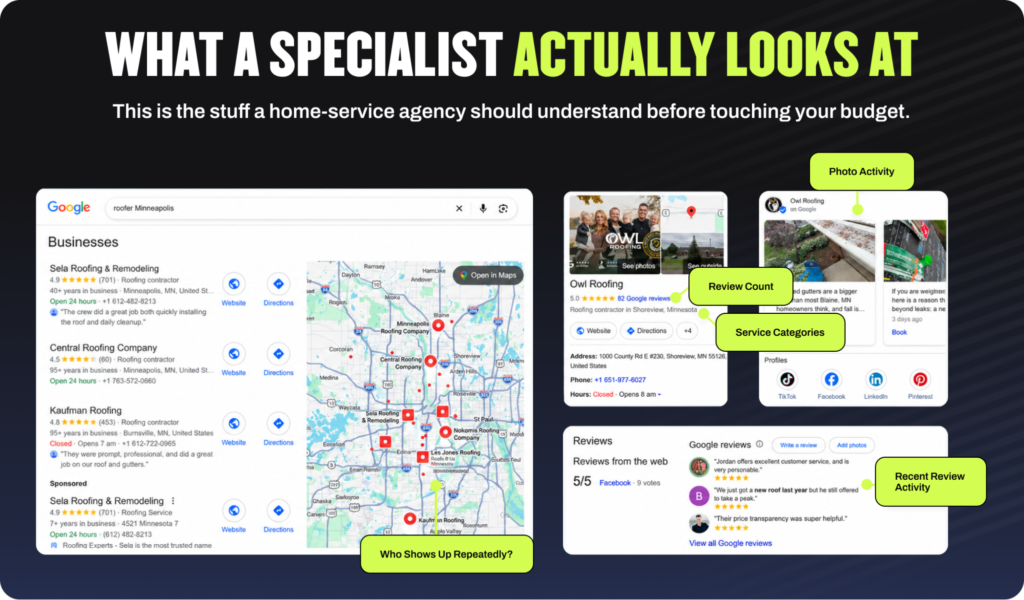
For home service contractors, that gap is expensive. The seasonal demand patterns, Google Local Services Ads dynamics, the review thresholds that move local pack rankings, the service area page strategy, and the homeowner buying behavior are all specific to this category. An agency that has never looked at what a 400-review HVAC company’s profile looks like next to a 20-review competitor does not know where your leads are coming from or how to grow them.
What a Specialist Actually Knows That a Generalist Does Not
A specialist in home service contracting knows:
- That a plumbing company in a competitive metro needs well over 1,000 reviews to hold a strong local pack position
- That GBP photo volume drives calls at a measurable rate
- That response time is one of the most powerful conversion variables in home service, and that fixing it often produces more leads than any ad campaign change
None of this is common knowledge in a generalist agency. All of it is standard for a specialist. How homeowners research contractors covers the buyer behavior that makes trade-specific experience matter.
The Five Questions to Ask Before You Sign Anything
Tim Brown, who founded Hook Agency, put together a video on exactly this and I think about it every time we talk to a contractor who’s been through a bad agency relationship. His framing: these questions separate agencies that know what they’re doing from ones that are very good at sounding like they do.

Here is what each question is actually designed to surface. More detail in the Hook Agency guide to questions to ask your SEO agency.
1. How Long Does It Take to See Results From Our Investment?
Tim said it plainly in the video: ‘If they say things like you’re going to get leads in the next month, we guarantee this amount of leads, that’s a red flag. That’s a very hungry or thirsty marketer that sometimes just needs your business right now and will say whatever they can possibly say to get your business in the door.’
The right answer looks like: Google Ads generating leads at 30 days, improving at 60, stable and predictable by 90. SEO compounding over six to nine months. Any agency that cannot explain what work produces what result is selling activity, not outcomes.
2. How Do You Define and Qualify a Lead?
Tim’s version: ‘Three months down the road and they’re like, well, we got you 30 leads this month, and you’re looking through and there are 15 form fields that are spam and five that are warranty claims and 10 real leads.’ Have this conversation before you launch anything.
A qualified lead is someone who needs your service, is in your service area, and is a realistic candidate for a booked job. Get that definition in writing. Otherwise you and the agency are measuring two completely different things.
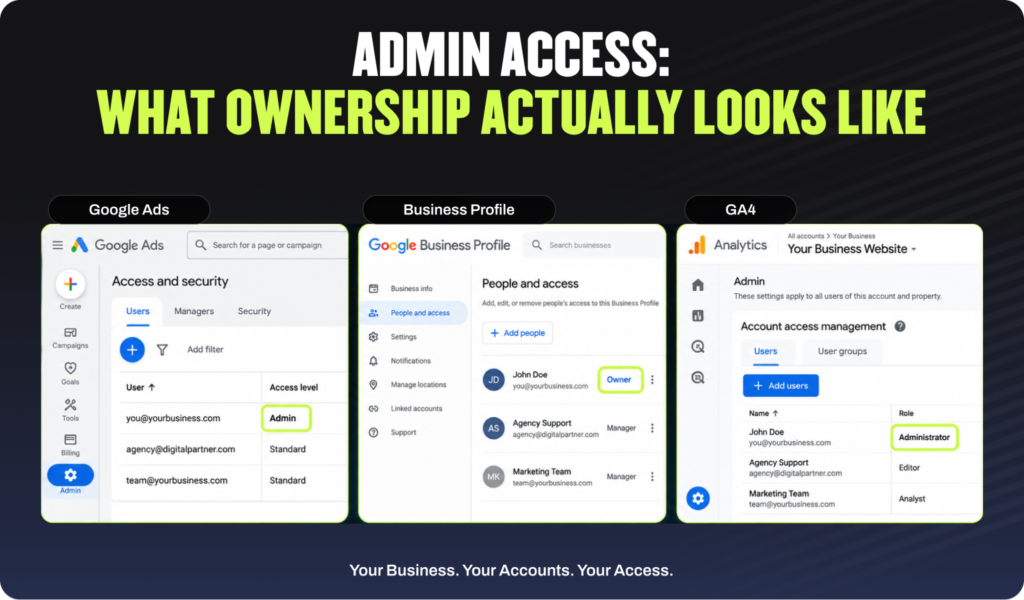
3. What Do I Own If I Leave Your Agency?
Tim in the video: ‘You should own your website. You should own your Google Business Profile. You should own your ad accounts and your data. You own your content. You own your leads. If you leave, everything goes with you. You shouldn’t be held hostage by a marketing agency. We believe that’s just plain wrong.’
He also flagged a specific trap: agencies that build websites on proprietary platforms the client cannot take anywhere else. ‘They hate me for saying this out loud. But it’s your stuff. You should own it.’ Any agency that ties your accounts to their login is building a dependency, not a partnership.
4. Who Actually Does the Work on My Account?
The most common source of contractor disappointment: discovering the senior person who sold the contract handed them off to a junior account manager or overseas subcontractor the following week.
Tim’s direct quote from the video: ‘A red flag is when you don’t have subject matter experts in the company that you can talk to about the work that are actually getting the work done. Because there will be issues. There will be problems on your account. You should have somebody to be able to talk to that actually knows how to get the work done.’
5. What Are Your Contract Terms and What Happens If Results Miss?
A 90-day initial commitment followed by month-to-month is the clearest standard in 2026. Six-month commitments are defensible when onboarding is genuinely heavy. Twelve-month lock-ins without a performance clause tied to specific missed KPIs are an agency protection mechanism, not a client benefit.
The minimum to negotiate: 30-day cancellation notice after the initial term, no early termination fee, clean account handoff, and an exit clause tied to specific metrics. If the agency refuses a performance clause, ask why. The answer is usually more informative than the clause itself.
Red Flags That Appear on Almost Every Bad Proposal
Bad proposals do not look obviously bad. They look confident and professional, which is exactly why the red flags are worth knowing before you are sitting across from one.
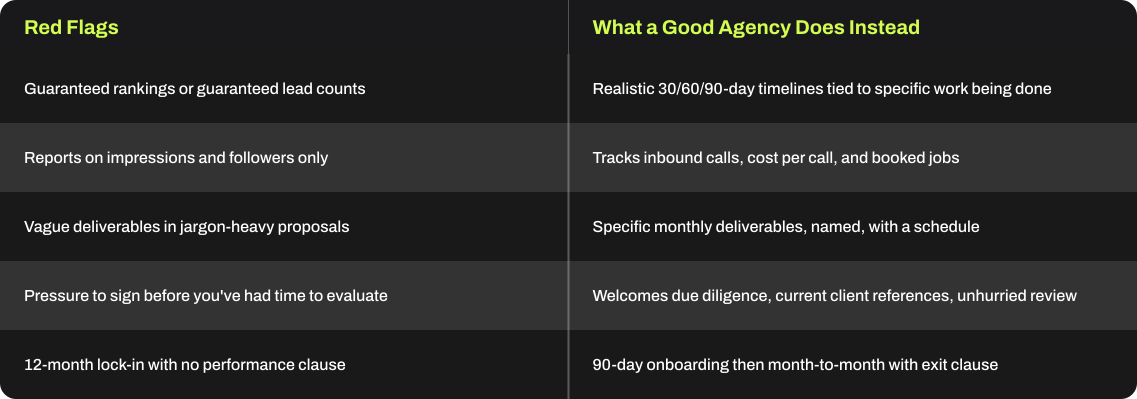
Guaranteed Rankings or Guaranteed Lead Volumes
Google has explicitly said no one can guarantee a search ranking. Any agency claiming otherwise either does not understand how search works or does understand and is betting you don’t. Lead guarantees have the same problem: leads depend on market demand, seasonality, your response time, and your close rate, none of which the agency fully controls.
Reporting on Impressions and Clicks With No Call Tracking
If monthly reports show page views, click-through rates, and social media reach without a single mention of phone calls or booked jobs, the agency is measuring what is easy to move rather than what matters to your revenue.
Call tracking is not optional for a home service engagement. It is the minimum standard. Without it, neither you nor the agency knows which channel is producing calls. Which is sometimes the point.
Vague Deliverables Dressed in Jargon
‘Boosting your online presence’ and ‘comprehensive digital strategy’ are not deliverables. They are placeholders. A real proposal names exactly what will be produced each month, by whom, and on what schedule. Tim described the transparency standard they hold at Hook Agency: a Google Drive folder updated every month with everything done so the client can see exactly what they paid for.
Pressure to Sign Before You Have Had Time to Think
A reputable agency welcomes due diligence. They let you talk to current clients, review proposals without a deadline, and take whatever time you need. Urgency around signing is a data point. Pay attention to it.
What Fair Pricing Looks Like in 2026
Most home service contractors pay between $2,500 and $10,000 per month for a full-service marketing retainer. Hook Agency’s digital marketing cost guide breaks this down by channel and market. The short version:
- Starter ($2,500 to $4,000/month): Website plus standard local search. Right for establishing a baseline
- Growth ($4,000 to $8,000/month): SEO, GBP management, paid search, and content. Right for increasing call volume
- Aggressive ($8,000 to $15,000/month): Full-service in a competitive metro
Anything below $1,500 a month for SEO is almost certainly templated work with automated reports. The discount is the expensive option when you factor in what it does not produce. The right question is not which agency costs less but which one produces the lowest cost per booked job.
What the First 90 Days Should Look Like
What a Real Agency Does in Month One
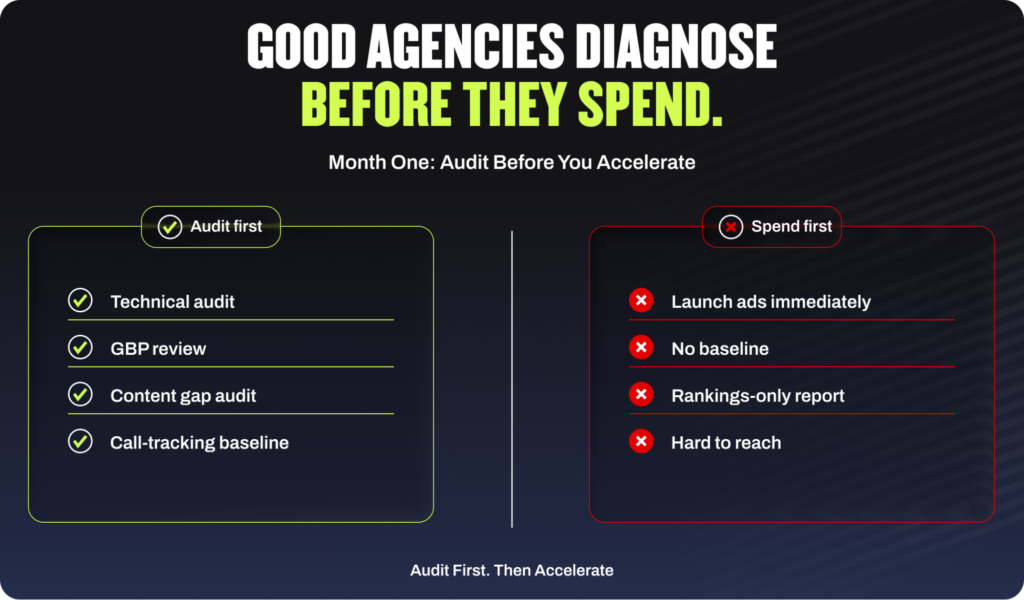
A serious agency audits before it builds. Month one should include:
- Website technical health check
- GBP completeness review, photo volume, review velocity
- Existing content audit for keyword coverage gaps
- Call tracking baseline established so you know what is coming in before anything changes
An agency that launches ads in week one before the website is optimized is spending your money on traffic a weak site will not convert. Home service websites that actually convert covers what has to be in place before paid traffic makes sense.
What a Warning Sign Looks Like in Month One
- Ads launched before any audit of the site
- Month one report shows keyword ranking improvements with no mention of call volume
- Hard to reach after signing. An agency that is slow in month one does not get faster in month six
- No documented record of work completed
How to Evaluate an Agency After You Have Hired One
Evaluating an agency after the fact is simpler than most contractors realize: is the phone ringing more, and is the cost of each call going down over time?
Reports That Actually Tell You Something
- Inbound call volume by channel this month versus last month versus six months ago
- Cost per call from each channel
- Call-to-booked-job conversion rate
- New Google reviews added in the month
- GBP views and direction requests
- Cost per booked job
Reviews are a measurable outcome, not a vanity metric. The guide to reviews for contractors covers the ask system that makes review volume a predictable output.
Reports That Mean Nothing
- Impressions without calls
- Followers without leads
- Domain authority improvements without ranking changes
- Keyword rankings without traffic or calls
- Social media reach without engagement or conversion
These metrics exist. They are real. They are also easy to move without moving anything that affects a contractor’s revenue. An agency that reports only these things is measuring what is easy to improve, not what you hired them to improve.
Why Hook Agency Is Worth Putting on Your List
I’ll be direct: Hook Agency works specifically with home service contractors. HVAC, roofing, plumbing, electrical. The case studies on our site have real client names and real numbers. If you apply the criteria in this article to us, they should hold up. We welcome that test.
We give clients full ownership of every account. Performance clauses are available in our contracts. We document work monthly. And we are honest when we are not the right fit, because a contractor in the wrong agency relationship is worse than a contractor who hasn’t hired anyone yet.
If you want to evaluate us specifically, schedule a call with our team and we’ll walk you through what we would actually do for your business.

Frequently Asked Questions
How do I choose a digital marketing agency for my contracting business?
Start with agencies that specialize in home service contractors, not generalists who serve every industry. Ask for a verified case study from a business in your trade, confirm who will actually manage your account, ensure you will own all accounts and data, and check that the contract includes a performance clause. These five criteria eliminate most bad fits before money changes hands.
What should a digital marketing agency for contractors report on?
Inbound call volume by channel, cost per call, call-to-booked-job conversion rate, new Google reviews added, GBP views and direction requests, and cost per booked job. Reports that cover only impressions, clicks, and keyword rankings without connecting to phone calls are measuring the wrong things for a home service business.
What are the biggest red flags when hiring a marketing agency?
Guaranteed rankings or guaranteed lead volumes, reporting on impressions with no call tracking, vague deliverables in jargon-heavy proposals, pressure to sign before you have had time to evaluate, and a long contract with no performance clause or exit clause tied to specific missed KPIs.
How much should a home service contractor pay a marketing agency?
Most pay between $2,500 and $10,000 per month for a full-service marketing retainer in 2026, depending on market competitiveness, scope, and quality of work. Anything below $1,500 per month for SEO is likely a commodity package. The right question is not which agency costs less but which produces the lowest cost per booked job.
Should I hire a generalist or a specialist agency?
A specialist in home services almost always produces better results. They already understand LSAs, GBP management, review thresholds, seasonal demand, and homeowner buying behavior specific to trades. A generalist learns your industry on your budget, which extends timelines and raises the cost of getting to results.
Who should own my marketing accounts when working with an agency?
You should. Every account an agency creates or manages on your behalf, including Google Ads, Google Business Profile, the website, and analytics, should be in your ownership. An agency that refuses to give you admin access is creating a dependency that makes switching expensive regardless of performance. This is non-negotiable.
The Right Agency Has Nothing to Hide
The agencies worth hiring welcome scrutiny. They share case studies with verifiable numbers, introduce you to the person who will actually manage your account, and put performance clauses in contracts because they’re confident in the work.
The ones that deflect, stay vague, and pressure you to sign are showing you exactly who they are. Before you hand them a retainer.