
You have a 4.8 star rating. Dozens of reviews. Maybe a few that mention the owner by name.
And homeowners still hesitate. They ask for three estimates when two would have done. They go quiet after the quote. Or they go with someone else and you can’t figure out why, because you know your reviews are better.
I have heard this from too many contractors to count. The frustration is real and the confusion is understandable.
The reason is not the reviews. The reasons are:
- A slow response that signals disorganization before a word is exchanged
- No visible pricing, which reads as evasiveness even when it isn’t
- A gap between what the website promises and what shows up at the door
- Vague answers to specific questions that make a homeowner feel like they’re guessing
Homeowners stop trusting a contractor for reasons that have little to do with star ratings. Reviews get a business onto the shortlist. Something else decides who gets the call.
Understanding how homeowners actually choose a contractor shows the full decision sequence. This piece focuses on the trust signals that decide who gets hired once a homeowner has already seen good reviews from several options.
The Reviews Myth: Why 5 Stars Doesn’t Automatically Mean Trust
Reviews function as a filter, not a decision. They get a business onto the shortlist. They rarely decide who gets the call.
Most competent local contractors now maintain a decent star rating. The days when a 4.7 meaningfully separated one business from another are largely over in most markets. A homeowner searching for a plumber, HVAC company, or roofer will find several strong-rated options before they even get to a quote.
According to BrightLocal’s Local Consumer Review Survey 2026 (published February 11, 2026), 31% of consumers now only use businesses rated 4.5 stars or higher, up from 17% in 2025. The floor is rising, which means more businesses clear it, which means the rating itself does less differentiating work than it used to.
What homeowners are actually reading in reviews is not the star count. It is the text. They want answers to specific questions:
- Was the crew on time?
- Did they explain what they were doing?
- Did the final invoice match the estimate?
Generic five-star praise doesn’t answer any of those questions. A specific 4.6-star review reads as more credible than a vague five-star one.
This foreshadows a theme throughout: specificity builds trust, vagueness erodes it.
6 Trust Signals That Actually Decide Who Gets Hired
These are the signals homeowners are reading, often without realizing it, from the moment they first contact a contractor through the moment someone shows up at the door.
1. How Fast You Respond
Response speed is the most underestimated trust signal in home services. Not because homeowners are impatient, but because a fast response communicates something before a single word of content is exchanged.
A contractor who returns a call or message within minutes signals: we are organized, we want this work, we have the capacity to handle it. A contractor who takes four hours to respond signals the opposite, even if the actual response is warm and professional when it arrives.
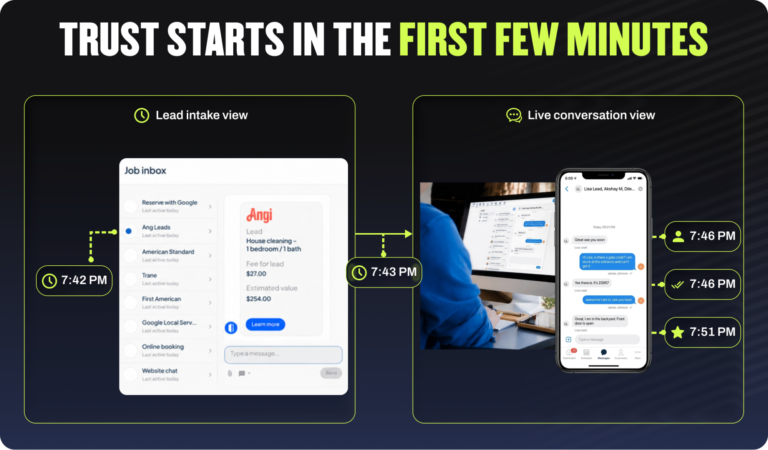
Ryan Finn of Chirp, who has built a follow-up platform that has processed hundreds of millions of home service text messages, put it simply when we talked on our podcast: “Marketing is extremely important, but follow-up is every bit as important. I see a lot of people focusing a lot of their effort just on the marketing and not putting as much effort into the follow-up.”
He also described a principle from his windshield repair days that applies directly here. He discovered that one word change in his opening line shifted his conversion rate from roughly 10% to 90%. The words a homeowner encounters in those first seconds of contact either open the door or quietly close it. Speed determines whether those words get heard at all.

The real cost of a slow response is easier to understand when it is calculated directly. What a missed call is actually costing a home service business makes that math concrete with real numbers.
2. Whether Your Price Is Knowable Before the Estimate Call
Most home service contractors don’t list pricing on their websites. The reasons are usually legitimate: job complexity, variable materials, market conditions.
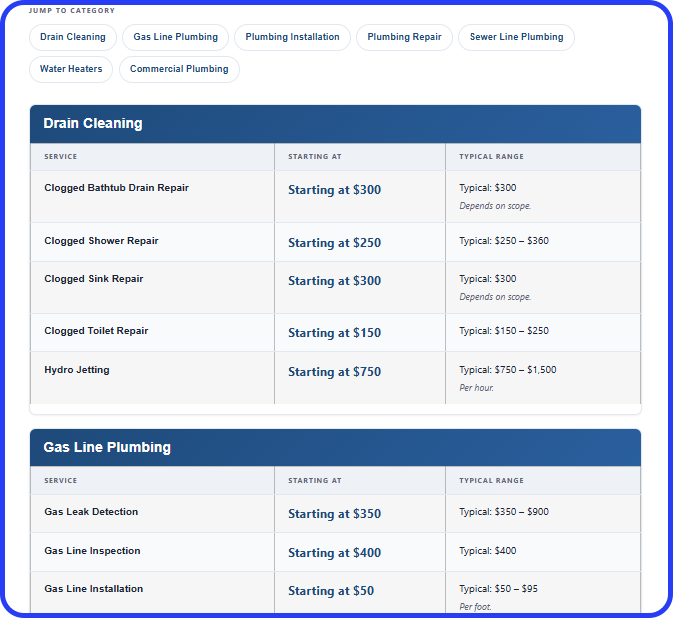
But from the homeowner’s perspective, no visible pricing reads as evasiveness even when it isn’t. A homeowner who can’t find any price signal, not even a starting range or a typical job cost, will often move to the next option rather than call and ask. The friction of not knowing feels like risk.
What a visible price range actually does:
- Signals confidence and transparency before the first conversation
- Filters out price shoppers before a tech drives out for an estimate
- Gives the homeowner something to trust before they speak to anyone
The fear that pricing loses jobs to cheaper competitors is real but usually overstated. The mechanics of including clear pricing information on your website also carry SEO and AEO benefits most contractors haven’t considered yet.
3. Whether What Shows Up Matches What Was Promised Online
This one is quiet and damaging. A homeowner who saw a professional website, strong photography, and a polished Google Business Profile expects the experience to match that standard when someone actually shows up.
When it doesn’t, the trust that the online presence built collapses fast. A generic unmarked truck when the website showed a branded fleet. A crew without uniforms when the photos showed organized workers. A technician who doesn’t know the details of the estimate when the intake was smooth and professional.
The mismatch doesn’t have to be dramatic to do damage. It just has to be noticeable. And homeowners notice. Especially homeowners who chose based on the online impression.
This is why stock photos are costing contractors jobs is one of the more consequential things a business can fix. The gap between polished generic imagery and the reality that arrives at the door is a trust problem, not just an aesthetic one.
4. How Specific Your Communication Is
Vague answers to specific questions are one of the fastest ways to lose a homeowner who was otherwise ready to hire.
Consider the difference between these two responses to “what happens during the appointment?”
- “We will come out, take a look, and give you a quote.”
- “Our tech will walk the roof with you, photograph anything that needs attention, and hand you a written breakdown on-site. The whole thing takes about 45 minutes.”
Both responses are honest. One creates a specific mental picture. The other leaves the homeowner to guess. Specificity reads as competence and honesty. Vagueness reads as evasiveness, even when nothing is actually being hidden.
This extends to written communication, follow-up messages, and even the tone of text replies. Building a more relatable, human brand covers the voice and tone side of this. The specificity principle applies across every channel the homeowner touches.
Verint’s State of Customer Experience 2025 report (a survey of 5,000 US consumers, conducted early 2025) found that 74% of consumers say they would switch to a competitor after just one bad experience, and that CX quality is now the second most important factor in customer loyalty after the product or service itself. The implication for a home service call: the interaction quality during the estimate and follow-up is not a soft concern. It is a business-critical one.
5. Whether the Process Feels Predictable, Not Just the First Call
Trust built during intake erodes quickly if the actual job feels disorganized or surprising.
A homeowner who had a smooth booking experience expects the same quality to carry through. The tech should know what was discussed. The crew should arrive in the stated window. Any changes to scope or timeline should be communicated proactively, not discovered when the homeowner checks in.
The businesses that retain trust through the full job have a simple system:
- Confirmation text the morning of the appointment
- A check-in when the crew is on the way
- A summary when the job is done and the site is clean
None of these are complicated. All of them signal the same thing: this business does what it says it will do.
The on-site consistency side of this, keeping team branding consistent on the job site, reinforces the same trust signal the website started building. A professional online presence followed by an unmarked truck and a crew in street clothes is a mismatch homeowners notice.
6. Whether Credentials Are Easy to Verify, Not Just Claimed
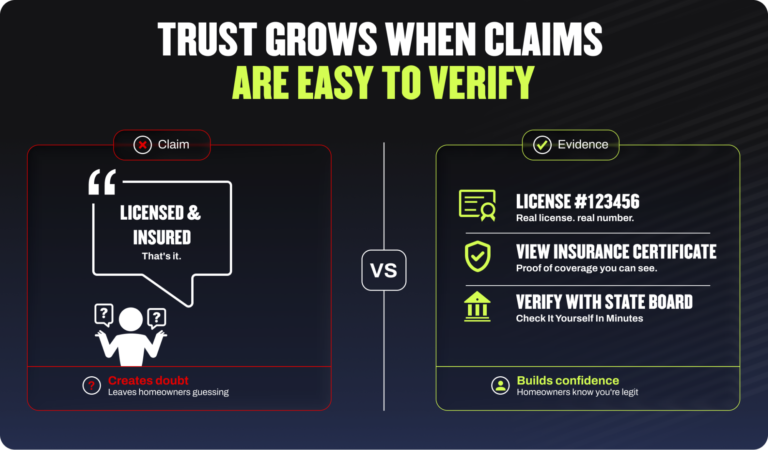
“Licensed and insured” appears on tens of thousands of contractor websites. It is so common it has stopped doing much work as a trust signal on its own.
What actually reduces perceived risk is making verification easy. Three things that shift this from a claim to evidence:
- A license number listed on the website that can be looked up
- A certificate or proof of insurance that can be viewed directly
- A link to the state licensing board for anyone who wants to confirm
These are small additions. What they communicate is large: this business has nothing to hide. One is a sales statement. The other is evidence.
Where Reviews Actually Fit (Just Not Where You Think)
None of this means reviews don’t matter. It means they matter earlier than most contractors think, and stop mattering as much right when the real decision gets made.
Reviews are still the filter. A thin or aging review base eliminates a business before the six signals above even get a chance to work. The threshold is rising:
- 47% of consumers won’t consider a business with fewer than 20 reviews (BrightLocal LCRS 2026)
- 32% specifically want reviews from the last two weeks
- 89% expect owners to respond to reviews, with 19% expecting a same-day response
A business without recent, specific reviews is getting cut before anyone sees what happens next.
But once a homeowner is comparing several similarly well-reviewed businesses, the star rating stops doing meaningful work. The six signals above take over at exactly that point.
The right takeaway is not stop asking for reviews. It is stop assuming reviews alone will close the gap. They open the door. Something else has to walk through it.
For the systems that build review volume consistently, how to get more reviews for contractors covers the practical side. Keep doing that work. Just don’t assume it handles the conversion problem on its own.
A Quick Self-Check: Are You Trustworthy, or Just Well-Reviewed?
Run this honestly before assuming reviews are explaining slow conversions.
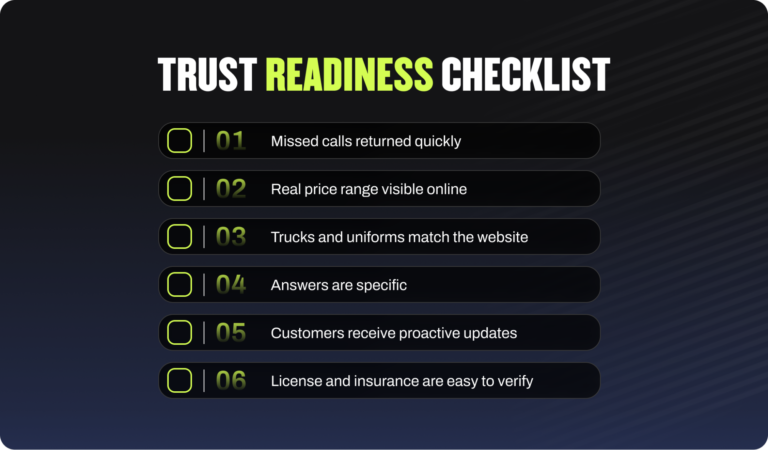
- How long does it actually take to return a missed call or web form, on a normal busy day, not the best day?
- Can a homeowner find a real price range before ever picking up the phone?
- Do the trucks, uniforms, and job-site reality match what the website and ads show?
- When someone asks a specific question, does the answer come back specific, or does it default to reassurance?
- Is there a system for proactive updates during a job, or does communication only happen when the homeowner initiates it?
- Can someone verify a license or insurance in under a minute, or does it require asking?
A business can pass every one of these and still benefit from more reviews. But it is very hard to convert well from strong reviews with a “no” on most of this list.
For the website-design level trust signals, the badge placement, the about page, the live chat, and all the rest, the complete list of website trust factors covers that ground in detail.
Frequently Asked Questions
If reviews don’t decide trust, why do they matter at all?
Reviews are the filter that gets a business onto the shortlist. A thin or outdated review base can eliminate a contractor before anyone reads further. They just stop being the deciding factor once several similarly well-reviewed businesses are being compared.
What is the single fastest trust signal to fix?
Response speed. It requires no design work, no rebrand, no new marketing spend. Just a faster, more consistent process for returning missed calls and form submissions. Research consistently ties response speed to who actually gets hired.
Does listing prices on a website scare off customers who will go with someone cheaper?
Less often than most contractors assume. A visible price range signals transparency and filters out price shoppers before the first call. Homeowners who were going to hire based on price alone were unlikely to convert well anyway.
Can a contractor have great reviews and still lose trust?
Yes. A strong rating paired with slow responses, vague answers, or a mismatch between the website and what shows up at the door will still lose jobs to a competitor who handles those signals better, even with a slightly lower rating.
How do I know if my business has a trust problem instead of a reviews problem?
Run the self-check above. If review count and rating are solid but leads still hesitate or choose a competitor, the gap is more likely in response speed, pricing clarity, or consistency. The know, like, and trust framework provides useful context for how these signals connect to the broader relationship-building process.
Reviews Open the Door. Trust Is What Closes the Job.
A strong review base is necessary. It is not sufficient.
The homeowner who goes with a competitor despite your better reviews is almost never making an irrational decision. They found something in the six signals above that told them, quietly and without being able to articulate it exactly, that the other contractor was more likely to deliver on what they promised.
The good news is that every one of those signals is fixable. None of them require a new logo or a bigger ad budget. Most of them require a process change: a response-time standard, a clearer price page, consistent communication during jobs.
If you want help identifying which signals are costing conversions and what to fix first, that is exactly the kind of marketing and operations work we do with home service businesses at Hook Agency. We work exclusively with contractors across plumbing, roofing, HVAC, and electrical, and we know what separates the businesses that convert well from the ones that don’t.
Schedule a call with our team and we will walk through where your specific gaps are and what to prioritize first.
And if you want to build the website-design layer alongside this, the trust factors checklist is the companion resource for that work.