
A contractor I talked to recently told me his close rate had dropped but he couldn’t figure out why.
The leads were still coming in. His pitch hadn’t changed. His prices were competitive. But something was off. Jobs he expected to close weren’t closing.
I’ve heard this more times in the last year than I can count.
And almost every time, the answer isn’t the pitch. It’s what happened before the pitch.
Homeowners in 2026 are doing serious research before they call anyone:
- Asking ChatGPT which contractors to consider
- Checking reviews on Google and Reddit
- Visiting your website on their phone to decide if you’re worth calling
By the time your phone rings, they’ve already formed an opinion. You’re not starting from zero. You’re either winning or losing a game that’s mostly over before it starts.
This guide maps every stage of that journey so you know exactly where you’re visible and where you’re getting filtered out. For a broader look at how homeowners choose contractors across different trades, that post covers the decision-making side of the same shift.
The Homeowner Research Journey Has Fundamentally Changed
The homeowner research journey has changed because buyers now do most of their evaluation online and in private, deciding who to trust before they ever contact a contractor.
It used to be linear.
Need a roofer, search Google, call whoever shows up. The first impression was the phone call. The contractor controlled that moment.
Now the journey loops.
It starts somewhere you’re not watching, crosses four or five channels, and arrives at a phone call that has already been shaped by everything the homeowner found before they called.
I call it the Digital Double Check. Before a homeowner contacts anyone, they run through a private checklist:
- An AI query or Google search to get names
- Reviews on Google to see what real customers say
- Reddit or neighborhood Facebook groups to find unfiltered opinions
- Your social media or Instagram to see if you look active and real
- Your website to decide if you look like the kind of company worth calling
Then they reach out to two or three contractors and hire whoever responds first with something credible.
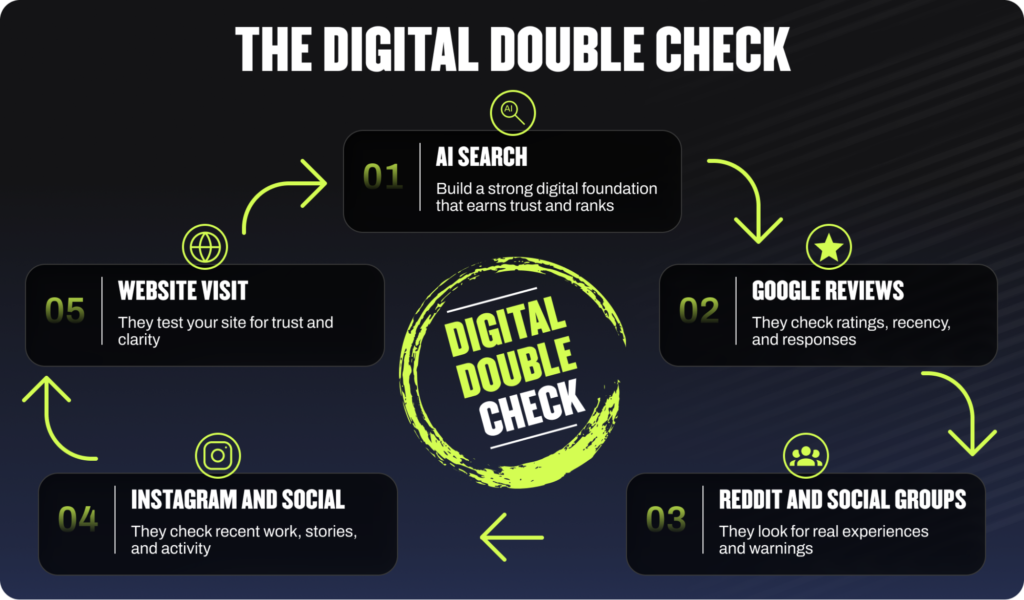
The contractor is being evaluated at every one of those steps without knowing it. By the time someone calls, the shortlist is usually already set. If you’re not on it, no amount of sales skill or phone presence saves the job.
Stage 1: Homeowners Start With AI, Not Just Google
The first stop is increasingly an AI tool, not a Google search bar.
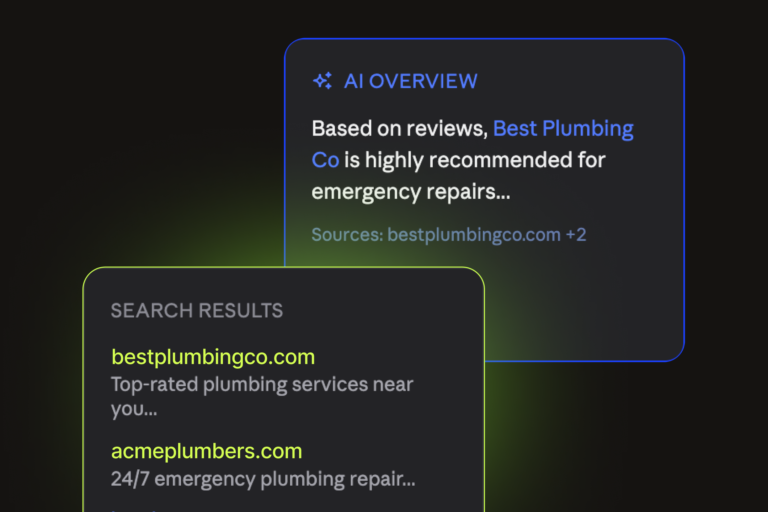
I know that sounds like something you’ve heard a lot recently. But I want to make it concrete because the behavior shift is faster than most people realize. Homeowners are literally opening ChatGPT and typing “what should I look for in a roofing contractor” or “best HVAC company in Minneapolis.” They get a direct, synthesized answer. No ads. No map pack. Sometimes with specific business names. And whatever comes back shapes their shortlist before they’ve done anything else.
The scale of this shift is real. AI tools surged from 6% to 45% usage for local business recommendations in a single year, according to BrightLocal’s 2026 Local Consumer Review Survey. That kind of jump in one year is not a gradual trend. That is a behavior change.
The stakes in AI search are structurally different from Google. In Google there is a page two. In an AI answer there is not. The homeowner gets four or five contractor names, sometimes fewer. If yours is not one of them, you are invisible at the very first stage of the process. No amount of optimization later in the funnel compensates for being filtered out before the shortlist forms.
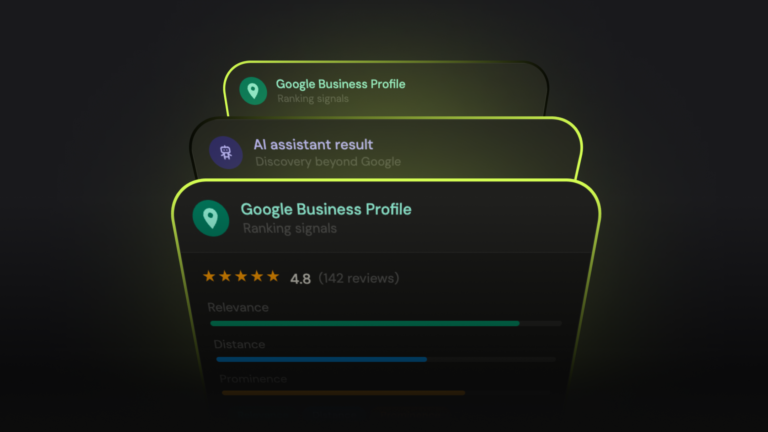
The businesses showing up in AI answers are not getting there through tricks. They’re showing up because they have strong, consistent signals: a complete Google Business Profile, real reviews, website content that clearly states what they do and where, and mentions across multiple platforms. If you want to understand why your business is invisible to ChatGPT, the answer almost always comes down to weak or inconsistent signals that AI tools can’t confidently read.

Stage 2: They Validate You Through Reviews and Social Mentions
Once a homeowner has names, they validate them. This is where trust is won or lost before you ever know they’re looking.
What the Review Data Actually Shows in 2026
According to BrightLocal’s 2026 research, the numbers are clear:
- 97% of consumers rely on reviews to guide purchase decisions
- 41% always read reviews before contacting a business, up from 29% just one year ago
- Consumers increasingly only consider businesses with 4.5 stars or higher
Volume matters. Recency matters more. A page full of reviews from 2022 looks like a business that stopped caring.
The detail most contractors miss: homeowners read your responses too.
- A defensive or dismissive response to a bad review damages trust
- A thoughtful response that acknowledges the issue and explains what you did about it can actually strengthen it
For a practical approach to building online reviews for contractors consistently: ask every time, right after the job. Not later. Not in an email campaign three days out. Right then.
Why Social Mentions Have Become a Serious Factor
Reddit and neighborhood Facebook groups are now a real part of how homeowners validate contractors, especially for larger jobs. A homeowner spending $15,000 on a roof replacement is going to search “best roofer [city] reddit” before they call anyone.
Why it matters:
- Those conversations are unfiltered and unsponsored
- They carry more credibility than anything you put on your own website
- They feed AI answers directly, platforms pull from public discussions when making local recommendations
- A business with consistent mentions across multiple platforms gets recommended. One that only exists on its own website doesn’t.
Reviews and social mentions are the homeowner’s background check. They run it before you get a say.
Stage 3: Your Website Becomes the Trust Test
When a homeowner clicks through to your website, it stops being a marketing asset and becomes a credibility test.
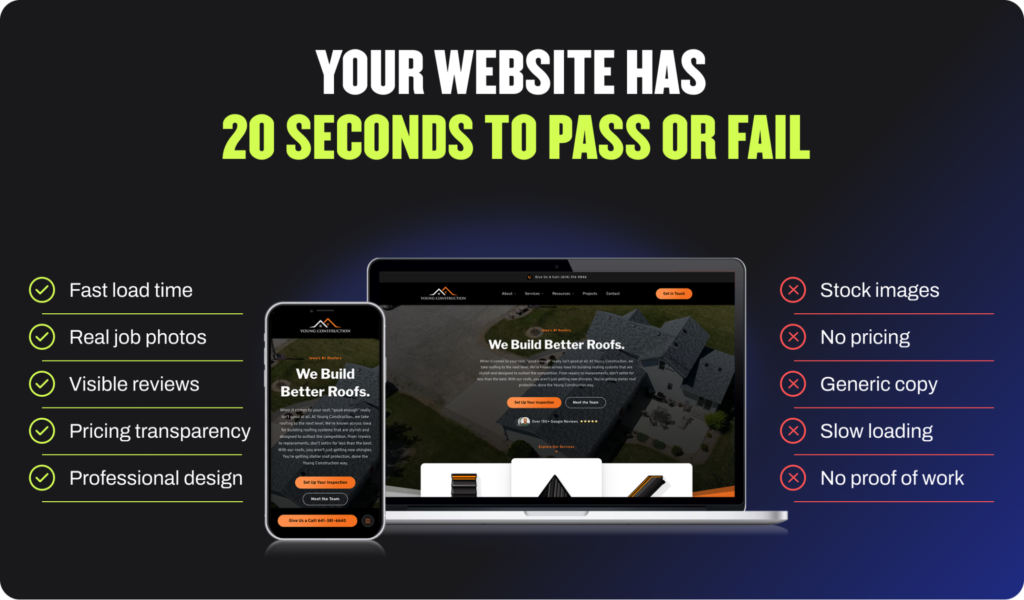
According to Clutch’s 2025 website trust research, 83% of consumers judge a website’s credibility in under 20 seconds, and 87% have immediately left a site that didn’t look trustworthy.
Not minutes. Seconds.
Your entire presentation as a business is being evaluated before the homeowner reads a sentence.
The failure mode for most contractor websites is not that they’re terrible. It’s that they’re generic. Stock photos, a paragraph about being family-owned, a form to get a free quote. A homeowner who just read twenty reviews and had AI tell them your name is now looking at something indistinguishable from every other contractor in the region.
What the website trust test actually checks:
- Speed on mobile. Most homeowner research happens on phones. A slow site reads as unprofessional regardless of the content.
- Real photos of real work. Not stock images. Actual before and after shots, job site photos, named team members. Evidence that real people did real work.
- A project gallery that tells the story. Not a grid of finished roofs. Context about the job, the challenge, what was done and why. This is what converts skeptical homeowners into callers.
- Pricing transparency. Many homeowners want a rough number before they’re ready to talk to anyone. A page with honest range-based estimates removes friction that sends them to a competitor who answered the question.
- Visible reviews on the site itself. Embedded, current, specific reviews they can read without leaving the page.
The AI angle makes a weak website worse than it looks: a thin template site is also harder for AI tools to read and recommend. The same site that fails the homeowner also fails the algorithm. Our guide to home service websites that convert covers what the ones that actually work have in common.
Your website either confirms you’re the right choice or quietly kills the deal before you even know someone was considering you.
Stage 4: Speed Decides Who Gets the Job
By the time a homeowner reaches out, the final filter is speed.
Here’s what’s actually happening when they fill out your form or call. They’ve done the research. They have two or three names. They reach out to all of them at roughly the same time. The job goes to whoever gets back first with something that doesn’t feel like a bot or a voicemail.
Not the most experienced. Not the best reviews. The fastest credible response.
The numbers on this are not subtle:
- 78% of customers buy from the first business that responds
- Leads contacted within 5 minutes are 21 times more likely to qualify than those reached at 30 minutes
- The average home service company takes over 3 hours to respond to an inbound lead
Three hours. In a market where the decision is often made in the first fifteen minutes.
There’s a 2026 wrinkle that makes this even more painful. Apple’s AI call screening is now intercepting calls from unknown numbers for a significant chunk of iPhone users. If you didn’t text the lead first while they still remember contacting you, your follow-up call may not even ring through. They’re not ignoring you. Your call literally isn’t landing. What a missed call is actually worth in dollar terms is a sobering calculation for most contractors who do it.
I talked with Noah Williams from the Home Doctor Sales System on our podcast and something he said about the “I need three estimates” objection stuck with me.
He said by the time a homeowner throws that at you, their mind is already halfway made up about who they trust. The three estimates thing is covered. It’s what people say when they’re not fully sold yet but they’re leaning somewhere already. That lean usually started well before the conversation, and speed played a big role in shaping it. Whoever reached them first and felt solid in those first few minutes built the trust the others are still trying to catch up to.

Why Most Contractors Lose Deals Before the First Call
This is the honest section. I talk to contractors all the time who tell me their leads stopped converting and they can’t figure out why. Nothing obvious has changed. Same marketing, same pricing, same people. But something is different.
Almost always, they’re getting filtered out silently at one or more stages of the research journey without knowing it. Here’s what that actually looks like:
- Invisible to AI tools. No consistent online signals, no presence in AI answers, no entry into the consideration set. The homeowner’s shortlist forms without you.
- Too few reviews, or reviews that are too old. A business with 15 reviews from 2022 fails the validation stage. Homeowners want to see recent proof that real customers hired you and were happy.
- No social footprint. A contractor who appears nowhere in neighborhood group discussions or third-party mentions looks unverified to a homeowner doing real research.
- A website that looks cheaper than the price. If you charge premium rates but your website looks like a template site, the gap between presentation and pitch breaks trust before anyone calls.
- No pricing transparency. Homeowners doing research often want a number before they’re ready to talk. A site with no pricing information sends them to someone who answered the question.
- Slow response. Slow response times cost leads in a way that is measurable and direct. Every hour of delay is jobs going to whoever answered faster.
Most lost contractor deals are not lost at the sales table. They’re lost silently during a research process the contractor never sees. Which is exactly why the leads “just stopped converting” with no obvious cause.
How to Match Your Marketing to How Homeowners Research
Once you see the journey, the fixes map directly to each stage. This is the home services marketing strategy framework we use with every client: one connected system, not four separate tactics.
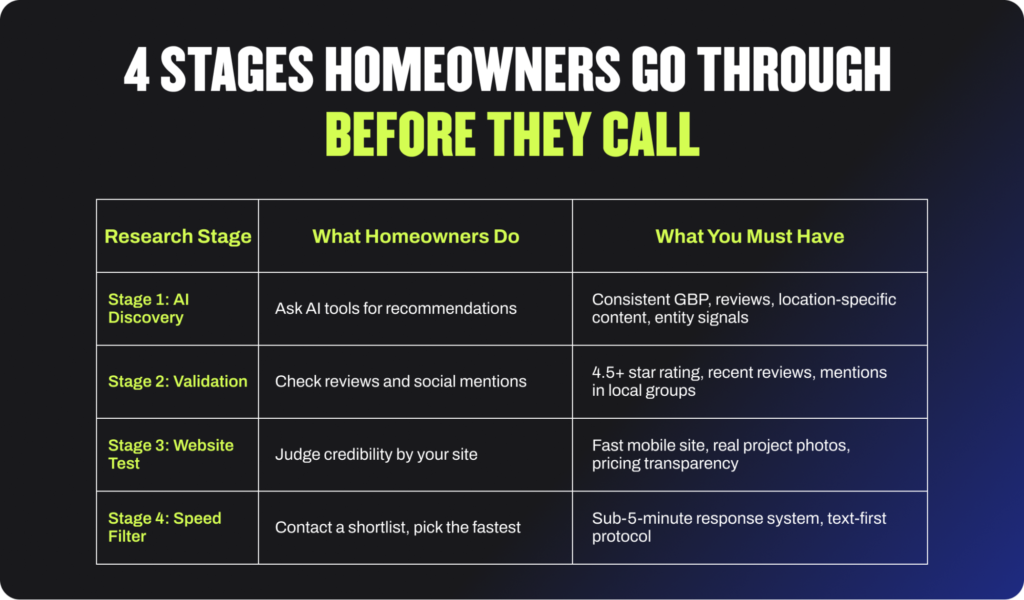
The stages are connected because the homeowner experiences them as one continuous journey. Winning Stage 1 and failing Stage 3 means you entered the consideration set and then talked yourself out of it. All four have to hold.
What Consistent Visibility Actually Looks Like
We had a roofing client in Myrtle Beach a while back. Solid company, good reviews, guys who actually knew their craft.
But they were invisible in search in all the ways that matter for Stage 1 and Stage 2 of this journey. Nobody could find them through AI or Google when searching for roofers in their area. Not because they weren’t good. Because they hadn’t built the signals those tools look for.
We built out targeted content and location-specific pages around the searches their customers were actually running. Here’s what happened within a year:
- 351% increase in total keywords ranking on Google
- Position one for “Roofing Myrtle Beach”
- 92.98% year-over-year increase in qualified organic leads
Same company. Same crew. Same quality of work. They just stopped being invisible at the stages where homeowners were looking.
The full breakdown is in the Monarch Roofing case study if you want to see exactly what was built and in what order.
For contractors who want to go deeper on the AI discovery piece specifically, our guide to answer engine optimization for home services covers what it actually takes to get your business included in AI-generated answers rather than filtered out.
Frequently Asked Questions
How do homeowners find contractors in 2026?
Homeowners increasingly start with AI tools like ChatGPT, Gemini, and Perplexity for recommendations, then validate those names through online reviews and social mentions, check the contractor’s website, and contact a shortlist, often hiring whoever responds first with something credible.
Do homeowners really use AI to choose contractors?
Yes. BrightLocal’s 2026 Local Consumer Review Survey found AI tools surged from 6% to 45% usage for local business recommendations in a single year. In AI answers there are no ads or map pack. A business is either in the response or invisible entirely.
How important are reviews when homeowners research contractors?
Very. BrightLocal’s 2026 research found 97% of consumers rely on reviews and 41% always read them before contacting a business, up from 29% one year earlier. Homeowners increasingly only consider businesses with 4.5 stars or higher, and they look at recency and detail, not just overall rating.
Why do contractors lose leads they never knew they had?
Most contractor deals are lost during the homeowner’s private research, not at the sales table. If a contractor is invisible to AI, has weak or old reviews, an unconvincing website, or a slow response time, they’re filtered out before the first real conversation.
How fast should a contractor respond to a lead?
Within five minutes if possible. Leads contacted within five minutes are 21 times more likely to qualify than those at thirty minutes, and 78% of customers buy from the first business to respond. The average home service company takes over three hours. That gap is where jobs disappear.
What do homeowners expect from a contractor website?
Clutch’s 2025 research found 83% of consumers judge a website’s credibility in under 20 seconds, and 87% have immediately left a site that didn’t look trustworthy. Homeowners expect fast load time on mobile, real project photos, visible reviews, and some form of pricing transparency.
The Research Journey Gets More Digital From Here
Everything in this guide is only going to intensify. More AI usage for local discovery. Higher review standards. Less tolerance for slow response. The contractors adapting now are building an advantage that compounds every month. The ones who don’t will keep losing leads they never knew they had.
At Hook Agency we work exclusively with home service contractors. We build the websites, run the SEO, and develop the marketing systems that put contractors in front of homeowners at every stage of this journey. If you want to see what that looks like for your trade and your market, schedule a call with our team. No generic proposals. Just an honest conversation about what we’d build.