
A few months ago I pulled up the GBP profiles of the top three map pack results for “roof replacement [city]” in a mid-size market. All three were ranked within a few positions of each other. Two of them had not posted anything in four months. The third had posted eleven times in that same window: job photos, a seasonal offer, a before-and-after from a recent hail job two miles from the city center.
Guess which one was getting more calls.
Not because the posts were pushing them higher in the rankings. The research on that is pretty clear, posts are not a direct local ranking factor. But homeowners in that market were clicking all three profiles. And one of them looked alive. The others looked like businesses that might not be answering their phones.
That is the real case for GBP posts. Not an algorithm play. A conversion play. Here is what this guide covers:
- Whether GBP posts actually help and the honest answer on rankings
- The four post types and what each one does
- A four-category content system that produces posts without burning out
- Trade-by-trade examples you can use this week
- How often to post and a simple weekly rhythm
- How to measure whether any of it is working
Contractors should post on Google Business Profile at least once per week, rotating completed job updates, seasonal reminders, and service offers. Every post needs a real photo and a clear call to action.
Do GBP Posts Actually Help? The Honest Answer
GBP posts are not a direct local ranking signal, but they produce engagement that supports local visibility and gives homeowners a reason to call instead of clicking away.
How homeowners research contractors has shifted. 86% of GBP impressions come from category-based searches rather than branded queries, per BirdEye’s 2026 State of Google Business Profiles analysis. The homeowner is not looking for a specific company. They are searching for a service and then choosing between three profiles they know nothing about.
What Posts Do Not Do
Sterling Sky tracked 441 keywords over nine weeks and found zero direct ranking movement attributable to posts alone. Google’s 2026 GBP guidance confirms it: treat posts as conversion assets, not ranking signals.
There is a nuance in the data most GBP articles miss. A Localo analysis of 16,098 profiles and 111,000+ Google Posts found that posting frequency showed a slight negative correlation with top-3 rankings: profiles posting fewer than once a month ranked top-3 at 73%, versus 70.5% for those posting eight or more times a month. But profiles with 10 or more total posts ranked top-3 at 73% versus 63.7% with none, a 9.3 percentage-point difference, per Whitespark and Localo’s 2026 local ranking factor data.
Spamming posts daily does not help. Building a library of real, substantive posts over time does. That distinction changes the entire strategy.
What Posts Actually Do
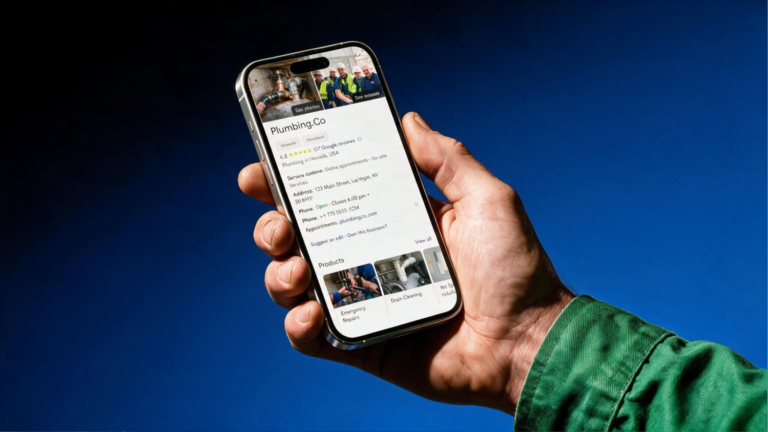
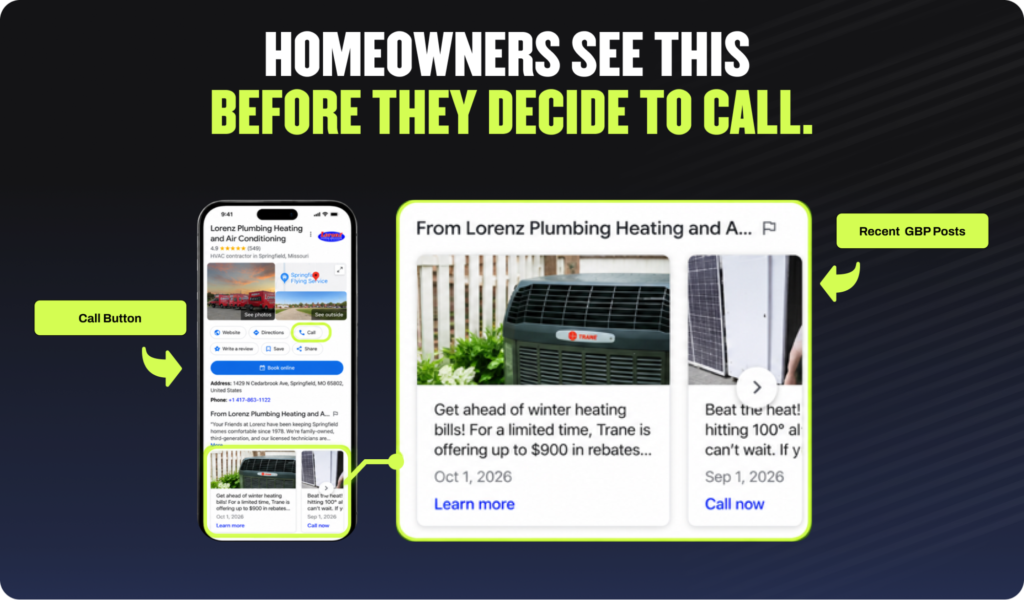
What posts produce is engagement: call clicks, website visits, direction requests. Every GBP post appears just above the primary Call button on the profile. A homeowner who found the business and is deciding whether to call sees the most recent post before making that decision.
A static profile with nothing posted in three months signals one thing: this company may not be actively taking work. A profile updated last week with a real photo from a completed job in their neighborhood signals the opposite.
For the broader picture of what drives Google Maps rankings for contractors, posts are one piece of a larger system. But within that system, they have the most direct line to the moment a homeowner decides to call.
The Four Post Types and When to Use Each
Google Business Profile offers four post types in 2026. They display differently and each serves a different purpose.
What’s New Posts
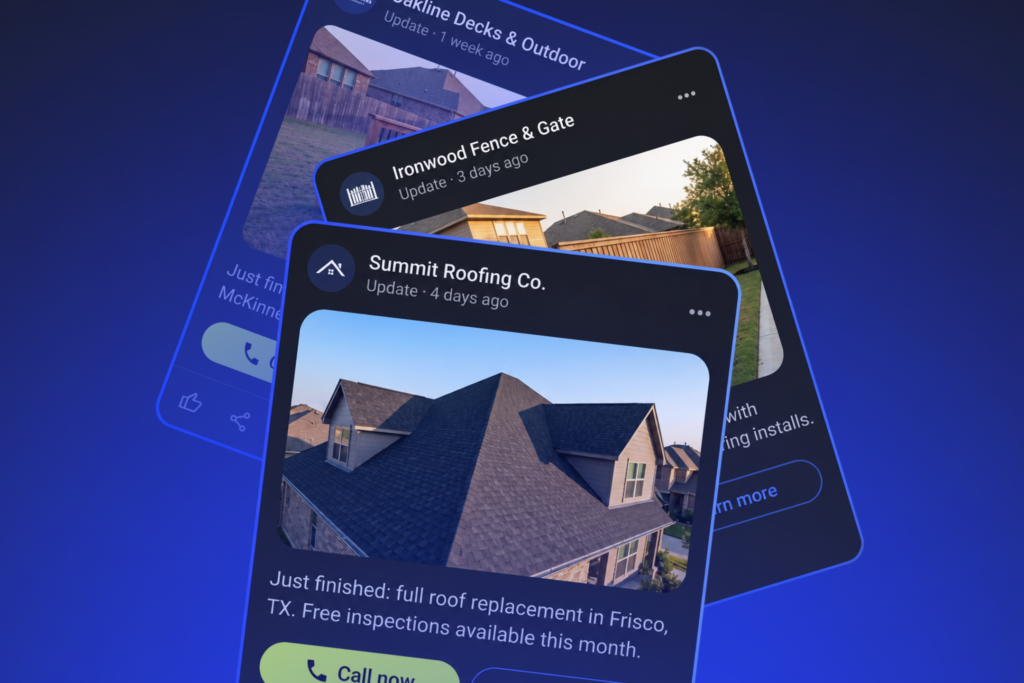
The default for most contractor updates. Use it for completed job photos, team announcements, new services, and anything without a defined end date. What’s New posts expire from the active section after seven days but stay in the profile archive. This is the post type for the weekly completed job rotation.
Offer Posts
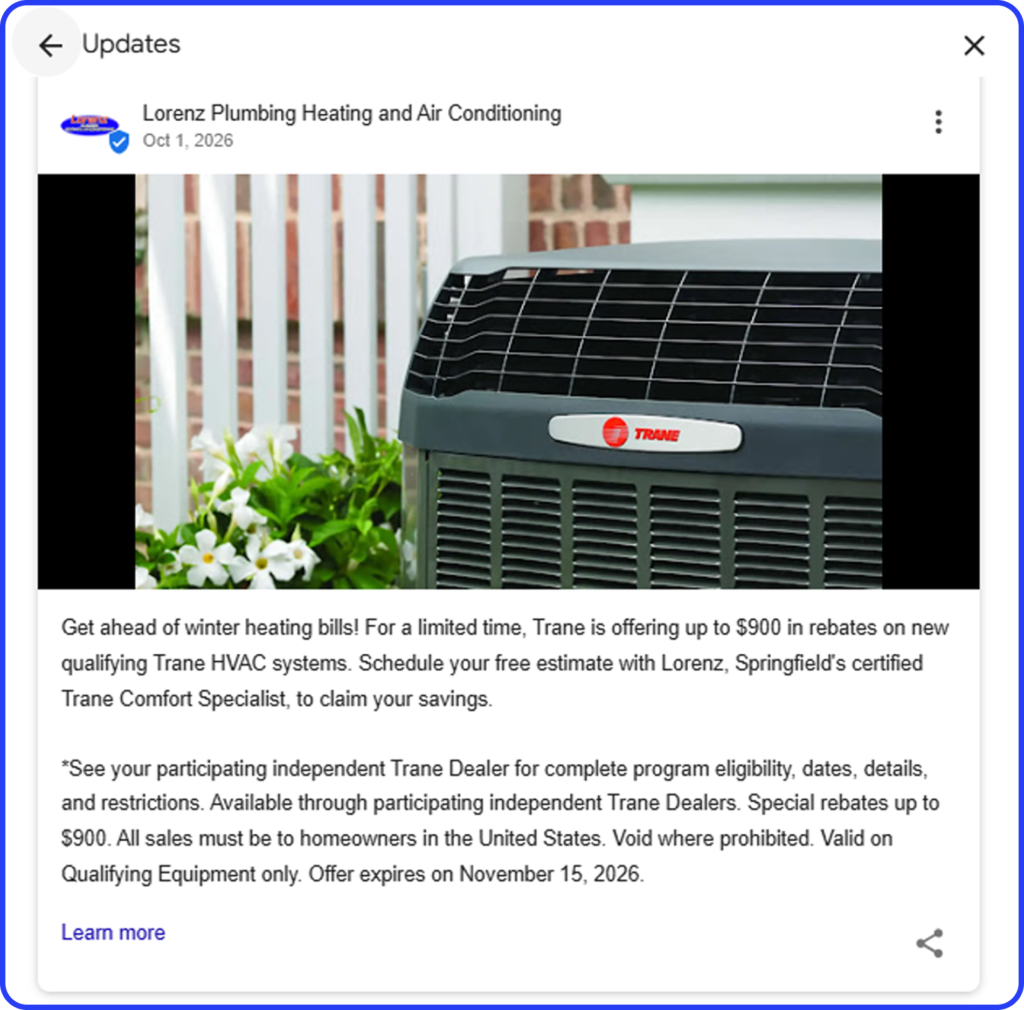
Offer posts display a promotional badge on the profile and drive the highest click-through of any post type. They require a start and end date. Use them for seasonal tune-up discounts, free inspections, or limited booking availability. They are underused by most contractors: pre-season AC tune-up offer in March, pre-winter furnace inspection in September.
Event Posts
Tied to a specific date. A free consultation day, a home show appearance, a community sponsorship. Less frequent for most contractors, but worth using when a real time-bound opportunity exists.
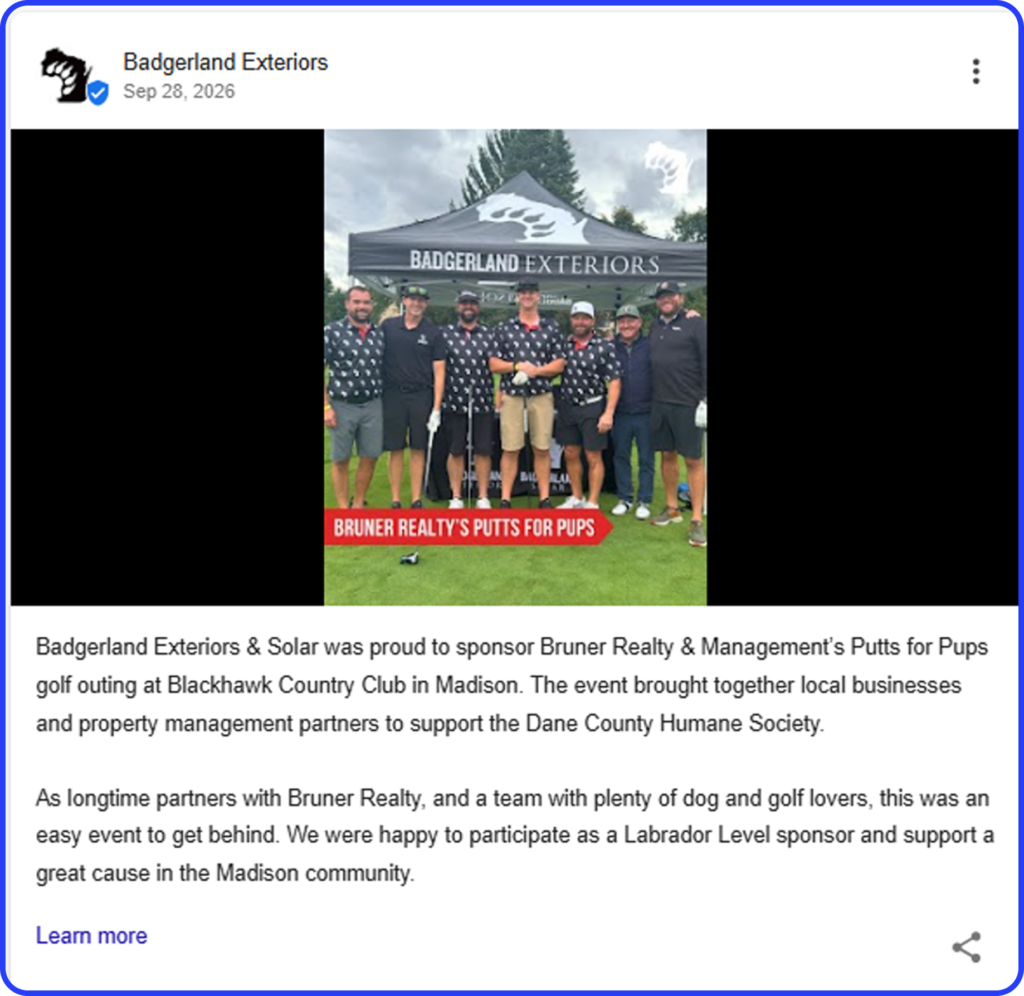
Photo and Video Posts
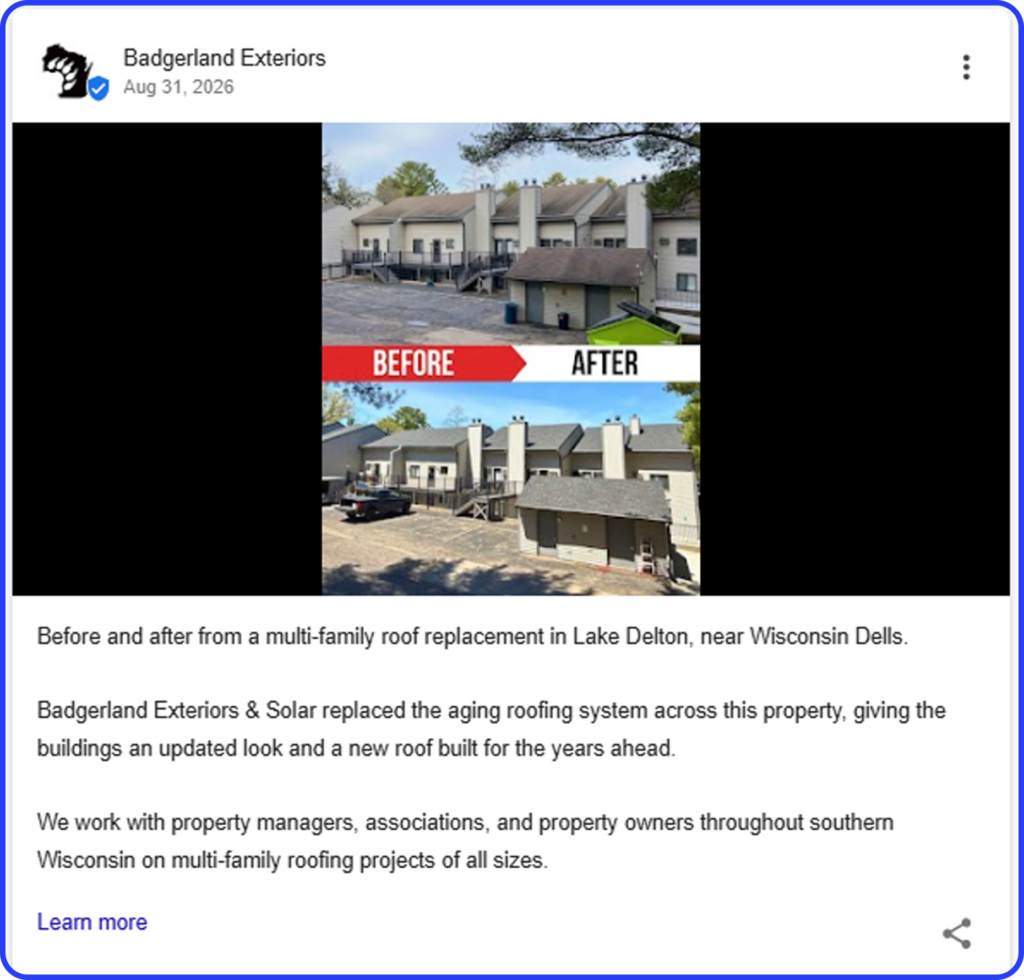
Any post is better with a photo, but a post leading with a genuine before-and-after image is in a different category. According to BirdEye’s 2026 GBP analysis, the average verified profile has fewer than one photo. A clear smartphone photo from an actual job site outperforms every stock image. Real photos from real jobs, posted consistently, build a profile that looks exactly like what homeowners want to see before they call.
What to Actually Post: A Contractor Content System
Four content categories cover everything a home service contractor needs to post without running out of material.
Completed Job Posts
The highest-trust content a contractor can post and the easiest to produce. After every job: one before photo, one after photo, three sentences. What was the problem, what was done, and where it happened.
Example: “Replaced a failing 18-year-old furnace in Kirkland last week. Installed a high-efficiency Carrier unit. Same-week installation. Call us if your heating system is struggling before the cold hits.”
This post type proves real local work, reinforces geographic relevance, and gives a specific reason to call. It is the backbone of the entire posting strategy.
Seasonal and Timely Posts
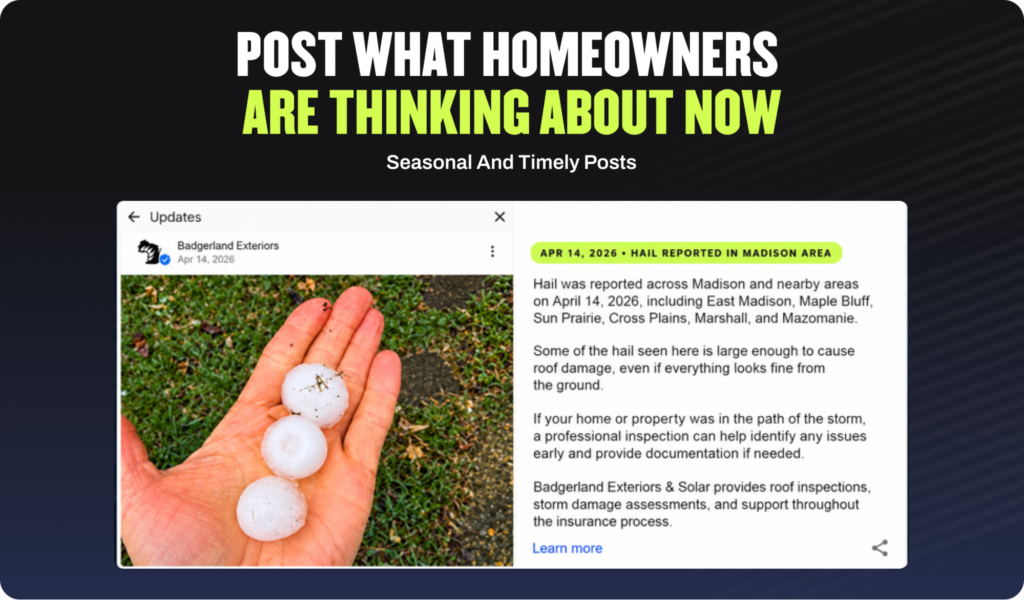
Timed to what homeowners in the service area are thinking about right now. A roofing contractor posts about ice dam prevention in October. An HVAC contractor posts about AC tune-ups in March. Weather events are an underused trigger: a storm hits, the next post is about storm damage inspection availability. Homeowners who just watched hail hit their roof are already looking.
Trust and Credibility Posts
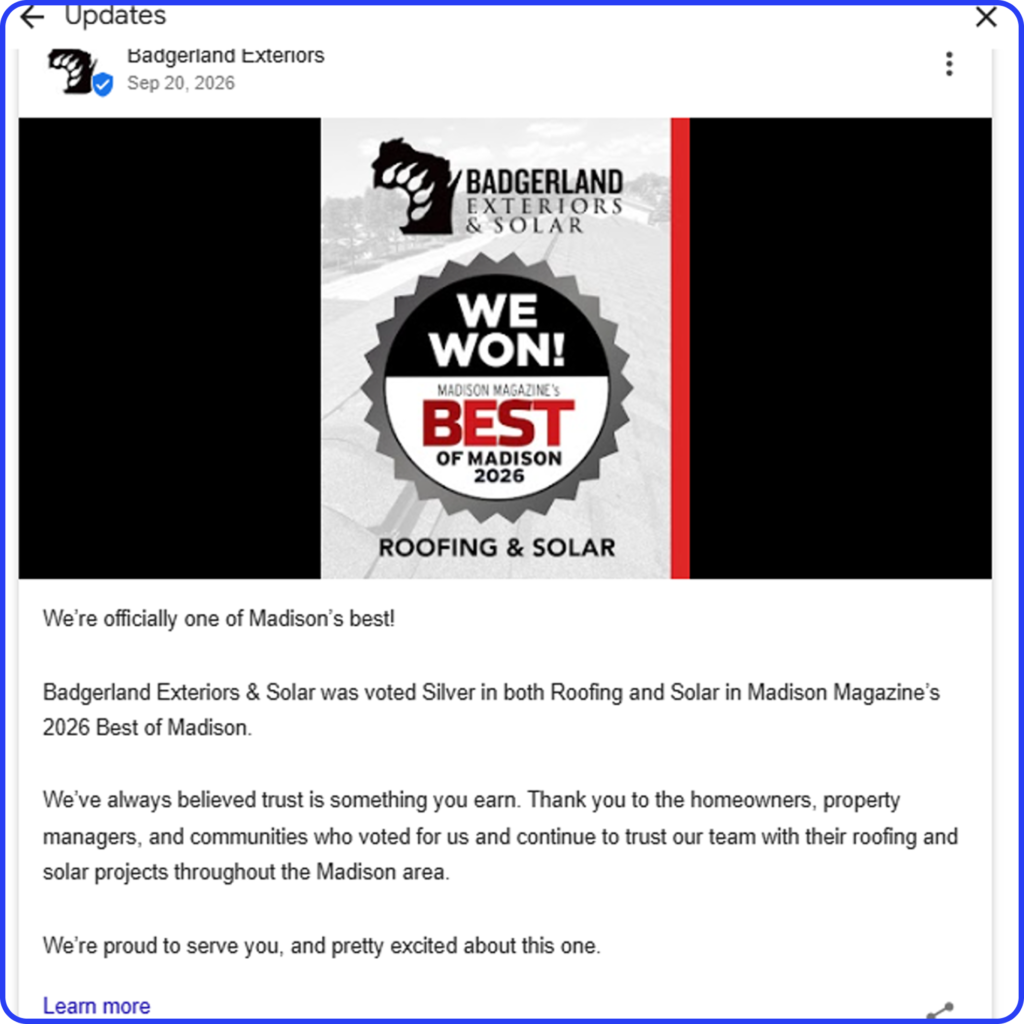
A strong Google review shared as a post. A photo of the team in uniforms at a job. A milestone like years in business or number of jobs completed. These posts build the human layer of the profile that homeowners scan before calling.
For the full strategy on building online review volume for contractors, that system runs alongside the posting strategy rather than separately.
Service Spotlight Posts
One service per post, explained plainly and tied to a current need. Not a list of services. “We install whole-home generators in Bellevue and Kirkland. If the power goes out for more than a few hours, a generator keeps everything running. Call for a free quote.”
This type of post also reinforces the service-to-geography association that ties directly back to the total post volume effect in the Localo data.
Trade-by-Trade Post Examples
HVAC
- Completed job: “Replaced a 16-year-old AC unit in Bellevue last week. Installed a 16 SEER Trane unit. House is cooling evenly for the first time in years. We have availability this week for tune-ups before the heat wave. Call us.”
- Seasonal: “Spring is the right time to get your AC serviced before summer demand hits. Booking tune-ups in Bellevue and Kirkland now. Call before the schedule fills.”
Roofing
- Completed job: “Finished a full roof replacement in Redmond after hail damage from last month’s storm. Tear-off, new OSB, Owens Corning Duration shingles. Done in two days. Call if you need a storm damage inspection.”
- Seasonal: “Ice dam season is coming. If you had ice dams last winter, your attic ventilation may be the problem. Free roof inspection on the Eastside this month.”
For the full roofing marketing strategy that these posts fit into, that guide covers the complete local search picture.
Plumbing
- Completed job: “Water heater replacement in Kirkland. 18-year-old tank unit replaced with a Bradford White 50-gallon. Same-day installation. If your water heater is over 10 years old, a quick inspection can tell you how much time it has left.”
- Seasonal: “Frozen pipe season is two months away. If your home has pipes in unheated spaces, call us for a winter prep check. Prevents expensive emergencies.”
Electrical
- Completed job: “Panel upgrade in Redmond last week. 100-amp to 200-amp service. The homeowner had breaker trips and could not add an EV charger. Now fully upgraded and permitted.”
- Seasonal: “Outdoor lighting adds security and curb appeal before the holidays. Doing outdoor electrical installations in Kirkland and Bellevue through November. Call for a free quote.”
How Often to Post and a Simple Weekly System
The Right Frequency
One to two posts per week. Not daily, not monthly. The Localo data makes the case precisely: it is the total library of posts that correlates with top-3 rankings, not the pace of posting. A contractor posting once a week for a year builds a meaningfully stronger profile than one who posts daily for a month and then stops.
What’s New posts expire from the active section after seven days. A profile that posted three times last month looks dormant to homeowners checking it today. Consistency over intensity.
A Simple Weekly Rhythm That Takes 20 Minutes
Monday: Pull one completed job from the previous week. Use the before and after photos from the job file. Write three sentences: what the problem was, what was done, which neighborhood. Set CTA to Call Now. Post.
Friday (optional second post): Write a seasonal reminder or service spotlight tied to what homeowners in the area are thinking about in the next few weeks. One photo from a similar past job. Post.
The raw material already exists after every completed job. The system is just capturing it before it disappears into a job file.
The CTA That Turns a Post Into a Call
Every GBP post has a call to action button. For home service businesses, Call Now and Book drive the most direct action because they match what a homeowner who is ready to decide actually wants to do. Learn More works only when the post is informational and links to a relevant service page.
Never link a GBP post to the homepage. If the post is about water heater installation, link to the water heater service page. A homeowner who clicked because they need a water heater and lands on a generic homepage will not dig to find it. For home service websites that actually convert those clicks, the service page connection matters beyond GBP.
The CTA in the post text matters as much as the button. “Call us this week before the schedule fills” is a prompt with urgency and specificity. “Contact us for more information” is not. When one is vague, the other cannot compensate.
How to Tell If Your Posting Is Working
GBP Insights connects posting activity to profile actions. Three numbers tell most of the story.
- Profile views: how many people saw the profile in search results
- Call clicks: how many clicked the phone number from the profile
- Website clicks: how many clicked through to the site
Compare the same month before and after starting consistent posting. GBP Insights also shows post-level performance: views and clicks per individual post. If completed job posts consistently produce more clicks than seasonal reminders in a specific market, adjust the rotation.
According to BirdEye’s 2026 data, phone calls represent 15% of total GBP customer actions, behind website visits (47%) and direction requests (38%). For contractors, that 15% is disproportionately high-value. A homeowner who calls from the profile is much further along in the decision process than one who visited the website.
Call clicks is the number that matters most. A call tracking number on the GBP listing ties profile calls to booked jobs and shows what the profile is generating in revenue, not just activity. For broader GBP optimization, Hook’s guide on improving Google local services ranking covers the full picture beyond posts alone.
Start This Week, Not Next Quarter
The weekly posting system described here takes 20 minutes. The before-and-after photos already exist. The seasonal timing is predictable months in advance. The only thing missing is the habit of capturing it consistently.
A complete Google Business Profile that posts real work weekly, runs offer posts before each season, and uses a specific CTA is one of the highest-ROI free tools available to any home service contractor. Free in the sense that Google does not charge for it. Not free in the sense that it requires attention. But the attention required is small relative to what it produces.
For contractors who want a GBP strategy managed alongside their full local SEO program, Hook Agency works specifically with home service businesses across HVAC, roofing, plumbing, and other trades.
FAQs
Do Google Business Profile posts improve local search rankings?
Not directly. A Sterling Sky study tracking 441 keywords over nine weeks found zero direct ranking movement from GBP posts. What posts do produce is profile engagement: call clicks, website visits, direction requests. Localo’s analysis found profiles with 10 or more total posts rank top-3 at 73% versus 63.7% with none, but that correlates to post volume over time, not frequency.
How often should a contractor post on Google Business Profile?
Once per week minimum, two as a comfortable target. Consistency matters more than frequency. A contractor posting once a week every week outperforms one who posts twelve times in January and then disappears for three months.
What should a home service contractor post on GBP?
Four categories: completed job updates with before-and-after photos and a neighborhood reference, seasonal reminders tied to current homeowner concerns, trust-building posts like shared reviews or team photos, and service spotlight posts focused on one specific service and one area. Every post needs a real photo and a clear CTA.
What type of GBP post drives the most calls?
Offer posts drive the highest click-through rates. For actual calls, completed job posts with real before-and-after photos and a location reference build the most trust at the moment a homeowner is deciding. The CTA button should be Call Now or Book, not Learn More.
How long do GBP posts stay visible?
Most post types expire from the active section after seven days and move to the archive. Offer posts stay visible until the offer end date. Event posts stay visible until the event date. This is why consistent weekly posting matters: a profile that last posted two months ago looks inactive to homeowners checking it today.
What photos should contractors include in GBP posts?
Real job site photos. Before-and-after pairs are the most effective format because they show the problem and the solution together. Team photos in uniform at a real job build trust. A clear smartphone photo from an actual job is more effective than a professionally staged image that does not show real work.