
You ever test your own company in ChatGPT?
“Who are the best roofers in Dallas?”
“Top HVAC companies near me.”
“Most trusted plumbing company in Phoenix.”
And your business is nowhere in the answer. Meanwhile, some competitor you know is smaller, newer, or honestly not better than you gets mentioned by name.
If your business is invisible to ChatGPT, it feels personal. Like the internet just skipped you. Here’s the reality. ChatGPT is not scrolling Instagram. It is not driving past your yard signs. It is not impressed by how busy your crews are. It pulls from structured, authoritative content across the web. If your site is thin, generic, or built only for basic local SEO, AI has nothing strong enough to summarize.
This is not about chasing some shiny AI trend. It is about whether your online presence is built in a way machines can understand and trust.
If you want to stop being invisible to ChatGPT and start showing up in AI-driven answers, we need to talk about signals, authority, and what actually makes a contractor visible in this new layer of search.
Why AI Tools Do Not “See” Most Local Businesses
A lot of contractors assume ChatGPT works like Google. It does not.
Google crawls and indexes websites constantly. ChatGPT generates answers by summarizing patterns from high-trust, well-structured content across the web. It is not actively scanning every local roofing or HVAC site looking for hidden gems.
If your business is not clearly established in places AI systems recognize as credible, you will not show up.
And this is not some fringe trend. 64% of consumers now use AI tools for product discovery. That number jumps to 66% among frequent online shoppers. Even more telling, 34% of those high-intent users start with ChatGPT. For a growing group of buyers, AI is the front door.
AI tools tend to pull from signals like:
- In depth, well structured website content
- Clear service breakdowns that directly answer questions
- Trusted directories with consistent business information
- Strong brand mentions across reputable sites
This is also where AI overviews in local SEO come into play. Google is increasingly summarizing businesses directly inside search results. Those summaries are built from structured, authoritative content. If your site lacks depth or clarity, you do not make it into that layer.
How AI Tools Decide Which Businesses to Mention
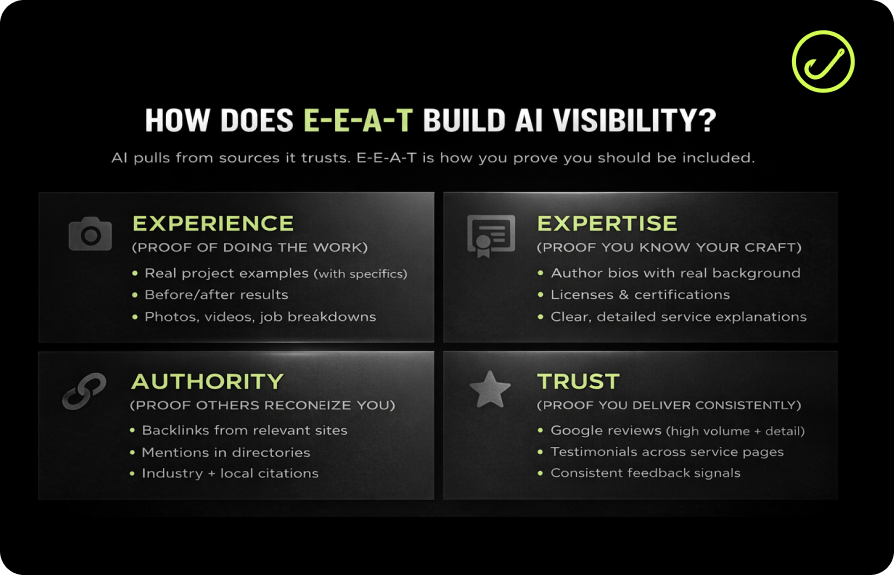
Here is where things get real. AI does not randomly pick businesses. It leans toward signals that look credible, consistent, and authoritative across the web. This is where brand authority and EEAT in AI search start to matter.
AI models favor businesses that clearly demonstrate:
- Experience
- Expertise
- Authority
- Trust
Not as buzzwords on an About page. As proof.
That proof usually looks like:
- Detailed service pages that actually explain the work
- Case studies with specifics
- Clear authorship and visible leadership
- Reviews and third-party citations
- Mentions across other reputable websites
If your website reads like a 500 dollar template with city names swapped in, AI knows. There is no depth to anchor to. No signal that says this company leads in its space.
There is research behind this pattern. A 2023 Stanford and Berkeley study found that large language models tend to overrepresent high-profile publishers in summaries. Why? Because syndication and indexing signals reinforce their authority across the web. The 2024 Reuters Institute report echoed this. AI aggregators frequently cite established brands because their E-E-A-T signals make their content citation-worthy across models.
In plain English, AI reflects what already looks authoritative at scale.
This also explains why structured, specific content beats generic volume every time. Ten shallow blog posts will not move the needle. One strong, well-structured, authoritative piece that clearly answers a real question? That is something AI can confidently summarize.

The Most Common Reasons Your Business Is Invisible to ChatGPT
Let’s make this simple. If your business is invisible in AI answers, it usually comes down to a few predictable gaps.
1. Thin or Generic Website Content
“We offer quality roofing services.” That kind of line is everywhere.
No differentiation.
No depth.
No proof.
If your service pages are 400 words of recycled contractor language, AI has nothing meaningful to summarize. It cannot detect expertise if you never demonstrate it. Strong content explains process, pricing factors, materials, common mistakes, timelines, and real scenarios. Thin content just fills space.
AI can tell the difference.
2. No Authority Signals Outside Your Website
AI does not rely only on what you say about yourself. It looks for reinforcement across the web.
If you have:
- No backlinks
- No media mentions
- Weak directory presence
- Inconsistent NAP information
There is no external validation.
If no credible source talks about you, references you, or links to you, AI has no reason to surface your brand. Authority is built through repetition and consistency across platforms, not just your homepage.
3. You Are Relying Only on Local SEO
Ranking in the map pack does not guarantee visibility in AI answers.
AI often pulls from:
- Informational content
- High authority educational resources
- Strong service breakdowns
If your site only has basic service pages and city pages, you may rank locally but still lack topical authority. This becomes even more important when you look at the future of LSAs and AEO. As AI driven summaries and answer engines expand, businesses with deeper educational content and structured expertise will win more visibility beyond paid placements.
Map rankings are one layer. Authority content is another.
4. Your Brand Is Not Clearly Defined
AI struggles with vague positioning.
If:
- Your messaging is broad
- Your niche is unclear
- You look interchangeable with five competitors
You are harder to confidently reference. Specific beats generic. Every time.
The clearer your positioning and expertise, the easier it is for AI to understand who you are, what you specialize in, and when to mention you.
How to Make Your Business Visible to ChatGPT Without Chasing Hype
Let’s zoom out for a second.
ChatGPT now processes 2.5 billion prompts daily. About 31% of those prompts trigger web searches, and 59% of those searches are tied to local business intent. That means contractors are already being researched inside AI tools every single day.
This is not experimental traffic. It is a major discovery channel.
But here is the mistake we see. Contractors hear stats like that and start looking for the latest shiny tool or some oversized AI marketing stack. In reality, visibility inside AI answers is built on strong SEO fundamentals done exceptionally well.
Step 1: Build Authoritative Service Pages
Your core service pages need to become true resources. If you offer roof replacement, AC installation, or sewer line repair, those pages should go deep. In many cases, 1,000 to 2,000 words makes sense because you are covering real questions, real objections, and real scenarios.
That means:
- Detailed explanations of your process
- Clear differentiation from competitors
- Real FAQs pulled from sales calls
- Structured headings that make information easy to scan
- Schema markup where relevant
Step 2: Publish Strategic, High-Intent Content
Not all content moves the needle. Random blog posts about seasonal tips will not build authority on their own. What does work is content aligned with buyer intent and structured for clarity.
Focus on comparison posts, cost breakdowns, process explainers, and qualification-based content. These topics map directly to the kinds of questions people type into AI tools.
This is where real answer engine optimization for home services comes into play. You are not writing for keywords alone. You are structuring content so that answer engines can confidently extract and summarize it.
One strong, authoritative article that clearly answers a high intent question will outperform a stack of shallow posts every time.

Step 3: Strengthen EEAT Signals
AI summarizes what the internet already trusts. So you need visible proof of Experience, Expertise, Authority, and Trust.
Add real author bios. Show licenses and certifications. Include project examples with specifics. Display reviews prominently across service pages.
Consistent, detailed feedback matters. In competitive markets, Google reviews beat competition when they reinforce strong on site content and positioning. Beyond your website, earn backlinks from relevant local and industry sources. Get mentioned in reputable directories. Build signals that extend past your own domain.
The stronger your external authority, the easier it is for AI to include you in answers.
Step 4: Optimize for Answer Engine Visibility
This is not some secret AI hack. It is disciplined structure. Clear headings. Direct answers to common questions. Concise explanations. Logical formatting. Strong internal linking between related services and blog content.
You do not need a bloated AI marketing stack to start winning visibility. You need clarity, authority, and structure across your site.
If AI Cannot Explain Your Business, It Will Not Recommend It
Here is the reality.
AI tools can only summarize what is clear, structured, and trusted online. If your website is thin, generic, or missing authority signals, your business stays invisible. If your competitors are easier to understand and better reinforced across the web, they get mentioned instead.
This is not about hype. It is about clarity and authority.
The contractors who win are the ones with strong service pages, real EEAT signals, and content built to answer real questions.
If you are not sure where you stand, let’s find out. Book a call with Hook Agency and we will assess your site’s readiness for AI-driven search. You will get a clear breakdown of what is working, what is not, and what to fix first.