
I spent some time earlier this year with Brad Strawbridge, founder of Capital City Roofing and BuilderLync out of Austin. We were talking about Claude AI specifically, which I know sounds like every other conversation in the trades right now.
This one was different. Brad wasn’t theorizing. He walked me through his actual daily setup inside Claude:
- The specific workflows he built and saved as reusable commands
- The crew training system he runs off Claude projects
- The teach feature he uses to record processes his team triggers on demand
Two years into a business that now has seven sales reps focused almost entirely on relationship-building, not paperwork. That’s the version of the AI conversation I find genuinely useful. Not “Claude is going to change everything” but “here is exactly what changed in my roofing business and how I set it up.” That’s what this guide is built around.
Roofers using Claude are automating the non-revenue tasks that eat hours every week:
- Proposal creation
- Dispatching and scheduling
- Lead nurturing and follow-up
- Crew training and knowledge management
Which frees their teams to focus on selling and customer experience. That’s the core of it. Everything below is the detail.
Why Roofers Are Turning to AI Right Now
Roofers are turning to AI because it automates the non-revenue tasks that consume staff time, letting teams focus on selling and serving customers.
Think about what actually eats hours in a roofing office. Proposals. Supplement letters. Dispatching sales reps. Following up on cold leads. Onboarding new crew. None of those activities put a roof on a house. They’re necessary and they take a significant chunk of the working day.
The Numbers in 2026
This isn’t a future trend anymore. Roofing companies that have already built AI into their operations are pulling ahead operationally, and the gap between them and everyone else is opening fast. Larger companies are moving first. Smaller shops are still figuring out where to start.
The urgency piece: 78% of homeowners choose the first contractor that responds to them. A competitor running AI for roofing answers leads at midnight during a storm. A competitor without it plays phone tag the next morning. That’s not a small difference.

The Core Idea
AI doesn’t replace the people doing revenue work. It removes the busywork keeping those same people from doing more of it. McKinsey’s 2025 research found that 92% of companies plan to increase AI investment, but only 1% say they’re at actual maturity. That gap is opportunity. Most of your competitors are talking about AI without consistently using it.
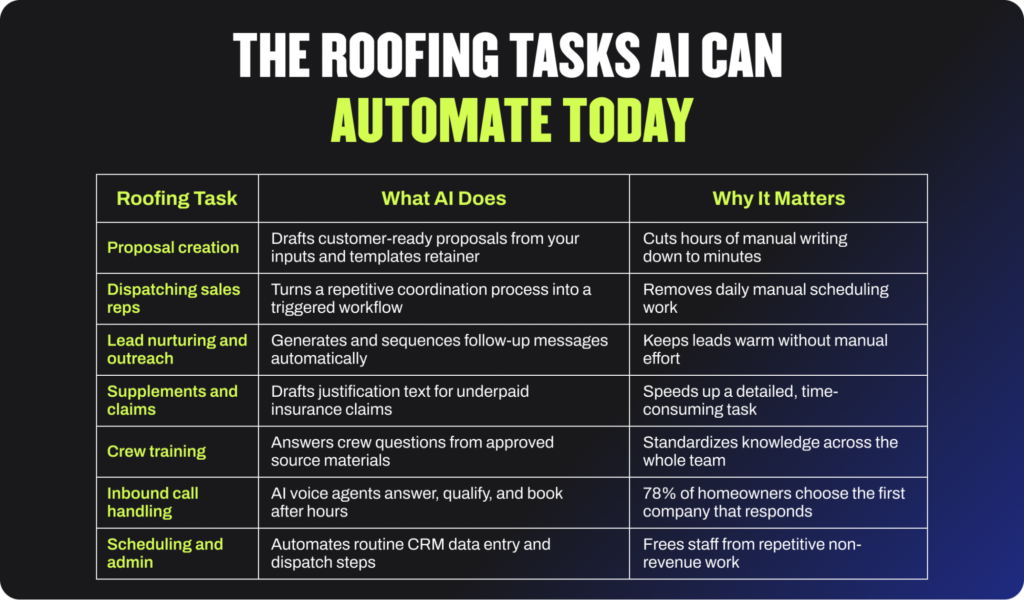
The Roofing Tasks AI Can Automate Today
AI fits best wherever a roofing task is repetitive, document-heavy, and doesn’t require a human relationship to complete. Our deeper guide on automation in roofing covers the operational side in more detail, but here’s the practical task breakdown:
How a Real Roofing Company Uses AI Every Day
Brad Strawbridge didn’t get into roofing because he loves technology. He’s a roofer who got tired of how much time was disappearing into paperwork and coordination instead of actual work.
When I sat down with him on our podcast, he walked me through his setup in detail. Here’s what it actually looks like:
The Workflow-First Approach
Brad uses an AI assistant to build reusable workflows for everything from proposal creation to dispatching sales reps. Instead of doing each task manually every time, he walks through the process once, the AI records and captures every step, and then he saves it as a named command. After that, it runs on demand or on a schedule without anyone managing it.
His example: the proposal creation process alone, pulling the measurement report, selecting the shingle line, building pricing, formatting the document, happens a hundred times a year. Teaching that workflow once means it never has to be manually managed again.
BuilderLync: One Platform Instead of Six
Brad built BuilderLync specifically because most roofing companies run five or six separate tools to sell and install one roof. CRM integration, measurement reports, cold outreach, scheduling, supplements, payment collection. His platform brings all of that into one system with AI running through each piece. The result: his seven sales reps spend their time building relationships and closing jobs, not entering data between platforms.
How to Use Claude in Your Roofing Business
Brad uses Claude more than any other AI tool in his operation. Not because it’s the flashiest, but because it’s the one that actually finishes things. Most AI tools in 2026 can start a task. Claude Co-work, which is Claude’s desktop app with an agent mode built in, can run multi-step workflows from start to finish without someone babysitting every step.
Here’s the thing he said that stuck with me: he manages Claude the same way he’d manage a senior employee. Not micromanaging every decision, but giving clear high-level direction, defining the role, setting the objective, and then checking the output. “I used to always say I’m an inch deep and a mile wide,” he told me. “A specialist is inch wide but a mile deep. Claude lets you operate that same way with your AI agents. I know at a high level what it should look like, but I don’t know all the specifics. I hold AI agents accountable to produce the results.”
That mental shift is more important than any feature. Once you stop thinking of Claude as a chatbot you type questions into and start thinking of it as a team member with a defined role and a knowledge base, the whole thing starts working differently.
Set Up Co-Work Projects by Division
The first real unlock for roofing companies is Claude Co-work’s Projects feature. Brad has separate Co-work spaces for each division of Capital City Roofing: one for residential, one for multifamily, one for low-slope commercial. Each project has its own context, its own files, its own objective.
Why does this matter? Because a question about an EPDM flat roof and a question about a residential insurance claim need completely different knowledge sources and different output formats. Mixing them into one generic workspace produces generic answers. Separated by division, each project produces output that’s actually specific to that type of work.
- Go to Claude at claude.ai or open the Co-work desktop app
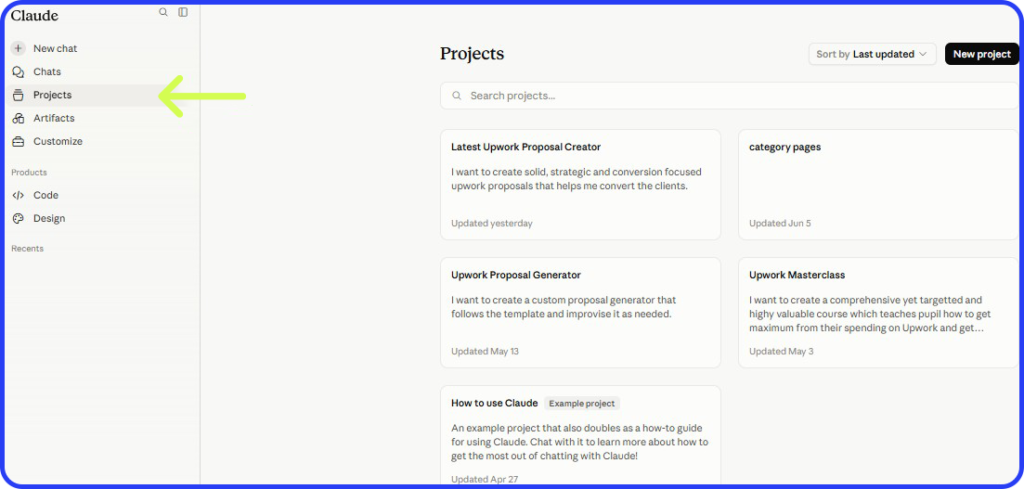
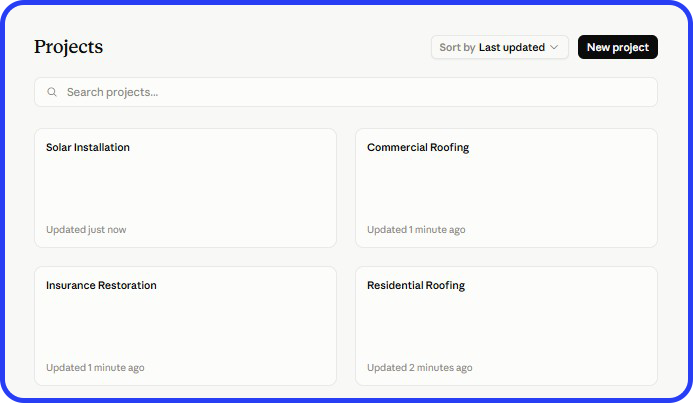
2. Create a new Project for each division: Residential Roofing, Insurance Restoration, Commercial Roofing
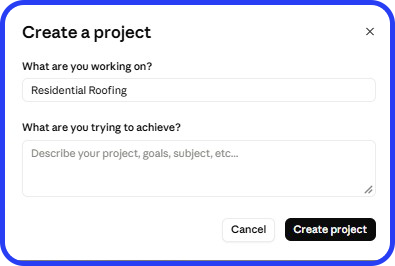
3. Name them clearly so your team knows exactly which one to open for each job type
Build Your claude.md File: Give Claude Its DNA
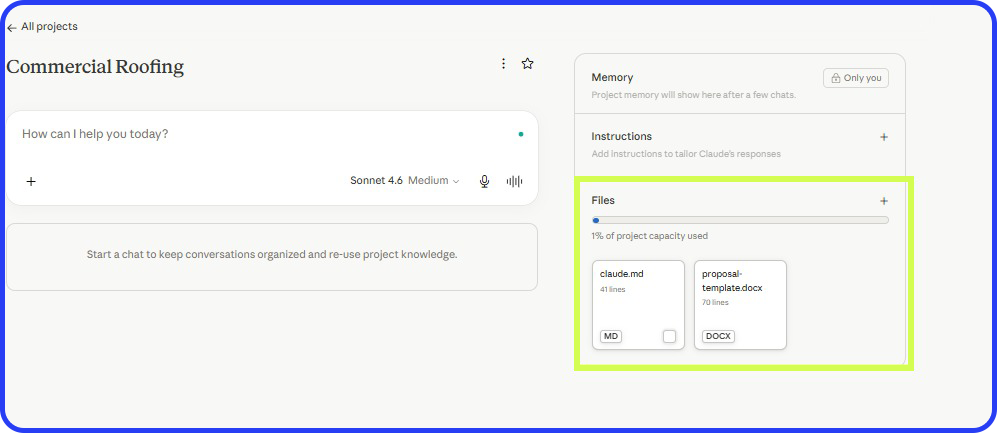
This is the step that separates roofers getting real output from those getting generic answers. Brad calls the claude.md file the identity and DNA of the project. It’s a text document you put inside each project that tells Claude exactly who it is, what company it works for, and what its job is.
For Brad’s residential project, his claude.md says something like: Claude, you are the co-visionary to Brad Strawbridge. You support Capital City Roofing’s residential operations. You run on EOS. Your objective is to produce residential roofing proposals, follow-up sequences, and customer communication that matches our brand voice. Then he lists the specific operations it handles.
Your version for a roofing company might look like this:
claude.md example for a roofing company: You support [Company Name] residential roofing operations in [City/State]. We focus on [retail/insurance/both]. Our average job is [dollar range]. We install [your shingle brands]. Our brand voice is [professional/conversational/direct]. When writing proposals, always include [your specific elements]. When writing supplements, always reference [manufacturer specs / Xactimate line items]. Never send anything without including our warranty language: [your warranty statement].
Once that file is uploaded to the project, every conversation in that project has that context baked in. Claude doesn’t forget who it is or what company it works for between sessions.
Automate the Commercial Roof Evaluation Process
This is one of Brad’s most impressive real-world examples. Commercial roof evaluations, doing the inspection report, the portfolio analysis, the documentation for a property manager or REIT, used to take hours of human labor. He’s automated it inside Co-work.
He built a commercial project with all of his inspection templates, property analysis frameworks, and reporting formats uploaded as source material. Now he can take the raw inspection notes and photos from a job and have Claude produce a complete, formatted portfolio analysis ready for the client.
For a roofing company doing any volume of commercial inspections, this one workflow alone is worth the time to set up.
Use the Teach Feature to Record Repeatable Workflows
The Teach feature is in the input box of the Claude desktop app. It’s a small arrow pointer icon. When you activate it, you narrate your way through a process in your browser or CRM while Claude records every click and takes a screenshot at each step. When you’re done, it generates a full SOP from your demonstration and saves the workflow as a named command.
The important thing Brad told me: run the workflow once, check the output carefully, fix it, then scale. There’s a strong temptation to immediately run it 50 times. But if there’s a problem in the setup, you’ve now made that mistake 50 times. Five at a time is the max he’d recommend until you’ve confirmed it’s working right.
- Open the Claude desktop app and click the teach icon in the input box
- Name your workflow: something like ‘proposal-creation’ or ‘supplement-draft’
- Walk through the process yourself in your CRM or browser, narrating each step out loud
- When finished, Claude generates the SOP automatically
- Trigger the saved workflow anytime with a forward slash command: /proposal-creation
- Put recurring workflows on a schedule so they run automatically at the right time
Real Prompts Roofers Can Use Right Now
These work inside a properly set-up project. Without your context files and claude.md, the output will be generic. With them, it matches your voice and format:
- Proposal from job details: “Using my proposal template and the job details below, write a customer-ready replacement proposal for [customer name] at [address]. Scope: [scope]. Product: [shingle brand and line]. Match my template format exactly.”
- Supplement justification: “Using the adjuster’s scope below, write a detailed supplement letter for the missing and underpaid line items. Reference Xactimate pricing norms and manufacturer installation requirements where relevant.”
- Lead follow-up sequence: “Write a 3-message follow-up sequence for a homeowner who received an estimate 3 days ago and hasn’t responded. Tone: helpful, not pushy. Match my company voice from the uploaded examples.”
- Crew training answer: “Based on the GAF and NRCA materials I’ve uploaded, explain the correct way to install step flashing along a brick chimney. Write it for a new installer, not an experienced tech.”
- Post-job review request: “Write a short text message asking the customer to leave a Google review after their completed job. Keep it under 30 words. Make it feel personal and specific to the job type.”
Why AI-First Roofing Companies Have the Advantage
Here’s the thing Brad said that stopped me. He thinks newer roofing companies have the bigger advantage right now, not the established ones.
His reasoning: a new company can build AI-first from day one. No legacy tools to abandon. No staff habits built around manual processes. No inertia. You just build the right way from the start.
He started Capital City Roofing two years ago. He’s already at seven sales reps and has automated the commercial roof evaluation process that used to take hours of human labor. He did that because he didn’t have years of existing workflow to fight against.
What About Established Companies?
They’re not locked out. I’ve seen established roofing companies make real gains with AI. But it requires actually committing to rebuilding specific processes, not just buying a tool and bolting it onto the existing way of doing things.
I talked about this directly with Bruce Leffler of Best Roofer Marketing on our podcast. His line on it was sharp: “You can’t take bad marketing and duplicate it with AI and have it become good marketing. You have to take good marketing and duplicate that with AI.” Same principle applies to every operational process in a roofing company. The advantage goes to whoever has clean processes and then automates them. Understanding how the AI search shift affects contractors is part of the same picture.

What AI Cannot Replace in a Roofing Business
I want to be direct about this because a lot of AI content skips it entirely. There are things that stay human and they’re not small things.
Selling and Closing
Closing a roof replacement with a homeowner at the kitchen table is a human conversation. It requires reading the room, handling objections in real time, and making someone feel confident about a large purchase. Roofing sales and AI work best when AI handles the preparation and follow-up, and the rep handles the relationship. No AI closes a complex residential sale the way a skilled rep does.
Field Judgment
A roofer who’s been on a thousand roofs reads a situation differently than any model can. Code questions, substrate conditions, storm damage assessment, supplement decisions that require context. That experience doesn’t live in a language model. It lives in the people who’ve done the work.
Customer Relationships
What makes a homeowner call you again and tell their neighbor about you is how they were treated. Not how efficiently your dispatch workflow ran. AI handles the paperwork so your team has more time and energy for the relationship. That’s the whole trade. It’s about keeping the human touch with AI for contractors rather than letting the tool replace the parts that actually earn loyalty.
Context Is Everything
Brad’s honest warning: AI is only as good as the context you give it. A roofer who feeds it almost nothing will get generic results that sound like everyone else’s proposal. The roofers getting real output are giving the AI their templates, their voice, their process details, and their specific materials before asking it to produce anything. IBM research shows organizations deploying AI at an operational level outperform peers by 44% on metrics like employee retention and revenue growth. The key word is operational. Integrated into how the business actually runs, not sitting in one person’s browser tab.
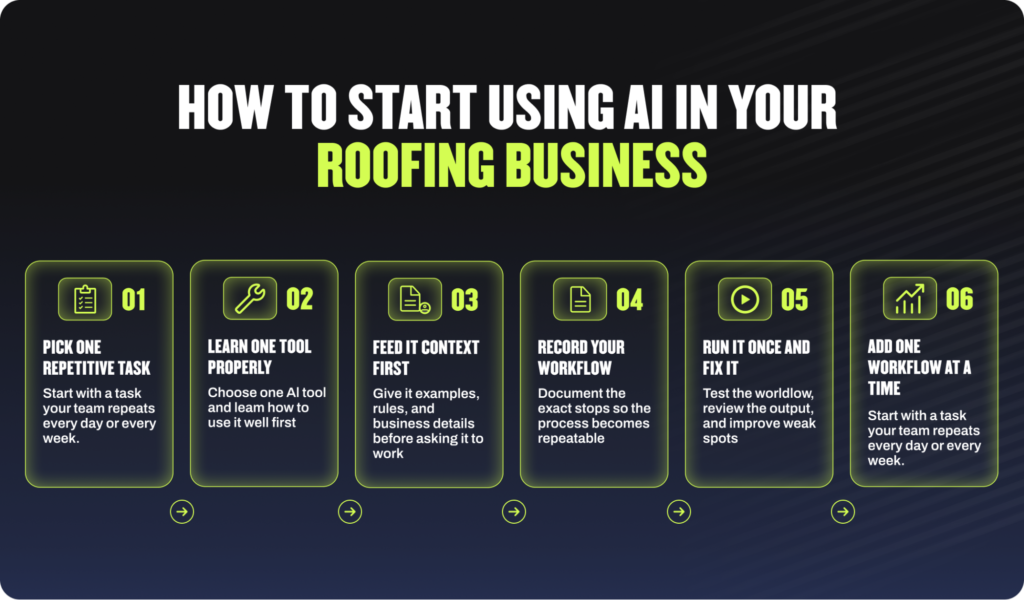
How to Start Using AI in Your Roofing Business
You don’t need a consultant, a three-month rollout, or a new tech stack. Here’s the path that actually works for roofing companies:
- Pick one repetitive non-revenue task. Proposals, follow-up sequences, supplement letters. Something document-heavy you do constantly.
- Choose one tool and learn it properly. Don’t start with five. Claude works well for roofing workflows. So does ChatGPT with the right setup. Pick one and get comfortable before adding anything.
- Feed it context before you ask for anything. Give it your templates, past proposals, process notes, company voice. This is the step most people skip and then wonder why the output feels generic.
- Use the teach feature to record your workflow. Walk through your process once, let the AI capture every step, and save it as a named workflow.
- Run it once, fix it, then scale. Check the output carefully before triggering it repeatedly. One fixed workflow pays off every time. Fifty flawed outputs wastes the same time you were trying to save.
- Add one workflow at a time. Expand only after the previous workflow is running reliably and your team has actually adopted it.
The roofers winning with AI right now didn’t transform everything at once. They automated one task, proved it, and built from there.
I also talked with Same Day AI on our podcast about AI voice and follow-up specifically for home service companies. Their argument is worth holding onto: stop evaluating voice AI by whether it sounds human in a demo and start judging it by whether it actually protects expensive leads and improves booking rates in your real operation. That’s the right frame for every AI tool, not does it look impressive, but does it produce measurable results inside your specific business.

Something to note: The roofing companies we work with that see real gains from AI don’t start by trying to transform everything. They identify the single most painful non-revenue task and automate just that first. The other thing that consistently separates useful AI output from generic output is context. The owners who give AI their actual materials, their real process, and their company voice before asking it to produce anything get results that sound like them and convert. The ones who just open a chat and type a question get an answer that sounds like everyone else’s proposal.
Frequently Asked Questions
How are roofers using AI in their business?
Roofers use AI to automate non-revenue tasks like proposal creation, dispatching sales reps, lead nurturing, cold outreach, supplements, and crew training. This frees their teams to focus on selling and delivering a better customer experience.
Can AI automate roofing proposals and estimates?
Yes. AI can draft customer-ready proposals and estimates from your inputs and templates, cutting a task that often takes hours down to minutes, as long as you give it enough context and your own materials to work from first.
What is the best way to start using AI in a roofing company?
Start with one repetitive non-revenue task such as follow-ups or proposals. Pick a single AI tool, feed it your materials and process context first, teach it your workflow, and expand one task at a time once each one is running reliably.
Is it too late for an established roofing company to adopt AI?
No. Newer companies have an edge because they can build AI-first from the start, but established roofers still get real gains by committing to rebuilding specific processes around automation rather than just bolting AI tools onto old routines.
Can AI replace roofing sales or office staff?
No. AI removes repetitive busywork, but selling, building homeowner trust, and judgment on complex jobs stay human. The goal is to give your team more time and energy for the revenue and relationship work by removing the paperwork that was consuming their day.
Can AI help train a roofing crew?
Yes. By uploading manufacturer materials and approved roofing content into an AI tool as knowledge sources, you can build a training resource that answers crew questions accurately from vetted material rather than relying on whoever is available to answer.
Roofing Is Moving Toward AI. The Gap Is Opening Now.
Forty percent of roofing contractors are already using AI. Another 36% are planning to. The companies pulling ahead are automating non-revenue work one task at a time, not because it’s trendy, but because it frees their teams to close more jobs without burning out.
If you want to understand how AI fits into a broader roofing growth strategy, or if you want help building the marketing system that fills the pipeline your team now has capacity to handle, that’s exactly what we do at Hook Agency. We work exclusively with roofing and home service companies.
Our guide on how to market roofing covers the commercial side. And when you’re ready to talk about what a real program looks like for your market, schedule a call with our team. No generic proposals.