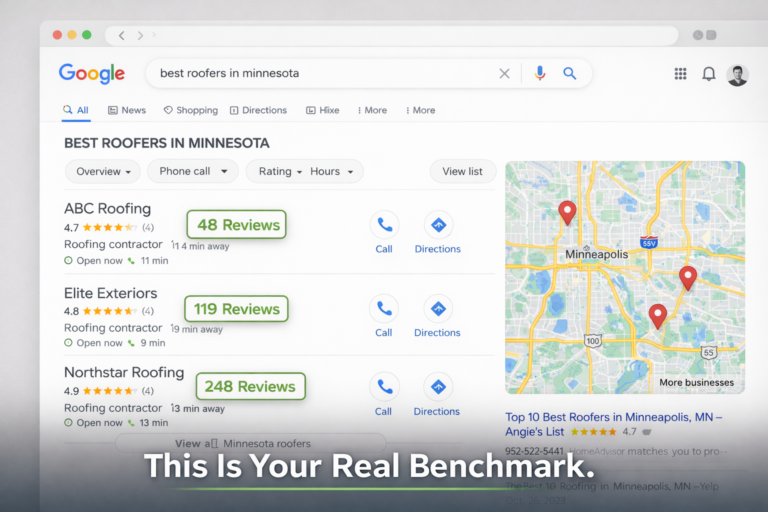

I’ve had the same conversation with contractors probably a hundred times. Business is decent, mostly referrals, maybe a few jobs from Google here and there.
Then I ask them to search their own trade in their city and watch their face. They’re not showing up. Or they’re showing up fourth, fifth, below a competitor they know isn’t doing better work.
That’s a local search problem. And fixing it is usually less complicated than people think.
Local search marketing is the practice of getting your business to show up when nearby customers search for the products or services you offer. This guide explains how it actually works, what changed in 2026, and what to do first if you’re starting from scratch or trying to close the gap on competitors who got there before you.
This is based on what we see working for home service contractors every day, plumbers, roofers, HVAC companies, and electricians who are trying to get found by local customers without wasting budget on things that don’t move the needle.
What Is Local Search Marketing?
Local search marketing is the practice of getting your business to show up when nearby customers search for the products or services you offer.
It goes by a few names. Local SEO for home service businesses is the most common. In practice it covers Google Search, Google Maps, and the local pack, which is that cluster of three business listings sitting above the organic results when someone searches for a nearby service. It includes both organic visibility and paid local ads.
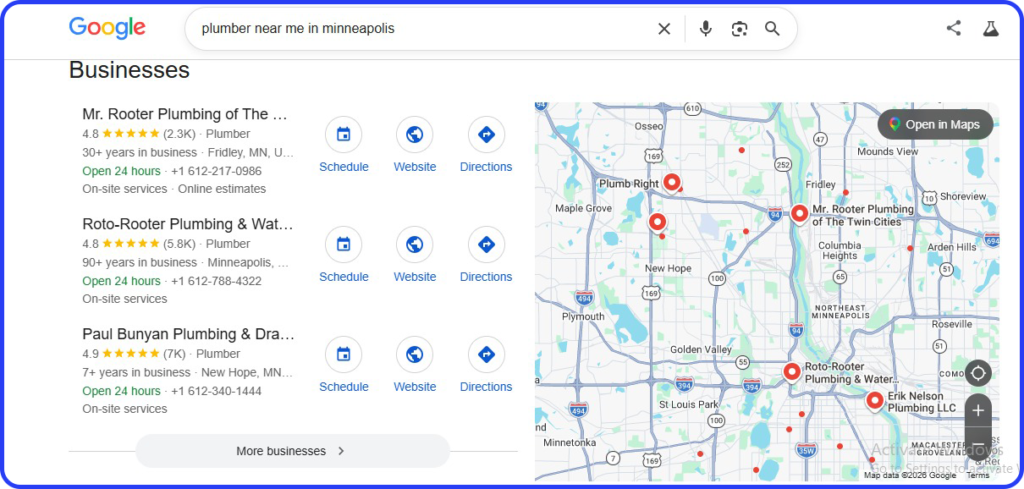
In 2026 it’s also no longer just Google. People find local businesses through AI assistants like ChatGPT and Gemini, through Instagram and TikTok, through voice queries. But Google is still the foundation. Everything else builds on what you’ve built there. If your Google presence is weak, nothing else is going to compensate for it.
For a home service business the question is simple: when someone in your area needs what you do, do you show up? Local search marketing is the work that changes the answer.

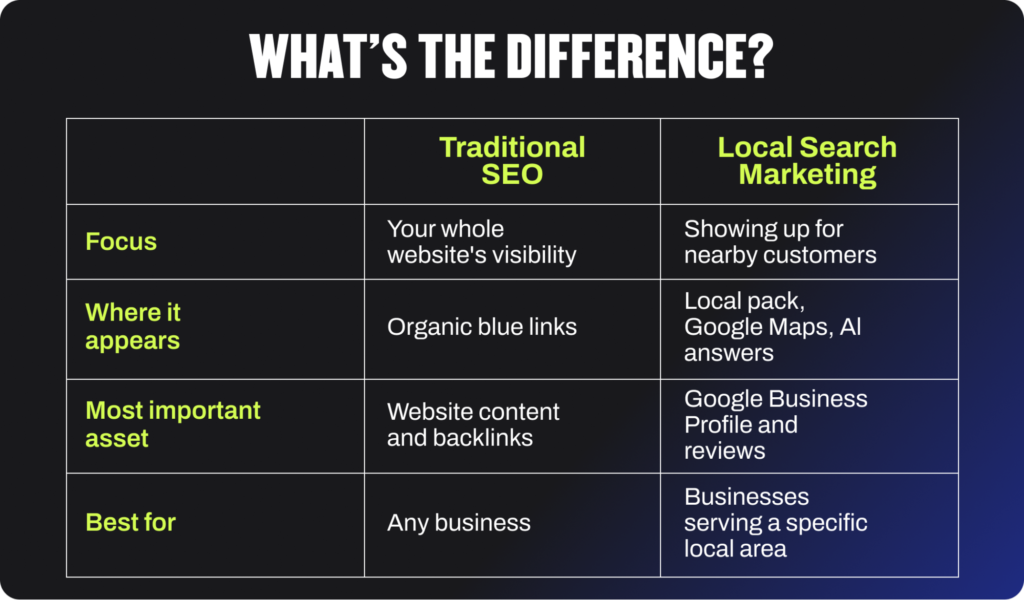
How Does Local Search Marketing Work?
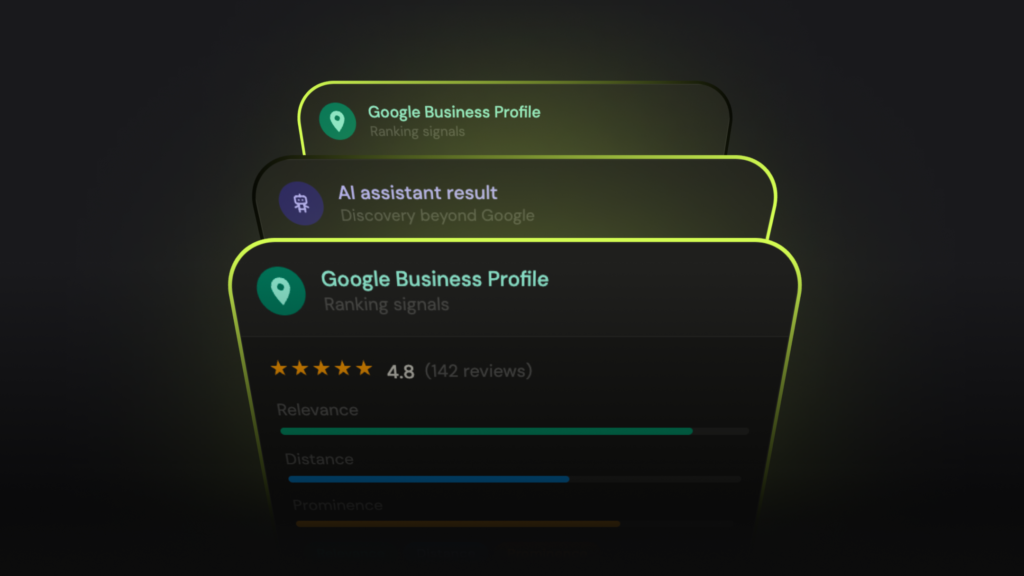
Google decides which local businesses to show using three main factors. These come directly from Google’s own documentation and they are still the core of how local ranking works in 2026, even as AI has changed how results are displayed.
Relevance
How well your business matches what someone searched for. This is shaped by your Google Business Profile, which categories you chose, which services you listed, and what your website actually says. A plumber with specific services listed like “water heater repair” and “drain cleaning” is more relevant to those searches than one whose profile just says “Plumbing Company.” That level of detail sounds small. It’s not.
Distance
How close your business is to the searcher or the location they mentioned. You can’t move your shop. What you can control is making sure your address is accurate and consistent everywhere online. Inconsistencies confuse Google, and that confusion costs you rankings.
Prominence
How well-known and trusted your business appears to Google. Reviews, web mentions, citations, your overall online reputation. A roofing company with 200 reviews and consistent mentions across the web looks more prominent than one with 12 reviews and a half-filled profile, even if both are the same distance from the searcher and both do equally good work. This is the factor contractors have the most control over, and the one most of them underinvest in.
According to the 2026 Whitespark Local Search Ranking Factors report, which surveyed 47 local SEO experts, Google Business Profile signals remain the single most influential factor group for local pack rankings, followed by reviews and on-page website signals. The fundamentals haven’t changed. What’s changed is how costly it is to ignore them.
What Changed in Local Search in 2026?
The underlying model is the same. Relevance, distance, prominence. But the environment around it has shifted in ways that matter, and the contractors who aren’t paying attention are falling behind faster than they realize.
AI Overviews and AI Assistants Are Now Part of Local Search
Google’s AI Overviews now summarize local service providers at the top of the search results page. ChatGPT and Gemini answer questions like “who’s the best HVAC company near me” by pulling from your reviews, your Business Profile, and your website content. For a plain explanation of how this actually works, our breakdown of how AI Overviews in local SEO work is worth reading before you assume it doesn’t apply to you.
The contractors showing up in those AI summaries aren’t doing anything out of the ordinary. They built a clean, consistent local presence and the fundamentals did the work. AI didn’t replace local search marketing. It made the basics matter more, because AI tools need accurate, well-organized information to feature a business confidently. A half-filled GBP and 15 old reviews isn’t going to cut it.
Building brand authority for AI search is the same work you’d do for traditional local SEO. The difference is the stakes are higher now.

Fresh Reviews Now Beat Volume
A business with 30 reviews in the last 90 days will often outrank one with 300 reviews from three years ago. Review themes also shape how AI tools describe your business to potential customers. If your reviews consistently mention fast response and honest pricing, that’s what AI summaries will say about you. That’s your reputation being written in real time without you in the room. For a practical approach to building online reviews for home service businesses, consistent habit beats every campaign.
People Are Finding Local Businesses in More Places Now
Google is still the dominant channel. But the map of where homeowners are looking has expanded, and the data on what’s happening inside Google is worth understanding.
According to the 2026 Google Local Search Report from Rio SEO, which analyzed over 239,000 business locations, total Google Business Profile views fell 13.2% year over year, Maps views dropped 13.0%, and Search views declined 13.4%. That’s a significant contraction in traditional Google-driven local discovery. The one bright spot: direction clicks actually rose 6.4%, meaning the people who do find you are taking action at a higher rate.
What that tells us: the pool of passive discovery through Google is shrinking. The businesses capturing that shrinking pool are the ones with the strongest profiles. And the gap between strong and average local presence is getting wider every year. If you’re sitting on a mediocre GBP and hoping the phone keeps ringing, the numbers say it won’t.
Instagram, TikTok, and AI assistants are picking up some of that discovery slack. An empty social profile or no footprint in AI tools is now a real missed opportunity, not a theoretical one.
Why Local Search Marketing Matters for Home Service Businesses
Here’s what most contractors miss about local search. When someone types “roof replacement near me” into Google, they already know they need a roofer. They’re not researching. They’re ready to call. The business that shows up gets the job. The one that doesn’t is invisible at the exact moment it should be visible.
This is also one of the few places in marketing where a small, well-run local business has a genuine structural advantage over bigger competitors. Google prioritizes proximity and relevance. A local HVAC company that’s built a strong local presence will outrank a national brand every single time for someone searching two miles away.
The intent behind these searches is unusually high. LocalIQ’s 2026 search advertising benchmarks show home service businesses see some of the highest conversion rates of any industry in paid local search. People searching for a plumber or roofer near them aren’t comparison shopping. They need someone. Right now.
Something to note: “Some of the best marketing moves are long-term.” I’ve said this probably a hundred times and I’ll keep saying it because contractors keep getting sold the opposite. In my video on 5 Questions to Ask Any Marketing Agency Before You Hire Them, I talk about how SEO compounds over 6 to 9 months. You start getting more clicks, then more conversions, and a year in there’s a meaningful lift in leads that didn’t exist before. The businesses I’ve watched win in local search aren’t the ones who tried everything. They’re the ones who picked the right fundamentals early and didn’t stop. Most of the tactics people waste money on are just shortcuts to avoid doing the boring consistent work that actually builds something.
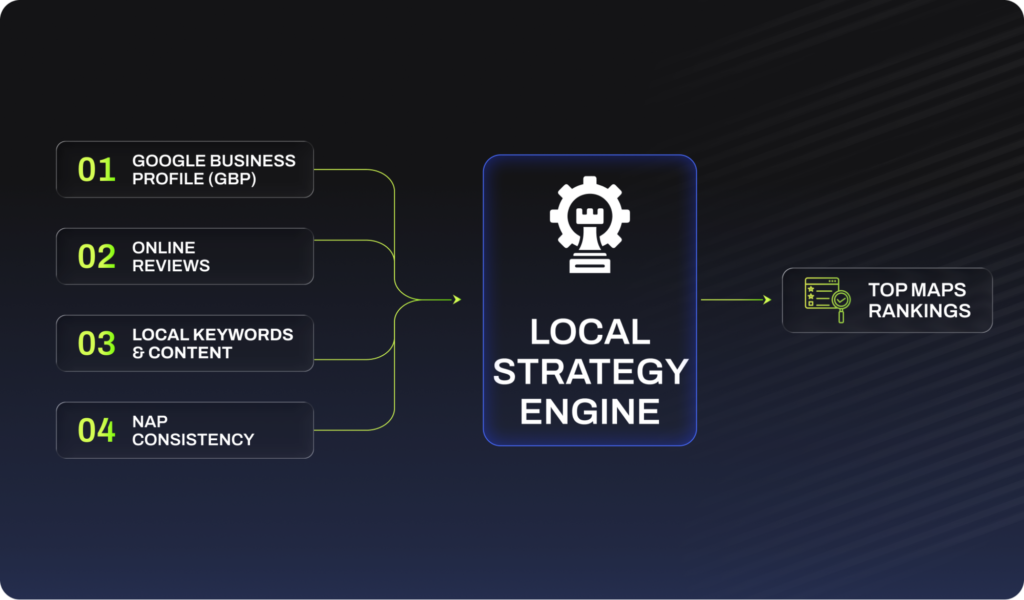
The Main Parts of a Local Search Marketing Strategy
None of this requires a big agency or a complicated tech stack. The businesses winning in local search right now are doing a small number of things well and doing them every week. Here’s what that actually looks like.
Google Business Profile
Your GBP is the single most important asset in local search. It’s what populates the map pack, what AI tools pull from, and what a homeowner reads when they search your business name. A complete, accurate, actively managed profile is the starting point for everything else. Not optional. Not something to set up once and forget. Our guide to Google Business Profile optimization walks through exactly what a complete profile looks like for a home service business.

Online Reviews
Reviews are the clearest prominence signal Google has. They’re also the thing a homeowner reads before they decide whether to call you. Fresh reviews, specific reviews, reviews that mention your actual services by name, those carry more weight than a pile of old generic ones. The business that builds a simple review habit, asking every satisfied customer before the truck leaves the driveway, compounds that advantage week after week. The one waiting for reviews to come in naturally falls further behind.
Local Keywords and Website Content
Your website needs to clearly tell Google what you do and where you do it. That means dedicated service pages with specific language about the areas you cover, not just your city name dropped once in a footer. A home services web design built for local search does this deliberately. Most contractor websites are built for aesthetics. They look fine and rank for nothing.
Accurate Listings and NAP Consistency
NAP stands for Name, Address, Phone number. If those three things don’t match exactly across Google, Yelp, Angi, Facebook, and your website, Google loses confidence in which information to trust and that uncertainty hurts your rankings. In 2026 this applies to your social bios too, not just traditional directories. Your Instagram bio and your LinkedIn page should have the same address and phone number as your GBP. Every inconsistency is a small trust leak.
How to Get Started With Local Search Marketing
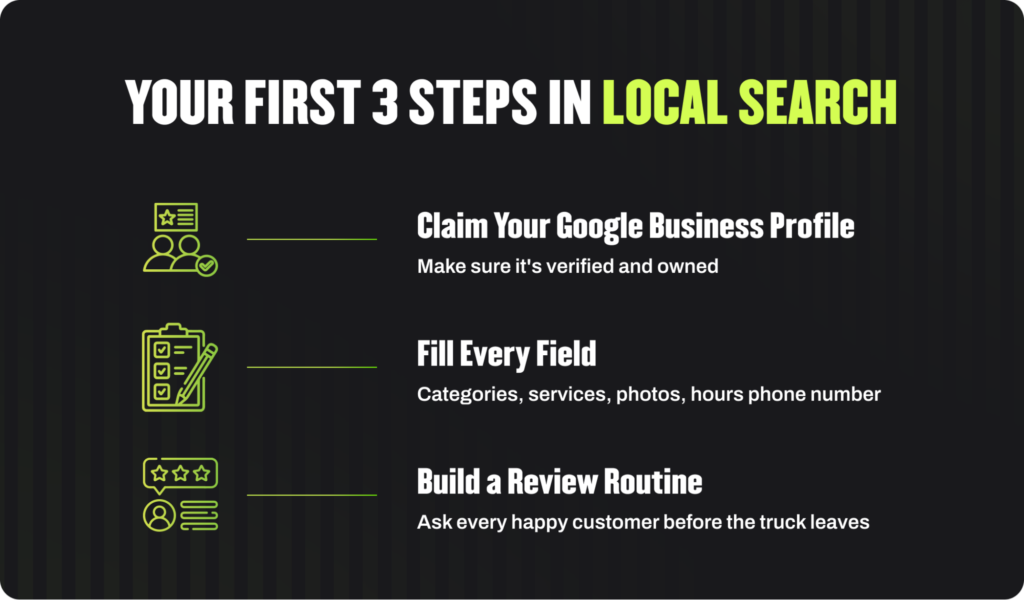
You don’t need an agency to get started. You need to do a few things right and then do them consistently. Here’s what we tell every new client to do first, before anything else.
Claim and Complete Your Google Business Profile
If you haven’t claimed it yet, that’s step one. If you have it but it’s half-filled, that’s nearly as costly as not having it at all. Every field matters: categories, service areas, hours, phone number, photos, services list, description. An incomplete profile tells Google you’re not serious about being found. A fully completed one gives it everything it needs to show you to the right people. Start here and use our Google Business Profile optimization guide so you don’t miss anything.
Build a Simple Review Routine
Stop waiting for reviews to come in on their own. They won’t, not at the volume you need. The businesses with 150 Google reviews didn’t get there by luck. They asked. After every job that went well, before the truck leaves, hand the customer a direct link to your Google review page. Send it by text right after the job closes. Do that consistently for 90 days and the local pack rankings will start to move.
This connects directly to your broader home services marketing strategy. Reviews aren’t just an SEO tactic. They’re the thing a homeowner reads when they’re deciding between you and the company right next to you in the results. You want that decision made before they even look at a website.

Frequently Asked Questions
What is local search marketing?
Local search marketing is the practice of getting your business to show up when nearby customers search for what you offer. It covers Google Search, Google Maps, the local pack, paid local ads, and increasingly AI tools and social platforms.
Is local search marketing the same as local SEO?
Essentially yes. Local SEO refers to the organic side of getting found in local search. Local search marketing can include paid tactics like Local Services Ads alongside organic local SEO. Most people use the terms interchangeably.
How does Google decide which local businesses to show?
Three factors: relevance (how well your business matches the search), distance (how close you are to the searcher), and prominence (how well-known and trusted your business appears online). This framework comes directly from Google’s own documentation and is still the foundation of local ranking in 2026.
Does local search marketing still work in 2026 with AI changing everything?
It works better than ever, actually. AI tools like ChatGPT and Google’s AI Overviews pull from the same signals local SEO is built on: your GBP, your reviews, your website content. The businesses that built a strong local search foundation are the ones showing up in AI results too. AI didn’t replace local search marketing. It raised the cost of ignoring it.
How long does it take to see results?
Most home service businesses start seeing movement in local pack rankings within 60 to 90 days of completing their GBP and building a consistent review habit. Full results compound over 6 to 12 months. The fastest movers are typically businesses starting from a clean but incomplete baseline, not ones starting from zero reputation.
Does a small home service business really need this?
Yes. Local search is one of the few marketing channels where a small, well-run local business has a genuine advantage over national chains. Google prioritizes proximity and relevance. A local plumber who’s built a strong local presence will outrank a national company for someone searching two miles away every single time.
Is local search only on Google?
No. Google and Google Maps are still the biggest channels, but in 2026 people also find local businesses through AI assistants like ChatGPT and Gemini, and through platforms like Instagram and TikTok. Strong Google fundamentals are the foundation for all of them.
Can I use AI to respond to reviews?
Yes. Google has confirmed that using AI to help draft review responses doesn’t go against its guidelines, as long as the response is high quality and actually addresses what the customer said. What matters is quality, not who wrote the first draft.
Local Search Is Where Home Service Businesses Win or Lose Jobs
The contractor at the top of Google Maps when a homeowner needs a roofer right now didn’t get there by accident. They built something consistent over time and it compounded.
At Hook Agency, we work exclusively with home service contractors. We’ve spent over a decade helping plumbers, roofers, HVAC companies, and electricians build the kind of local search presence that actually generates calls, not just rankings. We build the websites, run the SEO, and manage the paid ads. You get full transparency on what we’re doing every month and you own every account we build.
If you want to see what that looks like for your business, schedule a call with our team. No generic playbooks. Just an honest conversation about what we’d actually build for you.