
If you work with contractors long enough, you start to notice a pattern with Instagram.
They know they should be posting. They’ve seen competitors doing it. Some of them even have someone on the team who handles it. But when it comes to actually experimenting with new content, different hooks, different formats, different angles, there’s a wall.
The wall isn’t laziness. It’s this:
- Their followers are also their customers and referral sources
- A bad post in front of those people has a different kind of cost than a bad post in front of strangers
- So they stick to what’s safe, post inconsistently, and never really figure out what actually works
Instagram Trial Reels were built specifically for this problem.
Instagram Trial Reels let you share a Reel with non-followers only, so you can test hooks, formats, and ideas before your existing customers ever see them. Your followers don’t see it. It doesn’t appear on your grid. If it flops, it’s like it never happened. If it works, you share it with one tap.
This guide is written specifically for HVAC, plumbing, roofing, and electrical companies who want to use the feature in a way that actually makes sense for their business. Not for lifestyle creators or influencers. For people who spend their days on job sites and want to show that work online without looking like they’re trying too hard. For broader context on what a real social media strategy for home service businesses looks like, that post is a good place to start before this one.
What Are Instagram Trial Reels?
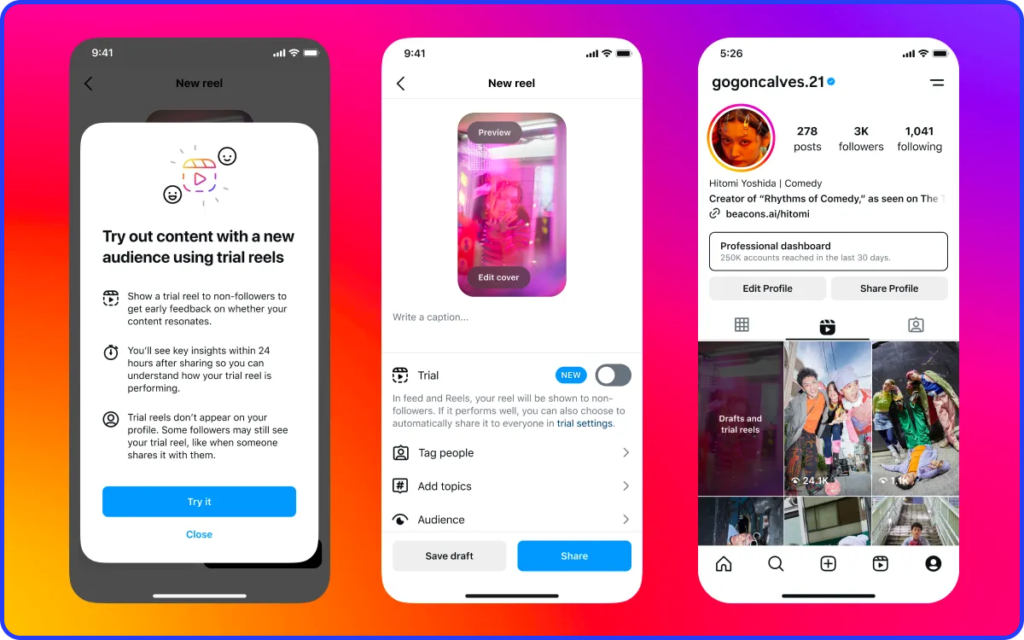
Instagram Trial Reels are a built-in feature that shows a Reel only to people who don’t already follow you, before you decide whether to share it more widely.
Meta launched the feature in December 2024. As of July 2026, it’s available globally to eligible accounts. After you post a Trial Reel, your followers don’t see it in their feed or Reels tab. It doesn’t appear on your profile grid. Instagram pushes it to non-followers, collects performance data, and after roughly 72 hours, you can review how it performed and decide what to do with it.
If it did well, you can share it with everyone with one tap, or turn on auto-share when you post so Instagram releases strong performers automatically. If it flopped, you’ve learned something useful and your existing audience never knew the post existed.
Eligibility and Limits
Before you go looking for the Trial toggle:
- Your account must be public and set to a Professional account type, either Creator or Business. Personal accounts don’t have access.
- Most accounts need at least 1,000 followers for the Trial option to appear. Instagram confirmed this threshold as of May 2026, though it may expand over time.
- The daily posting limit appears to be around 5 Trial Reels per day for most accounts, though this is not officially confirmed by Instagram and varies by account. Exceeding it may temporarily restrict your access to the feature.
- In February 2026, Instagram added the ability to schedule Trial Reels in advance, so you can batch a week of tests in one sitting if that fits your workflow.
- Instagram’s originality policy, expanded on April 30, 2026, penalizes duplicate content. This applies to Trial Reels too. Reposting someone else’s content as a trial will flag your account. Reworking your own original ideas into new content is encouraged.
If you can’t find the Trial toggle, check that your app is updated to the latest version and that your account is set to Creator or Business. Those two things resolve most cases.
Why Trial Reels Matter for Home Service Businesses
Most contractors don’t have a content problem. They have a confidence problem.
Here’s how it usually goes. A plumber spends twenty minutes recording a before-and-after on a slab leak. It’s real work, genuine expertise, something a homeowner would actually find useful. Then they sit on the video for three weeks because they’re not sure the lighting was good enough. Or they worry it makes them look too small. Or they post it and it gets twelve views and they decide Instagram doesn’t work for them.
The problem isn’t the content. The problem is there’s no safe place to test it before it lands in front of the people who matter.
The Instagram algorithm in 2026 has made this harder, not easier. SocialEcho’s Q1 2026 Reels data report tracked over 15,000 brand accounts and found that Reels engagement dropped 23% year-over-year in Q1, with completion rates falling from 38.4% to 29.7%. The algorithm now treats the first three seconds of a video as the primary signal of quality. If fewer than 25% of viewers complete your reel, it’s unlikely to be pushed to a secondary audience at all.
That means the pressure to get the hook right on the first try is real. Trial Reels remove that pressure.
For a contractor trying to build organic reach and search visibility on the platform at the same time, our guide to Instagram SEO for contractors covers how to optimize your Reels content so it works in search as well as the feed.
How to Post a Trial Reel (Step-by-Step)
The process is almost identical to posting a regular Reel. The only difference is one toggle.
- Open Instagram and tap the + icon to create a new post. Select Reel.
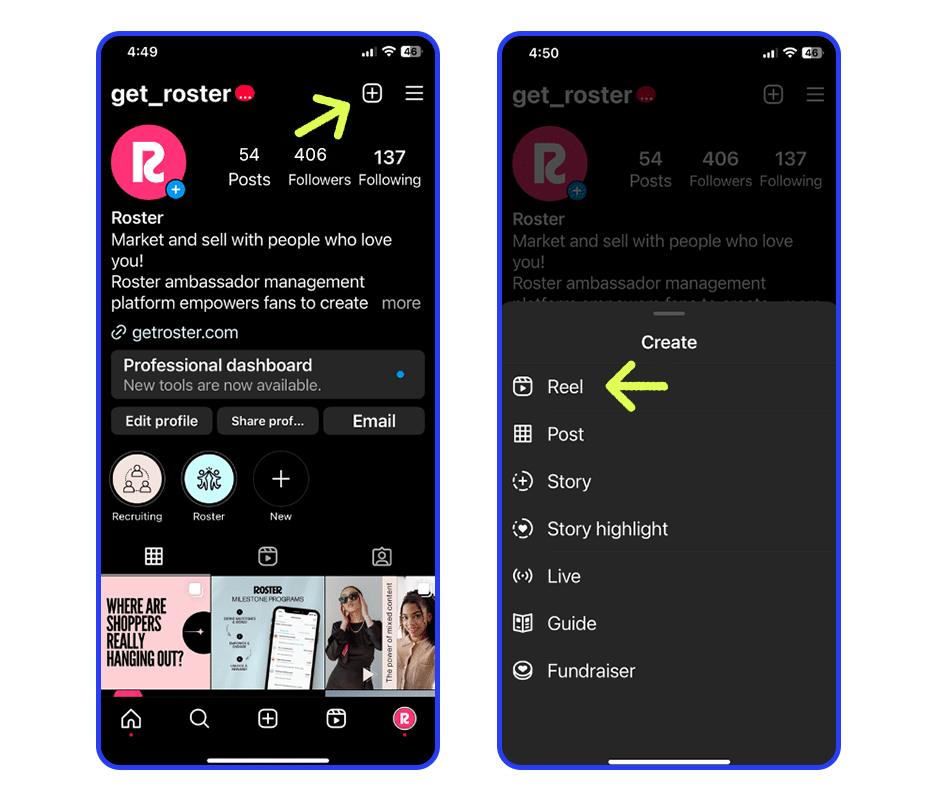
- Choose your video from your camera roll or record directly in the app. Edit it as normal: trim, add audio, text overlays, captions.
- On the final sharing screen, look for the Audience or Trial section. Tap the Trial toggle to turn it on.
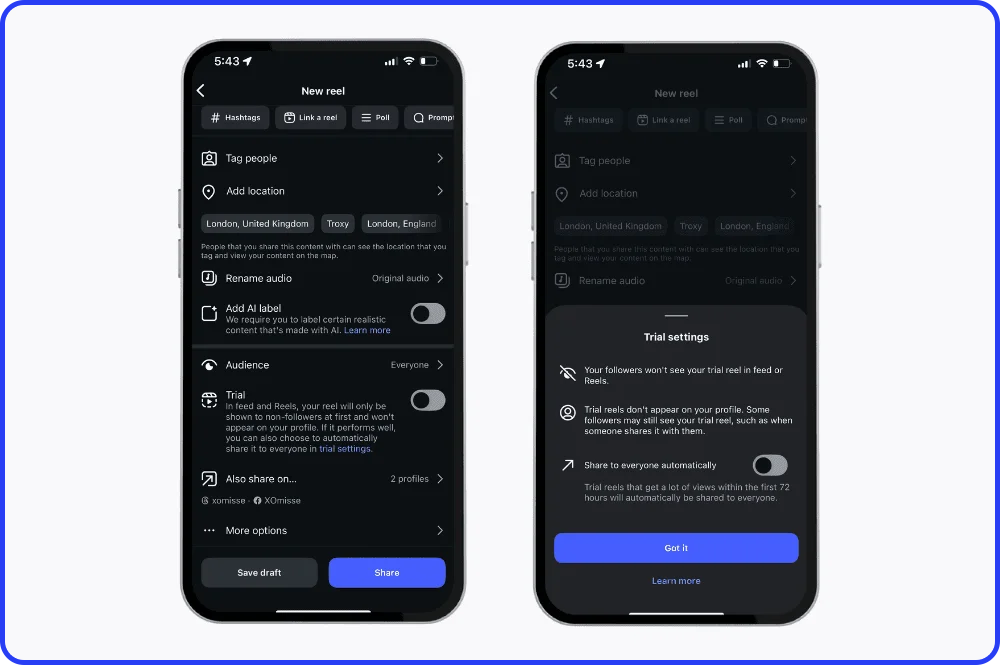
- Optional: Toggle on auto-share if you want Instagram to release the Reel to your followers automatically if it performs well within 72 hours. Leave it off if you want to review performance data first and decide manually.
- Post. Your followers won’t see it. It won’t appear on your grid. Instagram will serve it to non-followers in the Reels feed and Explore.
- After 72 hours, check your Reels Insights for that post. Review completion rate, shares, saves, and any comments. Decide whether to share it with everyone or try a variation.
Trial Reel vs Regular Reel: A Quick Comparison
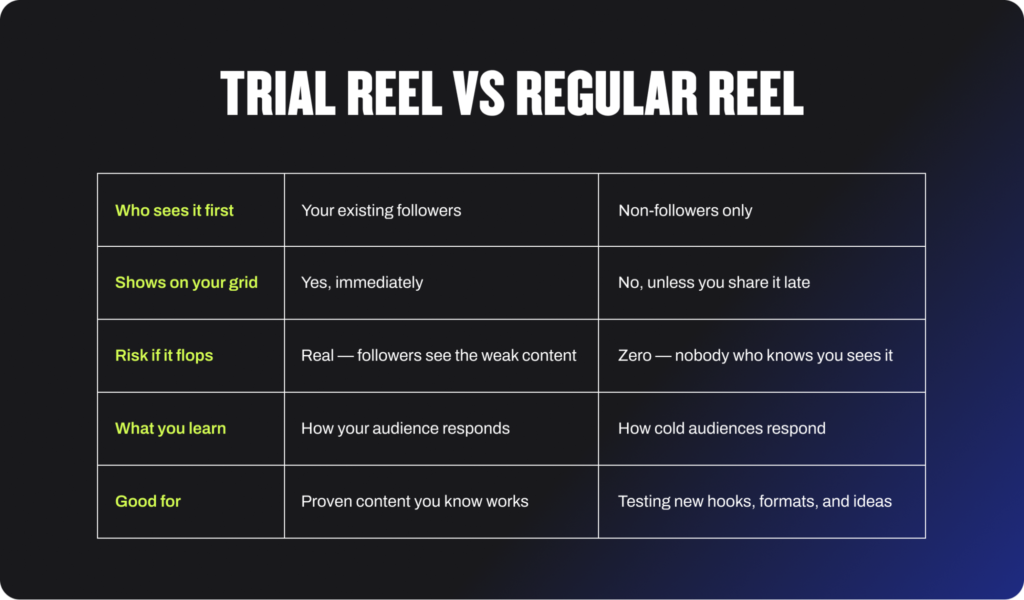
3 Smart Ways Contractors Should Be Using Trial Reels
Each of these works because it removes the one thing that stops most contractors from posting more: the fear that an experiment could look bad in front of the wrong person. For context on how this fits into a broader Instagram strategy for hardscaping and other trade companies, the same principles apply across trades.
1. Test Which Pain Point Actually Gets Attention
The first three seconds of a Reel decide everything.
Adam Mosseri, the head of Instagram, has said this publicly. The Q1 2026 algorithm data confirms it. If fewer than 25% of viewers complete your Reel, Instagram won’t push it further. And the biggest reason viewers drop off in the first three seconds is a weak hook.
Most contractor Reels start the same way. “Hey, it’s Mike from ABC Plumbing, and today I’m going to show you how to check your water heater.” There’s no reason to keep watching that. There’s no tension. The viewer isn’t wondering anything.
The question isn’t what do you want to say. It’s what makes someone stop scrolling. Those are different questions. Trial Reels give you a way to find the answer with data instead of guessing in front of your existing customers.
Here’s how to actually run this test:
- Shoot one video. Same footage, same length, same visual.
- Cut two versions with different opening text overlays or spoken hooks.
- Post each version as a separate Trial Reel, a few days apart so the data doesn’t overlap.
- Compare completion rates and shares. Share the winner to your main feed.
Trade-specific hook pairs to test:
- HVAC: “Is your AC secretly dying?” vs. “Your energy bill is about to spike”
- Plumbing: “Why your water bill jumped $40” vs. “The $200 mistake hiding in your water heater”
- Roofing: “How to tell if your roof has storm damage” vs. “What your insurance company doesn’t want you to know”
- Electrical: “The one thing you should never plug into a power strip” vs. “Why your circuit breaker keeps tripping”
One variable at a time. Don’t change the visuals, the length, and the hook all in the same test. Change the hook, hold everything else steady, and let the data tell you which version a cold audience responds to. Once you know what gets attention, you build all your content around that opening pattern.
An HVAC contractor we’ve worked with tested exactly this approach before committing to a social content format. They ran the same job-site walkthrough with two different hooks, one educational and one problem-focused. The problem-focused version had a completion rate nearly double the educational one with a cold audience. They now open every Reel with a problem statement and have seen consistent improvement in non-follower reach as a result.
2. Test Job-Site Content Formats Before Committing to Them
There’s a question every contractor eventually lands on when they start taking Instagram seriously: should I post raw job-site footage or polished before-and-afters?
The instinct is usually to go polished. Professional equals credible, right? But the Reels data in 2026 says otherwise. Real-world and process-oriented content grew 24% in Q1 while polished brand content kept declining. Authenticity is outperforming production value, and that’s actually good news for contractors who don’t have a video crew.
The catch: you still don’t know which format your specific audience responds to. Every market is different. A roofing company in a rural area might get completely different results than one in a suburban neighborhood. The only way to know is to test it. And Trial Reels let you test it without your current customers watching you experiment.
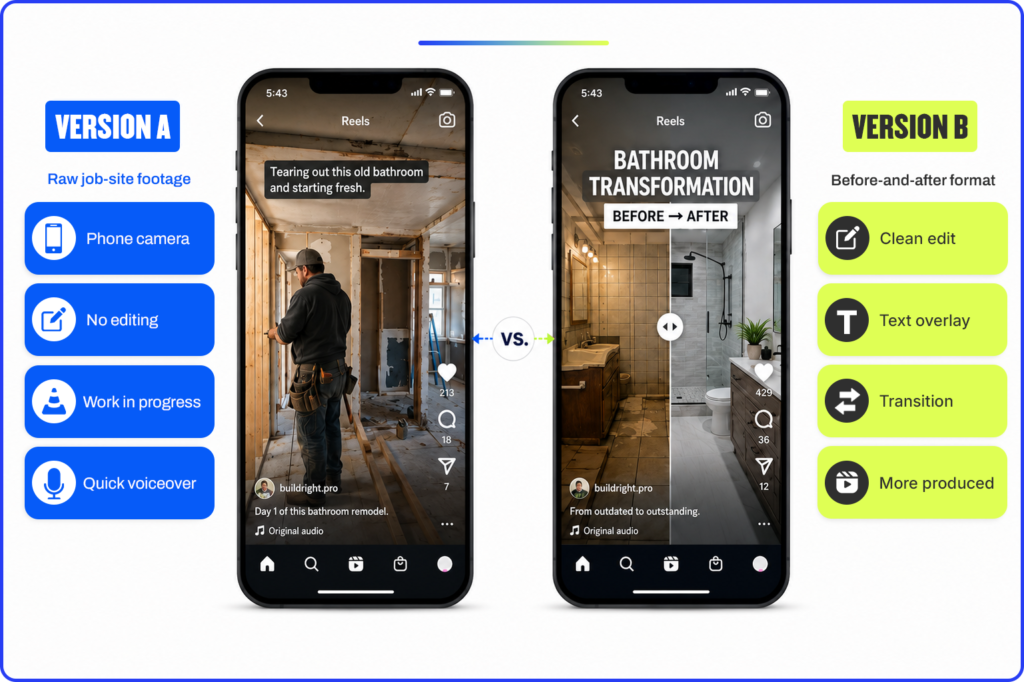
Run two versions of the same job as Trial Reels:
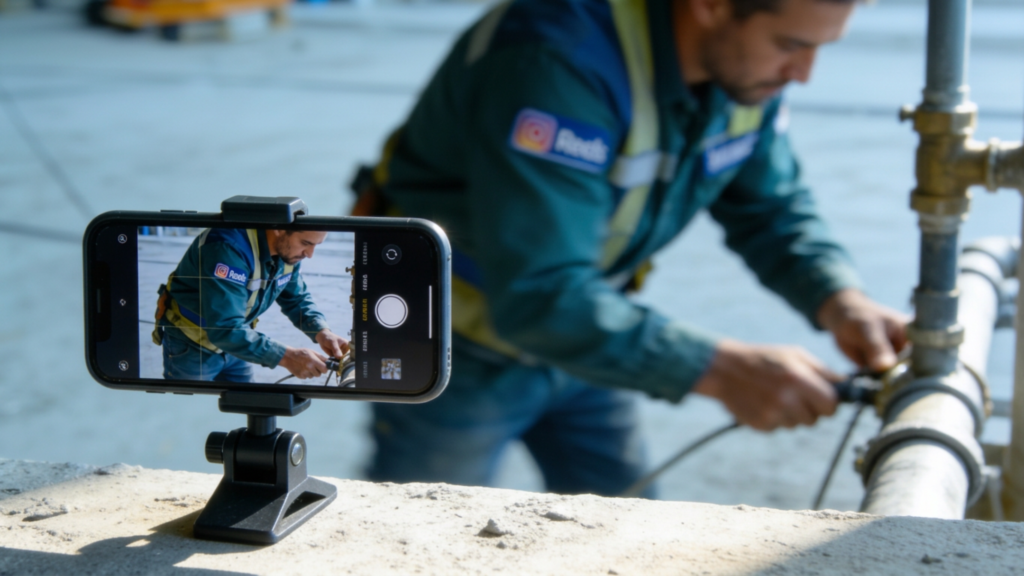
- Version A: Raw job-site footage. Phone camera, no editing, just the work in progress. Maybe a quick voiceover explaining what’s happening.
- Version B: Before-and-after format. Clean edit, text overlay, transition. The more produced version.
Post both as trials. Let a cold audience tell you which format they engage with more. The answer might surprise you. From what we see across contractor accounts, raw job-site footage with a strong spoken hook frequently outperforms polished before-and-afters in completion rate, because it feels more real and less like an ad.
For more on what types of short-form content homeowners respond to, that post covers the formats that drive the most engagement in home service categories specifically.
Once you know which format wins with cold audiences, you can produce more of it confidently, knowing it earns reach instead of just filling your grid.
3. Repurpose Proven Content to Reach New Service Areas
This one is underused by almost every contractor we work with.
You already have content that worked. It earned reach. People saved it. Strangers found it and commented. That’s the algorithm telling you something specific: this topic, in this format, resonates with people who don’t know your company yet.
The question most contractors never ask: does that content travel? Does it hold up with a cold audience in a neighborhood or city where nobody knows you yet? That’s exactly what a Trial Reel can answer before you spend a dollar on ads.
Here’s how to run it:
- Pull a Reel that already earned reach organically. High completion rate, real saves, comments that asked about your service.
- Create a fresh version with any location-specific references updated for the new area you’re targeting.
- Post it as a Trial Reel. Instagram serves it to non-followers, which pulls from geographic areas beyond your current audience.
- If engagement holds up, the content travels. The paid budget you eventually put behind it goes toward something you already know converts.
This removes one of the biggest gambles in service area expansion. You’re not guessing anymore. You’re testing first and spending second.
And Reels is where that paid investment lands hardest right now. CNBC’s January 2026 reporting from Sensor Tower found that more than half of all Instagram ads ran on Reels in 2025, up from 35% the year before. Reels also accounted for 46% of total time spent on Instagram in the US. When you know a piece of content converts with cold audiences, putting money behind it on Reels is the most efficient use of your Instagram ad budget.
For the paid side of that strategy once your content is proven, see our guide to advertising on Instagram for the setup that works best for home service companies. And if you’ve been using the repost feature to extend the life of your best content, see our breakdown of Instagram’s repost feature for home service businesses for how that fits into the same organic strategy.
Trial Reel Mistakes Home Service Businesses Should Avoid
The feature is simple. The mistakes are simple too, but they’re common enough to call out.
- Posting too many at once. Accounts appear to be limited to around 5 Trial Reels per day, though this is unconfirmed. Posting the same concept five times trying to optimize it in one afternoon also teaches you nothing useful. Space your tests out so the data doesn’t bleed together.
- Changing too many variables at once. If you change the hook, the format, the music, and the length all in the same trial, you don’t know what drove the result. One variable per test.
- Only posting your most polished content as trials. The whole point is to test things you’re not sure about. If you’re only running polished content you’re already confident in, you’re not learning anything. The raw, unpolished, riskier ideas are exactly what you should be testing first.
- Ignoring the data after 72 hours. The feature is only useful if you look at what it tells you. Check completion rate, shares, and saves before you decide what to do with the content.
- Duplicating content instead of reworking it. Since April 2026, Instagram’s originality policy penalizes accounts that repost identical content. Reworking your own original ideas into fresh content is fine. Uploading the same exact video again as a trial is not.
How Do You Know If a Trial Reel Is Working?
Views are the least useful number here.
A Trial Reel gets served to cold audiences, which means it starts without the engagement boost your existing followers would normally give it. Comparing Trial Reel view counts to your regular Reel view counts will always make trials look worse. That comparison doesn’t tell you anything useful.
The metrics that actually matter for a Trial Reel:
- Completion rate. The single most important signal. If more than 40% of viewers watched all the way through, the content held attention. Under 25% and Instagram’s algorithm will likely not push it further. This is the number to watch first.
- Shares and saves. These are the engagement signals most associated with content reaching non-followers. A Trial Reel that gets saved or shared by people who don’t follow you is telling you something concrete: this content is worth repeating.
- Comments that ask real service questions. If someone who has never heard of your company watches your trial reel and asks “Do you work in X area?” or “How much does that cost?” that is a lead. That is the content working at its highest level.
Compare Trial Reels to other Trial Reels, not to your regular posts. Over time, the pattern of which topics and hooks consistently outperform becomes clear, and that’s your content strategy. For a broader read on what the engagement benchmarks mean across platforms, our breakdown of Instagram engagement benchmarks provides the comparative data for context.
Frequently Asked Questions
What are Instagram Trial Reels?
A built-in Instagram feature that shows a Reel only to people who don’t already follow you, giving you performance data before deciding whether to share it with your full audience. Launched in December 2024, now globally available to eligible creators.
How many followers do you need for Trial Reels?
Most professional accounts need at least 1,000 followers for the Trial toggle to appear, as confirmed by Instagram as of May 2026. The feature is only available on public Creator or Business accounts, not personal accounts.
How many Trial Reels can you post per day?
Instagram has not officially confirmed a fixed daily limit, but most accounts appear to be capped at around 5 Trial Reels per day. Exceeding it may temporarily restrict your access to the feature. Check your account’s current behavior, as limits can vary.
Will my current customers see Trial Reels?
No, not in their feed, Reels tab, or on your profile grid. The only exception is if a follower has the trial reel shared with them directly via DM, or if it appears on a page showing Reels with the same audio or location tag. For most practical purposes, your existing followers won’t see it unless you decide to share it with everyone.
Should home service businesses use Instagram Trial Reels?
Yes. They’re a low-risk way to test hooks, formats, or content for a new service area before committing it to your main feed. For contractors who already feel hesitant about experimenting on Instagram, the ability to test in front of strangers instead of customers removes the main barrier to posting more.
Can you schedule Instagram Trial Reels?
Yes. Instagram added the ability to schedule Trial Reels in February 2026, so you can batch a week of tests in one sitting. Some third-party scheduling platforms also support this, though requirements may vary by tool.
What’s the difference between a Trial Reel and a regular Reel?
A regular Reel is shown to your followers first and appears on your profile grid immediately. A Trial Reel is shown to non-followers only, doesn’t appear on your grid, and carries zero risk to your existing follower relationship. If a trial performs well, you can share it to your followers afterward.
Instagram Is Worth Getting Right for Contractors
Trial Reels are one of the more practical tools Instagram has added for businesses that want to experiment without the risk of looking unprofessional in front of people who are already customers.
For contractors, that risk is real. Your existing followers are also your referral network. A weak post in front of them has a different kind of cost than a weak post in front of strangers. Trial Reels let you do the experimental work in front of strangers and bring only the proven content to the people who already trust you.
If you want help building an Instagram strategy that connects to the rest of your marketing, website, SEO, paid ads, and reviews, that’s what we do at Hook Agency. We work exclusively with home service businesses. Schedule a call with our team and we’ll walk you through what we’d build for your specific trade and market.