
Most contractors hear the phrase “brand authority” and assume it means one of two things: having a lot of good reviews, or having a nice logo.
It is neither. And understanding the difference is worth the five minutes it takes to read this piece, because brand authority is what decides whether a homeowner calls you or your competitor when the reviews and quotes look similar.
Brand authority is the level of trust and credibility a business has earned in its market, strong enough that its name alone lowers a homeowner’s perceived risk before a single review or quote is even compared.
Here’s what we’ll cover:
- A real definition that distinguishes authority from awareness and reputation
- Concrete business outcomes that brand authority drives, with data behind them
- Specific, buildable actions for home service businesses to build it
What Brand Authority Actually Means
Brand authority is not the same as brand awareness, reputation, or reviews. It is the compounding effect of all three, strong enough that a homeowner stops comparison-shopping once your name is in the conversation.
The distinction matters because each of these things does a different job:
- Awareness is knowing a business exists. A homeowner who has seen your truck in their neighborhood has awareness. That is the beginning of the chain, not the end.
- Reputation is a specific opinion formed from experience or what others have said. Reviews, referrals, word-of-mouth. Reputation can be good or bad.
- Authority is the further step where a business’s name alone reduces perceived risk. Before any individual review is read or quote is compared, the name itself carries weight.
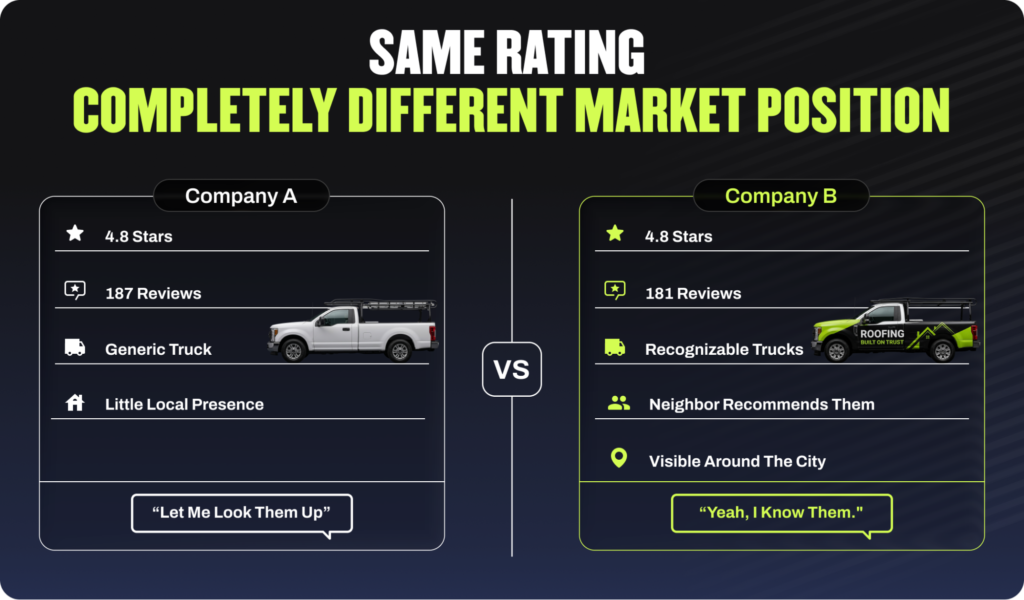
Here is the clearest way to see the difference in practice. Two roofing companies can have identical star ratings and similar review counts. But when a homeowner’s neighbor asks “who should I call,” one of those companies gets named without hesitation and the other one requires the homeowner to look it up. The first company has authority. The second has reputation.
This is where the know, like, and trust framework is useful context. Authority is what happens past the trust stage, when a business’s name starts carrying trust on its own, ahead of any individual interaction being evaluated.
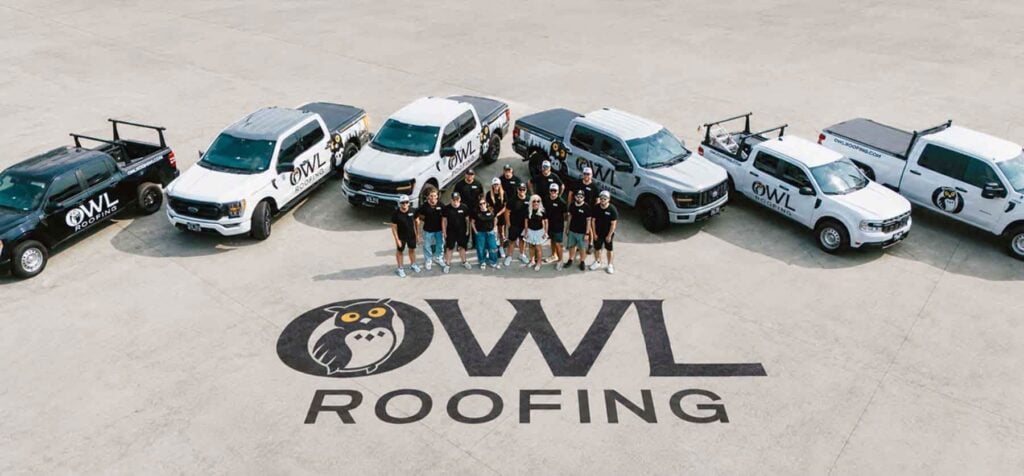
Tim Brown, our founder, built Owl Roofing around this principle from day one. His framing on the podcast: pick three things you want to be known for, make them specific, and repeat them everywhere until the market does the work for you.
“If you can’t tell people why you’re different in one sentence, the market won’t do it for you.”
For Owl Roofing, those three things became Protect Your Nest, wise choice, and the word who. Each one connects back to the owl symbol. Each one gives a homeowner something specific to say to a neighbor. That is what brand authority looks like when it is being built deliberately, not by accident.

Why Brand Authority Matters for a Home Service Business
This is not an abstract marketing concept.
Brand authority shows up in real business outcomes that directly affect revenue, margins, and the quality of leads that walk in the door. Here is what each of them actually looks like.
Referral Behavior and Revenue Premium
Referrals are where brand authority pays off most directly. New research from Bain and Mention Me published in Harvard Business Review in August 2026, based on an analysis of more than 10 million consumers, found that referred customers account for 72% of new customer profits despite representing only 20% of new customers. Referred customers are more profitable because the person who sent them has already done trust-building work that would otherwise fall on the business. A homeowner who was recommended by a neighbor who trusts you is not starting from zero.
For home service businesses specifically, referrals close faster and at higher ticket values. The homeowner arriving via referral is already past comparison-shopping. They are there to confirm what they already half believe.
Brand authority is what drives that referral volume. Homeowners only recommend names they can say with confidence.
Pricing Power
A business with real authority gets compared less on price.
When a homeowner is comparing three quotes and one company is a name they have seen on trucks for three years, heard from a neighbor, and found easily when they searched, the price gap that would normally trigger a second conversation shrinks. The perceived risk of going with an unknown competitor outweighs the savings.
That is not a soft benefit. That is margin protection, and it compounds as the authority grows.
Shorter Sales Cycles
Less time spent re-explaining credentials or convincing a skeptical homeowner means faster close rates and less wasted estimate time. A business with authority arrives to an estimate with the homeowner already inclined toward yes rather than inclined toward hesitation.
Resilience During Slow Seasons
Authority-driven demand holds up better when ad costs rise or competitors cut prices, because it is not purely a function of media spend. A business that relies entirely on paid search for awareness has no resilience when the channel gets more expensive or a competitor outbids them. A business with genuine local authority maintains demand through other channels: referrals, organic search, and the kind of passive word-of-mouth that happens when homeowners associate a name with confidence.
Recruiting and Retention
Skilled trades workers are drawn to and stay longer with companies they are proud to be associated with in their own community. This matters more than most owners realize as the labor shortage in home services continues. Attracting and retaining skilled trades talent is easier when the company has a local reputation that makes a technician’s friends and neighbors say something positive when they mention where they work.
Search and AI Visibility
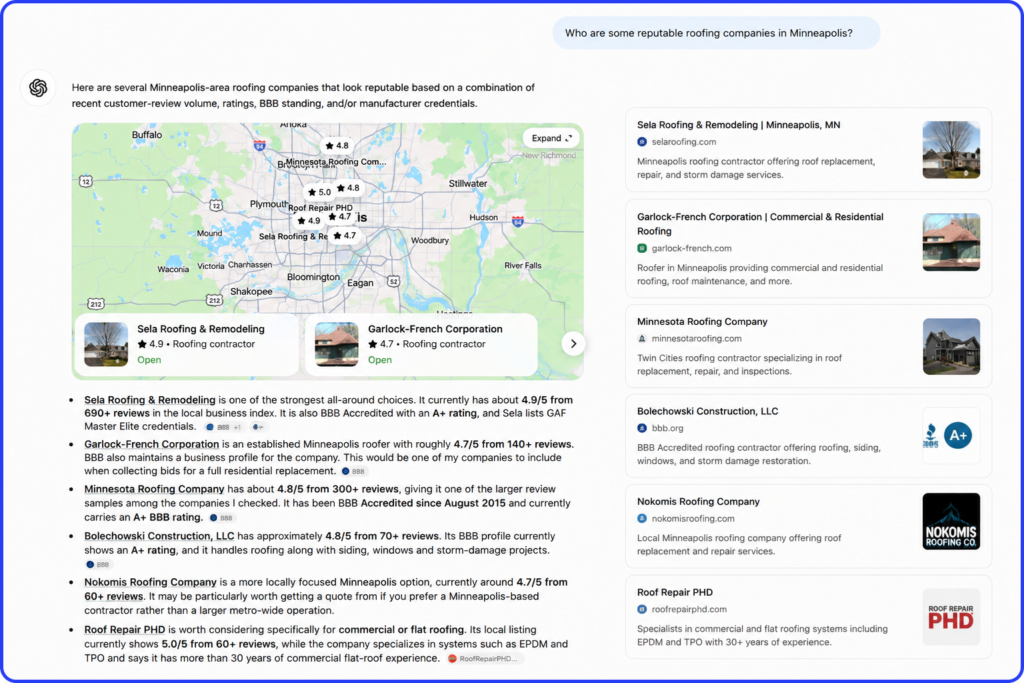
Brand authority increasingly influences what AI search tools surface when a homeowner asks for a recommendation. According to SOCi’s 2026 Local Visibility Index, which analyzed more than 350,000 business locations across nearly 2,800 brands, ChatGPT currently recommends only 1.2% of local business locations.
The brands that get recommended share a common profile: accurate, complete data across every directory; strong review volume and sentiment; and consistent engagement signals across platforms. These are the same signals that produce brand authority in traditional local markets. AI has amplified the consequences of having them or not having them.
How to Build Brand Authority as a Home Service Business
The tactics below are in rough priority order. The first one is the most commonly skipped and the most important.
1. Fix the Trust Gaps Before Building on Top of Them
Authority compounds on a foundation of basic trust. Slow response times, unclear pricing, or a mismatch between what is promised online and what shows up at the door will undercut any authority-building effort before it starts.
We see this constantly. A contractor running ads, posting content, building reviews, but losing jobs because the follow-up is slow or the crew on-site doesn’t match the professionalism the website implied. The marketing creates an expectation the operation doesn’t meet.
Authority cannot be borrowed by marketing. It has to be backed by the actual experience. The trust factors that come before authority covers this foundational layer in detail.
2. Be Visually and Structurally Consistent Everywhere
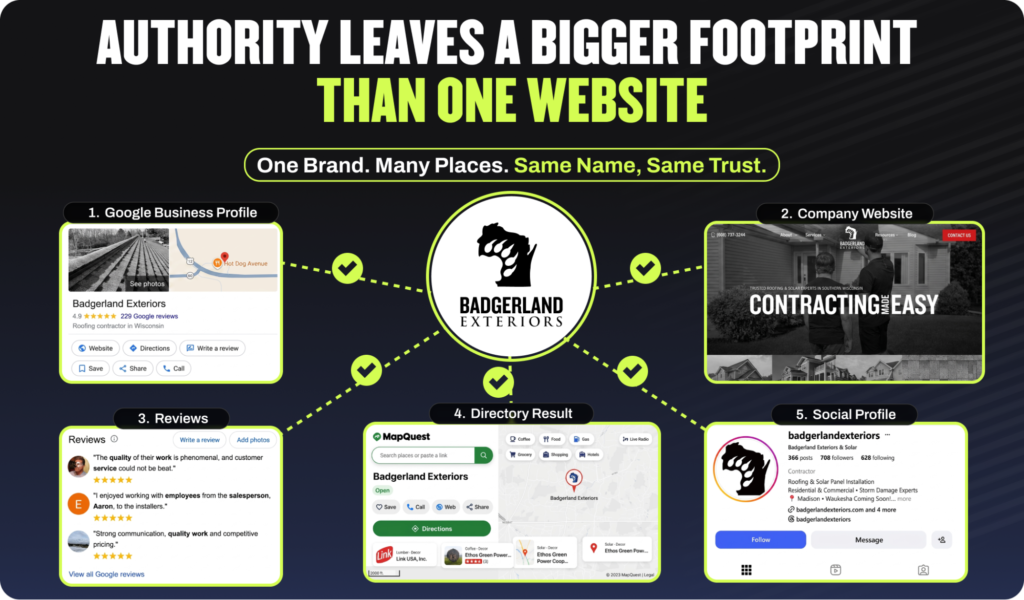
The same color, mark, and voice across the truck, the website, the GBP photos, and every piece of content makes a business easier to recognize, and easier to recognize is easier to trust.
Recognition and authority are close cousins. A homeowner who has seen the same consistent brand in their market for three years does not consciously think about that exposure. They just find themselves with more confidence when that business’s name comes up. This is how brand equity builds silently. Inconsistency resets the clock.
Building a more relatable, consistent brand across all those surfaces is covered practically in how to build a more relatable brand.
We built the website for Owl Roofing before the company had done a single job. The site went live with real photos, a defined brand identity, and consistent messaging from day one.
Because the brand was built consistently from the start rather than patched together as the company grew, Owl Roofing already has recognizable local presence in the northeast Twin Cities market. That is consistency doing work that ad spend alone could not have done as quickly. It is a repeatable model.
3. Publish Real, Specific Expertise, Not Just Reviews
Reviews are one input into authority. Documented process, real job examples, and direct answers to the specific questions homeowners actually ask build more authority than review count alone.
BrightLocal’s Consumer Search Behavior and Decisions research published July 2026, which surveyed 1,227 US consumers who had searched for a local business in the last three months, found that 22% cited recognizing the business name as a deciding factor in who they chose to contact.
That number rises to 27% for consumers using AI tools specifically, where the business name or how professional it sounds carries more weight than on any other channel. AI tools have less context to evaluate a business, so name familiarity matters more, not less.
Published expertise, real job photos, process documentation, and direct answers to the questions homeowners actually search build the familiarity that creates name recognition. Getting more reviews for the business is still important, but it is one tool in the kit rather than the whole strategy.
4. Earn Third-Party Validation Beyond Your Own Claims
Reviews are written by customers. Industry awards, trade association memberships, press mentions, and partner recognition are written by someone other than the business itself, which makes them a different category of signal.
The mechanism is simple: the more sources outside the business that attest to its quality, the more confidence a homeowner can form before they have any direct interaction. Any individual source can be questioned. A pattern of recognition across multiple independent sources is much harder to dismiss.
Industry awards and recognition covers the specific opportunities home service businesses should be pursuing in this space. Most contractors underinvest here because the payoff is not immediate and not directly tied to a specific campaign.
5. Show Up Consistently Over Months and Years, Not a Single Campaign
Authority is a compounding asset. It is built through repeated, consistent exposure in a market over time, not a rebrand or a single content push.
The businesses in any local market that carry genuine authority are almost never the ones who ran the cleverest campaign last year. They are the ones who have shown up with the same message, the same colors, the same three things they want to be known for, month after month, long enough that homeowners have absorbed it without consciously noticing.
This connects directly to long-term how brand strength affects business valuation. A company with genuine local brand authority is worth more than one with identical revenue and no brand, because the authority-carrying business has a demand source that does not disappear when the ad budget stops.
6. Make Sure the Name Is Easy to Find and Cite Everywhere
This is where search and AI visibility specifically come in. A business whose information is inconsistent, incomplete, or missing across directories is not just a ranking problem. It is an authority problem.
Joel, our Director of Strategy at Hook Agency, put this plainly in a recent video about Google’s August 2026 LSA changes. He said your Google Business Profile now runs the show: ads sync directly from the profile in real time, which means a weak or half-finished profile does not just hurt your rankings, it undermines your entire paid presence.
The same logic applies to brand authority. An AI tool evaluating whether to recommend a business reads your profile data as a confidence signal. Inconsistent information reads as a business that is not paying attention. And a business that is not paying attention does not get recommended.

A Quick Gut-Check: Do You Actually Have Brand Authority?
We run a version of this internally before making recommendations to clients. It cuts through the assumption that awareness equals authority.
Run it honestly:
- If a satisfied customer’s neighbor asked for a recommendation, would your business get named without hesitation?
- Does the business get compared line by line on price as often as competitors, or less?
- Has the business been mentioned, awarded, or cited by anyone other than itself in the past year?
- Would a homeowner recognize the truck, uniform, or logo without reading the name?
- Does the sales process usually involve convincing a skeptical stranger, or confirming what they already believed?
Strong reviews can exist without real authority. Authority is what happens when a name starts doing some of the selling on its own.
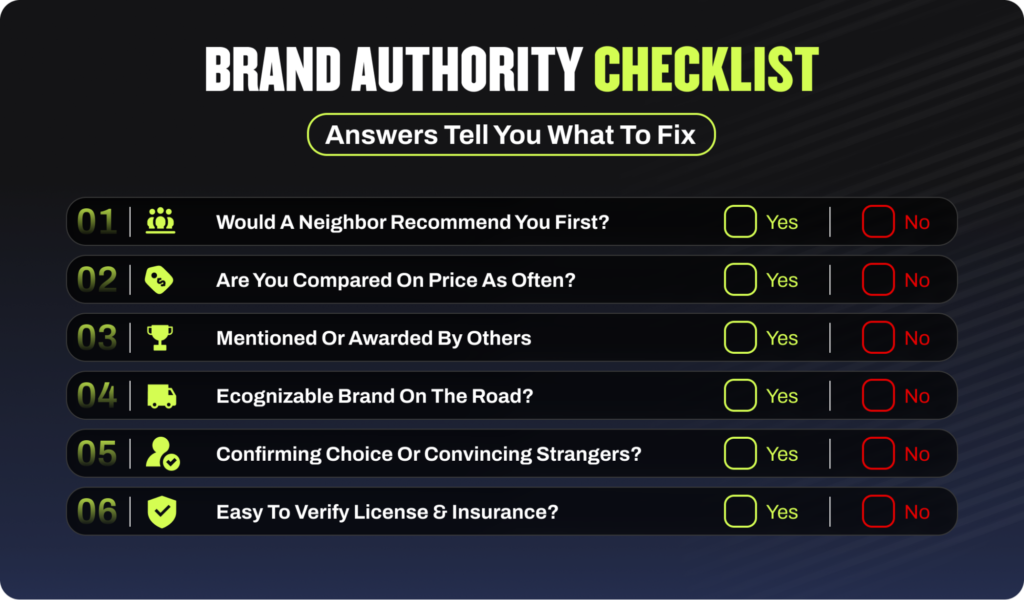
If most of those land as no, the gap is usually one of two things: the brand signals are inconsistent and recognition has not had time to compound, or the business is newer and authority simply hasn’t built yet. Knowing which one it is tells you whether this is a messaging problem or a patience problem.
For a practical measure of where AI visibility specifically stands right now, tracking whether the brand shows up in AI search results is a useful audit to run alongside this.
Frequently Asked Questions
Is brand authority the same thing as reputation?
No. Reputation is a specific opinion formed from direct experience or reviews. Brand authority is the further step where a business’s name alone reduces perceived risk before any individual opinion is even checked.
Can a small local business really have brand authority, or is that only for big companies?
Yes. Brand authority is relative to a market, not a national scale. A local roofer can have real authority within their service area the same way a national brand has it nationally. The mechanics are the same, just at a smaller radius.
Does brand authority mean I don’t need reviews anymore?
No. Reviews remain one input into authority, particularly for getting a business considered at all. Authority is what happens in addition to reviews, when a name starts carrying weight on its own.
How long does it take to build brand authority?
It compounds through consistent, repeated exposure and delivered experience over months and years rather than a single campaign or rebrand. There is no fixed timeline, but the compounding effect is real and accelerates over time.
Does brand authority affect how AI tools like ChatGPT or Google AI Overviews recommend a business?
Increasingly yes. SOCi’s 2026 Local Visibility Index found that brands with strong local signals, accurate information, high review volume, and consistent engagement, are significantly more likely to be surfaced by AI platforms. That research covers the mechanics in depth.
Authority Is Earned, Not Announced
Brand authority is not something a business can claim in its own marketing. It is something the market confers when the brand has been consistent enough, specific enough, and present long enough that homeowners know what to say when a neighbor asks who to call.
For home service businesses specifically, the path is clear: fix the trust gaps, build a consistent visual identity, publish specific expertise, earn third-party recognition, and show up the same way every month for years. The compounding happens quietly and then becomes very visible.
If you want to understand where your brand authority currently stands and what to prioritize building first, that is the kind of work we do with home service businesses at Hook Agency. Schedule a call with our team and we will walk through it together.