
Growth brings a familiar question for home service companies: stay focused locally, or start targeting the whole state?
For most HVAC, roofing, and plumbing businesses, that jump happens too early. A bigger service area sounds like growth, but it often means thinner budgets, weaker lead quality, and slower returns.
That is the real issue behind statewide vs local marketing for home services. It is not about reaching more people. It is about reaching the right people without losing efficiency.
In most cases, local targeting wins because it helps you rank faster, build trust quicker, and generate leads that are actually close enough to convert. Statewide marketing can work, but only when your budget, team, and service capacity are ready for it.
Before you expand, it helps to know what usually drives ROI and what usually drains it.
Why “Going Bigger” Feels Right (But Usually Isn’t)
Statewide marketing usually starts with a strong month. The phones are ringing, jobs are booked, and the next thought comes fast: if one city is working, why not open up the whole map? That is where a lot of contractors start burning budget.
More territory does create more impressions, but it also forces your budget into more auctions, more competitors, and more searches that are not always worth paying for. In 2026, Google does not just reward reach, it rewards relevance.
What usually follows:
- Your budget gets spread thinner across every service area
- Clicks increase, but many come from places that rarely book
- Cost per lead climbs because Google keeps testing weaker markets
- Your local message starts losing punch
The bigger issue is timing. If you have not fully locked down your strongest local market, statewide targeting often adds cost before it adds growth.
That is why local still wins for many service businesses. About half of national brand marketing executives expect stronger ROI from local marketing than statewide or national campaigns, according to Ballyhoo and GatePoint Research.
For contractors, bigger only works when local already feels predictable. Until then, broader reach usually means paying more to learn the same lesson twice.
Why Local Targeting Wins for Most Home Service Businesses
Local usually wins because that is how homeowners think.
When the AC stops working or a roof starts leaking, nobody is looking for the company that covers the widest map. They want the company that feels close, trusted, and ready to show up.
That is exactly why local search keeps driving stronger returns. 46% of Google searches seek local information, which means nearly half of search traffic starts with local intent, not statewide curiosity.
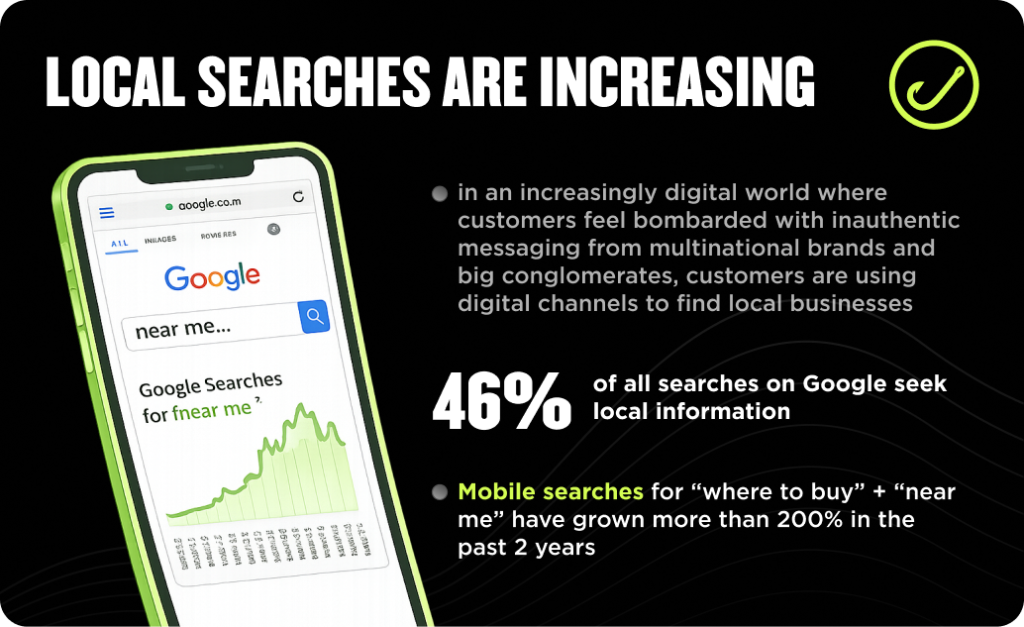
Google Pushes Nearby Businesses First
Google is built to reward relevance, and in home services, relevance usually means proximity.
That shows up in the places that matter most:
- Local pack results
- Google Business Profile visibility
- City-specific service pages built through local SEO for home service businesses
A contractor with strong local signals often outranks a bigger company trying to appear everywhere at once, simply because Google trusts the local fit more.
Close Leads Feel Easier to Say Yes To
A homeowner calling from ten minutes away behaves differently than one calling from two counties over.
The closer the lead, the easier it is to believe your crew can get there quickly, quote accurately, and handle the job without delay. That confidence matters during the decision.
It gets even stronger when Google reviews beat local competition. A stack of recent reviews tied to one city tells people you work there all the time, not occasionally.
Tight Radius = Less Waste
This is where ad spend usually gets protected.
A tighter radius means your message stays specific, your targeting stays sharper, and your budget stops leaking into weak clicks.
Texas makes that obvious. Austin buyers respond differently than West Texas homeowners because priorities, pricing, and buying habits shift fast across regions. Even inside San Antonio, zip code targeting often changes results because some neighborhoods respond to premium offers while others react to budget-driven messaging.
One statewide campaign cannot speak clearly to all of that.
Local Momentum Compounds Fast
When one city starts working, everything starts stacking:
- More reviews
- More referrals
- More repeat work
- Better rankings
That momentum is hard to replicate when attention is split too early.
When Statewide Marketing Actually Makes Sense
Statewide marketing can absolutely work. It just stops working fast when the business expands before the systems do.
A lot of contractors assume more geography automatically means more opportunity. Sometimes it does. Sometimes it just means paying for leads your team cannot service well enough to close.
You Can Actually Service the Area You’re Targeting
This is the first filter. If a lead comes in two cities away, can your crew get there fast, quote confidently, and still make the job profitable?
If the answer is shaky, statewide targeting usually creates more stress than growth.
If the answer is yes because you already have multiple crews, another office, or strong field coverage, then broader campaigns start making sense. That is usually the point where multiple websites vs one website for multiple locations becomes a serious decision, because each market needs enough local authority to compete.

The Job Is Big Enough to Justify a Bigger Radius
Some services can afford distance because one job covers the cost of getting that lead.
Commercial roofing is a good example. Standby generators too. You do not need dozens of leads if one project carries strong margin. That changes the math completely. A wider service area becomes easier to defend because every closed deal has more room to absorb acquisition cost.
Your Local Market Feels Predictable
The best time to test statewide is when your main city stops feeling unpredictable. You are ranking well. Calls are steady. Reviews keep coming in. Your calendar fills without constantly fighting for visibility.
That is also when smart companies start to track marketing ROI more aggressively, because expansion should be driven by what your strongest market is already proving, not by guesswork.
How to Expand Without Tanking Your ROI
The safest expansion usually looks boring from the outside, and that is why it works.
A roofing company in Dallas does not suddenly launch campaigns across all of Texas and hope for the best. The smarter move is to first lock down nearby markets where crews already travel, where referrals already happen, and where Google is already showing signs of demand.
That is the difference between strategic growth and expensive guessing.
A better way to expand:
- Start with the next city your trucks already reach easily.
If your HVAC team is already taking occasional jobs in Fort Worth, that market makes far more sense than opening paid campaigns three hours away in Houston.
- Build a real city page before spending a dollar on ads.
A plumber targeting Plano needs a page that speaks to Plano jobs, local service expectations, and proof from nearby customers, not a copied version of the Dallas page with the city name swapped.
- Let stronger markets earn more budget.
If roof replacement leads in one county close at twice the rate of another, do not split spend evenly just because both are on the map.
- Use your own job history before trusting broad search volume.
If generator installs keep coming from one neighboring suburb, that is often a better expansion signal than chasing a city with high search traffic but heavy competition.

Grow Where You Can Actually Win
The best marketing move is not always the bigger one.
For most home service companies, local still wins because it keeps your budget focused, your leads stronger, and your close rate healthier. Statewide growth works, but only after one market is already pulling its weight.
Own your city first. Then expand with proof, not pressure.
If you want a service area strategy built around real search demand, real margins, and real growth potential, Hook Agency can help you map it out and build a Local SEO plan that fits where your business is headed.