
There are two ways to steal a marketing idea. One is lazy. You grab someone else’s headline, ad, or offer, swap in your logo, and hope nobody notices.
The other is what good marketers have been doing forever.
You notice what keeps working. You figure out why it works. Then you take the underlying idea and rebuild it around your own business, customers, proof, and personality.
That distinction matters because contractor marketing is full of clues. A competitor keeps the same ad running for three months. Homeowners repeatedly praise one part of their service. A certain topic keeps showing up in search. One company’s project photos get far more engagement than its polished graphics.
None of that means, “Copy this.” It means, pay attention.
A little competitive research can give you:
- A starting point based on what homeowners in your market already respond to
- Content ideas backed by keyword demand instead of gut feel
- Ad creative clues before you spend money testing from scratch
- A clearer view of the gaps your next marketing dollar could fill
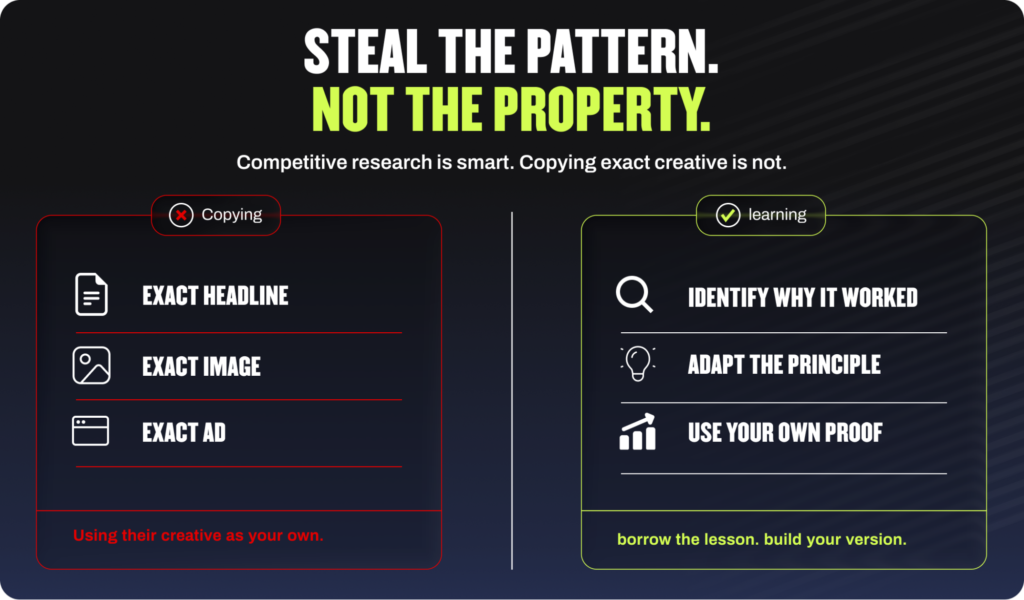
The rule is simple: steal the pattern, not the property.
What “Stealing” Actually Means in Marketing
First, a small but important distinction.
The Difference Between Copying and Learning
Copying is taking someone’s exact words, images, or ad creative and using them as your own. That is unethical, lazy, and usually ineffective anyway. The thing worked in their context: their team, reviews, offer, and market position.
Learning is different. You figure out why something works and build your own version around what is actually true about your company. HVAC companies study the highest-reviewed shop in town. Roofers notice who keeps getting local press. That is market intelligence, not theft.
Your Market Is Already Running Experiments for You
The contractors ranking first in your city have already tested messaging, built review systems, published content, and learned what gets attention. You can see the result on their Google Business Profile, website, ads, and review history.
Using that information is not cheating. It is paying attention. Surprisingly few competitors do it well, which is why an hour of deliberate research can beat another week of brainstorming.
Where to Look First: Five Places That Show You What Is Working
Before spending money on another campaign, spend an hour studying the top five contractors in your market. How homeowners choose contractors tells you what to watch for: trust, reputation, and specificity. These five places reveal how competitors are building, or missing, all three.
Their Google Business Profile
A top competitor’s GBP can tell you a lot in about two minutes:
- How many reviews they have and how recent the newest ones are
- What categories they rank in beyond their main service
- Whether they keep adding photos or set the profile up once and forgot about it
Hook Agency has made this point on its channel: “Google and homeowners both read a stale profile the same way. It looks like a business that stopped caring. Even if the actual work behind the profile is great, five photos from three years ago sitting there untouched tells people, true or not, that something’s off.”
The 90-day rule is a useful gut check. Job-site photos from the last 90 days make a profile feel active and current. A profile that has not moved in years can look abandoned, even when the crew is busy every day.
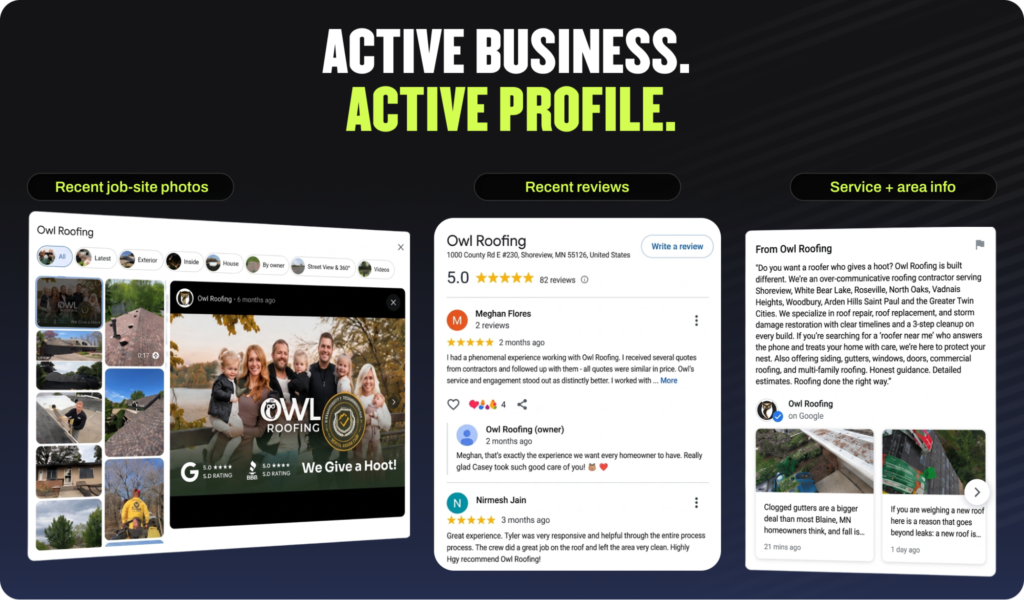
Compare the top three competitors. If the market leader posts after every job and has 400 reviews with recent dates, that is not random. It tells you they have a system, not a lucky streak. You do not need their exact system, but you do need one of your own.
Their Reviews (Yours and Theirs)
Reviews are free customer research, and most contractors barely use them that way.
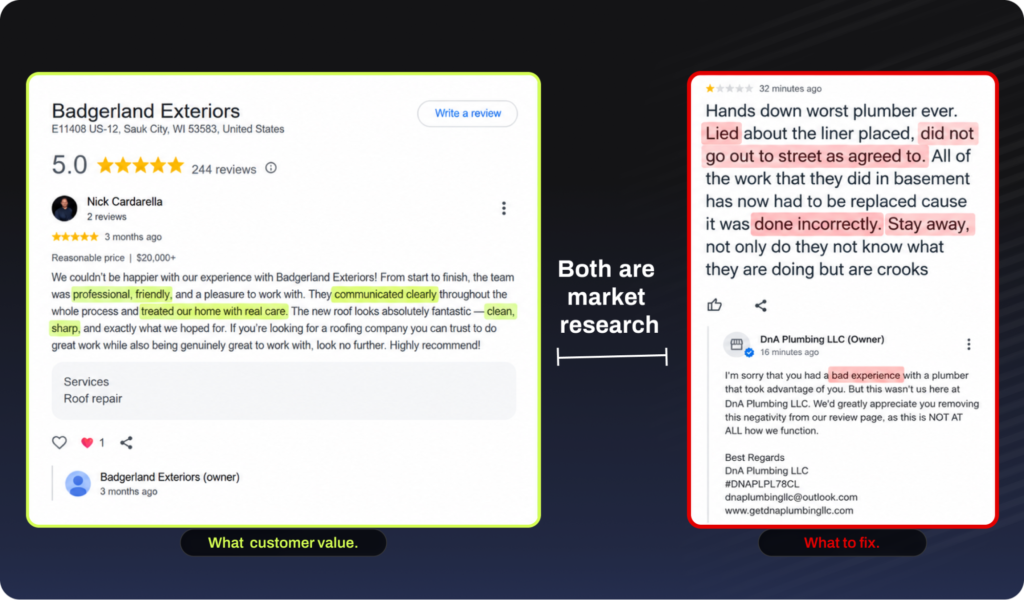
Start with five-star reviews. What do homeowners keep praising? Same-day service? A tech who explains the repair first? A crew that leaves the house cleaner than it found it? Repeated praise is a signal that the market values that experience. One review is a compliment. Ten reviews saying the same thing is positioning data.
Then read the one-star reviews. Not for entertainment, although some will test your self-control. Look for what homeowners wanted and did not get. According to BrightLocal’s Local Consumer Review Survey 2025, 89% of consumers expect a business to respond to all reviews, yet most local contractors do not. Unresolved complaints are a tidy little list of opportunities.
Online reviews for contractors covers how to build the ask process that generates enough review volume to compete.
Their Meta Ads Strategy
Facebook’s Ad Library is basically legal snooping. It is free, public, and shows every ad a business is currently running across Meta’s platforms.
Use it like this:
- Go to facebook.com/ads/library
- Select your country, choose “All Ads,” and search the competitor by business name
- Review the active creative, copy, format, and how long each ad has been running
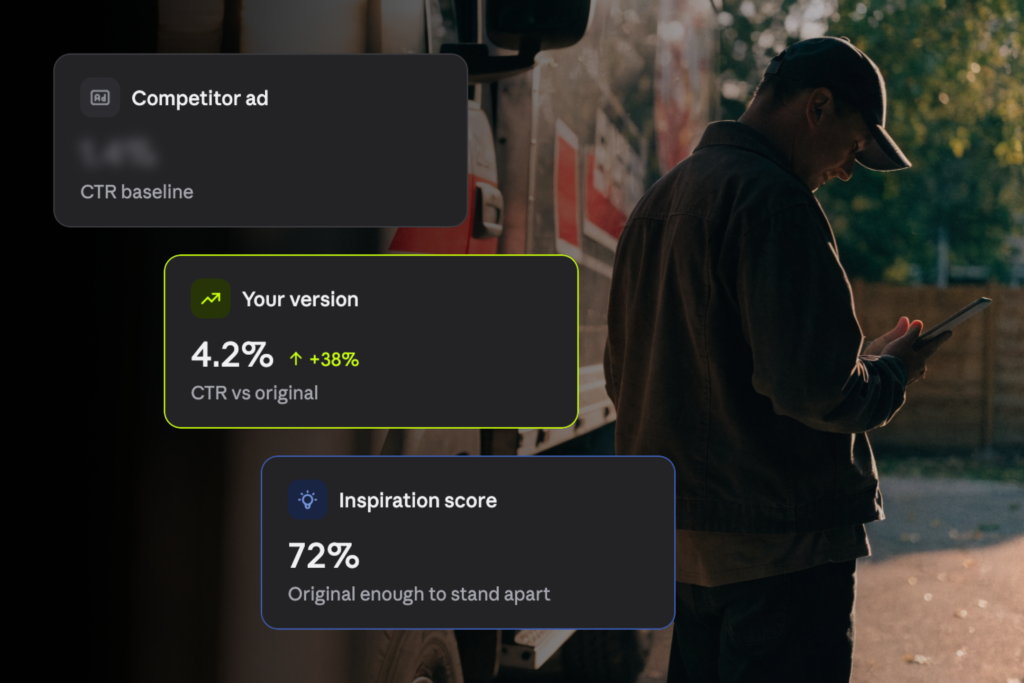
An ad that has been running for 60+ days without being paused is almost certainly performing. Meta advertisers kill what does not work. If the same video has survived for three months, study the format: owner on camera, before-and-after, testimonial, job-site walkthrough, offer, or hook. Longevity does not tell you the exact return, but it does tell you the advertiser has not rushed to shut it off.
One thing is hard to miss in the Ad Library: on Meta, a real person’s face often beats a polished logo. Most contractors know this and still avoid the camera. That reluctance is visible in the Ad Library, and so is the opportunity.
You are not there to clone the ad. You are there to learn what kind of creative is getting enough traction to stay live, then test your own version. Think of it as skipping the completely-blind first draft, not skipping the work.
Their Content and Blog
If a competitor publishes blogs or FAQs, look at what they keep answering. Questions like “how long does a roof replacement take” or “what causes an AC to short cycle” are not glamorous, but homeowners search them before they call.
Any useful topic a local competitor ranks for and you do not is a gap. Your job is not to rewrite their article. Write the clearer, more specific answer, add the local context they missed, and make the page genuinely more useful.
Connecting content gap research to answer engine optimization for home services matters here: in 2026, well-structured answers to specific homeowner questions show up not just in search results but in AI-generated responses. A contractor who publishes a thorough page on “how to tell if storm damage is covered by insurance” in the Bellevue market is positioned to appear when homeowners ask that question to ChatGPT or Gemini.
Their Social Media Presence
Now check social. Ignore the polished roof-anatomy graphic with seven likes from employees. Look for the posts that actually move: crew photos, job-site videos, team milestones, before-and-afters, and real captions.
High engagement tells you which formats and topics homeowners respond to. Borrow the format, then use your own team, jobs, voice, and proof.
The bigger issue for most contractors is not a lack of ideas. It is a lack of footage. A common problem is that teams restart from zero every time they need content because nobody has built the habit of filming. One afternoon on a live job can create weeks of usable material: quick explanations, crew clips, before-and-afters, customer reactions, and the small moments that make a company feel real.

What to Actually Do With What You Find
Watching competitors is only useful if it changes what you do next.
Turn Content Gaps Into Rankings
Find the homeowner questions no local competitor answers well. Google’s People Also Ask surfaces them in minutes. If nobody has a useful local page on “what to expect during a roof replacement in Seattle,” that is not a blank space to admire. It is a page to build. The opportunity is especially strong when the existing answers are generic, dated, or written for a national audience.
Turn Their Website Gaps Into Your Conversions
Next, compare the pages your top competitors have with the pages you do not. Common gaps include:
- Individual service-area or suburb pages for hyper-local searches
- An FAQ page built around questions homeowners actually ask
- A project gallery with useful descriptions, not a wall of photos
- A pricing transparency or “what to expect” page
Each missing page can be a ranking and conversion opportunity. Home service websites that actually convert covers the page types that move call volume, so competitor research quickly turns into a build list.
Use Review Intelligence to Sharpen What You Say
Competitor reviews tell you what to emphasize in your own copy. Five-star reviews show what homeowners value. One-star reviews show where expectations break.
If several five-star reviews praise communication, say more about communication. If one-star reviews keep mentioning surprise pricing, explain your estimate process clearly. If people rave about cleanup, put that standard somewhere homeowners can see it before the job. That is not imitation. It is writing to the concerns your market has already handed you.
Tools That Make This Faster
Most of this can be done for free. Paid tools mainly make the digging faster.
Free Tools That Work
- Google Search in incognito mode. See the results a homeowner sees without your browsing history muddying the water.
- Meta Ads Library (facebook.com/ads/library). See every active Facebook and Instagram ad a competitor is running.
- Google Business Profile search. Check review counts, categories, and photo activity.
- Google People Also Ask. Turn real homeowner questions into a quick content roadmap.
- Ubersuggest free tier. Get a partial view of competitor keyword rankings and obvious content gaps.
Paid Tools Worth It
- Ahrefs or Semrush. See the keywords competitors rank for that you do not. One month of access is enough to build a six-month content plan from those gaps.
The free stack is enough for a solid quarterly review. Paid tools save time and make patterns easier to spot, especially when you are comparing several competitors at once.
How Often to Do This and What to Track
Do this quarterly. Any more often and you risk turning competitor research into a hobby instead of a marketing tool.
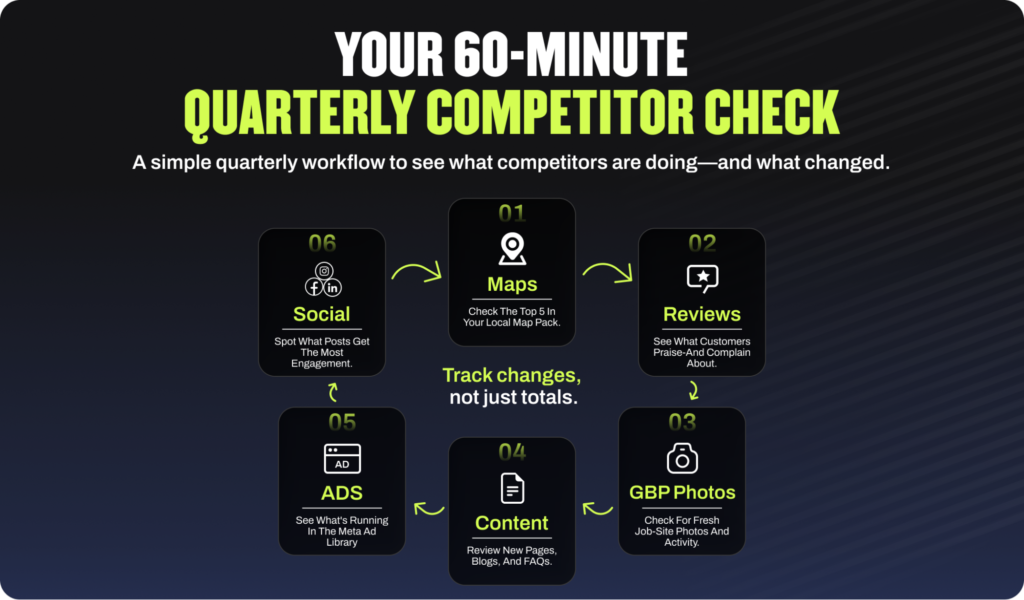
A simple quarterly rhythm:
- Pull the top five competitors in Google Maps for your main service category
- Record review count and most recent review date
- Check for GBP photo activity from the last 90 days
- Run each domain through Ubersuggest or Ahrefs for new content
- Check the Meta Ad Library for active campaigns
- Skim social profiles for the highest-engagement posts from the last 90 days
Track the basics in a spreadsheet: competitor, review count, last review date, active ads, notable new pages, and top-performing social content.
After a few quarters, patterns appear. Rising review counts point to a consistent ask process. New rankings point to publishing. Strong social engagement usually points to real footage rather than stock graphics. A competitor suddenly running three versions of the same offer is another clue worth noting. The point is not to obsess over competitors. It is to stop making marketing decisions in a vacuum.
Home services marketing strategy shows where competitive intelligence fits inside the larger marketing system.
Frequently Asked Questions
Is it ethical to look at what competitors are doing for marketing inspiration?
Yes. Studying competitor GBPs, reviews, ads, and content is normal competitive research. The line is simple: do not take their exact words, images, or creative. Learn the principle and build your own version.
What is the most useful thing to look at on a competitor’s profile or site?
Review trajectory is especially revealing. Look at how many new reviews they added in the last 30 to 90 days, not just the lifetime total. A company at 80 reviews adding 15 a month may have more momentum than one stuck at 500.
How do I use competitor reviews to improve my own marketing?
Read both ends. Five-star reviews show what homeowners value; one-star reviews show what is frustrating them. Use those patterns as input for website copy, offers, and ad creative.
Do I need paid tools to research competitors?
No. Google incognito search, Meta Ads Library, GBPs, competitor sites, reviews, and People Also Ask are enough to do useful research. Ahrefs or Semrush mainly speed up keyword-gap work.
What is a content gap and how do I find one?
A content gap is a question homeowners search that local competitors answer poorly or not at all. Find recurring pre-call questions, search them, and look for weak local results. People Also Ask is a free place to start.
How often should a contractor review what competitors are doing?
Once per quarter is enough for most contractors. Track review growth, GBP photo recency, active Meta ads, and new content so you can see what changed, not just what exists.
The Best Contractor Marketing Ideas Are Already Out There
Most contractors still post, advertise, and publish based on hunches. That is expensive improv.
The companies that pull ahead are better observers. They notice what earns five-star reviews, which ads survive for months, what content ranks, and what social posts people actually engage with. That information is public, free, and mostly ignored. The advantage is not having secret marketing tricks. It is being the contractor who actually bothers to look, learn, and act.
For home service businesses that want a marketing program built around what is actually working in their market, Hook Agency works specifically with contractors across HVAC, roofing, plumbing, and electrical. The goal is not to copy the company down the street. It is to learn faster than they do.