
Here is a situation I see constantly with new clients. They know they are losing jobs. They can feel it. The phone is slower than it should be for their market. Someone else is getting calls they should be getting.
But when I ask what they know about their top three competitors, the answer is almost always some version of: they have more reviews, they show up higher on Google, and I think they are running ads. That is observation. It is not a competitive analysis for contractors.
A competitive analysis is a structured review of what your top local competitors are doing across six specific areas, used to find the exact gaps where your business can win more leads. Not a gut feeling. An actual picture of the market.
What it covers:
- Google Business Profile: review count, velocity, photos, categories
- Review content: what homeowners specifically praise and where competitors consistently fail
- Website gaps: pages they have that you don’t, trust signals on display
- Keyword and content gaps: topics they rank for that you aren’t competing on
- AI search visibility: whether Perplexity or ChatGPT recommends them when homeowners ask
Step 1: Identify Your Real Local Competitors
Before analyzing anything, identify which competitors actually matter. The ones you’ve heard of may not be the ones winning the leads you’re losing.
Start With Three Incognito Searches
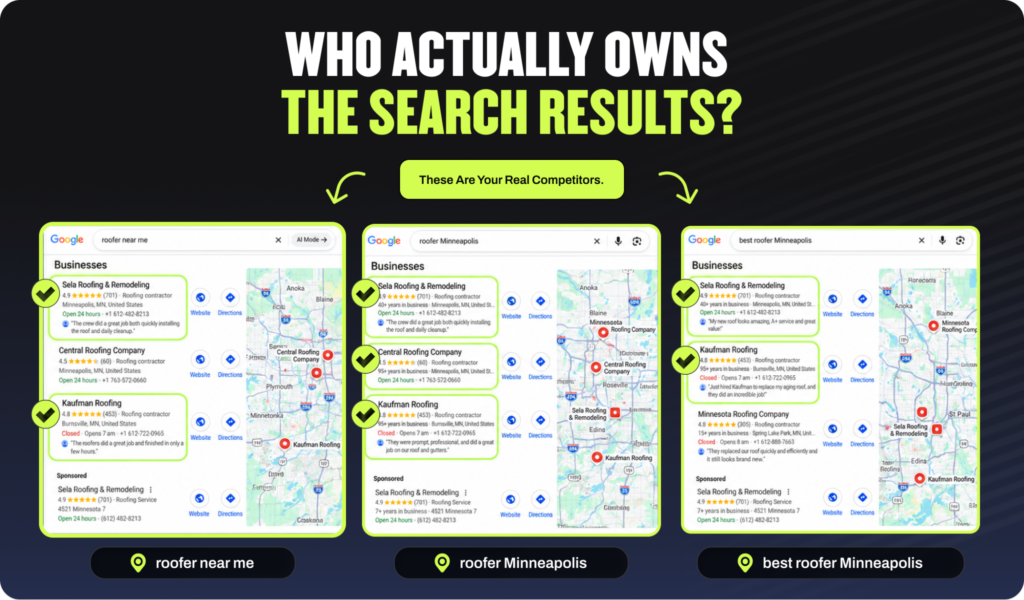
Open an incognito browser window to strip out your location and browsing history. Search these three variations using your primary service and city:
- [your service] near me
- [your service] [your city]
- best [your service] [your city]
The businesses appearing in the local map pack and top organic results are your real competitors. Directory listings like Angi or Thumbtack are not. You want the actual local business names that show up consistently across all three searches.
Build Your Competitor Shortlist
Pick three to five businesses that appear across all three searches. These are your primary competitors for this analysis. Write down their business name, website URL, and GBP link. That shortlist is the foundation of every step that follows.
Step 2: Analyze Their Google Business Profile
The GBP is the single most visible piece of real estate in local search. According to the 2026 Local Search Ranking Factors survey by Whitespark, surveying 47 of the world’s top local SEO experts, GBP signals remain the dominant local pack ranking factor in 2026. What a competitor has built there tells you more about their marketing strategy than almost anything else.
What to Record for Each Competitor
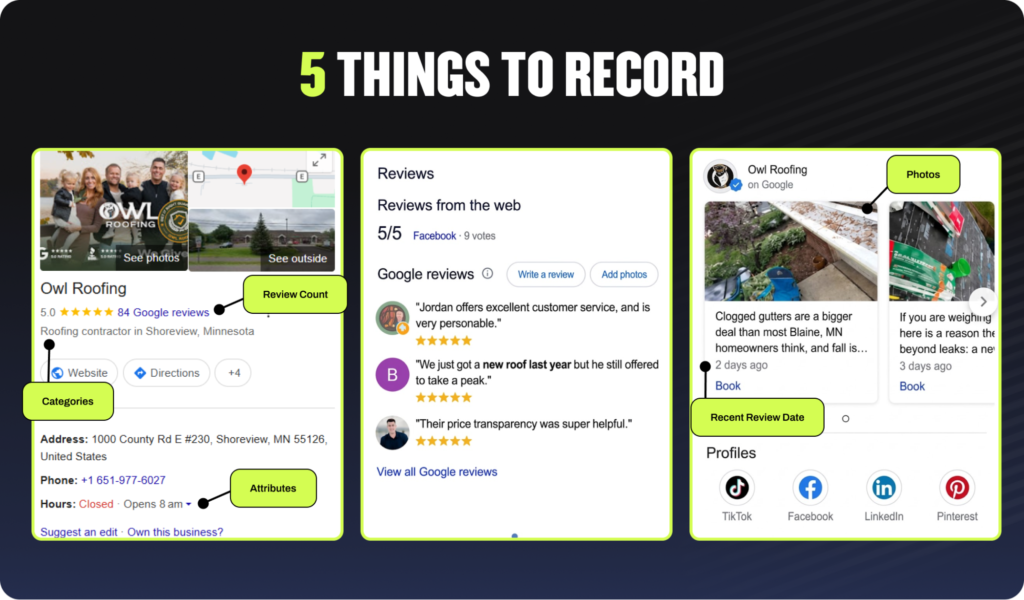
Spend five minutes on each profile and write down:
- Total review count and star rating
- Most recent review date and average new reviews per month (check 10 to 15 reviews and note the dates)
- Total photo count and date of most recent photos
- Categories listed beyond the primary service
- Attributes enabled: Open 24 hours, Background-checked, Free estimate
- Whether they use GBP posts
What the Numbers Actually Mean
Review velocity matters more than total count. A competitor with 200 reviews and nothing new in five months is stalling. A competitor with 60 reviews and three new ones each week is building momentum, and that momentum is what moves rankings.
Photo count is underestimated as a competitive signal. Local pack ranking research from BGR Review 2026 found that GBP completeness, including regular photo updates, correlates strongly with local pack position. Most contractors have 8 to 15 generic photos. Competitors with hundreds of real job-site photos are building a visual library that affects both ranking and conversion. If a competitor has significantly more photos and reviews than you, those two gaps alone are likely costing you map pack position.
Step 3: Mine Competitor Reviews for Intelligence
Competitor reviews are the most underused free market intelligence available to any contractor. Most people glance at star ratings and move on. The real information is in what the reviews actually say.
Read the Five-Star Reviews First
Look for patterns across all your competitors’ top reviews. What do homeowners specifically mention? If four out of five top competitors have multiple reviews praising same-day response, that is a purchase driver in your market. If reviewers consistently mention that the tech called ahead before arriving, communication is something homeowners in your city care about enough to write about.
Write down the three or four things homeowners praise most across all competitors. That is what the market values. Your marketing should reflect those things.
The full guide to online reviews for contractors covers how to build the ask process that generates the volume to compete here.
Then Read the One and Two-Star Reviews
This is where real competitive intelligence lives. Negative reviews of competitors reveal where the market leader is consistently failing. LocalImpact’s State of Online Reviews 2026, based on a survey of 1,068 US adults, found that 88% of consumers have avoided a business because of negative reviews, and 78% won’t consider a business with a rating below 4 stars. Homeowners are actively using negative reviews as a filter.
If a market leader’s one-star reviews consistently mention surprise pricing, technicians showing up late, or calls going to voicemail, those are specific gaps you can address with positioning. A contractor who builds their messaging around the exact things the market leader fails at is not playing catch-up. They’re flanking.
Read how competitors respond to negative reviews too. A defensive response to a one-star review is a visible trust signal that a homeowner scrolling the profile will notice.
Step 4: Audit Their Website
A competitor’s website shows you which content the market has built, and every page they have that you don’t is a potential ranking and conversion gap.
Pages They Have That You Don’t
Go through each competitor’s navigation. Look for:
- Individual service area pages for each city or suburb they serve
- A pricing or what-to-expect page
- A detailed FAQ page
- A project gallery with job descriptions, not just photos
- A financing page
Any page type that appears on three or more competitor sites and is absent from yours is a priority gap. Flag it. Every gap has both an SEO implication and a conversion implication.
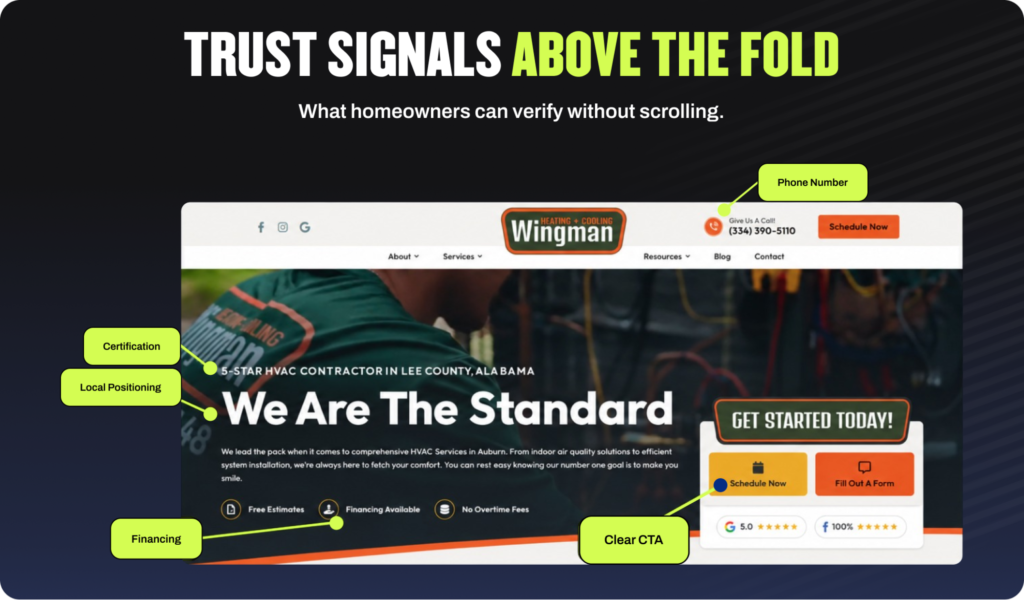
Trust Signals on Display
Note what trust signals competitors show on their homepage: license numbers, insurance status, manufacturer certifications, founding year, review counts, guarantee statements.
If a competitor displays NATE certification above the fold on their HVAC site and you don’t, that is a conversion gap. If three roofing competitors show a manufacturer warranty badge you also qualify for but haven’t added to your site, that is a five-minute fix with a measurable conversion impact.
Home service websites that actually convert covers which trust signals matter most by trade.
Step 5: Find the Keyword and Content Gaps
Keyword gaps are topics homeowners search for that competitors rank for and you don’t. Finding them gives a direct roadmap for content that generates leads.
Free Method: Incognito + People Also Ask
Search homeowner questions in incognito mode: “how much does HVAC replacement cost in [city],” “what to do if your roof is leaking,” “emergency plumber [city].” Look at which local competitors appear for each question. Any question a competitor ranks for that you don’t is a content gap.
Google’s People Also Ask section and autocomplete suggestions show you what homeowners are actually searching. Each suggestion is a potential page or article topic. This costs nothing and takes about 30 minutes to run across a handful of service categories.
The contractor marketing ideas guide covers how to turn these gaps into content that ranks.
Paid Method: Keyword Gap Tools
Ahrefs and Semrush both have keyword gap tools that take two domains and return every keyword one ranks for that the other doesn’t. Enter your domain and a competitor’s domain. The result is a content roadmap.
Even one month of access to either tool is enough to build a six-month content plan. For contractors not ready for a paid tool, Ubersuggest’s free tier gives a partial view of the same data. Local Falcon shows where you and competitors appear across the full service area on a geographic grid, not just a single average ranking position.
Step 6: Check the AI Search Layer
This is the step that most competitive analysis guides skip entirely. In 2026, it is one of the most important.
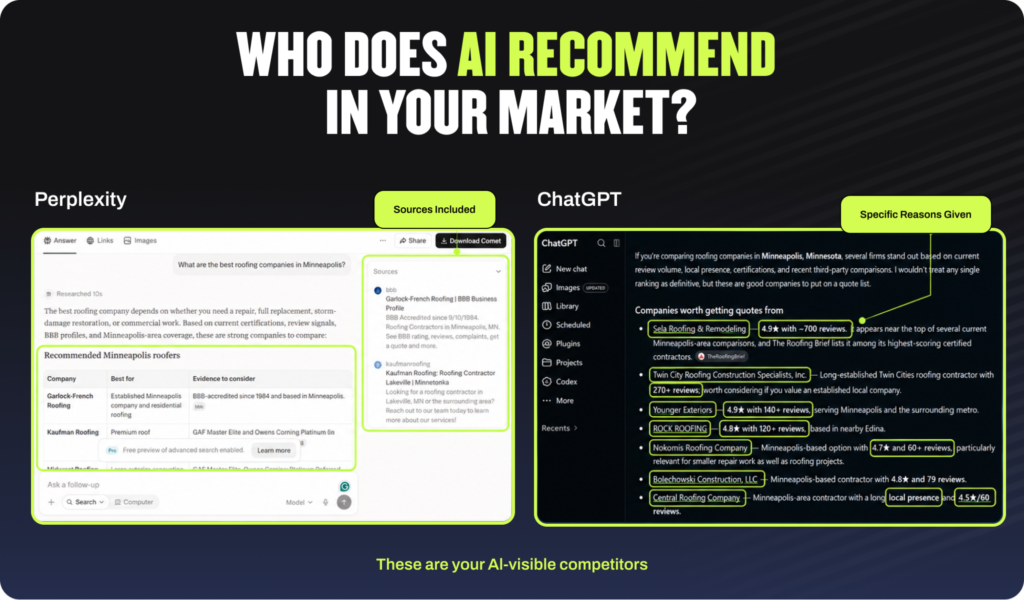
Homeowners increasingly ask AI tools for contractor recommendations before they open Google. Perplexity, ChatGPT, Gemini. AI tool usage for local business recommendations grew from 6% to 45% in a single year according to BrightLocal’s 2026 research. The contractors who appear in those answers are capturing a research stage that never even shows up in traditional analytics.
How to Check Who AI Is Recommending
Open Perplexity and ChatGPT. Type the same question in both, with a few variations:
- “What are the best [your service] companies in [your city]?”
- “Who should I call for [your service] in [your city]?”
- “Recommend a [your trade] contractor near [your city]”
Perplexity is particularly useful here because it shows its sources. When a competitor appears in a Perplexity answer, you can see which pages, directories, or review platforms Perplexity pulled from to make that recommendation. That tells you exactly which signals drove the AI result, which tells you exactly what to build.
Note which competitors appear across multiple AI tools and multiple question variations. Consistent AI visibility is a compounding advantage. Note how each competitor is described. Specific descriptions like “known for same-day emergency service” or “highly rated for insurance claims work” reflect what the AI has been trained on from their review content and website copy.
What to Do If Competitors Show Up and You Don’t
The signals that drive AI visibility are the same signals that drive local SEO: review volume, review recency, consistent business information across directories, strong service-specific content on the website, and a complete GBP. There is no separate AI optimization trick.
The specific content structure changes that support AI citation are covered in the answer engine optimization guide for home services. If a competitor appears in AI answers and you don’t, start with your GBP completeness, your review velocity, and your service page specificity. Those three gaps almost always explain the AI visibility gap.
Step 7: Build a Simple SWOT From What You Found
A SWOT is only useful if it leads to decisions. Everything found in steps one through six goes into four boxes, and those four boxes produce three specific actions.
The Four Boxes
- Strengths: what your business does better than each competitor right now, based on what you found, not what you assume
- Weaknesses: where competitors are visibly ahead in reviews, GBP completeness, content, or AI visibility
- Opportunities: gaps no competitor is filling well — topics no one ranks for, review categories no one leads in, trust signals no one displays
- Threats: competitors who are clearly growing fast, have significantly more reviews, or are expanding into service areas you currently own
Turning It Into Three Actions
A SWOT that stays in a document is wasted research. Before closing the spreadsheet, assign three specific actions:
- One GBP improvement: more photos, a category addition, responding to reviews that haven’t had a response
- One content page: the highest-value topic a competitor ranks for that you currently have no page for
- One positioning change: based on what competitor reviews reveal the market values or what the market leader consistently fails at
Three actions from three to five hours of research is a return most contractors never capture because they never run the analysis in the first place.
The Competitor Tracking Table
Copy this into a spreadsheet and fill it in for each competitor. Run it quarterly.
| Competitor A | Competitor B | Competitor C | You | Priority | |
|---|---|---|---|---|---|
| Review count | |||||
| New reviews (30 days) | |||||
| GBP photo count | |||||
| Key service pages | |||||
| AI visibility (Y/N) |
The value is in the trend, not the snapshot. Quarter over quarter, the shifts in review velocity, photo activity, and AI visibility tell you which competitors are investing in their digital presence and which are standing still.
Tools by Step
Free Tools That Cover the Essentials
- Google incognito. Accurate view of what homeowners see
- Google Business Profile direct. Review count, velocity, photo activity, category data
- Google People Also Ask and autocomplete. Free keyword and content gap discovery
- Meta Ads Library. Free view of every ad a competitor is currently running on Facebook and Instagram
- Perplexity and ChatGPT. AI visibility check with Perplexity showing sources
- Google PageSpeed Insights. Benchmark competitor website speed
Paid Tools Worth Considering
- Ahrefs or Semrush. Keyword gap analysis and content opportunity mapping. One month of access builds a six-month content plan
- Local Falcon. Hyper-local grid rank tracking that shows where you and competitors appear across the full service area
- BrightLocal. Review monitoring, citation auditing, and local rank tracking in one platform
How Often to Run This
A full competitive analysis once per quarter is the right cadence for most home service businesses.
The first run takes three to five hours. Quarterly updates take one to two hours once the competitor shortlist and tracking format are established. In between quarterly reviews, keep a simple running log:
- Competitor review count and most recent review date
- Any new pages spotted on competitor sites
- Any new GBP activity
- Any new AI appearances
A contractor who does this consistently over 12 months builds market intelligence that no agency retainer can manufacture from scratch. The goal is not to obsess over competitors. It is to make decisions based on what is actually happening in the market rather than what feels right from inside the business.
Home services marketing strategy covers how competitive intelligence connects to the full marketing system rather than sitting in isolation.
Frequently Asked Questions
What is a competitive analysis for contractors?
A structured review of what your top local competitors are doing across their Google Business Profile, reviews, website, keyword rankings, content, and AI search visibility. The goal is to find where competitors are winning leads you should be getting and where the gaps are that your business can fill.
How long does a competitive analysis take?
The first full run covering three to five competitors takes three to five hours. Quarterly updates take one to two hours once the competitor list and tracking format are in place. Most of the time is spent reading reviews and checking GBP profiles, which requires no tools.
Do I need paid tools to run a competitive analysis?
No. Incognito Google searches, reading competitor GBP profiles and reviews directly, Google’s People Also Ask, and AI tools like Perplexity and ChatGPT cover the most important steps for free. Paid tools like Ahrefs or Semrush speed up keyword gap analysis but are not required.
What should I do with the results?
Summarize findings into a simple SWOT and assign three specific actions: one GBP improvement, one content page to create, and one positioning change based on what competitor reviews reveal homeowners care about most. Research that doesn’t produce at least three concrete actions goes nowhere.
How do I check if competitors appear in AI search?
Open Perplexity and ChatGPT and ask what are the best [your service] companies in [your city] with a few question variations. Perplexity is especially useful because it shows its sources, which tells you exactly which signals drove the AI recommendation. If a competitor consistently appears and you don’t, start with review velocity, GBP completeness, and service page specificity.
How often should a contractor run a competitive analysis?
Once per quarter is enough for most home service businesses. Between reviews, track competitor review velocity and any new website pages or GBP activity. The quarterly comparison shows which direction competitors are moving, not just where they are today.
A Competitive Analysis Tells You Where to Focus. Execution Is What Wins the Jobs.
Knowing that a competitor has three times your review count, ranks for service area pages you haven’t built, and appears in Perplexity recommendations when you don’t, that is useful information. It tells you exactly where the next quarter’s energy should go.
The contractors who dominate their local markets are not smarter. They are better informed. And the information is out there, sitting on Google Business Profile pages and in review tabs that most contractors scroll past without reading.
For home service businesses who want a marketing strategy built from actual market data rather than generic advice, that is the work we do at Hook Agency. The competitive analysis is always the first thing we run.