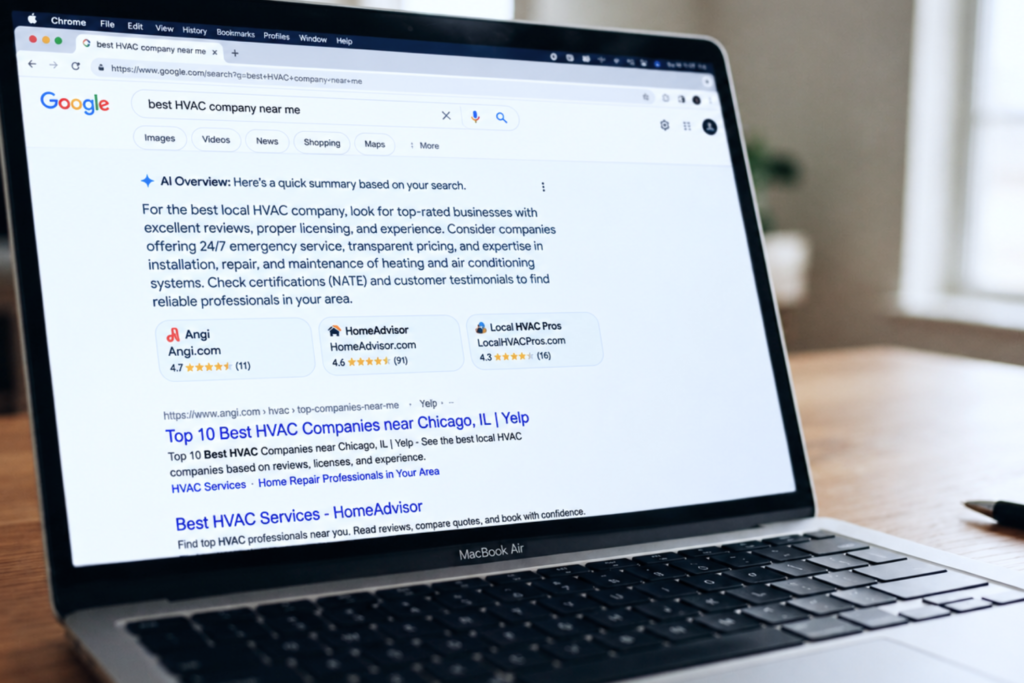

On a sales call last month, I asked a roofer to open ChatGPT, type his trade and city, and read me what came back. He found two competitors. Neither was him.
That is the AI search problem in one moment. His site ranked fine in Google. He had decent reviews. But ChatGPT does not show a list of ten options. It picks one or two businesses, names them, and moves on. For most roofing websites we audit, the named business is someone else.
According to a 2026 report from First Page Sage, AI platforms now account for 6.9% of all web sessions, and AI referral traffic is growing at 98% year over year. Visitors from AI search convert at 4.7%, versus 1.9% from Google organic. The traffic is smaller. The quality is not.
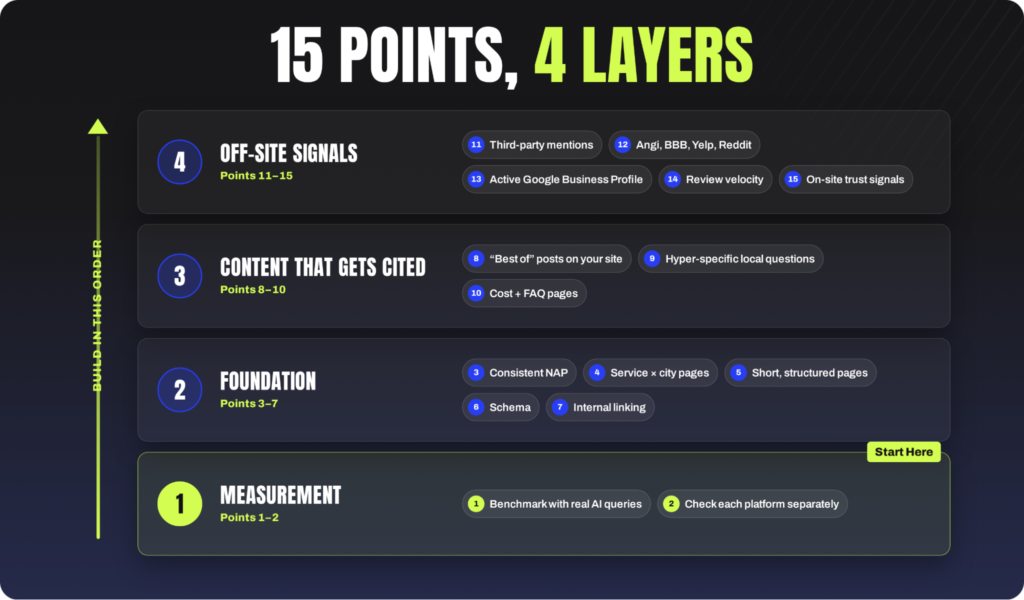
What follows is 15 points drawn from reporting calls with our SEO team, organized into four groups:
- Measurement: knowing where you actually stand before you change anything
- Foundation: the structural items every other fix depends on
- Content that gets cited: the pages and posts AI tools actually pull from
- Off-site signals: the external layer that tells AI tools your business is real
Why AI Search Readiness Is Different From Traditional SEO
Traditional SEO is a ranking game. You optimize for position in a list, and the homeowner picks from ten options. AI search is a citation game. ChatGPT extracts one answer and sometimes names one business. The difference between ranking eighth and not being named at all is now significant in a way it was not two years ago.
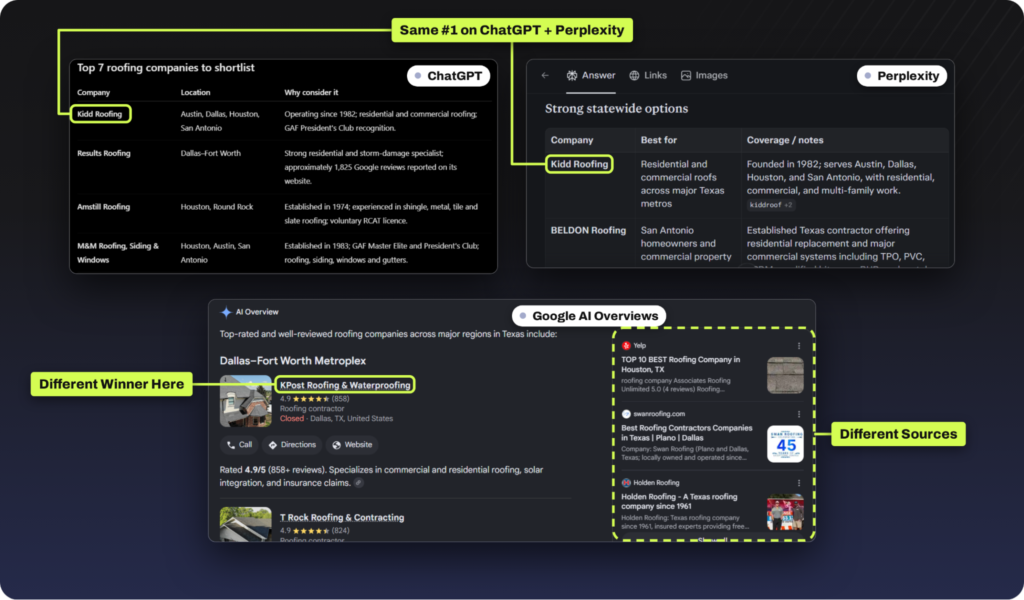
There is also something most people miss: not all AI tools pull from the same sources. The same client can sit first in Google AI Overviews and third in ChatGPT because ChatGPT weights Angi and third-party directories more heavily than Google does. That is why AI search readiness is not a single switch. It is a foundation that makes you visible across all of them, not just one.
Understanding AEO vs SEO is the starting point for contractors who want to know exactly where the two strategies overlap and where they diverge.
Group 1: Measurement
Before you change anything, run the test. The contractors who panic about AI visibility and the ones who ignore it completely have one thing in common: neither has actually measured where they stand.
1. Benchmark with real queries, not tool estimates
Free tools like SEMrush give estimated AI visibility scores. They are estimates. At Hook, we track AI visibility by running actual prompts across zip codes every few hours in a dedicated platform. The gap between estimated and actual AI visibility is frequently significant.
Right now, open ChatGPT, Perplexity, and Google AI Overviews in three separate tabs. Run these queries in each one:
- “Best roofing companies in [city]”
- “Most reliable roofer near [city]”
- “Who should I call for roof replacement in [city]”
Write down what comes back. That is your baseline. Everything else gets measured against it in 30 to 60 days.
2. Check each AI platform separately
Do not assume that appearing in Google AI Overviews means you appear in ChatGPT. They pull from different data sources. Run your queries across all three platforms and track them separately. The fix for a ChatGPT visibility gap looks different from the fix for a Google AI Overviews gap, and treating them as the same problem wastes time on the wrong solution.
Group 2: Foundation
These are the structural items that have to be in place before anything else works. If the foundation is missing, the content work above it has nothing to stand on.
3. Consistent business info everywhere
Check your business name, address, and phone number across:
- Your website
- Google Business Profile
- Angi, HomeAdvisor, BBB, Yelp
Any inconsistency between listings is a signal degradation. AI tools use cross-platform entity signals to verify that a business is real. Inconsistent NAP reduces citation confidence directly. This is a core build item in every SEO package at Hook because it underpins everything else on this list.
4. Service-times-city page coverage
AI tools answer specific local queries. ‘Roof replacement in [city]’ needs a dedicated page to cite. A single services overview page is not what gets cited for specific local queries. The minimum build we recommend:
- Top 5 services
- Top 5 cities
- That is 25 dedicated pages as a base
Building service area pages for contractors the right way is what turns that 25-page matrix into pages that actually get cited. Structure matters as much as coverage.
5. Short, structured pages over long ones
Short, focused service pages are easier for AI tools to read and place by service and city. Long-form content belongs in blogs. If your service pages are running to 2,500 words of background and context, they are written for a word count target, not for a crawler trying to match your page to ‘roof replacement in [city].’
One clean H1. Clear H2 sections. Direct answers in the first paragraph. That is the structure that gets cited.
6. Schema and technical SEO
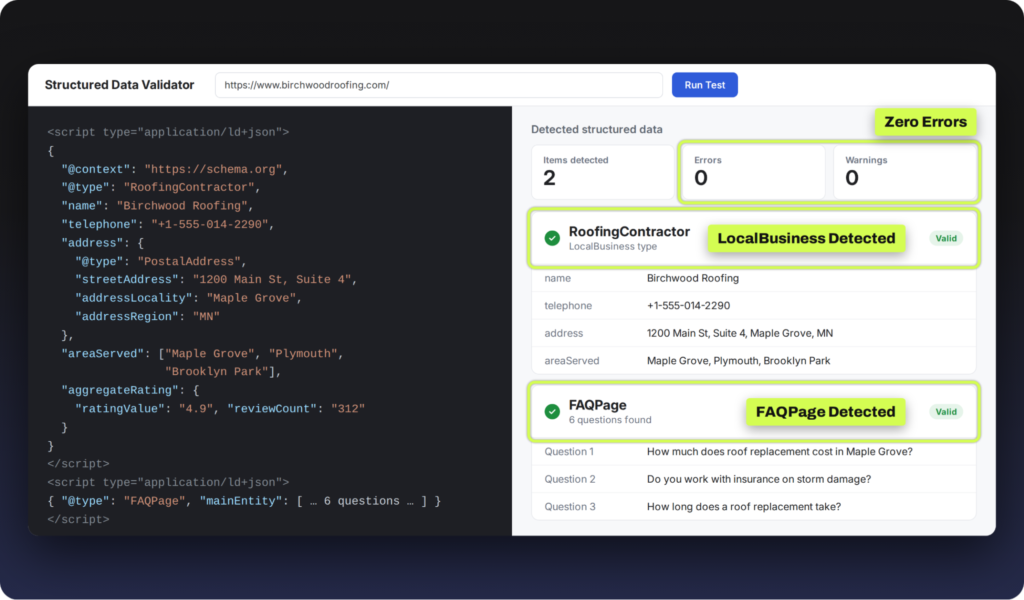
Schema is how your website communicates structured information to AI crawlers directly, without requiring them to interpret unstructured prose.
Two schema types matter most for roofing sites:
- LocalBusiness schema: tells AI tools exactly who you are, where you operate, what you do
- FAQPage schema: makes your question-and-answer content machine-readable and directly extractable
Use Google’s Rich Results Test on your homepage and service pages to check what schema is currently there. If LocalBusiness schema is missing from the homepage, that is the first fix. If service pages have FAQ sections but no FAQPage schema markup, that is the second.
7. Internal linking done right
Internal linking tells AI crawlers how your content is organized and passes authority between pages. Two patterns that consistently produce results:
- City hub pages linking to individual location pages
- Trending blog posts linking back to core service pages
A blog post on roof replacement costs that links to your ‘roof replacement in [city]’ service page sends that page authority and makes the relationship between educational content and local service intent explicit. That is the core idea behind answer engine optimization for home services: building a content architecture where every piece earns its place in the structure.
Group 3: Content That Gets Cited
The foundation makes you findable. This group determines whether AI tools actually pull from your content when a homeowner asks a question.
8. ‘Best [service] companies in [city]’ posts on your own site
When ChatGPT answers ‘who are the best roofers in [city]?’ it often cites a source that lists local options. If that source is a third-party directory, the click goes there. If it is a ‘best roofers in [city]’ post on your own site, the click comes to you, even when you name a few competitors.
The cited source is your domain. That is what gets the traffic. Write the post, include yourself, name legitimate competitors, make it genuinely useful. Jack at Hook calls it backdooring your competitors. The AI cites your page. The homeowner lands on your site.
9. Hyper-specific local queries
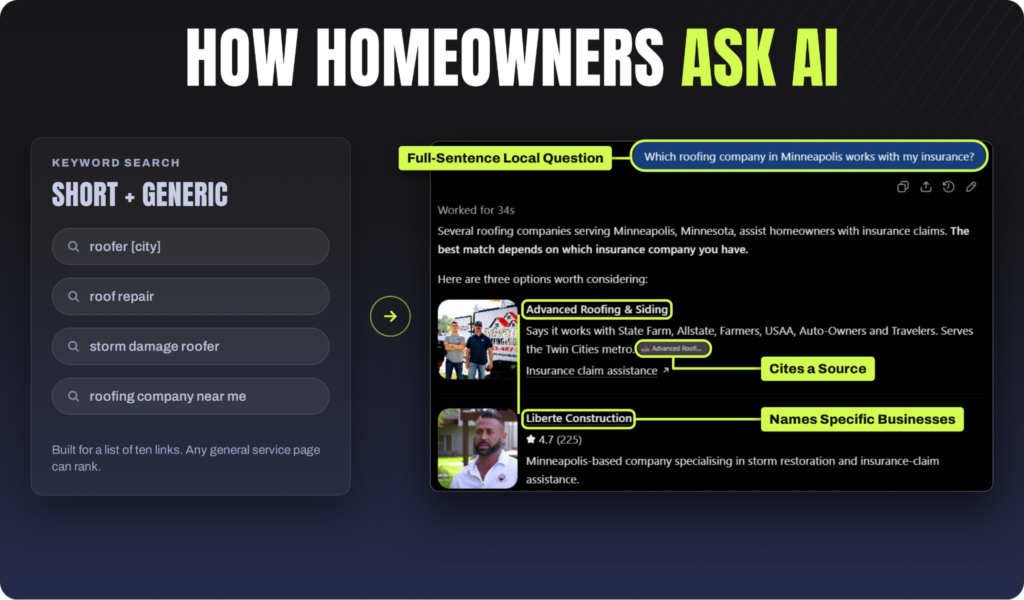
The shift that became measurable in 2026: AI tools are rewarding content that answers specific local questions, not general service overviews. Homeowners using AI search ask differently than keyword searchers:
- “Who handles storm damage roofing claims in [city]”
- “Best roofer for a historic home in [neighborhood]”
- “Which roofing company in [city] works with my insurance”
Think about the specific questions you hear on sales calls. Those are the blog posts that get cited. Running a competitive analysis for contractors is the fastest way to find what your competitors are ranking for and where the content gaps are that you can move into.
10. Cost and FAQ content
‘How much does roof replacement cost in [city]?’ is one of the most common queries homeowners run through AI tools before calling anyone. A dedicated cost page, written to answer that question directly with realistic local ranges and the factors that affect price, is exactly what AI tools cite.
A services page that buries cost information in a paragraph is not. The home services marketing glossary defines exactly what structured content types perform best here, broken down by format and intent. Build a cost page for each major service, lead with the answer, add FAQ schema.
Group 4: Off-Site Signals
Your website is one input. AI tools verify what your website claims by checking what other sources say about you. These five points are about building that external signal layer.
11. Presence on domains beyond your own
A business that only exists on its own domain has a thin authority footprint. AI tools use third-party mentions as external validation that a business is real and credible. One approach we use at Hook is placing a ‘best of’ guest post on a separate site that names our clients. Even a chamber listing or a manufacturer certification page counts. The goal is at least one crawlable third-party mention that is not a basic directory.
12. Third-party profiles: Angi, HomeAdvisor, BBB, Yelp, Reddit
ChatGPT pulls heavily from Angi for home service recommendations. A missing or incomplete Angi profile is a direct AI visibility gap. Claim and complete profiles on all major platforms. Keep them active. Respond to reviews. Update your services list.
These profiles are not just marketing channels anymore. They are the data sources AI tools use to verify your business is legitimate.
The SEOFOMO 2026 State of AI Search Optimization survey found that 75% of marketing professionals now have a dedicated AI search strategy for at least some client sites, up from 51% the prior year. The agencies working on this for competitors in your market are not waiting.
13. Active Google Business Profile
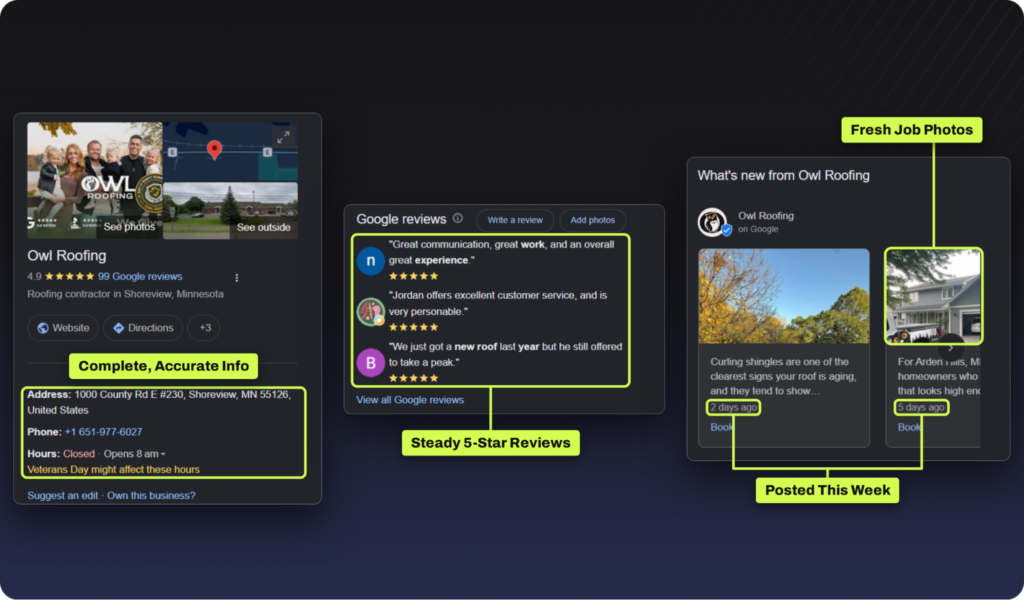
For Google AI Overviews specifically, an active GBP is one of the strongest local visibility signals. What ‘active’ actually means:
- Posts at least once a week
- Fresh photos from real jobs (within the last 30 days)
- Responses to every review
- Accurate hours and a complete services list
A GBP that has not been touched in six months sends a weaker signal than one updated last week. This is not optional maintenance. It is a live ranking input.
14. Review volume, velocity, and reputation
Review velocity is one of the highest-leverage factors for local AI visibility. The number of reviews matters less than the rate at which new ones are arriving. A business with 200 reviews but none in three months looks stagnant to an AI tool. A business with 80 reviews, ten in the last 30 days, looks active and trusted.
Build a systematic review request into your post-job workflow. Text or email every completed job. Make it one tap. Volume and velocity compound, and positive reputation shows up explicitly in some AI-generated answers.
15. Trust signals on the site
AI tools use trust signals on the website itself to decide whether a source is credible enough to cite. Display:
- Your state license number on the homepage and About page
- Manufacturer certifications: GAF, CertainTeed, Owens Corning
- BBB accreditation badge if applicable
- Industry association memberships
Each one is a verifiable trust signal. Their absence is a gap. Any serious home services marketing strategy treats these as non-negotiable baseline items, not optional extras.
Where to Start If You Are Running This for the First Time
Work in order. Each layer enables the next one and you waste effort if you skip ahead.
- Measurement first. Run the actual queries. Document what you see. This takes one hour.
- Foundation second. NAP consistency, service-times-city pages, schema, and internal linking are the structural items that everything else builds on.
- Content third. ‘Best of’ posts, specific local queries, and cost and FAQ pages. Write for the specific question, not the general topic.
- Off-site signals last. Directory profiles, third-party mentions, GBP activity, review velocity, trust signals.
According to the SEOFOMO 2026 survey, 69% of marketing professionals now have budget specifically allocated for AI search, up from 38% the prior year. The businesses showing up in AI answers in your market are increasingly there because someone is doing this work intentionally. The ones not showing up are waiting to feel the gap before they address it.
Frequently Asked Questions
What does AI search readiness mean for a roofing contractor?
It means your website has the specific signals that tools like ChatGPT and Google AI Overviews use to find, read, and recommend your business: AI crawlers can access your site, your business is clearly identifiable as a real local entity, your content is structured so answers can be extracted from it, and external sources verify that your business is credible. A site that ranks well in traditional search can still be invisible in AI-generated answers if these specific signals are missing.
Why is my roofing business not showing up in ChatGPT?
Usually one of three reasons: your website blocks AI crawlers (sometimes accidentally), your content is not structured in a way that lets AI tools extract direct answers, or your business lacks the entity signals AI tools use to verify you are a real local company. Missing Angi profile is frequently a direct contributor since ChatGPT pulls heavily from Angi for home service recommendations.
How long does it take to see results?
Initial AI visibility improvements following structural changes are realistic within 30 to 60 days. Run the same local queries in ChatGPT, Perplexity, and Google AI Overviews before and after. The delta is what shows you which fixes moved the needle.
Do I need a developer to run this audit?
Some points are DIY: running test queries, checking NAP consistency, reviewing GBP activity. Others require developer involvement: adding JSON-LD schema, fixing JavaScript rendering issues, building out service-times-city pages at scale. The checklist identifies what to fix. Not every fix is a one-person task.
Working on This as Part of a Broader Program
Most roofing websites are not AI-ready because they were built before AI search existed as a meaningful channel. The 15 points in this checklist do not require rebuilding anything. They require specific, targeted changes that make existing content readable and trustworthy to AI tools.
Hook Agency works exclusively with home service contractors on exactly this kind of work: building service-times-city pages, adding schema, managing directory profiles, running review systems, and building the content types AI tools actually cite. If you want to understand the full scope before reaching out, our breakdown of answer engine optimization for home services covers the whole framework from first audit to execution. When you are ready to get started, get in touch with our team and we can walk through what your site specifically needs.