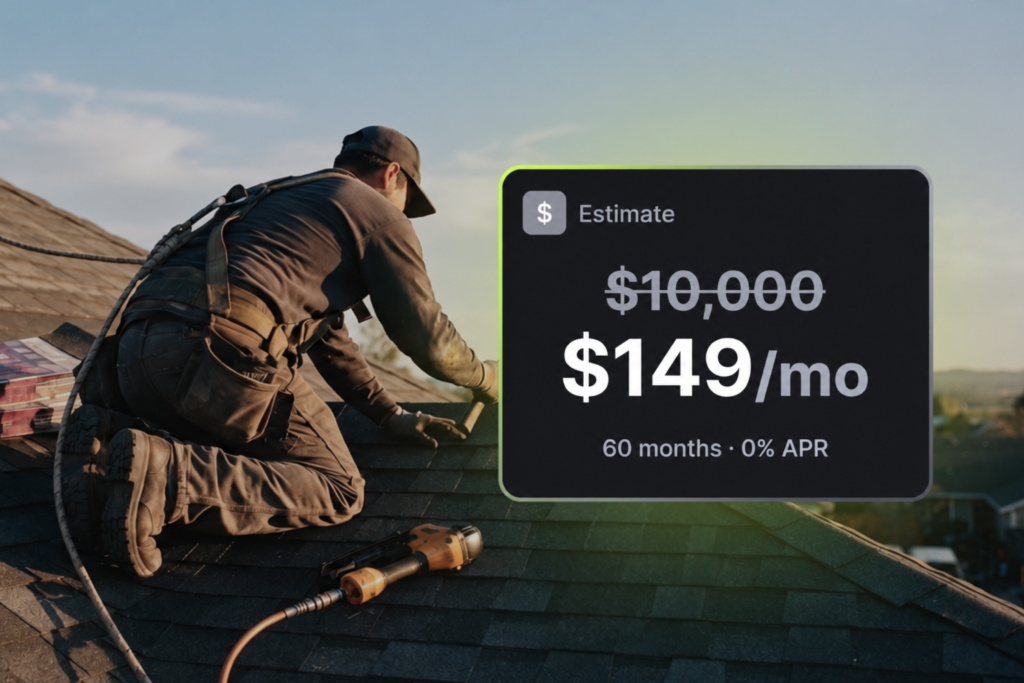

I have looked at hundreds of contractor websites. And one of the most reliably broken pages on almost all of them is the financing page. Not because the contractor does not offer financing. Most do at this point. But because the page they built around it is doing absolutely nothing.
A link in the nav. A lender logo. Maybe a sentence about flexible payment options. That is not a financing page. That is a placeholder with a URL.
Meanwhile, a 2025 Modernize homeowner survey found that 74% of homeowners would consider financing at least part of their project. Nearly one in five said they would finance the entire thing. And 31% cited difficulty accessing financing as one of their top barriers to even starting. The homeowner who would have said yes is leaving your site because you never gave them a number they could work with.
The fix is not a new financing provider. It is a page that actually does the job. Here is what that looks like:
- Reframes the number: turns $14,500 into a monthly payment the homeowner already knows how to decide about
- Explains the process: who the lender is, what happens to their information, how fast approval works
- Shows the math upfront: a live calculator or realistic payment range before they ever call you
- Removes the trust gap: keeps the homeowner in your branded experience instead of bouncing them to an unfamiliar portal
- Gives a specific next step: not ‘contact us,’ but ‘check your rate in 60 seconds’
Most contractor financing pages have one of these. Here is how to build one that has all five.
Why Your Financing Page Matters More Than Your Financing Terms
Contractors obsess over which financing provider to use, what rates they can offer, and whether 18-month same-as-cash beats a low-interest installment plan. I get it. But in almost every underperforming financing setup I have audited, the product is not the issue. The page is.
How clearly financing is presented, and how easy it is to access, matters more to homeowners than the specific terms. A Forbes Advisor survey found that 63% of homeowners fund home improvement projects through savings. But 75% of those who had never used a loan said they would or might consider one for a future project. The willingness is already there. The question is whether your website ever surfaces the option in a way that makes it real.
A page that links to a generic lender portal with no context does not make it real. It makes it confusing. And confused homeowners do not convert.
The Psychology Behind Why Monthly Payments Work
Before building the page, it is worth being clear about what it is actually doing psychologically, because that shapes every decision about what to put on it.
Sticker Shock Is a Framing Problem, Not a Price Problem
When a homeowner sees $14,500 for an HVAC replacement, their brain runs a comparison against every other large purchase they have made and flags it as exceptional. That triggers decision avoidance. The ‘let me think about it’ response.
Jeff Cronin, who trains plumbing, HVAC, and home service sales teams across the country, is blunt about this: the word ‘afford’ is a sales killer. When a rep says ‘can you afford this,’ it confirms the hesitation. The reframe is to point to the monthly number and ask, ‘is that manageable for you?’ Same question. No friction coming from the rep.
Good Better Best: Moving Homeowners Up the Ticket
Presenting three service tiers with monthly payment amounts alongside each one changes the homeowner’s question from ‘can I afford this’ to ‘which option works best for me.’ When the premium option is $70 more per month than the standard option, the homeowner frequently asks what that extra $70 gets them. That is the upgrade conversation. And it starts on the page, not in the estimate.
What a Contractor Financing Page Must Include
Five elements. Most contractor financing pages have one or two. Here is what all five look like and why each one matters.
1. A Plain Explanation of How Financing Works
A December 2025 FNBO survey of 947 homeowners who had completed or planned projects over $15,000 found that 68% worry about hidden fees with financing, and 51% find financing options confusing. Those are the default conditions most homeowners arrive in.
The page needs to answer the questions they have before they will consider applying:
- Who is the lender?
- Does applying affect my credit score?
- What information do I need?
- How fast is the approval decision?
- What happens between approval and the start of the job?
The soft credit pull explanation carries particular weight. ‘Checking your rate will not affect your credit score’ removes one of the most common hesitations before it becomes a reason to close the tab.
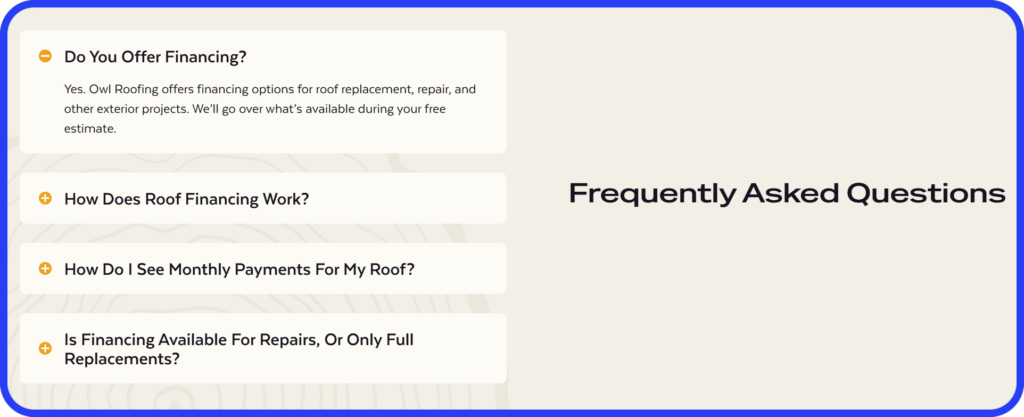
2. A Monthly Payment Estimate or Calculator
This is the highest-impact element on the page. A live calculator or payment estimator showing realistic monthly ranges for your services does the psychological reframing work before the homeowner picks up the phone. The homeowner who arrives at the call knowing their $11,000 roof is roughly $189 per month is a materially different buyer than the one who only saw $11,000 on the service page.
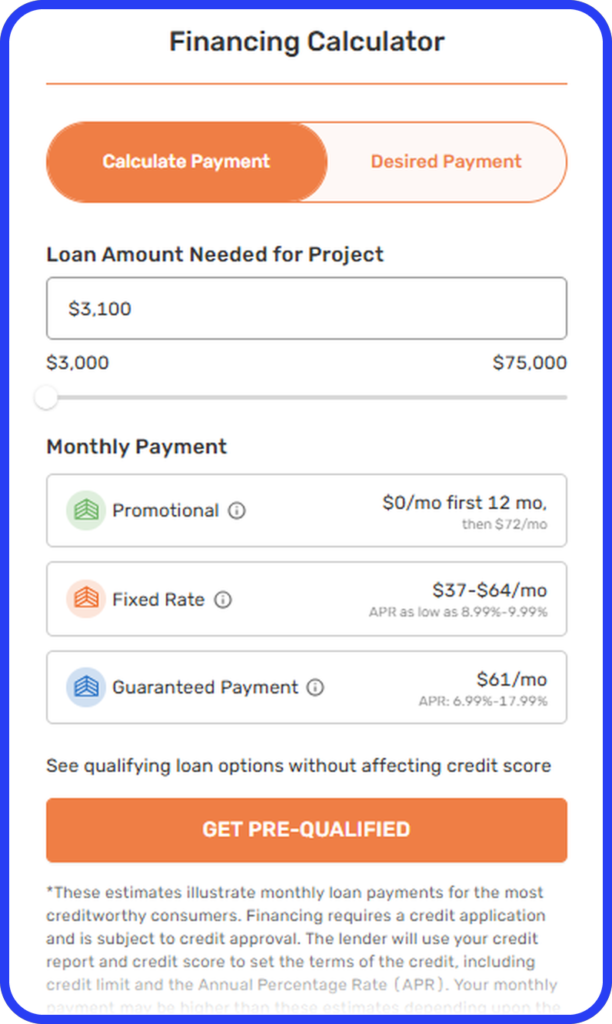
3. A Clear Application Path With No Surprises
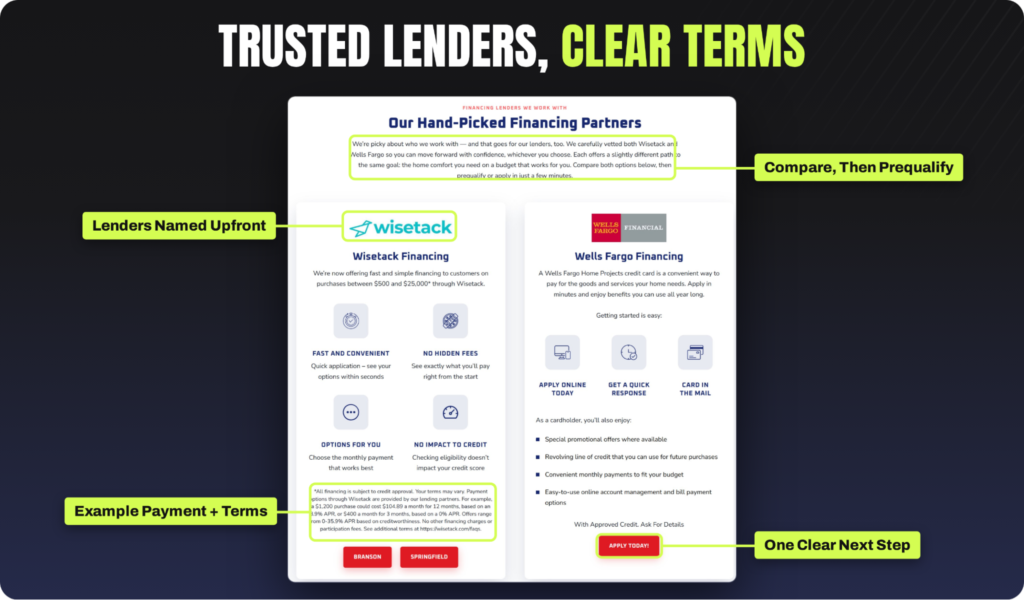
The application path should be reachable in one click from the financing page, optimized for mobile, and fast: a pre-qualification should complete in 30 to 60 seconds. No surprise redirects, no unexpected form fields, no gap between what the page promises and what the application actually requires. Every extra point of confusion reduces how many homeowners complete it.
4. Trust Signals That Address the Right Hesitations
The FNBO research found that 59% of homeowners say they would walk away from a project due to lack of trust in the process, and 93% say trust in the lender and clear loan terms are the most important factors in choosing financing. Generic five-star reviews do not address this. What does:
- Name the lender explicitly
- State that the contractor does not receive the homeowner’s financial information
- Confirm the credit decision is made independently by the lender
- Restate that checking a rate does not affect their credit score
Building trust on the financing page connects directly to the rest of your site. The same homeowner has usually just come from your about us page. Those two pages need to tell a consistent story.

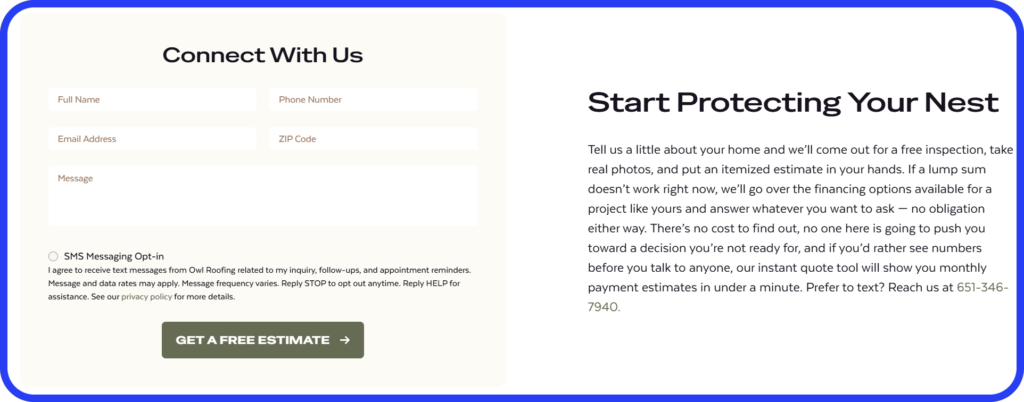
5. A Real CTA Tied to the Next Step
Not ‘contact us.’ Something specific: ‘Check your rate in 60 seconds.’ ‘See your estimated monthly payment.’ ‘Pre-qualify now with no impact on your credit.’ These CTAs describe an action and its outcome, which converts at a significantly higher rate than a generic form invitation because the homeowner knows exactly what they are about to do.
Where Financing Information Goes on Your Website
A dedicated financing page is necessary. It is also not sufficient. Financing information needs to appear at every point on the home service website where a homeowner might hesitate over cost.
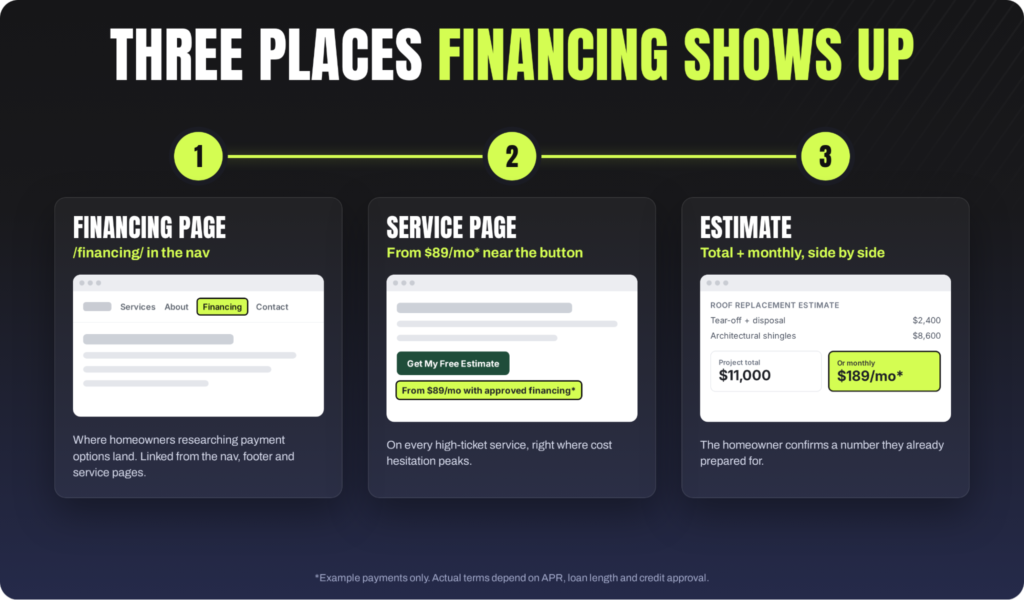
The Dedicated Financing Page
This is where homeowners specifically researching payment options land. It earns its own search value for queries like ‘HVAC financing [city]’ or ‘roofing financing options near me.’ It lives at /financing/, linked from the main nav, the footer, and service pages. Everything in the previous section lives here.
Service Pages for High-Ticket Work
For any service with an average ticket above $1,500, a financing mention belongs on the service page near the CTA. One line near the estimate button does real work: ‘From $89 per month with approved financing.’ The homeowner who is already on a roofing or HVAC replacement page is on the most conversion-relevant page on your site. That is exactly the moment to remove the cost hesitation.
The Estimate and Proposal Stage
The website financing page prepares the homeowner to receive the estimate. When the estimate shows the monthly payment alongside the total, the homeowner is confirming what they already prepared for, not encountering financing as a last-ditch close attempt. This is part of a broader home services marketing strategy that treats the website and the sales process as one continuous system.
The Trust Problem You Must Solve on the Page
The most common reason a contractor financing page fails to convert has nothing to do with the rate or the term. It is what happens the moment the homeowner clicks apply.
Why Third-Party Redirects Lose Homeowners
When a homeowner clicks apply on your website and lands on a page with an unfamiliar logo and different branding, their brain runs a quick check: who is this, should I trust them with my personal information? The FNBO research found that 46% of homeowners disengage when financing feels pushed aggressively or handled opaquely. A visual and brand break in the application process reads as both. This is the most fixable trust gap in a contractor’s financing setup and it is almost universally overlooked.
What Embedded or Branded Financing Fixes
Financing tools that embed directly into the contractor’s website and maintain consistent branding throughout the application eliminate the trust drop. A monthly payment calculator, pre-qualification form, and application path that stays within your branded experience converts at a measurably higher rate than a redirect to a lender portal the homeowner has never seen. This is one of the core reasons we build contractor marketing differentiation into how financing is presented on the web, not just what provider you choose.
What the Financing Page Looks Like by Trade
The page is not identical across trades. The average ticket, the typical decision timeline, and the most common homeowner hesitation differ enough that the structure and language should reflect them.
HVAC
HVAC replacement decisions are often semi-urgent: the system is failing, the homeowner already knows something has to happen, and cost is the primary barrier to moving forward now. Lead with seasonal urgency alongside the monthly payment context. A live calculator anchored to realistic replacement ranges for the local market, with a CTA like ‘Check your rate before the season, 60 seconds to see your options,’ is significantly more effective than a paragraph about financing availability.
Roofing
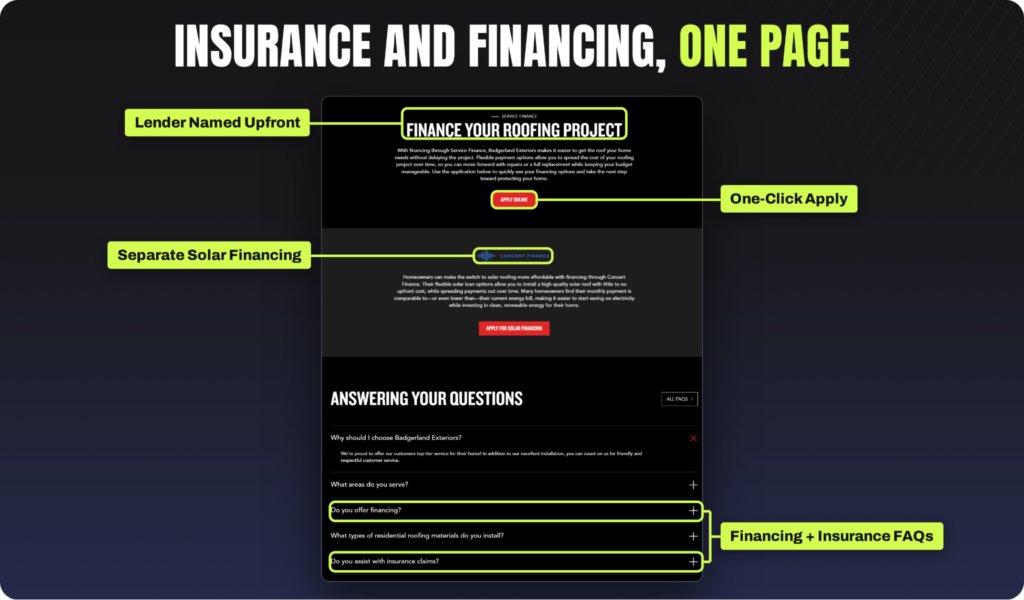
Roofing is higher ticket and frequently insurance-adjacent. Many homeowners assume insurance covers the full replacement cost and are surprised by the out-of-pocket gap. Addressing this directly on the financing page, ‘even with insurance, most homeowners have an out-of-pocket remainder of $2,000 to $6,000, here is what that looks like monthly,’ removes a hesitation generic financing pages never touch.
Tim Brown, CEO and Founder of Hook Agency, described this dynamic with Owl Roofing: they were losing deals in their first summer not because homeowners preferred the competition, but because the competition was simply offering payments and Owl was not. Homeowners went with whoever made the financial decision easier.
Plumbing and Remodeling
Emergency plumbing calls rarely involve financing. Remodeling, water heater replacement, and whole-home replumb projects do. The plumbing financing page should segment these clearly. Lead with a calculator for the higher-ticket services and do not apply financing framing to emergency repairs, because it creates confusion. The cleaner approach is a dedicated financing section scoped to planned projects with ticket thresholds clearly stated.
One Thing You Cannot Skip: Compliance
The specific language on a financing page is not entirely up to you. Financing providers have approved wording requirements, and language that falls outside their guidelines can create compliance issues. This is not complicated, but it matters. Check your financing page copy against your provider’s terms before it goes live and update it when their requirements change.
Transparent, process-level language that addresses homeowner hesitations tends to be both more effective and more compliant than vague promotional claims. Those two goals do not conflict. Understanding why homeowners freeze on big-ticket decisions helps you write language that is honest and persuasive at the same time.
Frequently Asked Questions
What should a contractor financing page include?
Five elements: a plain explanation of how financing works including who the lender is and that a soft credit pull does not affect credit scores; a monthly payment estimate or live calculator; a frictionless application path that completes in under 60 seconds on mobile; trust signals that explain the lender relationship; and a specific CTA tied to the next action like checking a rate or seeing a monthly estimate.
Where should financing information appear on a contractor website?
Three places: a dedicated /financing/ page for homeowners researching payment options; service pages for high-ticket work above $1,500 average ticket with a one-line monthly payment reference near the CTA; and the estimate itself, where the project total and monthly payment appear side by side.
How does monthly payment framing help contractors close more jobs?
It converts a lump-sum cost into a recurring payment decision the homeowner has made before, every time they financed a car or a phone plan. The Modernize 2025 research found that 74% of homeowners would consider financing for home improvement projects. That willingness is already there. Monthly payment framing makes it visible at the right moment.
Why do some contractor financing pages fail to convert?
Usually because the page buries financing in the footer, there is no payment estimator, the application path redirects to an unfamiliar branded portal, or the page does not address homeowner hesitations. The FNBO research found 51% find financing confusing and 68% worry about hidden fees. If the page does not answer those concerns immediately, most homeowners disengage.
Does offering financing actually affect whether homeowners hire a contractor?
Consistently, yes. The Modernize 2025 survey found 74% of homeowners would consider financing for home improvement projects, and 75% of non-borrowers in the Forbes Advisor research said they would or might consider a loan for a future project. Homeowners who go with a competitor because that competitor offered a payment option are not choosing based on quality. They are choosing based on perceived financial accessibility.
What is good-better-best pricing with financing?
Presenting three service tiers with monthly payment amounts alongside each, so the homeowner’s question shifts from ‘can I afford this’ to ‘which option works best for me.’ When the premium option is only $70 more per month than the basic option, the homeowner frequently asks what the difference is, which opens the upgrade conversation naturally.
Build the Page That Does the Closing Work
A contractor financing page that converts is one of the fastest changes a contractor can make to improve close rate on high-ticket work without touching pricing or marketing spend. The homeowner who says ‘let me think about it’ is usually not saying no. They are saying they do not have a number they can work with yet. The page gives them that number.
According to the Modernize 2025 research, nearly 80% of homeowners have not created a formal budget for their home improvement projects. That is not a reason to assume they cannot proceed. It is a reason to give them a framing that makes the decision manageable before they ever call.
At Hook Agency, we build websites specifically for home service contractors, and the contractor financing page is one of the highest-leverage pages we build. If you want your website working as hard as your sales team, let’s talk.