
Originally published April 17, 2026. Updated November 5, 2026.
The short answer
PPC works for home services when campaigns are split by service and location, every call is tracked to a booked job, negative keywords block junk searches, and budget follows the services that actually make money. Clicks and cost per lead are not the goal. Cost per booked job is.
- Track calls to booked jobs, not just leads
- Split campaigns by service so budget follows profit
- Run Local Services Ads alongside search for pay per lead
Google Ads will take every dollar you give it.
It will spend your budget. Generate your clicks. Produce a report that looks reasonable on paper. And if your campaigns are not built correctly, it will do all of that without booking you a single job worth writing home about.
PPC for home services is one of the highest-intent marketing channels available to contractors. A homeowner searching “emergency HVAC repair near me” at 2pm on a Tuesday is ready to book right now. The question is whether your campaign is structured to capture that moment or let it slip to a competitor who spent more time on the fundamentals.
Here is what those fundamentals actually look like in 2026.
Most Contractors Are Running PPC. Few Are Running It Right.
Google Ads is not complicated to start. Pick some keywords, set a budget, write a headline, and the platform starts spending. That is the easy part.
The hard part is building a campaign that connects ad spend to booked jobs. And that is where most contractors fall apart.
The difference between breaking even at $5,000 a month and scaling profitably at the same budget is not luck. It comes down to a handful of decisions most contractors never make deliberately:
- Campaign structure. Are you grouping all services into one campaign or separating by intent?
- Targeting. Are you paying for clicks from ZIP codes you do not even service?
- Landing pages. Is the page someone lands on built to convert or just your homepage?
- Attribution. Do you actually know which keywords are booking jobs and which ones are burning budget?
Google Ads will happily spend every dollar you give it. It does not care whether those dollars are turning into revenue. That is your job. Or your agency’s job.
The Foundations That Separate Profitable Campaigns From Money Pits
Most PPC campaigns fail at the foundation level. Not because Google Ads does not work. Because the structure underneath the spend was never built to win.
Build Your Campaign Around Intent, Not Just Keywords
There is a massive difference between a homeowner searching “roof replacement cost” and one searching “emergency roof repair near me.”
Same topic. Completely different intent. Completely different value to your business.
Grouping those into one campaign means your budget and messaging are trying to serve two different buyers simultaneously. It does not work.
Before you even think about keywords, understand what each service is actually worth to your business. The CPL benchmarks below show exactly how lead costs and margins vary across home service categories.
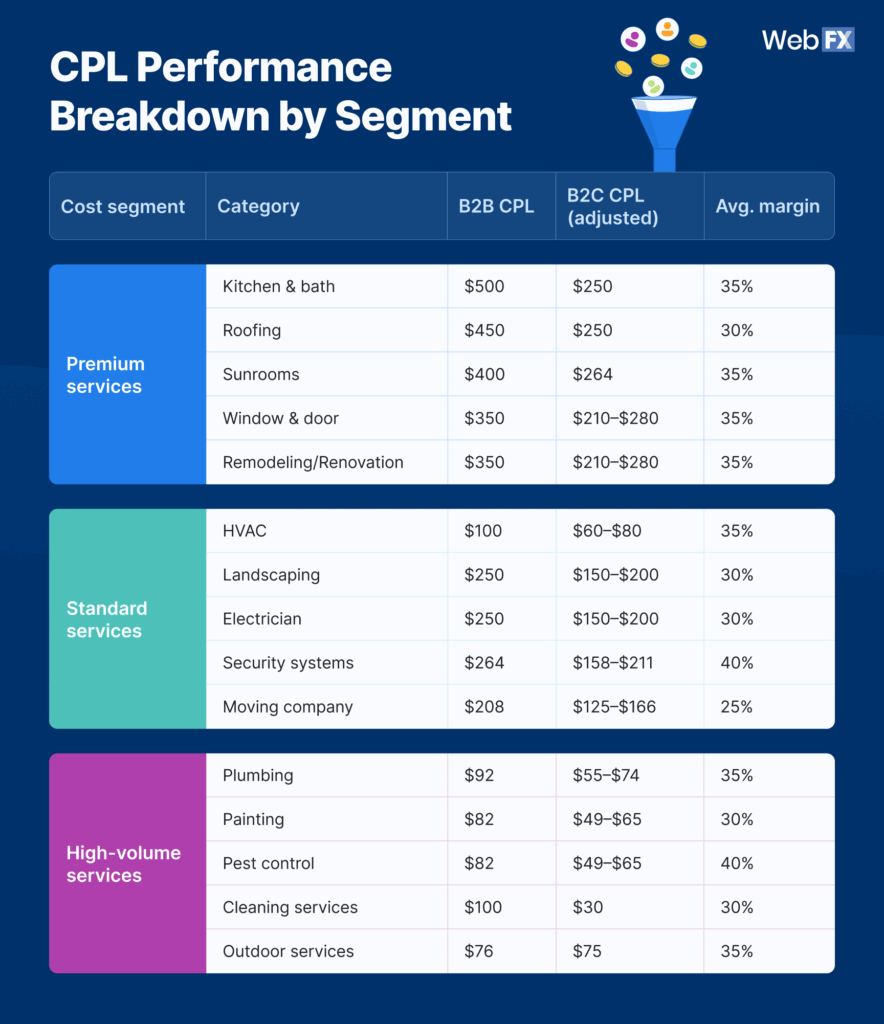
The fix is simple. Separate campaigns for emergency and repair work. Separate campaigns for replacements and installs. Separate brand campaigns protecting your name. Each with its own budget, bids, and copy tailored to where that homeowner actually is in their decision.
WebFX benchmarks show big installs average a 60-day sales cycle while emergency jobs close same-day. Your campaign structure needs to reflect that reality. How ad creative impacts cost per lead is directly tied to how well the message matches the moment.
Geo-Targeting That Focuses on Where the Money Actually Is
Left unchecked Google will show your ads outside your service area, in low-value ZIP codes, and in locations your crew cannot reach without eating the margin.
Map your highest-value ZIP codes. Bid higher there. Exclude the areas generating low-value calls or unprofitable drive times explicitly. Do not rely on Google to figure it out.
With CPC averaging $3.50 across home service search, geo-specific emergency keywords convert strongest. Every dollar spent outside your core service radius is a dollar working against you. Here is what contractors actually pay for Google Ads broken down by market.
Landing Pages That Convert Before the Phone Rings
The ad is tight. The targeting is dialed. The click happens. Then the homeowner lands on a slow generic page with no clear CTA and leaves.
The click cost you $3.50 anyway.
Industry-wide conversion rates sit at 7.8%. Plumbing converts at 12 to 16%. HVAC and roofing sit in the 3 to 7% range. That gap is almost entirely landing page quality.
What a high-converting page needs right now:
- Headline that matches the ad exactly. Message match kills bounce rate
- Trust signals above the fold. Reviews, ratings, years in business
- Two conversion paths. Click-to-call for the ready buyer. Short form for everyone else
- Financing options visible upfront. A $12,000 install is a real financial conversation

Load time matters too. Every additional second on mobile costs a measurable percentage of conversions.
- Google Ads and Local Services Ads
- Calls tracked to booked jobs
- You own your ad accounts
“Hook Agency has been an incredible partner for our digital marketing growth.”
Kristin Sullivan, Bob’s ACFocused on the map? See Google Maps SEO
The Levers That Control Whether You Scale or Bleed Budget
Getting clicks is the easy part. Knowing which ones are worth paying for is where profitable PPC is actually built.
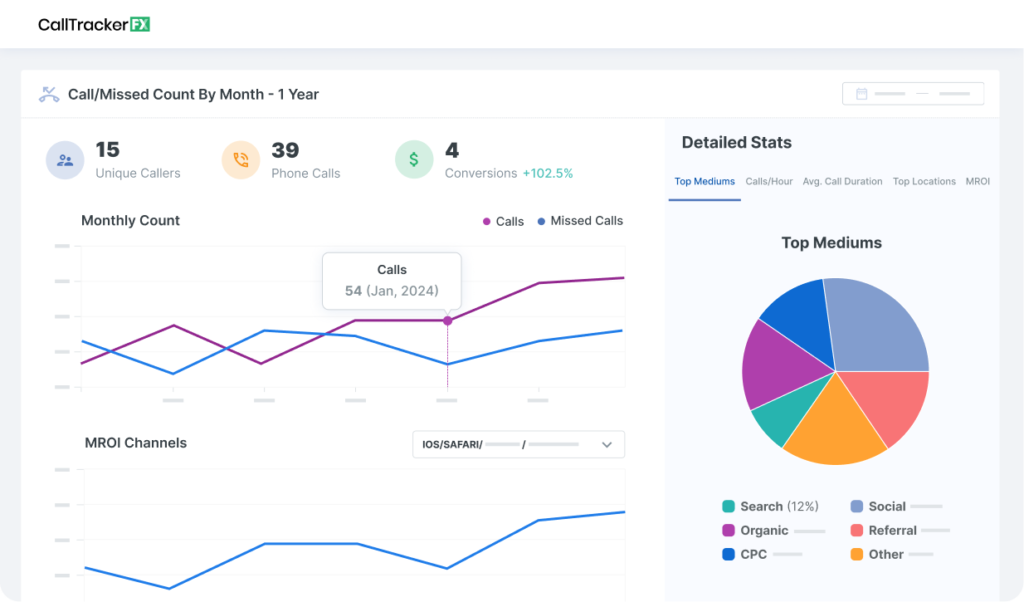
Call Tracking That Tells You What Is Actually Working
Most contractors know their total ad spend. Very few know their cost per booked job by keyword. That gap is where budget disappears.
B2C home service leads average $144 per lead. With gross margins at 33% across the industry there is almost no room for waste. Call tracking fixes this:
| What to Track | Why It Matters |
| Dynamic number insertion | Ties every call back to the exact keyword that generated it |
| Call recording and scoring | Separates real job inquiries from low-value tire-kicker calls |
| CRM integration | Connects ad spend directly to booked jobs and real revenue |
Without this you are optimizing for clicks. With it you are optimizing for revenue. Only one of those builds a profitable campaign.
Budget Control, Negative Keywords, and Cutting Wasted Spend
Negative keywords are the most underutilized tool in contractor PPC.
Without them your roofing budget pays for clicks from people searching DIY shingle tutorials, roofing nail guns, and job listings. Google broad match will spend your money on all of it if you let it.
The habits that keep spend under control:
Build your negative keyword list before launch. Not after you notice waste. Before.
Use dayparting. Most home service calls happen between 7am and 7pm. Ads running at 3am for non-emergency services burn budget on clicks that almost never convert.
Cut ruthlessly. A keyword that has spent three times the target CPL without converting is not a slow starter. Pause it and put that budget behind what is working.
Staying current on PPC trends in 2026 matters more than ever as CPCs climb across competitive home service markets. Budget discipline is not optional anymore.
PPC for Home Services in 2026 Looks Different Than It Did Two Years Ago
The contractors running Google Ads the same way they did in 2023 are paying more for worse results. The platform changed underneath them and most never noticed.
Here is what actually shifted.
Google killed Enhanced CPC in March 2025.
Campaigns that were not proactively migrated to a new bid strategy are now effectively running on Manual CPC. That means no smart bidding, no conversion optimization, and no algorithm working in your favor. If your agency has not addressed this you are leaving performance on the table every single day.
AI bidding is no longer optional.
Advertisers activating Google’s AI Max are seeing an average 14% lift in conversions at similar cost per acquisition. Some accounts reported improvements exceeding 60% during beta testing. That is not a marginal gain. For contractors doing hardcore marketing at scale that kind of efficiency difference is the gap between a campaign that compounds and one that flatlines.
First-party data is now a competitive advantage.
As privacy changes tighten targeting options, contractors feeding their CRM data into Google Ads are giving the algorithm better signals to work with. Past customers, booked jobs, high-value leads. That data trains smarter bidding and builds better lookalike audiences than anything Google can infer on its own.
PPC troubleshooting guide
Find your symptom, check the likely cause, then fix it.
Swipe sideways to see every column →
| Symptom | Likely cause | Fix |
|---|---|---|
| High spend, few calls | Broad keywords or a weak landing page | Tighten keywords, add negatives, send traffic to a focused service page |
| Lots of junk leads | Matching DIY, job and supply searches | Build a negative keyword list and review search terms weekly |
| Calls but few booked jobs | Slow answers or poor call handling | Track answer rate, record calls and coach the team |
| Low impression share | Budget too small or bids too low | Narrow the area or services before raising budget |
| Rising cost per click | More competitors or lower ad quality | Improve ad relevance and landing page experience |
More PPC lessons from the field
Clear, Simple Messaging
Every remodeling ad should have a simple, straightforward, and immediately obvious message. Good choices include attributes like price, speed, or variety. Don’t try to do everything with a single ad. Instead, focus on the qualities your potential customers care about most and match your ads to that.
As a general rule, anything in your ad that takes more than one sentence to explain is too complicated. You can occasionally stretch your messaging to cover two subjects instead of one, but remodeling ads are most effective when they match a specific thing that customers want.
Online Ads vs Traditional Ads
Traditional advertising methods, such as billboards, print ads, and TV commercials, might still hold their ground, but online advertising offers unique benefits that are hard to ignore. Unlike traditional ads, online ads allow for precise targeting of specific demographics, including gender, generation, or geographic area. Moreover, online ads are interactive, empowering users to take action, such as clicking and visiting the website.
The world of online ads is vast and varied, with text-based ads and visual advertisements such as banners being the most common types. Paid Search Advertising, for example, enables organizations to bid for top search placements on Search Engine Results Pages (SERPs). The return on investment for Pay-Per-Click (PPC) advertising, which includes the Google Display Network, can be as high as 200%. Native advertising, another form of online advertising, is designed to appear as an integrated promotion within content, rather than a conventional advertisement, like in-stream video ads.
Frequently Asked Questions
How much should a home service business spend on PPC?
Start with what you can afford to test for 90 days, then scale the campaigns with the best cost per booked job. Many contractors spend a portion of a 5% to 7% total marketing budget on paid search.
Is Google Ads or Local Services Ads better for contractors?
Most do best running both. LSAs charge per lead and sit at the top, while search ads give you more control over services and landing pages.
Every Day Your Campaigns Run Wrong Is Budget You Are Not Getting Back
PPC for home services is not complicated when it is built correctly. The right campaign structure. The right landing pages. The right tracking. A bidding strategy that actually reflects how Google works in 2026.
The contractors winning with Google Ads right now are not outspending the competition. They are outsmarting it.
If your current campaigns are generating clicks but not booked jobs, something in the foundation is broken. Book a call with Hook Agency and let’s find exactly where the spend is leaking and fix it.