HVAC Statistics (2026): Market Size, Shipments, Jobs and Homeowner Trends
11/05/26
12 Mins
Hook Agency
Last Edited: November 7, 2026
Publish Date: November 5, 2026
Originally published September 22, 2024. Updated November 5, 2026.
HVAC is a $159 billion contractor industry that just went through a reset. The refrigerant switch pulled sales forward into 2024, AC shipments dropped hard in 2025, and heat pumps kept their lead over gas furnaces.
Here are the HVAC statistics that matter in 2026, each with its source, plus what they mean if you run an HVAC company.
The short answer
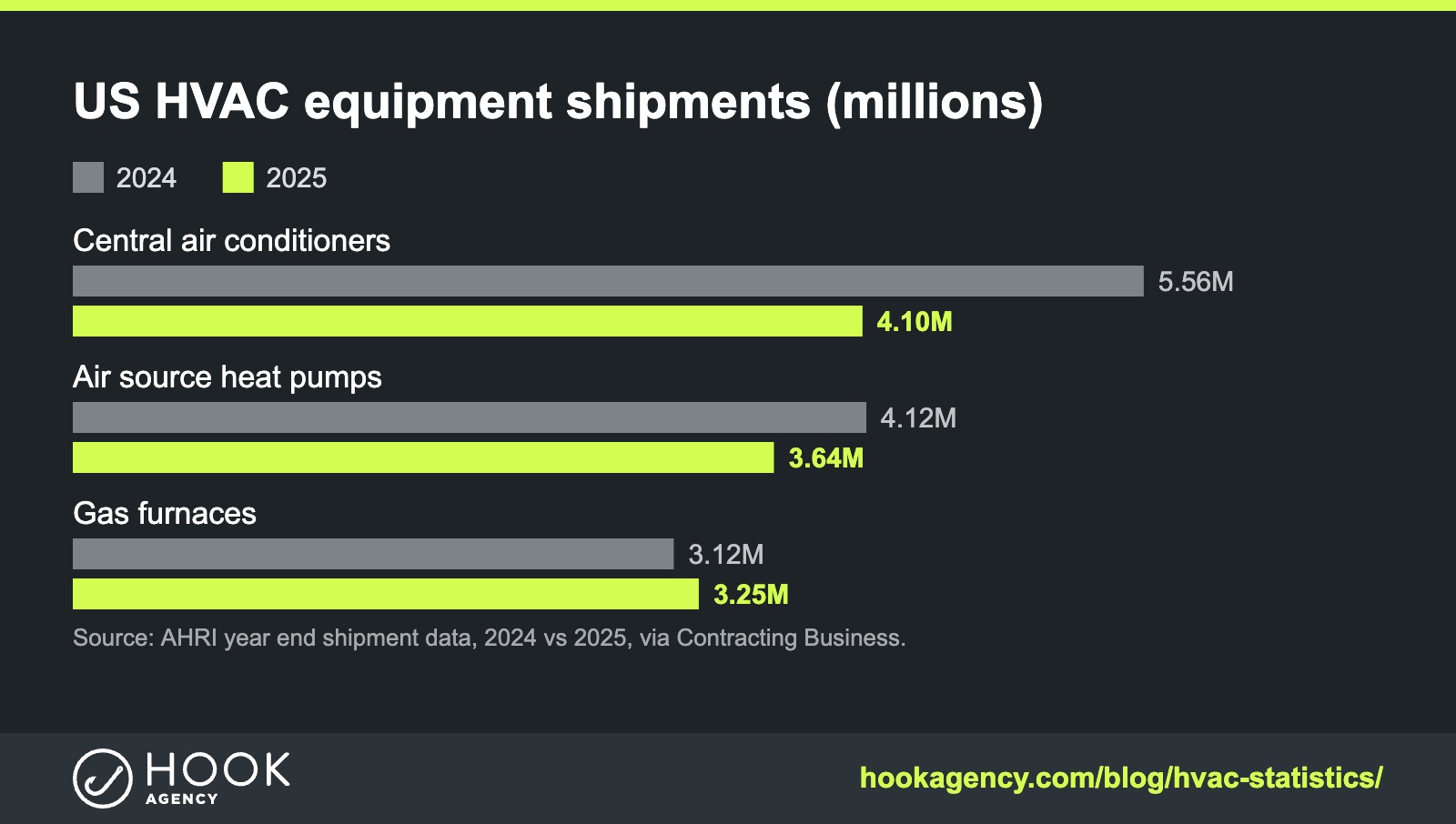
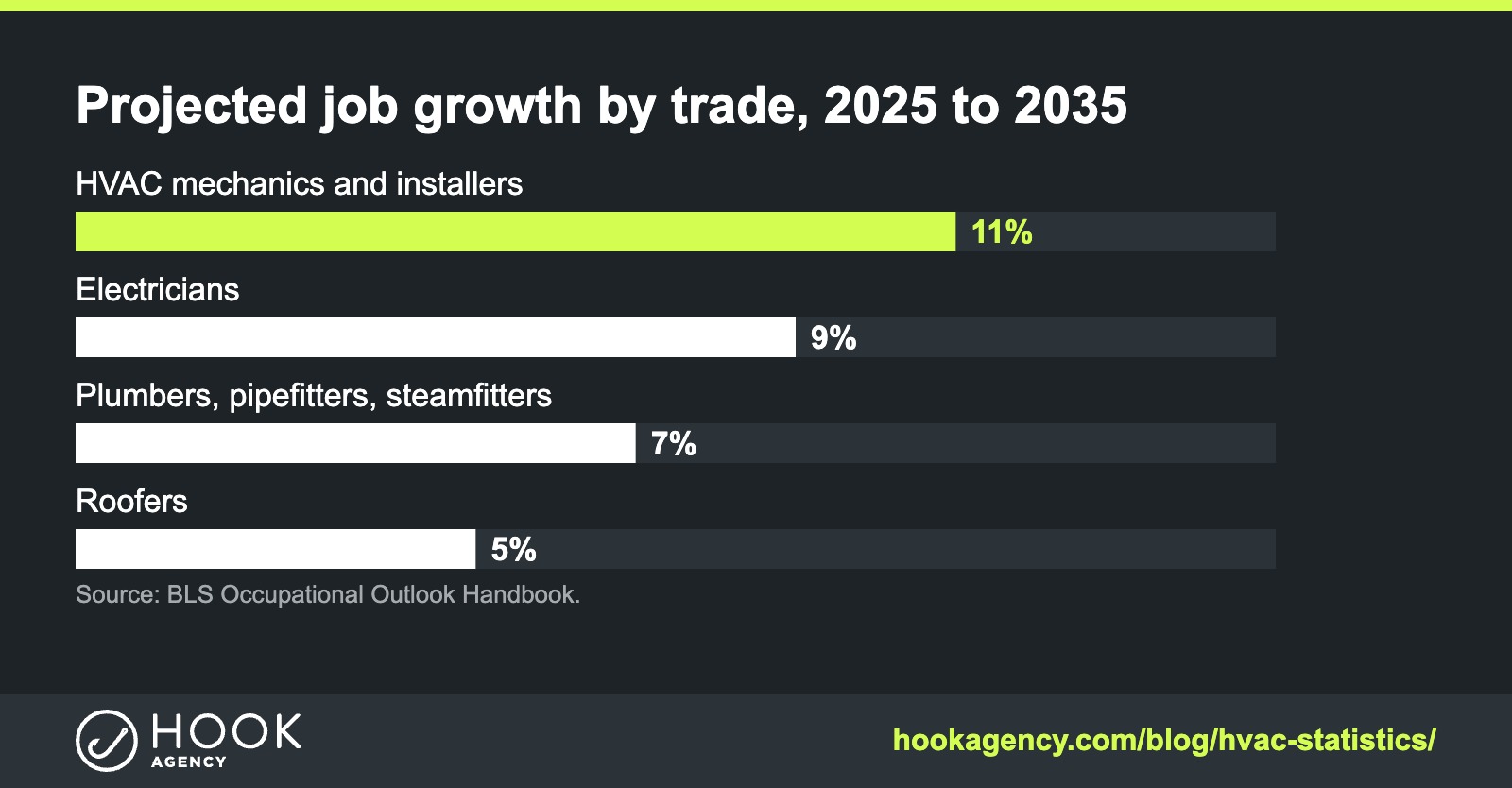
The US heating and air conditioning contractor industry is worth about $159.4 billion in 2026 (IBISWorld). In 2025, central AC shipments fell 26.2% to 4.1 million while heat pumps (3.6 million) outsold gas furnaces (3.2 million) for another year (AHRI). HVAC tech jobs are projected to grow 11% through 2035, much faster than average.
88% of US households use air conditioning
440,900 HVAC mechanics and installers, median pay $61,010
About 40,600 HVAC job openings a year
Updated November 2026. New numbers up top. Older stats live in the historical section below, unchanged, so existing links and citations still work.
$159.4 billion is the size of the US heating and air conditioning contractor industry in 2026, up 0.7%. It grew 2.6% a year from 2021 to 2026. (IBISWorld, 2026)
We work with HVAC companies across the country. Here is how we read 2026:
Replacement demand got pulled forward. The refrigerant change pushed a lot of system sales into 2024. 2025 was the hangover. Service agreements and repair calls carry you while replacement demand rebuilds.
Heat pumps are mainstream. They outsold gas furnaces again. Your site and ads should rank for heat pump installs, rebates and dual fuel, not just “AC repair.”
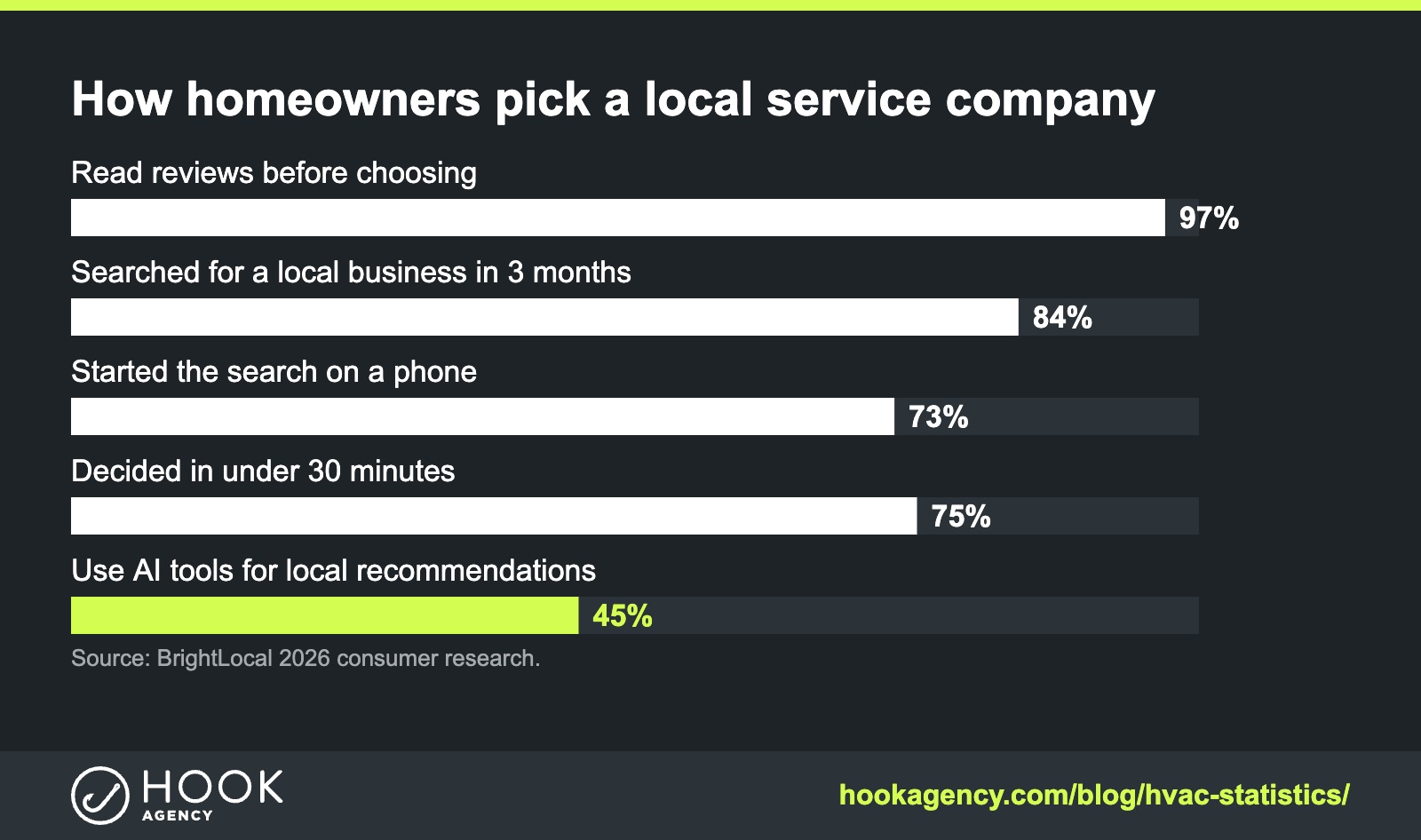
Speed wins emergency calls. Most homeowners pick in under 30 minutes. Answer live, show up first in the map pack, and offer online booking.
Hiring is a growth constraint. 40,600 openings a year. A careers page that sells your shop is marketing too.
HVAC is a strong business with steady demand. The winners in 2026 are the ones who own their local search and their review profile.
On the roof with a client
Leads from Google, Maps and AI search
Nobody else is buying the same lead
You own your website and ad accounts
Want this done for you?
Own Google, Maps and AI search.
Hook’s Local SEO + AEO is $3,750/mo. A Standard Website is an additional $1,000/mo when paired with a recurring service. We report on calls and booked jobs, and track how you show up across 25+ ChatGPT prompts.
★★★★★
“Hook Agency has been an incredible partner for our digital marketing growth.”
Historical HVAC statistics (2024 and 2025 edition)
Everything below is from our earlier edition of this page, kept as is because many sites link to these numbers. Some figures are several years old, so check the original source date before citing.
The HVAC industry isn’t just about keeping your house warm in the winter or cool in the summer, it’s a multi-billion dollar business that’s evolving faster than you might think. Whether you’re a homeowner concerned about energy efficiency or just someone who loves learning about the latest technology, these 45 HVAC industry statistics for 2023 and 2024 will have something for you. From surprising trends to game-changing innovations, these numbers tell the story of where heating and cooling are headed, and why it matters to you.
1. Technological Advancements: The Future of Climate Control
Ever wondered how much smarter your home could be? With the rise of smart HVAC systems, your thermostat is just the beginning of an intelligent home revolution. Let’s dive into the tech that’s reshaping how we stay comfortable.
Smart HVAC Adoption: 77% of millennial homeowners are investing in smart HVAC technology to optimize comfort and energy savings (Jobber.)
Geothermal Energy: Geothermal HVAC systems can reduce utility costs by up to 60%, making them increasingly popular for homeowners looking to go green (Jobber).
Energy Savings from Smart Thermostats: Switching to a smart thermostat can save homeowners up to 8% on their utility bills (Jobber).
Bluetooth Connectivity: HVAC systems with Bluetooth capabilities are becoming popular for contractors, enabling more efficient installation and diagnostics (HVACInformed).
Indoor Air Quality Tech: Since the pandemic, systems with advanced filtration and UV light purifiers are in high demand, improving air quality while regulating temperature(Global Market Insights Inc.).
2. Environmental Impact: Keeping Cool, But At What Cost?
Our desire for comfort comes at a price, not just on our energy bills, but on the planet. The HVAC industry is under pressure to innovate and reduce its environmental footprint, and some of the stats are eye-opening.
Global Warming Contribution from HVAC: By 2050, air conditioning is expected to account for 25% of all global warming(
U.S. Refrigerant Phase-out: Starting in 2024, the U.S. will enforce a 30% reduction in HFC refrigerants, known for their greenhouse gas effects(HVACInformed.)
Energy-efficient HVAC Systems: Inverter heat pumps, which are significantly more eco-friendly, are growing rapidly due to increased SEER energy standards (HVACInformed).
Electric HVAC Systems: Electrification of HVAC systems is gaining momentum, offering a cleaner alternative to gas-powered systems (HVACInformed).
Carbon-free Heat in Denmark: Denmark achieved 97% carbon-free heat in 2023 using advanced heat pump technology, showing what’s possible for the future of HVAC (HVACInformed).
3. Market Growth: A Billion-Dollar Industry Heating Up
It’s not just your house that’s warming up, the HVAC industry itself is booming. From the U.S. to global markets, the numbers show that heating and cooling are big business.
Global HVAC Market Size: The global HVAC market was valued at $294 billion in 2023 and is expected to reach $481 billion by 2032 (Jobber)(Global Market Insights Inc.)
U.S. Market Growth: The U.S. HVAC services market is projected to be worth $19.75 billion in 2024 (Jobber).
Heat Pump Market: Heat pumps are experiencing rapid growth, with the U.S. market projected to grow at a 7.7% CAGR through 2032 (Global Market Insights Inc.).
Commercial HVAC Sector: Commercial HVAC systems are expected to grow at an annual rate of 7% from 2023 to 2030 (Jobber).
Home Improvements Spending Decline: In 2024, residential improvements and repair spending will shrink for the first time since 2010, impacting the HVAC market (Jobber).
4. Consumer Trends: What Homeowners Want
What’s driving the HVAC market? A lot of it comes down to what consumers need and want, from smart homes to cost-saving energy solutions. These stats show the trends shaping the industry from a homeowner’s perspective.
Tax Credits for Heat Pumps: Homeowners can get up to $2,000 in tax credits for installing energy-efficient heat pumps (Jobber).
Air Conditioner Installation: 97% of new single-family homes in the U.S. have air conditioning, showing the continued demand for cooling(
Smart Home Adoption: Millennials are leading the charge in smart home technology, with over three-quarters integrating smart systems into their homes(
Energy Efficiency Awareness: Older homeowners are less likely to adopt smart HVAC systems, with only 25% of baby boomers using smart technology compared to 77% of millennials (Jobber).
5. Regulations and Challenges: Navigating the Red Tape
With great power comes great responsibility, and in the case of the HVAC industry, that means compliance with evolving regulations. From refrigerants to energy efficiency, here are the stats on how policies are shaping the future.
Regulatory Costs: Complying with U.S. energy efficiency regulations has increased manufacturing costs, affecting both companies and consumers(
Heat Pump Regulations: The U.S. government’s push for heat pumps over gas-powered systems is driving demand for more efficient and eco-friendly options (HVACInformed).
SEER Standards: As of 2023, new HVAC systems in the U.S. must meet higher SEER energy efficiency ratings(
Supply Chain Disruptions: Ongoing supply chain disruptions are impacting HVAC equipment production, leading to delays and higher prices for consumers(Global Market Insights Inc.).
As you can see, the HVAC industry is in the midst of a transformation that impacts everything from your home’s comfort to the planet’s health. Whether you’re a homeowner looking to upgrade your system, or just fascinated by the rapid changes in technology, these trends are shaping the future in ways that matter. So the next time you adjust your thermostat, remember, there’s a lot more behind that cool breeze than meets the eye. Stay tuned for more updates as the HVAC industry continues to heat up!
How to cite this page
Hook Agency, “HVAC Statistics (2026),” hookagency.com/blog/hvac-statistics/, updated November 2026. For any single number, please cite the original source linked next to it.
Frequently Asked Questions
How big is the HVAC industry in 2026?
The US heating and air conditioning contractor industry is worth about $159.4 billion in 2026, according to IBISWorld.
Do heat pumps outsell furnaces?
Yes. In 2025, US shipments of air source heat pumps (3.64 million) beat gas furnaces (3.25 million), per AHRI.
Why did AC shipments drop in 2025?
Central AC shipments fell 26.2% in 2025. A big factor was the refrigerant transition, which pulled purchases into 2024 ahead of the switch to new refrigerants.
How much do HVAC technicians make?
The median pay for HVAC mechanics and installers was $61,010 a year in May 2025, per the BLS.
Is the HVAC industry growing?
HVAC jobs are projected to grow 11% from 2025 to 2035, much faster than average, and contractor revenue grew 2.6% a year from 2021 to 2026.