
Google’s reps have been pushing Performance Max hard. So have a lot of agencies. The pitch is simple: HVAC and plumbing contractors running PMax in January 2026 paid an average of $72 per lead, compared to $149 for non-branded search. A 52% lower CPL. On paper, that looks like an obvious move.
Here is the problem. That $72 lives in the Google Ads dashboard. The number that matters lives in your CRM, and for a lot of contractors who turned on Performance Max without the right setup, those two figures tell completely different stories.
I run strategy at Hook Agency. I have worked with Performance Max for contractors across HVAC, roofing, and plumbing accounts, and I have watched it deliver strong results for some and quietly drain budget from others. The difference is almost never the campaign type. It is almost always three setup conditions that most accounts have not met before they flip the switch:
- PMax campaigns that look great in the dashboard but cannot explain the CRM numbers
- Brand cannibalization running invisibly for months
- Accounts optimizing against bad data because offline imports were never set up
The short answer: Performance Max for contractors can deliver 50% lower cost per lead for HVAC and plumbing compared to non-branded search, but only when the account produces 30 or more monthly conversions, offline conversion imports are running from a field service CRM, and brand exclusions with a negative keyword stack are in place before launch.
What Performance Max Actually Is (For Contractors Who Have Not Used It)
Performance Max is a Google Ads campaign type that uses machine learning to serve ads across Search, YouTube, Display, Gmail, and Maps simultaneously, letting Google’s algorithm decide where to show the ad and to whom.
That is the technical definition. What it means in practice for a contractor is a significant shift in how control works. Standard search campaigns are keyword-driven: you bid on “HVAC repair near me” and your ad shows when someone types that phrase. You decide the targeting. PMax does not work that way.
How It Works Differently From Standard Search
In a standard search campaign, you control which searches trigger your ad. In Performance Max, Google controls the placements, the audiences, and the optimization targets. You supply the signals: conversion data, audience lists, creative assets, and landing page content. The algorithm decides where across Google’s entire inventory to show your ads.
You give up control. In return, you get reach across surfaces your search campaigns never touch. When the signals are clean and conversion data is solid, it works. When the signals are thin or pointed at the wrong goal, the algorithm optimizes efficiently toward the wrong thing.
Why Google Keeps Pushing It
Performance Max gives Google’s algorithm maximum flexibility over where to spend your budget. The efficiency does show up in CPL numbers, and that is a real benefit. It also means less transparency for you. Standard search campaigns show exactly which keywords triggered your ads. PMax reporting is more opaque by default.
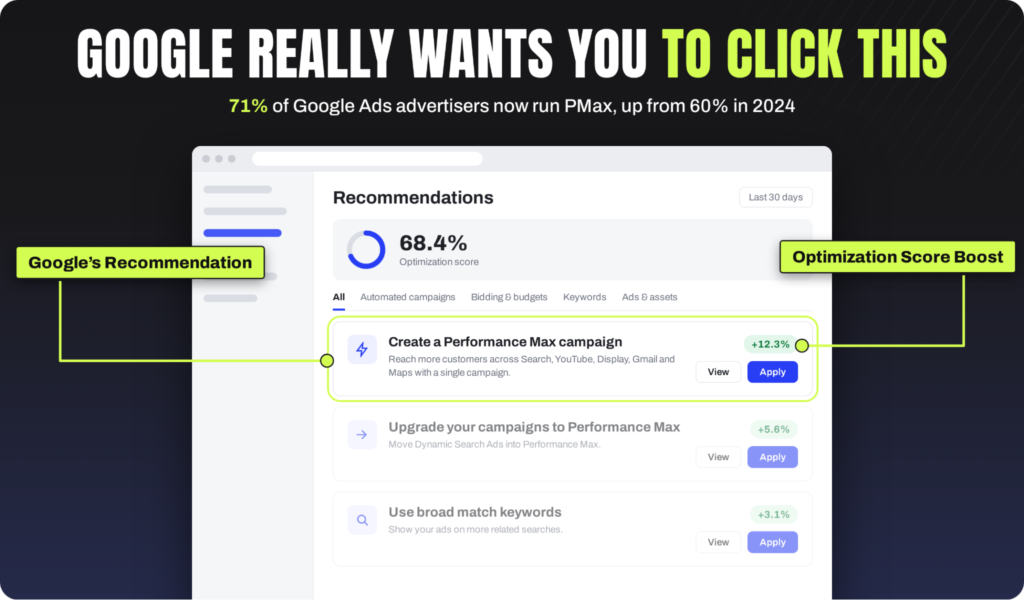
As of 2026, 71% of Google Ads advertisers now use Performance Max, up from 60% in 2024. Home and Home Improvement averages $8.33 per click, one of the highest CPCs across all industries. That cost context matters when you are evaluating whether PMax’s lower CPL actually changes your unit economics.
What the Data Actually Shows
The most comprehensive dataset on Performance Max for home service contractors comes from SearchLight Digital’s January 2026 analysis of $14.9 million in Google Ads spend across 816 HVAC and plumbing contractors running 8,077 campaigns, cited extensively by PipelineOn’s contractor paid advertising research.
The CPL Numbers That Made Everyone Pay Attention
SearchLight’s January 2026 benchmark across 816 contractors broke down like this:
- Performance Max: $72 average CPL
- Non-branded search: $149 average CPL
- Branded search: $34 average CPL
- Blended average: $104 across all campaign types
For plumbing specifically, PMax delivered a 5.54x ROAS versus 2.58x for non-branded search across 524 contractors in Q1 2026. Roofing PMax averaged $64 per lead versus $124 for non-branded. PMax adoption among HVAC contractors doubled from December 2025 to January 2026 alone, reaching 370 accounts. The numbers were getting around.
What the CPL Does Not Tell You
A roofing contractor documented his PMax results on r/PPC in early 2026. He ran Performance Max for 60 days without offline conversion imports or brand exclusions. His Google Ads dashboard reported a $61 CPL. His CRM reported a $612 cost per booked job.
That is not a fraud story. That is what happens when the algorithm optimizes toward cheap conversions without knowing which ones become paying customers. Google found cheap leads. Most of them did not book. The dashboard looked efficient. The business was not.
The Book Rate Problem
The CPL headline obscures a more important number. Here is what SearchLight’s January 2026 benchmark actually shows when you look past the lead cost:
- PMax book rate: 32.2%
- PMax cost per paying customer: $447
- Branded search book rate: 55.3%
- Branded search cost per paying customer: $104
The lead from PMax costs less. The booked job costs more. Leads from Display, YouTube, and Maps-adjacent placements convert into actual jobs at a lower rate than leads from someone who searched a specific service keyword. A lower CPL with a much lower book rate can easily produce a higher cost per booked job than a more expensive search campaign that closes at a higher rate.
The Two Biggest Risks for Home Service Contractors
Two failure modes appear consistently in contractor PMax accounts, and both are predictable. Neither is inevitable when the setup is done correctly.
Brand Cannibalization
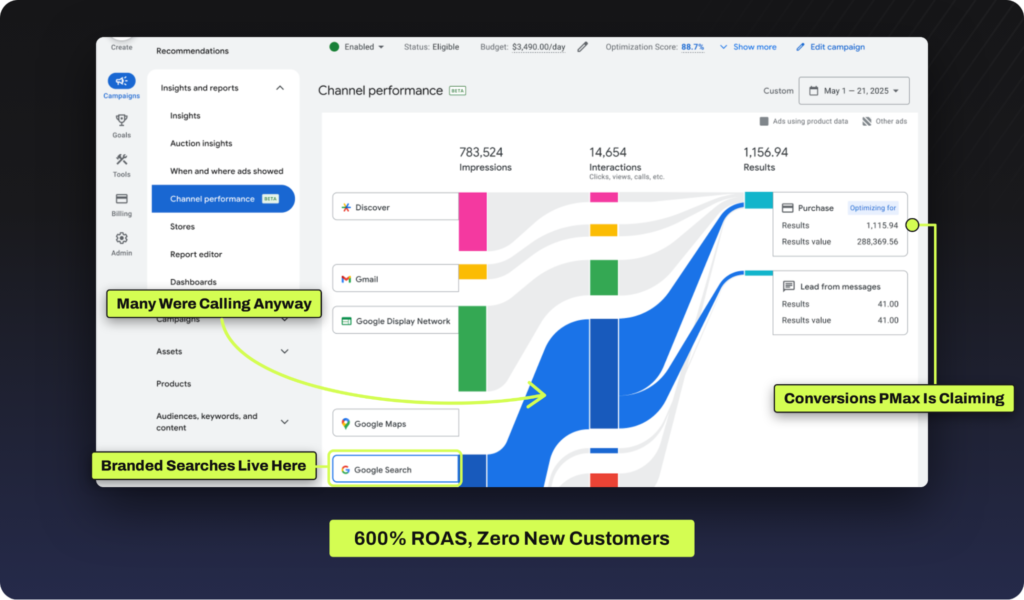
Brand cannibalization is the default behavior of Performance Max, not an edge case. Google’s algorithm learns quickly that searches for your company name convert at the highest rate. Without brand exclusions, PMax starts capturing that branded traffic, including people who were already going to call you. This inflates ROAS to 600% or higher while contributing nothing to new customer acquisition. The campaign looks excellent. New lead volume is flat.
The fix is a brand exclusion list applied at the campaign level before the campaign goes live. Treat it as a prerequisite, not an optimization.
Lead Quality Decay
Performance Max optimizes for the conversion goal you give it. If that goal is any form fill or any phone call, the algorithm finds the cheapest source of those across Google’s full inventory: YouTube viewers who filled a form out of curiosity, Display users in the wrong city, Maps-adjacent traffic outside your service area.
Contractors report 30 to 50% lower CPL from PMax alongside significantly worse lead quality as a consistent pattern, per PipelineOn’s contractor PMax analysis. The fix is offline conversion imports from your CRM marking which leads became paying customers, so the algorithm learns to optimize toward booked jobs. As we cover in our piece on SEO reporting for home service businesses, the metric you measure is the behavior you train.
The Three Preconditions Before Turning It On
Performance Max requires three things before it produces the benchmark numbers. Skip any one and the same campaign produces $180 to $240 CPL with worse lead quality than a search campaign built on basic keyword targeting, according to PipelineOn’s 2026 contractor PMax guide.
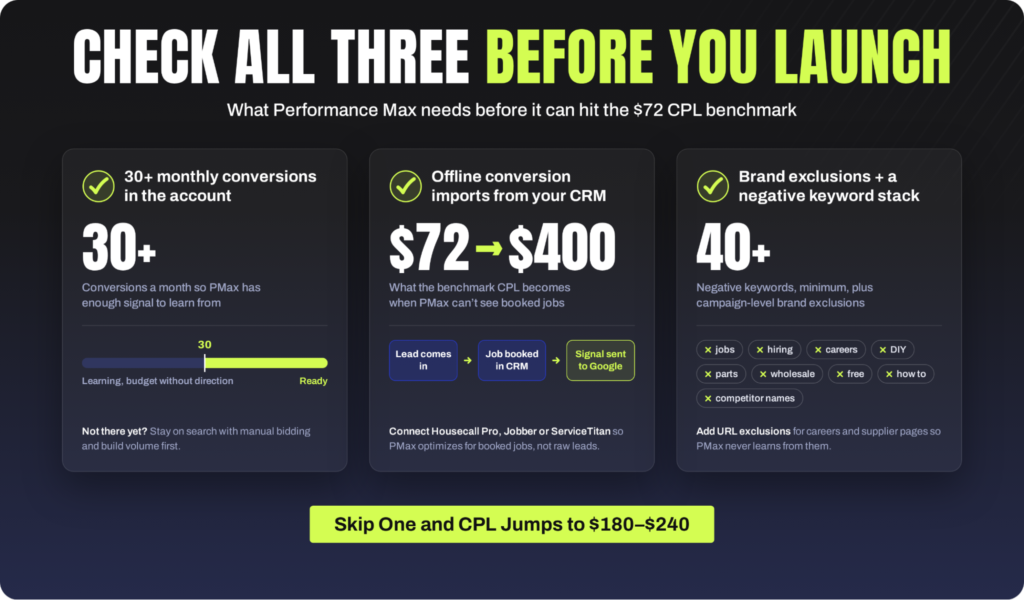
30 or More Monthly Conversions in the Account
An account producing fewer than 30 conversions per month does not give PMax enough signal to optimize toward. The result is an extended learning period where the campaign spends budget without direction, and standard search campaigns with manual bidding consistently outperform PMax for high-intent emergency keywords at low volume.
If your account is not there yet, build conversion volume through paid ads fundamentals for home services before layering in PMax. Skipping the foundation because the CPL benchmark looks attractive is how you end up with the r/PPC situation above.
Offline Conversion Imports Running From Your CRM
Without offline conversion imports, PMax does not know which leads became paying customers. It optimizes toward raw conversions and the $72 CPL from the benchmark becomes $400 in your account.
Connect your CRM (Housecall Pro, Jobber, ServiceTitan) to Google Ads so that when a lead books a job, that signal goes back to Google. Google’s own guidance on Performance Max confirms that the campaign optimizes toward whatever conversion actions you define. Defining the right ones, and importing booked-job signals from your CRM, is not optional setup. It is the whole mechanism.
Brand Exclusions and a Negative Keyword Stack
The minimum negative keyword list for a contractor PMax campaign includes 40 or more terms. The core categories:
- Employment terms: jobs, salary, hiring, careers, apprentice
- DIY and supply terms: DIY, parts, supply, used, wholesale
- Intent mismatches: free, complaint, review, how to
- Competitor brand names
Brand exclusions at the campaign level prevent cannibalization. URL exclusions block traffic from irrelevant pages like your careers page or supplier landing pages. These are setup requirements, not optimizations. PMax without this stack starts spending on searches that will never produce a booked job, and the algorithm learns from that bad data before you catch it.
Where Performance Max Fits in the Campaign Stack
Performance Max is a reach-expansion layer, not a campaign foundation. The contractors producing the best results from PMax in 2026 are running it on top of an established campaign structure, not instead of one.
The 2026 Campaign Hierarchy That Works
The stack producing the best combined results for established HVAC and plumbing accounts runs in this order:
- Local Services Ads: pay-per-lead, highest intent, the foundation everything else builds on
- Branded search: captures name searches, lowest CPL, protects your brand
- Non-branded search: core service keywords you control precisely
- Performance Max: reach expansion into audiences the first three layers are not capturing
Each campaign type has a specific job. PMax’s job is expansion, not replacing the high-intent search campaigns that are already working.
Trade-by-Trade Verdict
HVAC: Worth testing when the three preconditions are met. The $72 versus $149 CPL spread is real and meaningful in a high-ticket trade where a single booked job justifies the test period. Run it as a fourth campaign layer once the foundation is stable.
Plumbing: Strong ROAS data (5.54x PMax versus 2.58x non-branded search in Q1 2026). Emergency intent is high and the shorter sales cycle reduces the book rate risk. PMax works well here when offline imports are capturing the booked-job signal cleanly.
Roofing: Run with caution. Higher CPL volatility and a longer sales cycle amplify the lead quality risk. SearchLight’s Q1 2026 data shows roofing PMax averaging $64 per lead versus $124 for non-branded search, which looks attractive. But roofing’s longer consideration period means a low-quality PMax lead carries more cost. Run it only with offline imports active and brand exclusions tight, and compare cost per booked job from your CRM, not CPL from the dashboard.
A Low-Risk Way to Test It
If the three preconditions are in place and you want to test PMax, start controlled. Here is the framework:
- Allocate 20 to 30% of your current search campaign budget to PMax
- Run for a minimum of 60 days before drawing any conclusions
- Do not compare CPL. Compare cost per booked job using CRM data
- If cost per booked job is lower than or comparable to non-branded search after 60 days, scale gradually
- If it is not, cut the allocation or turn it off. No guilt required.
PMax is a tool, not a strategy. It works as a supplement to well-run search campaigns, not as a replacement for them. For home service businesses still building toward a full home services marketing strategy that connects paid, organic, and GBP into one system, getting the paid ads foundation right comes first.
Frequently Asked Questions
What is Performance Max and how does it work for contractors?
Performance Max is a Google Ads campaign type that uses machine learning to serve ads across Search, YouTube, Display, Gmail, and Maps simultaneously. Unlike standard search campaigns, PMax lets Google’s algorithm decide placements and audiences based on conversion signals and creative assets you provide. For contractors, it works best as a reach-expansion layer on top of an established campaign structure, not as a replacement for it.
What is the average cost per lead from Performance Max for HVAC contractors?
Based on SearchLight Digital’s January 2026 analysis of $14.9 million in spend across 816 HVAC and plumbing contractors, Performance Max delivered an average CPL of $72, compared to $149 for non-branded search and $34 for branded. The blended average was $104. The lower CPL does not automatically mean a lower cost per booked job, because PMax leads convert into actual jobs at a lower rate than intent-specific search leads.
What is the biggest risk of Performance Max for home service contractors?
Brand cannibalization and lead quality decay. Cannibalization happens when PMax captures branded search traffic, inflating ROAS while contributing nothing to new customer acquisition. Lead quality decay happens when the algorithm, without offline CRM signals, optimizes toward cheap raw leads rather than leads that become paying customers. Both are fixable with proper setup.
What preconditions does a contractor need before running Performance Max?
Three: 30 or more monthly conversions in the account so the algorithm has enough signal; offline conversion imports from a field service CRM (Housecall Pro, Jobber, ServiceTitan) so PMax learns from booked jobs, not raw leads; and brand exclusions plus a negative keyword stack of 40 or more contractor-specific terms in place before launch.
How does Performance Max compare to Local Services Ads for contractors?
LSA and PMax serve different roles. LSAs are pay-per-lead placements at the top of emergency service searches, the highest-intent and most efficient channel for immediate calls. PMax is reach expansion across multiple Google surfaces. The structure that works in 2026 runs LSA first, then branded search, then non-branded, then PMax as the fourth layer for audiences the first three channels are not reaching.
Should a roofing contractor use Performance Max?
With conditions. Roofing’s longer sales cycle amplifies the lead quality risk. The $64 versus $124 CPL spread looks attractive, but a low-quality PMax lead costs more downstream in roofing than in emergency trades. Run it only with offline imports active, brand exclusions in place, and compare cost per booked job from your CRM after 60 days, not CPL from the dashboard.
The Setup Is the Difference
The gap between a $72 CPL and a $612 cost per booked job is almost never a channel problem. It is a setup problem. Performance Max works when the three preconditions are met and the algorithm is learning from the right signals. Without those, it spends efficiently toward the wrong goal.
For contractors who want their Google Ads campaigns structured to produce booked jobs rather than dashboard metrics, Hook Agency works specifically with HVAC, roofing, and plumbing businesses. Review our cost per lead benchmarks for home service businesses to see how your numbers compare, or contact us to talk through what the right campaign structure looks like for your market.