
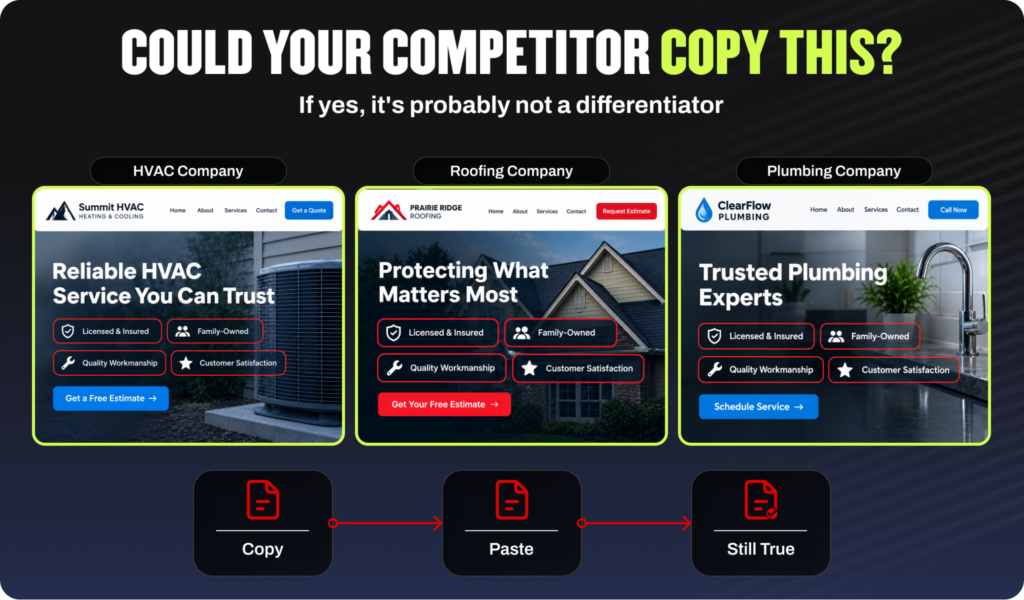
Pull up three HVAC company websites in the same city. Read the homepage headline of each.
All three probably say something about being licensed, insured, locally owned, and committed to quality. They didn’t copy each other. They all arrived at the same generic destination because those phrases feel safe and true.
The problem isn’t that they’re untrue. It’s that true isn’t the same as convincing. When every contractor in a market says the same things, none of them are saying anything.
What that actually costs:
- Homeowners compare on price because nothing else gives them a reason not to
- AI search tools have nothing specific to surface, so the business disappears from recommendations entirely
- Marketing spend produces noise instead of calls
Generic differentiators like “licensed and insured,” “quality workmanship,” and “customer satisfaction guaranteed” carry no weight in the moment a homeowner is comparing options because every competitor says the same thing.
This guide covers what homeowners are actually deciding on, what a real differentiator looks like, and how to find the one already inside the business.
What a Generic Differentiator Is and Why Every Contractor Has One
A generic differentiator is any claim a competitor could copy and paste onto their own website without it being untrue.
Most contractors write their marketing by listing what they’re proud of: the license, the years in business, the care put into every job. All real. All legitimate. All shared by most competitors.
Here is what that looks like in practice:
- “Licensed and insured.” Every homeowner expects this as a baseline. It is the equivalent of a restaurant advertising that it has a health permit. Required, not remarkable.
- “Family-owned and operated.” True for the majority of local contractors. Means very little unless backed by something specific about what being family-owned changes for the homeowner.
- “20 years of experience.” Experience is assumed once a business is running. Without a proof point attached, it is a number floating in a vacuum.
- “Quality workmanship.” Every contractor claims this. No contractor claims the opposite. Quality has become the price of admission, not a point of difference.
- “Customer satisfaction guaranteed.” Guaranteed how? What happens when a homeowner is not satisfied? Without specifics, this is a comfort phrase that carries no commitment.
A claim only works as a differentiator when no competitor in the market is making it, or when it can be proven in a way others cannot match. None of the phrases above meet either standard.
The Real Cost of Sounding Like Everyone Else
This is not a soft, intangible problem. Generic marketing produces two measurable, concrete outcomes that show up in close rates, margins, and where the business appears when homeowners go looking.
It Forces Homeowners to Decide on Price
When marketing cannot give a homeowner a reason to choose one contractor, the quote becomes the only variable they can compare. That is how contractors who do better work lose jobs to competitors who charge less. The homeowner didn’t prefer the cheaper option. The better contractor just gave them nothing else to choose on.
The data makes the cost concrete. Housecall Pro’s December 2025 homeowner report, based on a survey of more than 1,000 US homeowners, found that 72% of homeowners would pay up to 10% more for a contractor with a better customer service reputation. The contractors capturing that premium are not the most technically skilled. They are the ones whose marketing communicates something specific that earns trust before the quote is even sent.
The same report found that almost one in five homeowners say they cannot remember the last time a contractor wowed them with exceptional service. That is not a service problem. It is a communication problem. Most contractors do excellent work and then say nothing specific about it.
It Makes the Business Invisible in AI Search
This is the 2026 dimension, and it is accelerating fast.
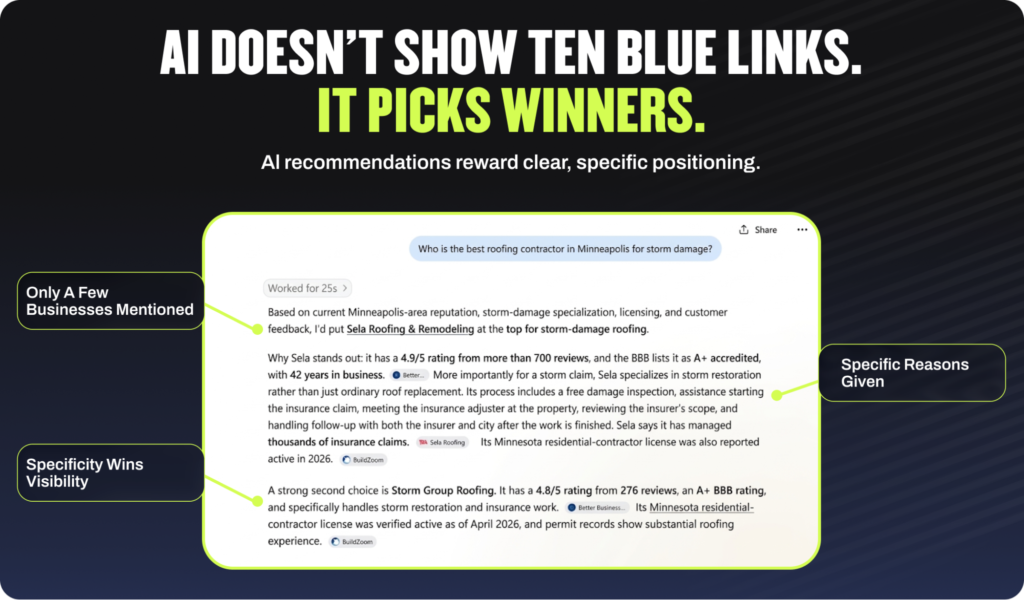
When a homeowner asks ChatGPT or Gemini to recommend an HVAC company, those systems don’t return a list. They give one or two specific answers. The rest of the market doesn’t exist in that conversation.
SOCi’s 2026 Local Visibility Index, which analyzed nearly 350,000 business locations across 2,751 brands, found that only 1.2% of local businesses get recommended by ChatGPT. For comparison, businesses appear in Google’s local three-pack 35.9% of the time. AI is roughly 30 times more selective.
The businesses that make it into that 1.2% have one thing in common: something specific is written about them, consistently, across their website, their reviews, and their mentions. A business described generically everywhere gives AI nothing to grab onto.
Generic marketing was already costing jobs in traditional search. In AI search, it costs the conversation before it starts.

What Homeowners Are Actually Deciding On
Homeowners in 2026 are not comparing credentials. They are comparing what they think the experience will feel like before it happens.
The 2025 Homeowner Roofing Survey by Roofing Contractor magazine found that more than half of homeowners ranked a contractor’s experience and reputation as the top factor in their hiring decision, with 34% calling it the single most important one.
Reputation is what specificity builds. A contractor cannot build a reputation for “quality workmanship” because that phrase means nothing that anyone can repeat to a neighbor. A contractor can build a reputation for “the crew that explains the problem before touching anything” or “the plumber who gives you a price range on the phone before they drive out.” Specific enough to stick. Specific enough to spread.
This connects directly to the know, like, and trust framework that drives most homeowner hiring decisions. Specificity is what moves a homeowner from knowing the business exists to trusting it enough to call.
How to Find the Real Differentiator
A real differentiator is already in the business. Most contractors are already doing something that sets them apart. They’ve just never written it down.
Ask the Best Customers, Not Yourself
The fastest way to find it is to ask five or six of the best repeat customers one question: why did you hire us again instead of calling someone else?
Not why the first time. Why again. The answers almost never involve licensing or years of experience. They are almost always specific and operational:
- “You showed up on time every time”
- “Your tech explained what was wrong before touching anything”
- “You were the only one who could come the same day”
- “You cleaned up after the job like it was your own house”
Those are real differentiators. Specific, provable, and not claimed by most competitors. The business is already doing them. The marketing just needs to say so.
Ways to make branding iconic for home service businesses covers how to take a genuine operational difference and build it into a visual and verbal identity that compounds over time.
Look for What Competitors Cannot Easily Copy
A differentiator is strongest when it is tied to something structural: a guarantee, a specialty, a service area commitment, a response time standard. Things that competitors could technically match but would have to rebuild their operations to do consistently.
Examples that work:
- A written two-year workmanship warranty on all installs
- Same-day service on all repair calls in a specific county
- A policy of sending a photo of every finished job to the homeowner before leaving
- Specialization in a specific equipment brand, building type, or insurance restoration

Turn Operational Facts Into Marketing Claims
This is the step most contractors skip. They do the thing and never say the thing.
Answering every call personally instead of using a call center? That’s worth saying. Serving the same zip codes for 15 years and knowing the neighborhoods? Worth saying. Tech calls 30 minutes before arrival so the homeowner isn’t sitting by the door? Worth saying.
The operational fact is already there. The marketing just needs to say it out loud, in plain language, where a homeowner can actually find it.
Generic vs. Specific: What the Shift Looks Like by Trade
The difference is easier to see than to explain. Here is what it looks like across three trades:
HVAC
Generic: “Quality HVAC service. Experienced technicians you can trust.”
Specific: “Same-day repair calls in King County. Tech explains the problem before touching anything. Written estimate if we can’t fix it today.”
Roofing
Generic: “Local roofer. Licensed, insured, committed to your satisfaction.”
Specific: “Storm damage specialists. 400+ Bellevue homeowners. Five-year workmanship warranty in writing before we start.”
Plumbing
Generic: “Family-owned plumbing company. Serving the area for over 20 years.”
Specific: “Real phones answered 24/7. Emergency tech available within two hours. Serving Redmond since 2003.”
The specific version in each case is not more dishonest. It is more accountable. It says something a homeowner can test, remember, and repeat to a neighbor. That is what a real differentiator does.
Contractor marketing strategies covers how to deploy these specifics across search, social, and paid channels once the message is right.
What We See Across Client Sites
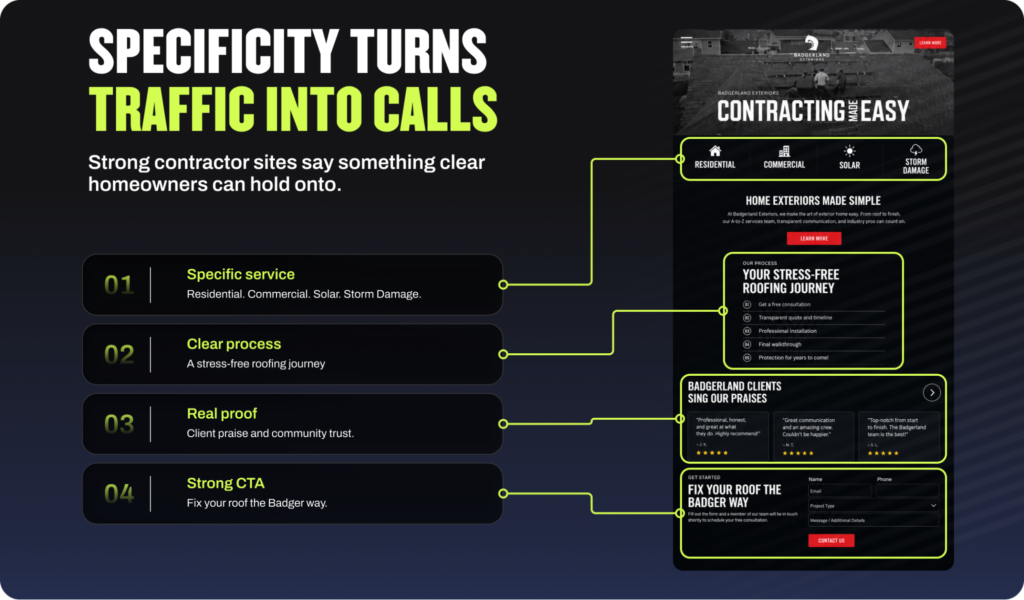
The contractor websites that convert traffic into calls are almost never the ones with the most features or the cleanest design. They are the ones that say something specific that no competitor in the market is saying.
Badgerland Exteriors is one example worth referencing. When we rebuilt their site and repositioned their messaging, the shift was not about getting more traffic to a generic site. It was about making the site reflect something specific about the business that homeowners could actually respond to. The Badgerland Exteriors case study covers the outcome in detail. The pattern holds across every trade we work in: specificity is what separates a site that gets traffic from one that gets calls.
The homeowners who were ready to hire but went with a competitor almost never made that choice because the competitor was better. They made it because the competitor said something clearer, something more specific, something they could hold onto when they called.
For a full look at how home services marketing strategy connects differentiation to every channel, that guide frames where the messaging work fits inside the broader marketing system.
Frequently Asked Questions
What is a generic differentiator in contractor marketing?
A generic differentiator is any claim a competitor could copy onto their own website without it being untrue. Licensed and insured, quality workmanship, and customer satisfaction guaranteed are common examples. They are expected by homeowners as baseline requirements, not reasons to choose one contractor over another.
Why does saying licensed and insured not help a contractor win jobs?
Because homeowners expect every contractor they consider to hold a license and carry insurance. It is a required baseline, not a competitive advantage. Stating it does not give a homeowner a reason to choose one contractor over another who is also licensed and insured.
How does a contractor find their real differentiator?
Ask five or six of the best repeat customers why they came back or referred someone instead of calling a competitor. Their answers almost always point to something operational and specific, such as response time, how the tech communicated, a guarantee, or a specialty. That answer is closer to a real differentiator than anything that comes from inside the business itself.
Does generic marketing really cost a contractor jobs?
Yes, in two specific ways. First, homeowners who cannot distinguish between contractors on anything other than price will choose on price, which compresses margins and attracts comparison shoppers. Second, generic descriptions give AI search tools nothing specific to surface when a homeowner asks for a recommendation, which removes the contractor from the conversation before any choice is made.
What is the difference between a generic and a specific differentiator?
A generic differentiator is something any competitor could also claim truthfully. A specific differentiator is tied to something measurable or observable in the business that most competitors either do not do or do not say. “We respond to all repair calls within two hours” is specific. “Fast, reliable service” is generic.
How specific does a differentiator need to be to actually work?
Specific enough that a competitor could not say the same thing without it being false for them, or without changing how they operate. A two-year written workmanship warranty on all installs is specific. “We care about quality” is not, because no contractor would claim the opposite.
Generic Marketing Is a Positioning Problem, Not a Design Problem
Fixing it doesn’t start with a new logo or a bigger ad budget.
It starts with being honest about what actually makes the business different from the twenty other contractors in the same city saying the same things. That difference is already there. It is in how the techs communicate on-site. The guarantee that was quietly added two years ago. The response time that nobody has ever put in writing. The neighborhoods served for 15 years that feel like home turf.
Say the thing. In plain language. Where a homeowner can find it before they call.
For contractors who want help identifying and communicating that difference across their website, ads, and content, Hook Agency works specifically with home service businesses to build marketing that reflects something real about the business, not just something that sounds safe.