
Every fall, the same thing happens. The phones slow down, the schedule opens up, and most home service businesses either cut everything or keep spending the same amount on the wrong channels. Neither works. And the contractors who figure that out are the ones who dominate come spring.
The question about contractor off-season marketing comes up in nearly every conversation we have with roofing, HVAC, and plumbing businesses heading into the slow months. What do we do now? Cut? Hold? Pivot?
The answer is not obvious from the inside. But after working with home service contractors across dozens of markets, the pattern is clear: the businesses that enter peak season ahead of their competition did not get lucky. They used the slow months to do specific things while everyone else was coasting.
Here is what that actually looks like:
- Shift paid ad targeting to lower-CPC maintenance and inspection keywords
- Invest in SEO and content that takes three to six months to rank
- Reactivate past customers who already know and trust the business
- Sell maintenance plans that produce recurring revenue in future slow seasons
- Build the review count before spring buyers start comparing options
Why Most Contractors Handle the Slow Season Wrong
There are two versions of the same mistake.
Mistake #1: Cut Everything
Pausing Google Ads does not just stop spend. It wipes out months of accumulated Quality Scores and bidding data that directly affect what you pay per click when demand comes back. When peak season arrives and the campaign restarts, the account is starting over at the exact moment CPCs are highest and every local competitor is also spending.
Roofing CPL dropped 23% from January to March 2026 while most contractors were sitting on the sidelines, per SearchLight by Hatch. The contractors who kept a baseline running locked in cheaper leads right before spring.
Local SEO works the same way. Three months of quiet loses ranking momentum that is slow and expensive to get back.
Mistake #2: Spend the Same on the Wrong Things
Keeping the full budget running on emergency-intent keywords in December is the other error. Homeowners in January are not searching for “emergency AC repair.” The demand is different. The intent is different. The budget needs to reflect that.
Off-season demand is real. It is just maintenance demand, inspection demand, planning demand. Contractors who shift their targeting to match what people are actually searching for in slow months get more from the same budget.
What the Off-Season Actually Is (It Is Different for Every Trade)
Before building a home service off-season marketing strategy, it helps to know exactly when the slow period hits. The timing varies by trade, climate, and whether the market sees storm activity.
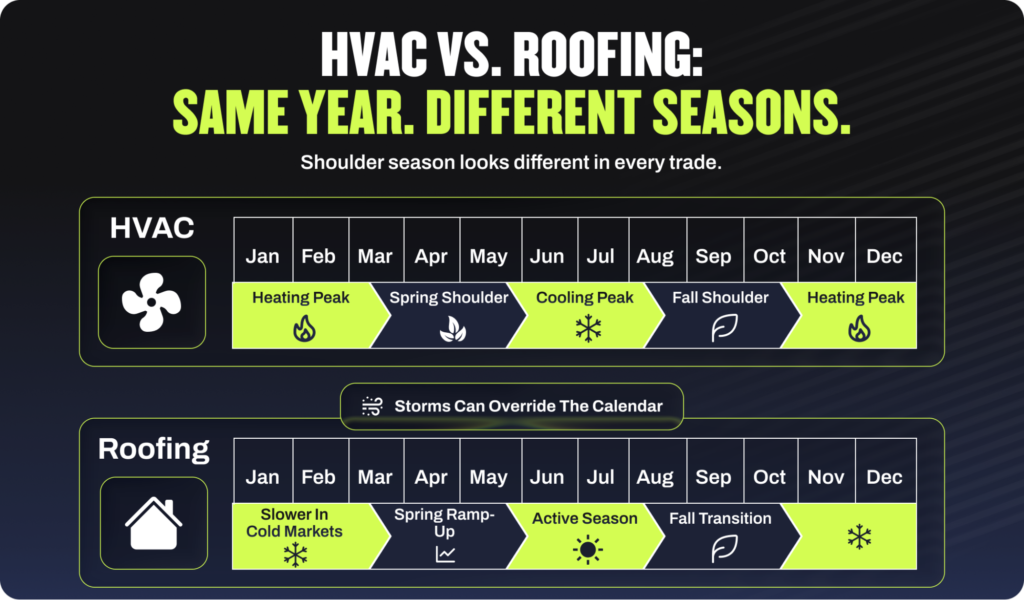
The term you hear most in HVAC is shoulder season, and it matters. Understanding it changes when to act.
HVAC: Two Shoulder Seasons Per Year
HVAC has two predictable shoulder season windows:
- Spring: March through May (between the winter heating rush and summer cooling peak)
- Early fall: September through October (between summer cooling and the winter heating push)
These are the stretches when homeowners are not running their systems and not thinking about them. Service call volume drops roughly 30% in these windows, per Hook Agency’s own seasonal data.
But that same shoulder season drop cuts cost per lead by 20 to 40% compared to peak months. The smart HVAC shoulder season marketing play is to run maintenance plan campaigns and inspection offers in September and October, before the fall surge, when the leads cost significantly less.
Roofing: Weather-Dependent, Not Calendar-Dependent
Roofing does not have clean shoulder seasons the way HVAC does. The true slow period for most non-storm markets is late fall through winter. Off-season Google Ads CPCs for roofing run $5.25 to $8.75 per click, compared to $8.50 to $14.25 at peak, a 30 to 50% difference, per PipelineOn’s roofing off-season research.
That window is not about matching summer volume. It is about building rank, review count, and brand recall before spring buyers start shopping. For the year-round strategy, Hook’s roofing marketing guide covers the full picture.
Plumbing and Electrical: Demand Is More Consistent
Plumbing is the most emergency-driven trade and the most consistent year-round. The slow window, when it exists, clusters around major holidays. The off-season strategy for plumbing and electrical is less about managing a sharp demand drop and more about working the customer database while the schedule has breathing room to absorb the responses.
The Five Things Smart Contractors Do With Their Off-Season Budget
This is the core of any effective contractor slow season marketing strategy. Not one of these things. All five, running simultaneously.
1. Shift Paid Ads to Lower-Competition Keywords
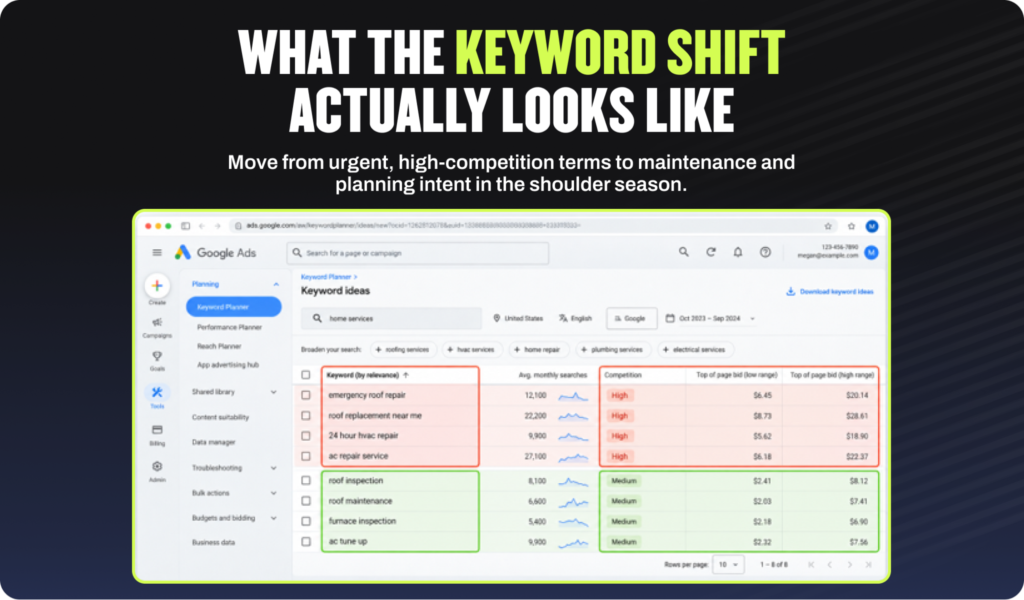
When competitor budgets pull back in slow months, CPCs drop. That creates a window where the same spend produces more clicks and better Quality Scores than peak season. The move is straightforward: shift keyword targeting from emergency and replacement intent to maintenance, inspection, and planning intent.
An HVAC company in Minneapolis shifts from “AC repair near me” to “furnace inspection before winter.” A Denver roofer moves from “emergency roof repair” to “roof inspection” and “is my roof ready for winter.” Lower CPCs, higher-quality leads, and a stronger account going into spring.
You’re not going to outspend a decrease in demand. But there’s not zero demand either. So it’s riding this wave, knowing what your customers want throughout the year, and making your marketing budget proportionate to those seasonal trends.
Google Ads costs rose for 69% of home service businesses in 2025, with cost per conversion up 19% for HVAC, according to LocaliQ data. The contractors who capitalize on the off-season CPC advantage are the ones who do not have to absorb those peak-season rates across their full lead volume.
2. Invest in SEO That Will Rank by Spring
SEO takes three to six months to move meaningfully. Content published in November starts ranking in February. That timing is not a limitation. It is the entire point.
A roofing company that publishes “how long does a roof last in Tennessee” in November will rank for it when homeowners start researching in February. A plumber who builds a local water heater comparison guide in December has that page pulling organic traffic in March before spring competition starts spending.
Focus on sowing things that you can reap later on. SEO, if you’re not doing SEO, the best time to start is in the off-season.
Roofing CPL dropped 23% from January to March 2026 for contractors who kept their local SEO content running through winter. Hook’s guide on SEO for roofing companies covers what that technical and content foundation looks like.
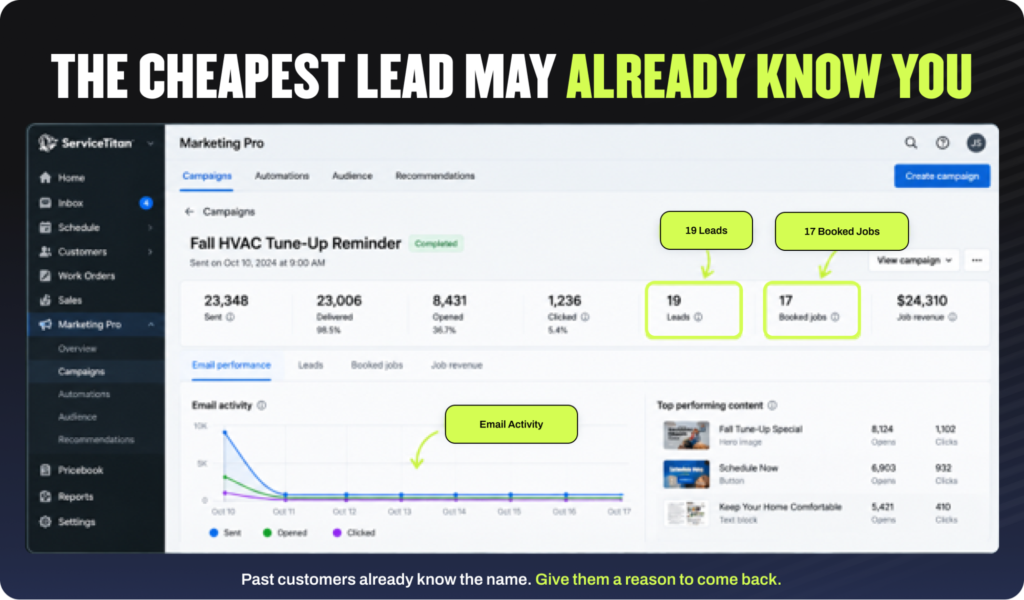
3. Reactivate Past Customers
Email marketing delivers around $36 for every $1 spent, making it the highest-return channel most home service businesses have available. It is also the one most consistently underused between seasons.
The slow season is the right time to run reactivation campaigns because the schedule can actually absorb the demand. A campaign launched when peak is already booked three weeks out wastes the leads it generates. Launched in January, those same leads fill the shoulder-season calendar at a fraction of paid search cost.
A winter prep email to 2,000 past customers, costing $150, produced 17 booked jobs averaging $285, per PipelineOn’s seasonal marketing research. Those are not paid leads. They are recovered revenue from people who already know the business.
Hook Agency’s home services marketing strategy guide covers how reactivation fits into a year-round system.
4. Sell Maintenance Plans
Only 30% of Americans schedule preventative HVAC maintenance, which means 70% of any HVAC contractor’s market is uncontracted and available. Maintenance plan members generate 2.4x to 3.1x higher lifetime value than one-time customers. The math on acquiring them in the off-season is straightforward: CPL runs 20 to 40% lower in shoulder months, the homeowner is not in crisis mode, and they are far more receptive to a preventive offer than when their system is failing on a Friday night.
Plans sold in October fill the February schedule. The recurring revenue changes what slow season costs the business over time. For seasonal content support, Hook’s HVAC social media guide covers the off-season content approach.
5. Build the Review Count Before Spring Buyers Compare
47% of consumers will not use a business with fewer than 20 reviews, and 31% now require a minimum 4.5-star rating before they’ll consider calling, per BrightLocal’s 2026 Local Consumer Review Survey.
The review count that influences buyers in April gets built in November and December, when the schedule has room to follow up on every job from the past twelve months. Reviews compound over time. The off-season review push changes the competitive position before spring buyers start making calls.
Hook’s guide on online reviews for contractors covers the outreach system and platform strategy.

What to Actually Do With the Budget
The off-season budget question is not how much to cut. It is how to redirect spend so it builds something. For a detailed look at channel-level costs by trade, Hook’s research on digital marketing costs for home service businesses has the numbers.
Spend Less On
- Emergency-intent paid search keywords (the demand volume is not there)
- Peak-season campaign structures built for urgent replacement demand
- Promotional content tied to spring and summer offers that will not close for months
Spend More On
- SEO and content investment timed to rank by peak season
- Email and SMS reactivation to the existing customer database
- Paid search on maintenance and inspection keywords at lower CPCs
- Website improvements and GBP updates that got deferred during busy season
- Review generation across every completed job from the past year
For the social content side of the off-season, Hook’s home services social media strategy guide covers what to post and when.
Never Fully Pause
Pausing Google Ads entirely loses Quality Score and optimization data. Pausing local SEO stalls ranking momentum. Letting the Google Business Profile go dark signals inactivity to both Google and every homeowner who checks the listing.
You’re not going to completely stop. You do it proportionally. If demand is going down 30% in January, reduce spend by approximately 30%. Use that as your starting point. You’re not going to outspend a decrease in demand, but you’re also not going to want to shut things off completely.
The off-season slice of a marketing budget tends to be the smallest. But it is the one that sets up the other two-thirds of the year.
What This Looks Like When It Works
The ROI of off-season marketing does not show up in the month it is spent. It shows up in March and April when calls come in at lower cost per lead than competitors who coasted through winter.
Hook Agency worked with Courtney Construction on a Google Ads and local SEO program that generated approximately $105,000 in sold work from roughly $6,000 in ad spend in a single month, with a cost per conversion of $122 and a CPC of $9. That kind of efficiency in peak season comes from having an optimized, data-rich account going into spring rather than restarting from scratch.
SEO built in the fall is ranking in April. Reviews built in December influence homeowners in May. Maintenance plans sold in October fill the February schedule. Peak season gets cheaper when those foundations are already in place before the auction starts.
FAQs
Should a contractor pause marketing in the off-season?
No. Pausing Google Ads loses Quality Score and optimization data that takes weeks to rebuild at peak prices. A maintained baseline across paid search, SEO, and GBP activity is far cheaper than restarting from scratch when demand returns and CPCs are highest.
What should a contractor spend their marketing budget on in the slow season?
Shift paid ads to maintenance and inspection keywords at 30 to 50% lower CPCs. Invest in SEO content that will rank three to six months later. Run past customer reactivation via email and SMS. Push maintenance plan enrollment. Build the review count before spring buyers start comparing options.
What is the shoulder season for HVAC?
HVAC shoulder seasons fall in spring (March through May) and early fall (September through October), the windows between the summer cooling rush and the winter heating push. Service call volume drops about 30%, but cost per lead for maintenance campaigns also drops 20 to 40%, making these the best windows for tune-up and inspection offers.
How much cheaper are CPCs in the off-season?
Off-season roofing CPCs run $5.25 to $8.75 per click compared to $8.50 to $14.25 at peak, a 30 to 50% difference, per PipelineOn’s roofing off-season data. HVAC shoulder-season CPL drops 20 to 40% compared to peak months.
When should a contractor start their off-season marketing push?
Three to four months before the slow season arrives. SEO and content published in October and November matures before spring rankings matter. Maintenance plan campaigns in shoulder months run at lower CPL before busy-season competition drives costs back up.
How much revenue can a past customer reactivation campaign generate?
A winter prep email to 2,000 past customers, costing $150, produced 17 booked jobs averaging $285, per PipelineOn’s seasonal marketing research. Email marketing overall delivers roughly $36 per $1 spent, so the economics of reactivating past customers consistently beats cold paid search.
How long does SEO take to produce results for a contractor?
Three to six months for meaningful movement. Content published in November starts ranking by February or March. Roofing CPL dropped 23% in the first quarter of 2026 for contractors who maintained their content program through winter, per SearchLight by Hatch data.
Start Before Everyone Else Does
The contractors who dominate peak season are not outspending their competition. They are out-timing them. The SEO, the review count, the reactivation list, the maintenance plan base: all of it gets built in the months when everyone else goes quiet.
You’re sowing things that you can reap later on. In the off-season, invest in things that aren’t going to get you immediate returns, so that they’re there for you when the busy season arrives.
For home service businesses that want a marketing plan built around their specific seasonal cycle, Hook Agency works with HVAC, roofing, plumbing, and other trades on SEO, paid search, and content strategy year-round. The off-season is not downtime. It is setup time.