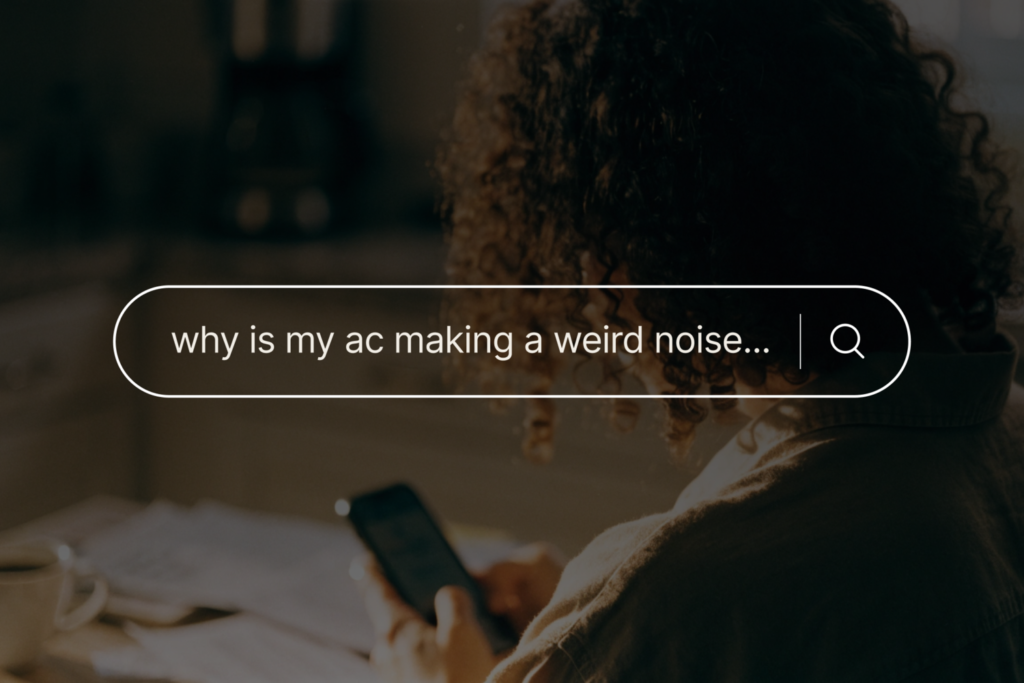

Picture two HVAC companies in the same city. One ranks for “HVAC company near me.” The other ranks for that and for “why is my AC freezing up,” “how long does a furnace last,” “what does HVAC replacement cost in Minneapolis,” and “is it worth repairing a 15-year-old air conditioner.” One gets more calls. It is not the one with only the broad keyword.
The difference is not SEO sophistication. It is a different starting point. The second contractor built content around what homeowners actually type when something breaks, not what a keyword tool says has the most volume. That shift, from the algorithm to the person, is what audience-first SEO for contractors looks like in practice.
We work with contractors across HVAC, roofing, plumbing, and electrical, and the pattern is consistent. The sites producing the most calls from organic are the ones answering real questions in the exact words homeowners use. Not generic service pages. Not keyword-stuffed blogs. Specific, question-based content tied to what people are actually searching in their specific cities.
What that looks like in practice:
- Content built around problem diagnosis questions, not just service keywords
- Cost and comparison pages written for specific cities, not generic national averages
- Trust and credibility content that earns rankings before someone even picks up the phone
- A connected topic cluster, not a collection of standalone pages
Keyword-First SEO and Why It Stops Working
The core contrast: Keyword-first SEO asks which terms have the most search volume. Audience-first SEO asks which questions homeowners are actually trying to answer, then builds content to answer them.
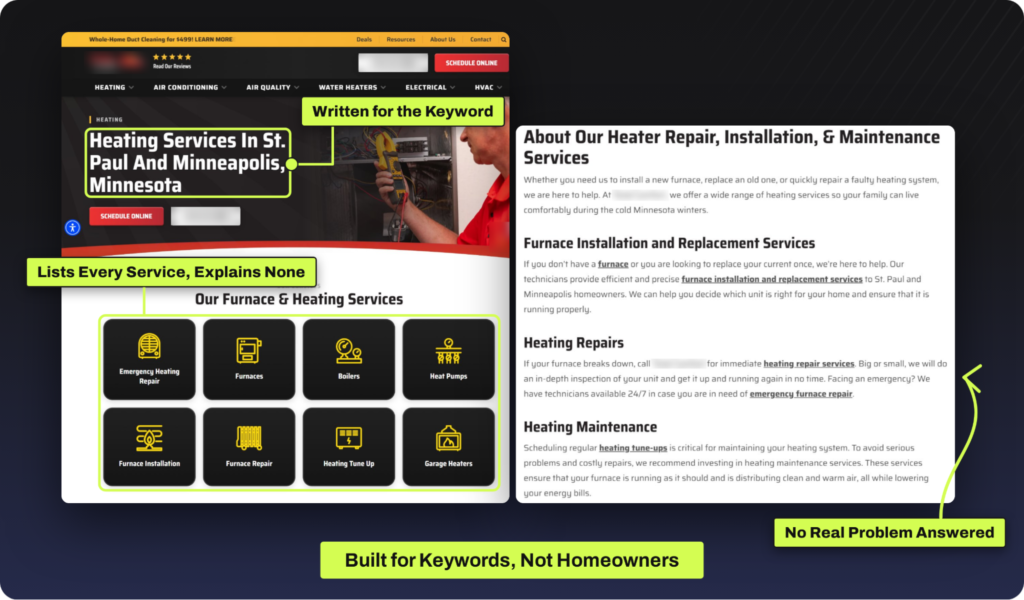
Most home service websites are built keyword-first. The tool says “roof replacement” gets searched a lot, so a page called “Roof Replacement Services” gets built. It might rank adequately. But it does not help the homeowner deciding whether to repair or replace. It does not help someone comparing quotes from three contractors. Generic pages answer the question the business wants to be known for. Audience-first pages answer the question the homeowner is actually asking.
What Keyword-First Looks Like on a Contractor Site
A homepage targeting “HVAC company [city].” A services page that lists every service without explaining any of them. A blog that publishes “5 Tips for a Healthy HVAC System.” None of it speaks to a homeowner who has a specific problem right now, which is the only kind of homeowner who calls.
What the Audience-First Shift Changes
When strategy starts with the person, the question changes from “what keywords rank well” to “what is a homeowner Googling at 9pm when the AC stops working.” Those two starting points produce completely different content. One produces impressions. The other produces calls.
The Three Questions Every Homeowner Is Really Asking
Every homeowner searching for a contractor is asking one of three types of questions, and the type tells you exactly how close they are to calling. Understanding this is central to how homeowners research contractors before they ever pick up the phone.
This framework comes from Insidea’s 2026 AEO content guide for HVAC, which maps content to stages of the homeowner’s decision process. The three categories cover the full arc from something is wrong to I am ready to hire someone.
Problem Diagnosis Questions
These are the highest-intent searches in any home service market. “Why is my AC freezing up.” “Why is my water pressure dropping.” “Do I have storm damage on my roof.” “Why does my breaker keep tripping.”
A homeowner asking these questions is not doing research. They have a problem to solve today. A plumbing company ranking for “why is my water pressure low” is reaching a homeowner who is about to call a plumber. As Footbridge Media’s 2026 contractor marketing research puts it: generic content does not get cited. Specific content does.
Cost and Comparison Questions
“How much does roof replacement cost in Denver.” “Is it cheaper to repair or replace my HVAC unit.” “What should I expect to pay for a water heater installation in Phoenix.”
These come from homeowners who have already accepted that work needs to happen. They are figuring out what is fair and who to trust. Ranking here brings homeowners who are building a shortlist and deciding which contractor to call first.
The local specificity is not incidental. A homeowner asking a cost question wants to know what it costs in their city. Contractor sites that answer with city-specific context, and that are intentional about naming the cities they actually serve, consistently outperform sites with boilerplate pricing language on these searches.
Trust and Maintenance Questions
“How do I find a reliable roofer.” “What certifications should an HVAC contractor have.” “How often should I get my plumbing inspected.” These come from homeowners building a longer-term service relationship. Not in immediate need, but open to a contractor who earns trust through the content. Covering all three categories gives a site presence across the full homeowner decision arc. Most contractor sites only reach one of the three.
Where to Find the Actual Questions Homeowners Are Searching
The best content source for an audience-first strategy is not a keyword tool. It is the conversations already happening inside the business every day.
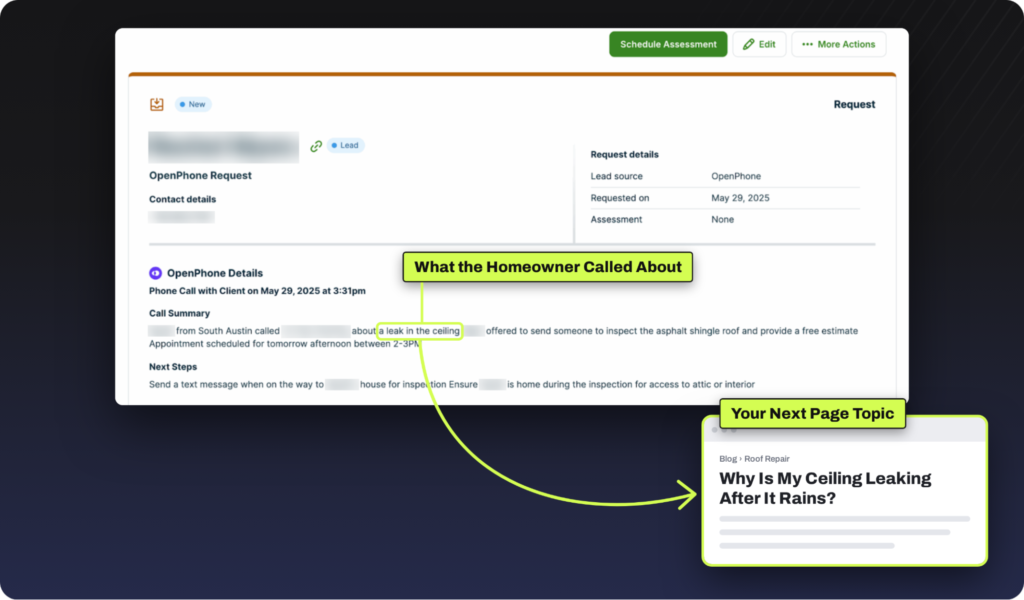
Your Own Call Logs and Tech Notes
Insidea’s 2026 HVAC content research recommends pulling terms from call logs, chat transcripts, and tech notes for the exact phrasing customers use. Every question a homeowner asks before booking is a potential page topic.
A contractor whose office manager hears “is it worth fixing at this age” three times a week has a page topic in plain sight: “When is it cheaper to replace your HVAC system than repair it.” That question is not in any keyword tool. It is in the call log. It is also exactly what a homeowner in comparison mode types at 9pm.
This is what being intentional about local questions actually looks like. Not writing more content. Writing the right content for the specific questions homeowners in your service cities are asking, in the exact words they use to ask them.
People Also Ask and Google Autocomplete
Search the primary service term and study the People Also Ask boxes. Each question Google surfaces is a confirmed homeowner query with enough search volume to earn a featured placement. Google autocomplete shows what homeowners type immediately after the service term. “Roof repair” followed by “cost,” “time,” “permit,” “insurance.” Each completion is a confirmed content angle with real demand.
Google Search Console
For contractors with an indexed site, Search Console shows queries driving impressions but not clicks. A page at position 14 for “how much does HVAC replacement cost” is nine positions from a featured snippet. A direct-answer rewrite of the opening paragraph is often what closes that gap.
How to Turn Those Questions Into Content That Ranks
Finding the questions is step one. Structuring the content to actually rank for them requires three practices most contractor sites skip.
Match the Question to the Right Format
Problem diagnosis questions belong on blog posts or FAQ pages with a conversational structure. Cost questions rank best as standalone pages with specific, locally grounded pricing context. Trust and maintenance questions work as blog posts or service page FAQ sections. The format signals intent match to Google. A cost question buried inside a general services page almost never ranks as well as a dedicated page built around that exact question.
Lead Every Page With a Direct Answer
Every page built around a homeowner question should open with a direct answer in the first paragraph. Not background context. The answer. As Foxxr’s 2026 local SEO trends analysis states, the shift in content is toward understanding and answering the question, not just targeting the keyword. Google’s featured snippet algorithm almost always pulls the clearest, most direct response from the first substantive paragraph.
Add FAQ Schema to Every Page With Questions
FAQ schema turns question-and-answer content into structured data that search engines extract and display as featured snippets and People Also Ask entries. According to Insidea’s 2026 AEO guide, FAQ schema is one of the most important tools for pages covering homeowner questions because it increases both traditional snippet appearance and AI citation rate. On pages with multiple questions and direct answers, it is not optional.
Topic Clusters: How to Build a System, Not Just a Page
Individual question pages are useful. Organizing them into a connected system is what compounds into lasting search authority.
What a Contractor Topic Cluster Looks Like
A topic cluster for roofing starts with a pillar page on roof replacement. Supporting pages answer specific homeowner questions across all three categories. For a Denver roofing contractor:
- “How much does roof replacement cost in Denver in 2026”
- “How to tell if my roof has storm damage from the ground”
- “Will my homeowner insurance cover storm damage roof replacement”
- “How long does a roof replacement take from start to finish”
- “What are the signs I need a new roof vs a repair”
Each supporting page links back to the pillar; the pillar links out to each supporting page. Google reads the cluster as comprehensive coverage. Notice the example pages above are Denver-specific. The service area pages for contractors layer sits underneath this: building locally grounded question pages for every city in the service area is how this scales geographically.
How It Compounds Over Time
One new question-based page per month is twelve new ranking opportunities per year, each targeting a confirmed homeowner query. Over 18 to 24 months, that library covers the full decision arc across every service and every city in the service area. The contractors dominating organic search in competitive home service markets almost always started building this library two or three years ahead of their competitors. Not a better homepage. A deeper content system.
How This Content Structure Also Wins AI Search
The content structure that ranks for homeowner questions in traditional search is the same structure that earns citations in AI-generated answers.
Why AI Tools Cite Specific Answers
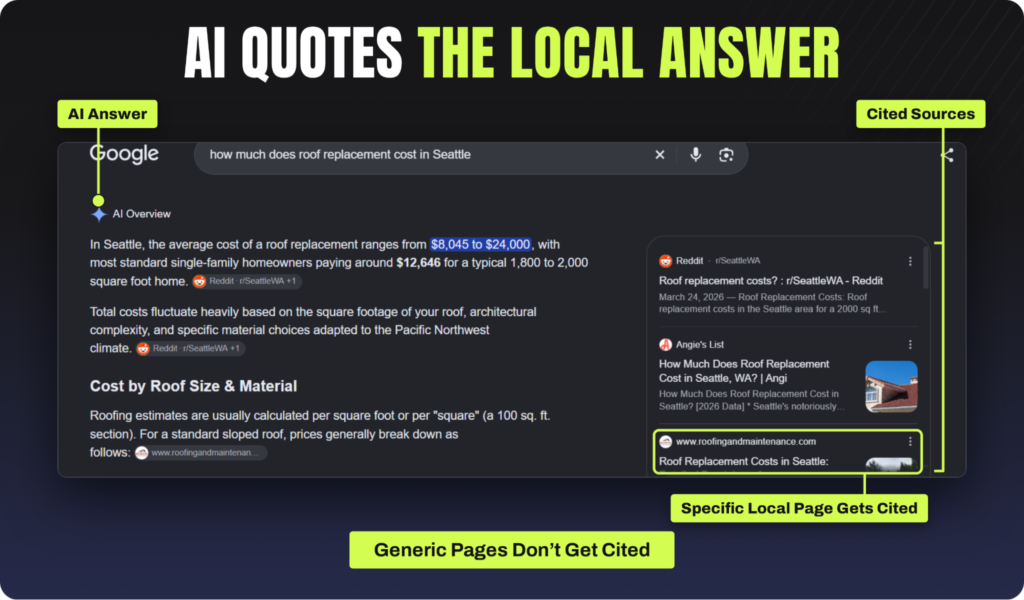
When a homeowner asks an AI tool “how much does roof replacement cost in Seattle,” the system cites pages that have given a specific, locally grounded answer. Generic service pages do not get cited. As Footbridge Media’s 2026 contractor marketing research puts it: generic content does not get cited. Specific content does.
Foxxr’s 2026 local SEO analysis adds context: AI-generated answers now appear in 25.8% of all searches and over half of long-tail queries. Only 40.3% of Google searches lead to an organic click at all. The searches that still drive clicks are the ones where someone asks a specific question and lands on a page that answers it. Broad informational traffic is moving to AI answers. Specific, direct-answer content is what survives that shift.
The Overlap Between Audience-First and AEO
Audience-first SEO and answer engine optimization are not two disciplines. They are the same principle on two delivery systems. The answer engine optimization for home services guide goes deeper on structure, schema, and citation patterns. The short version: write like you are answering a homeowner standing in front of a broken furnace at 9pm. That is the content that wins both.
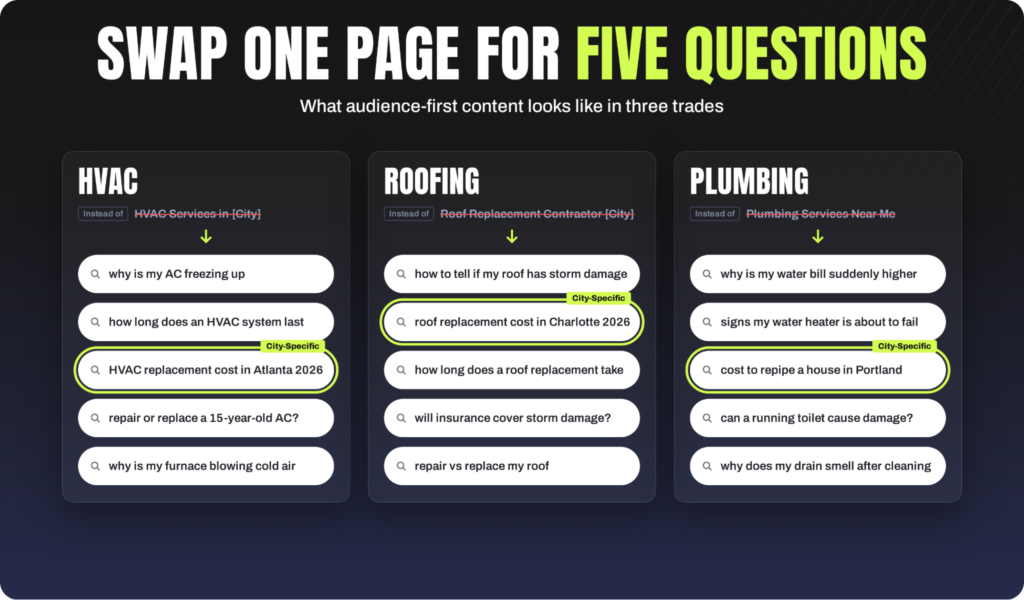
Trade-by-Trade Examples
Here is what audience-first content looks like across three trades, so the approach is immediately usable rather than abstract.
HVAC
Keyword-first page: “HVAC Services in [City]”
Audience-first pages built around real homeowner questions:
- “Why is my AC freezing up and what do I do about it”
- “How long does an HVAC system last before it needs replacing”
- “What does HVAC replacement cost in Atlanta in 2026”
- “Is it worth repairing a 15-year-old air conditioner or should I replace it”
- “Why is my furnace blowing cold air”
Each page targets a different buying stage. The diagnostic questions reach people with an immediate problem. The cost pages reach people in comparison mode. Together they cover the arc.
Roofing
The SEO for roofing companies guide goes deep on the full keyword and content strategy for this trade. Here is what the audience-first layer looks like:
Keyword-first page: “Roof Replacement Contractor [City]”
Audience-first pages:
- “How to tell if my roof has storm damage from the ground”
- “What does roof replacement cost in Charlotte in 2026”
- “How long does a roof replacement take from start to finish”
- “Will my homeowner insurance cover storm damage roof replacement”
- “Repair vs replace: how to decide what your roof actually needs”
Plumbing
Keyword-first page: “Plumbing Services Near Me”
Audience-first pages:
- “Why is my water bill suddenly higher than normal”
- “What are the signs my water heater is about to fail”
- “How much does it cost to repipe a house in Portland”
- “Can a running toilet cause water damage over time”
- “Why does my drain smell bad even after cleaning it”
A plumber serving Portland, Denver, and Phoenix builds three versions of the cost pages, each with city-specific pricing context. That local specificity is not busywork. It is what makes the pages rank for the homeowners who actually call.
Start With the Homeowner, Not the Algorithm
Most contractor websites answer the questions the business wants to be known for, not the questions homeowners are actually asking. Closing that gap is where organic search starts producing calls instead of impressions.
Find the real questions coming in through calls and chat logs. Map them to the three content categories. Build pages that answer directly, with local specificity for every city you serve. Add FAQ schema. Connect the pages into a cluster. That is the full system.
For home service businesses that want a content strategy built around real homeowner intent, Hook Agency works specifically with contractors on exactly this kind of work.
FAQ
What is audience-first SEO for contractors?
Audience-first SEO means building content around the specific questions homeowners ask at every stage of their decision process, rather than starting with keyword volume. For contractors, that means pages for problem diagnosis questions, cost and comparison questions, and trust and maintenance questions that match real homeowner intent rather than broad service category terms.
How do I find the questions homeowners are actually searching for?
Three sources: your own call logs and tech notes, which contain the exact language customers use; Google’s People Also Ask boxes and autocomplete, which confirm real search queries; and Google Search Console, which shows queries already driving impressions that could be strengthened with a direct-answer rewrite.
Why does question-based content produce more calls than service pages?
Question-based content reaches homeowners at the moment they are actively problem-solving. A homeowner searching “why is my AC freezing up” is about to call. A homeowner searching “HVAC services” may be weeks away from any decision. Intent match is what separates content that converts from content that just generates traffic.
What is a topic cluster and how does it help contractor SEO?
A topic cluster is a group of related pages built around a central service page, where each supporting page answers a specific homeowner question and links back to the main page. Google treats the cluster as comprehensive topic coverage, which strengthens rankings for the central page and gives each supporting page its own ranking opportunity.
How does question-based content help contractors appear in AI search results?
AI tools cite content that gives specific, structured, direct answers to the questions homeowners ask. Generic service pages do not get cited. Pages with direct-answer first paragraphs and FAQ schema are significantly more likely to be extracted and cited, which matters more as AI answers now appear in over a quarter of all searches.
How long does it take for audience-first content to start ranking?
Question-based pages targeting specific homeowner queries typically see initial ranking movement within 60 to 90 days. Competitive cost queries in dense metro markets take three to six months. The compounding benefit comes at 12 to 24 months, when a library of 20 or more question-based pages covers the full decision arc and creates a search presence no single broad-keyword page can replicate.