
Somewhere in your phone right now, there’s a homeowner who called you, got no answer, and hired the plumber who texted back in four minutes. That’s not a marketing failure. The marketing worked. The phone rang. What failed was everything after.
The follow-up gap is where most plumbing revenue disappears. Not in the ad campaign. Not in the search ranking. In the moment between a lead coming in and someone actually doing something with it.
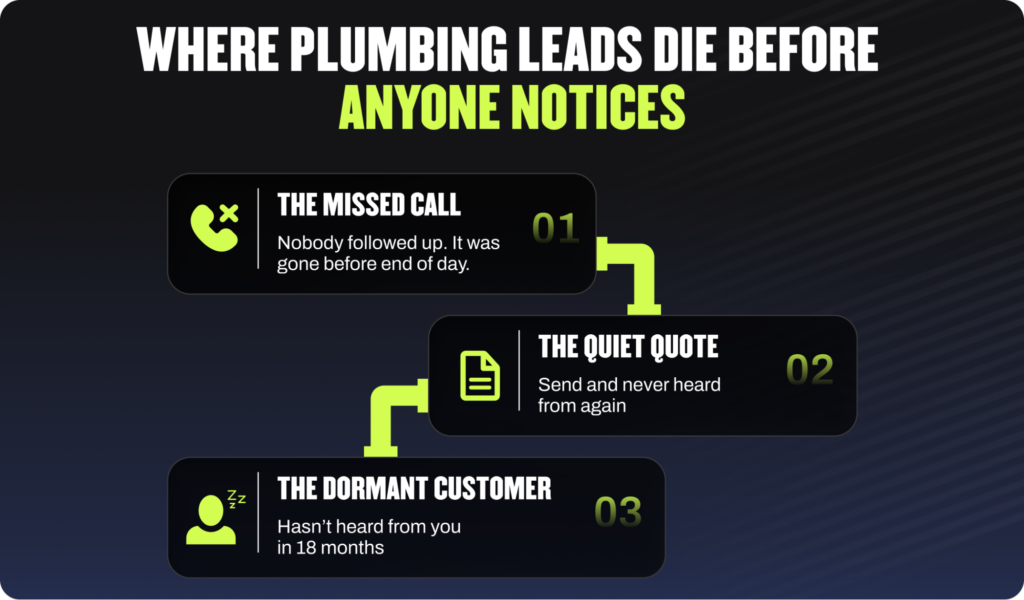
Three places leads get stuck and die:
- The missed call nobody followed up on
- The estimate that went quiet after it was sent
- The past customer who hasn’t heard from you in 18 months
This guide is 15 specific follow-up ideas organized by exactly where the lead is stuck, with copy you can paste into a text today. It’s not another article about 15 marketing channels. It’s about what happens after the lead is already in your hands. For the bigger picture on how plumbers get more leads, that post covers everything upstream of this one.
Why Follow-Up Matters More Than Getting More Leads
Most plumbing companies don’t have a lead problem. They have a follow-up problem.
Here’s the pattern I keep seeing. A company is running solid marketing. Calls are coming in. Estimates are being sent. But the close rate is soft and nobody can figure out why. Usually it’s not the market. It’s not the pricing. It’s that the follow-up is inconsistent or nonexistent.
The numbers on this are sobering:
- 50% of sales leads are never contacted a second time. Half of all the money spent generating those leads just evaporates.
- Contacting a lead within 5 minutes makes you 100 times more likely to reach them than waiting 30 minutes. In plumbing, where a homeowner with an active leak has already called three companies, that window is real.
- 93% of converted leads are reached by the sixth contact attempt. Most plumbers make one, maybe two.
The follow-up problem is not a knowledge problem. Everyone knows they should be following up. It’s an execution problem.
A contractor follow-up system turns good intentions into something that actually happens consistently. We’ve seen plumbing companies running well-optimized paid search generate well over 150 marketing-qualified leads a month. At that volume, even a modest lift in follow-up conversion is meaningful revenue every single month, with zero additional ad spend.
The other angle worth saying out loud: leads you already paid to generate are always cheaper to work than buying new ones. A dead lead that converts through follow-up has no acquisition cost. That’s pure margin recovery.
5 Ways to Recover a Lead the Moment You Almost Lose It
These are the leads most likely to still be warm if you move fast. A homeowner who just called and got no answer is still in decision mode. They haven’t hired anyone yet. You have a window.
1. Text Back the Instant a Call Goes to Voicemail
This is the single highest-leverage change most plumbing companies can make.
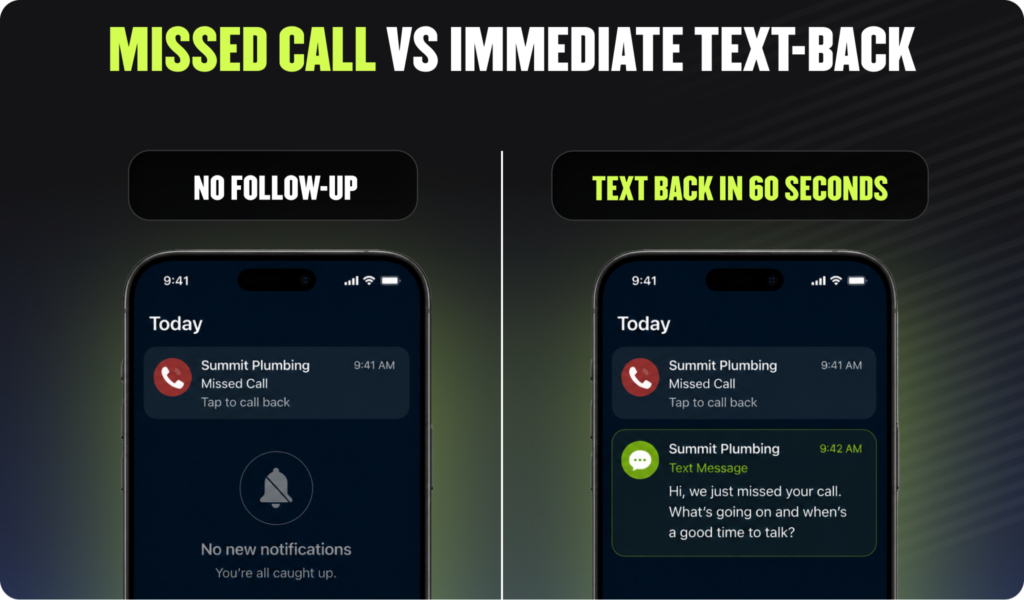
When a call goes to voicemail and nothing follows, the homeowner moves on. They call the next plumber on their list. When a text arrives within 60 seconds, they usually respond. Most people are still holding their phone.
Copy this: Hi, this is [Name] from [Company]. We just missed your call and want to make sure we help you out. What’s going on and when’s a good time to talk?
This can and should be automated. I had Aaron Cooper of Same Day AI on our podcast recently to talk through AI voice and follow-up for home services, and he made a point that’s hard to argue with: the difference between a lead that books and one that evaporates is almost always whether someone was there to respond immediately. His system handles the overnight and weekend coverage that no office staff can maintain consistently.

For follow-up templates for contractors that include this text and others, that post gives you the actual copy to set it up.
2. Call Back Within 5 Minutes, Not 5 Hours
Texting gets you back in the game. Calling closes the loop.
The data on response speed is consistent: contacting a lead within 5 minutes is dramatically more effective than waiting even 30 minutes. In plumbing, a homeowner with an active leak or a non-functioning toilet is not going to wait two hours for a callback. They’re going to keep calling until someone picks up.
If your team can’t guarantee a 5-minute callback during business hours, that’s a staffing or process problem worth fixing before spending more on marketing. You’re paying to generate leads that you’re then losing to response time.
3. Put a QR Code on Your Trucks and Invoices
Free and underused. A QR code on your truck or invoice linking directly to a booking form catches people in the moment. A homeowner who sees your truck on a neighbor’s driveway, or has your invoice on the counter two months later, can act without having to find your number or look you up.
Label it: Scan to book a service call or get a fast quote.
4. Tag Every Missed Call the Same Day in Your CRM
If a missed call isn’t logged before the end of the day, it doesn’t exist. The next morning it’s gone. Even a simple spreadsheet works to start. But a proper CRM makes the whole follow-up cadence run automatically.
Our breakdown of best CRMs for plumbers covers the specific tools that work well for this at every price point.
5. Give After-Hours Callers a Real Next Step
A voicemail that says “leave a message and we’ll get back to you” is a dead end. After-hours callers who get a specific next step, a time you’ll call back or a text number, convert at meaningfully higher rates than ones who just wait.
Better voicemail: Thanks for calling [Company]. We will call you back first thing tomorrow morning. If it’s urgent, text us at [number] and someone will respond tonight.
5 Ways to Follow Up on Quotes That Went Quiet
A quote that went quiet is not a dead lead. It’s usually a homeowner who got busy, got nervous about the price, or is waiting to see if they really need to do it now. The right follow-up sequence pulls a real percentage of these back.
6. Send a Same-Day Recap Text After Every Quote
Most plumbing companies send a quote and then wait. The homeowner leaves, gets distracted by life, and the quote sits in their email unread.
A same-day recap text that lands while the conversation is still fresh keeps you top of mind and gives them something easy to act on.
Copy this: Hey [Name], great meeting you today. I sent the full quote to your email. Quick summary: [one line on what’s included and the price]. Any questions, just reply here. Happy to walk through it with you.
One plumbing company we know added this single step to their post-quote process and saw a noticeable lift in quotes converting to booked jobs within the same month. The quote hadn’t changed. The follow-up did.
7. Check In 2 to 3 Days Later
If you haven’t heard back by day two or three, a light check-in is not pushy. It’s professional. The framing matters: not “just following up” but an actual question.
Copy this: Hi [Name], just wanted to make sure you got the quote I sent over. Happy to answer any questions or adjust anything. What’s your timeline looking like?
A single follow-up lifts reply rates by over 65% and spacing touches by about three days performs better than back-to-back messages, so the timing isn’t arbitrary.
8. Be Honest About What Waiting Actually Costs
This one has to be done right or it comes across as a pressure tactic.
The honest version: if a homeowner is sitting on a plumbing issue that will genuinely get worse, they deserve to know that. Not to scare them into booking, but because it’s true and actually useful information.
I had Jeff Cronin on our podcast. He sold $8 million in residential plumbing sales in a single year, and his whole philosophy is built around authenticity, not scripts. He told me that people can smell it from a mile away when you’re just telling them what they want to hear, and the same goes for fake urgency. The only version of this that works is the one that’s actually true.

Copy this: Hey [Name], wanted to flag something before you decide. The [issue] you described tends to get more expensive if it sits. Not trying to pressure you at all, just want to make sure you have that information. Happy to answer any questions.
9. Offer One Specific Time Slot Instead of “Let Us Know”
“Let us know when you’re ready” puts the work back on the homeowner. Most don’t come back. Offering one specific slot reduces friction and signals that you’re organized and in demand.
Copy this: We have an opening this Thursday at 10am or Friday afternoon. Either of those work for you to get started?
10. Set One Final Touch at 7 to 10 Days, Then Stop
A follow-up sequence has to have an end. Endless messages after a homeowner has gone quiet are annoying and damage your reputation.
At 7 to 10 days with no response, send one final message that closes the loop professionally. This is also the message most likely to generate a response from someone who was genuinely just busy.
Copy this: Hi [Name], just checking in one last time on the quote from [date]. If the timing isn’t right, totally fine. I’ll close this out on our end. If anything changes, don’t hesitate to reach out.

If you’re seeing a pattern of quotes going quiet and not knowing why, our post on what kills a contractor’s follow-up system identifies the most common reasons and how to fix them.
5 Ways to Turn Past Customers Back Into Booked Jobs
Past customers are the most underused asset in most plumbing businesses. They already trust you. They already hired you. Their cost of acquisition is zero.
I talked with Devin Murphy about lead rehash and reactivation on our podcast. He works specifically on reigniting dormant customer bases and the first thing he said when I asked for his biggest tip was almost too simple: just actually do the follow-up. Most companies let the relationship completely die after the job closes. That gap is where the money is sitting.

11. Send Seasonal Reminders Tied to a Real Risk
A generic “we miss you” message gets ignored. A message tied to something specific to the season and the homeowner’s actual situation gets opened.
Copy this (fall/winter): Hi [Name], as the weather turns, if you haven’t had your pipes checked before the freeze, now’s a good time. Happy to schedule a quick inspection. Just reply here.
Copy this (spring): Hi [Name], spring is a good time to check your sump pump before the rain hits. We’re booking inspections now. Want us to add you to the schedule?
12. Text Customers Who Haven’t Booked in 12 Months
A customer who hired you 12 or 18 months ago and hasn’t been back isn’t necessarily gone. They might just not have had a reason to call. A message creates the reason.
Copy this: Hi [Name], it’s been a while since we were last out at your place. Just checking in to see if everything is still working well. If there’s anything you’d like us to take a look at, we’re around. Easy to book, just reply here.
Devin’s team runs reactivation touches every day for the first 5 business days after a job closes, then every other day, then weekly for 90 days. That sounds like a lot but he made the point that even a small percentage of those converting is significant revenue from a list that cost nothing to build.
13. Lead With a Maintenance Nudge, Not a Hard Sell
The framing that works with past customers is helpfulness, not promotion. A message that sounds like useful information gets a response. A message that sounds like a sales pitch gets deleted.
Copy this: Hi [Name], water heaters typically need a flush every year or two to run efficiently. Yours was installed [timeframe] ago. Want us to take care of that before it becomes an issue?
14. Ask for Referrals Inside the Same Follow-Up Flow
The moment a customer responds positively to a reactivation message is the best time to ask for a referral. They’ve just re-engaged with you. They’re feeling good about the business relationship.
Copy this: Glad to hear things are still working well. If you know anyone who needs a plumber, we’d really appreciate the introduction. We always take great care of referrals from customers like you.
Our guide to plumbing referral marketing strategies covers how to build this into a consistent system rather than a one-off ask. And if you want to combine the referral ask with a review request, see our post on how to ask for a review for the exact framing that works.
15. Track Which Follow-Up Messages Actually Turn Into Booked Jobs
If you’re sending follow-up messages but not tracking which ones generate bookings versus which ones just generate replies, you’re optimizing for the wrong thing.
Tag each follow-up type in your CRM. Note which ones result in booked jobs. Over 90 days the pattern becomes clear and you stop doing what doesn’t work.
A Simple Follow-Up Cadence You Can Copy
Every idea above fits into this three-stage cadence. Use this as the skeleton and build the messages around it:
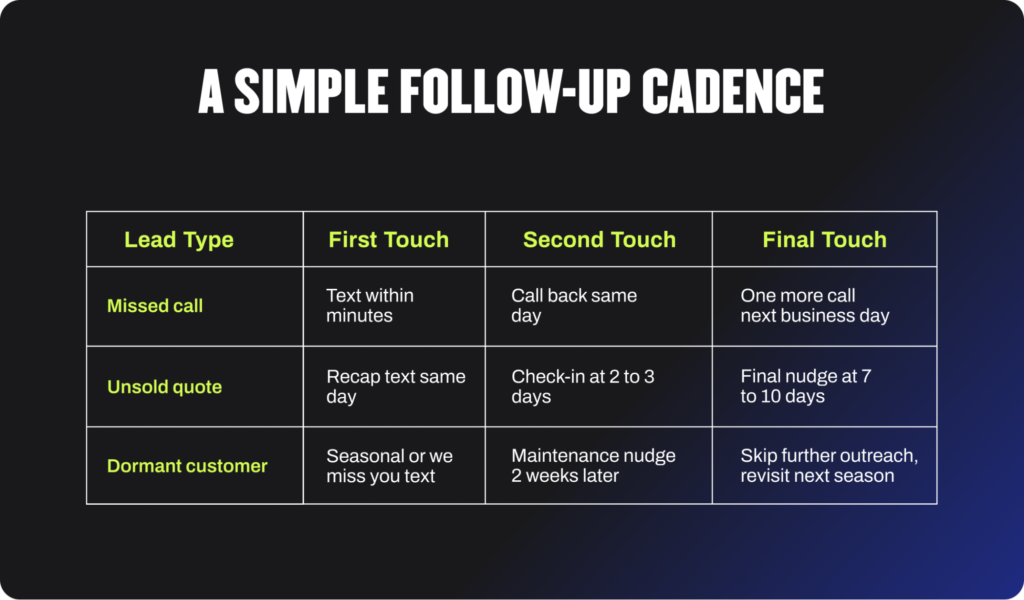
A CRM for plumbers that automates this cadence is what makes it actually happen. The follow-up that runs on a system is the only kind you can count on.
Something to note: When Devin and I talked, the point that stuck with me was about who should be doing the follow-up. His answer: not the salesperson. The person running the call and doing the service cannot also be relied on to run a 90-day cadence. It falls off the moment things get busy. And things always get busy.
Frequently Asked Questions
Why do plumbing leads go cold?
Mostly from slow or missing follow-up, not from losing the job to a better competitor. A homeowner who got one quote and never heard back didn’t necessarily choose someone else. They often just moved on to whoever called them next. The follow-up gap is where most plumbing revenue disappears.
How quickly should you follow up with a plumbing lead?
As close to immediately as possible, minutes rather than hours. Contacting a lead within 5 minutes makes you 100 times more likely to reach them than waiting 30 minutes. For missed calls, a same-day text within a minute or two is the most effective first move.
How many times should you follow up before giving up?
A reasonable cadence is 3 to 4 touches over 1 to 2 weeks for a new lead or unsold quote. For past customers, a seasonal or annual reactivation is appropriate and usually welcome. The key is having an actual end point so follow-up doesn’t turn into harassment.
What’s the easiest follow-up idea to start with today?
An automatic text the moment a call goes to voicemail. It costs nothing to set up in most phone or CRM systems, it requires no manual effort after the initial setup, and it captures leads at the highest-intent moment, right when they just tried to reach you.
Should you follow up with past customers too?
Yes. Past customers already trust the business and typically convert at a much higher rate than cold leads. Their cost of acquisition is zero. A seasonal check-in or maintenance reminder is one of the highest-ROI activities a plumbing company can do, and most companies never bother.
The Leads Are Already There. Follow-Up Is What Gets Them Across the Line.
Spending more on ads before fixing follow-up is putting more water in a leaky bucket. The leads exist. The marketing is working. What’s breaking down is what happens after.
If you want help building the marketing that fills the pipeline and the systems that convert it, that’s what we do at Hook Agency. Schedule a call with our team and we’ll walk you through what we’d build for your operation.