
Google doesn’t rank websites the way you think it does.
If you still believe you can outsmart the algorithm with a few extra keywords and some backlinks from random directories, you’re playing a 2012 game in a 2026 world.
Here’s the reality: when people ask how does Google rank websites, they’re usually imagining some mysterious formula that spits out winners and losers based on technical tricks.
That’s not what’s happening. Google is trying to think like a human. It’s evaluating intent. Authority. Trust. Experience. It’s deciding which business deserves attention when someone searches “AC repair near me” or “best roofing company in Minneapolis.”
And now, with AI Overviews summarizing answers directly in search results, it’s not just ranking pages. It’s ranking credibility.

The Core Goal Hasn’t Changed (But The System Has)
Google still wants to show the best answer to the person searching. That mission has not changed since the beginning. What has changed is how Google decides who qualifies as the best answer.
AI-Driven Search Results
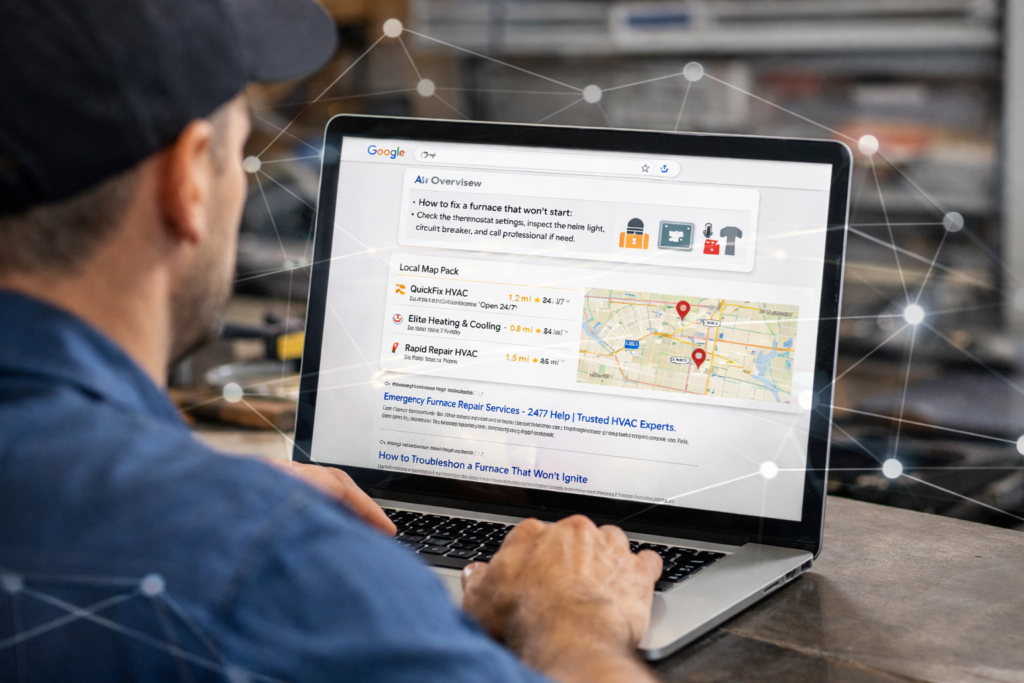
Search is no longer just ten blue links. AI Overviews now summarize information directly in the results. That means Google is evaluating which sources are credible enough to inform its answers, not just which pages mention the right words.
You are not only competing for rank. You are competing for trust.
Context Over Exact Keywords
Google understands intent. It connects related ideas and topics rather than relying on exact keyword repetition. If someone searches for “AC not cooling,” Google knows they may need repair, refrigerant checks, or emergency service. It interprets meaning, not just text.
Entity-Based Evaluation
Google sees businesses as entities with reputations, reviews, service areas, and authority signals across the web. Your brand, your mentions, your reviews, and your expertise all feed into how Google evaluates you. It is no longer just about a single page.
Behavior and Engagement Patterns
Google refines results based on how users interact with them. If people consistently click, stay, and engage with certain types of content, Google adjusts accordingly.
The 6 Pillars of Ranking in 2026
If you strip away the noise, the updates, and the speculation, ranking in 2026 comes down to a handful of core pillars. Not hacks. Not shortcuts. Foundations.
And the weight of those foundations has shifted.
According to First Page Sage’s 2025 analysis of top-ranking pages, consistent publication of high-quality, intent-matching content now carries roughly 23% of ranking influence, up from prior years. Backlinks account for about 13%. Niche expertise another 13%. Searcher engagement signals like dwell time and click-through rate about 12%.
In other words, Google is rewarding helpful, consistent, specialized brands.
Here’s what that looks like in practice.
1. Search Intent Alignment
You don’t rank because you mention the keyword.
You rank because you match the intent behind it.
There’s a difference between someone searching:
“how does a furnace work”
and
“emergency furnace repair near me”
One is informational. One is transactional. One is early-stage curiosity. The other is immediate need.
There’s also local versus national intent. A homeowner typing “roof leak repair near me” expects a local contractor. A blog post explaining roofing materials won’t satisfy that search, no matter how optimized it is.
Then there’s problem-aware versus solution-aware intent. Someone searching “AC blowing warm air” doesn’t want a sales pitch. They want clarity first. Someone searching “AC replacement cost” is closer to a buying decision.
In 2026, Google’s contextual understanding is strong enough to evaluate whether your page truly aligns with that intent. Especially with AI overviews in local SEO, the engine is summarizing answers based on pages that best match the underlying question.
Intent is the gatekeeper. Everything else builds on top of it.
2. Topical Authority, Not Just One Blog Post
One page does not build authority anymore.
Google looks at depth across a topic. For contractors, that means emergency HVAC repair is not a single article. It is an ecosystem.
It includes:
- A core service page
- Supporting blog content
- FAQs
- Related topics like troubleshooting, maintenance, and replacement
- Internal links connecting it all
When your site demonstrates complete coverage of a service category, Google begins to see you as an authority, not just a participant.
That 23 percent weight on consistent, intent-matching content matters here. Brands publishing helpful, aligned content twice per week often see faster indexing and stronger trust signals because Google recognizes a pattern of expertise.
This is where AI search and SEO fundamentals for contractors start to diverge from old-school SEO. It is no longer about ranking one keyword. It is about owning a category.
3. EEAT Signals
Experience. Expertise. Authority. Trust. These are not abstract ideas. They are measurable signals.
Google looks for:
- Author credibility
- Verified reviews
- Mentions across reputable sites
- Real-world business signals
For home service brands, this means your technician bios matter. Your reviews matter. Your Google Business Profile activity matters. Even your involvement in the community can reinforce authority.
Niche expertise carries roughly 13% of ranking influence according to 2025 data. That means being known as the emergency HVAC specialist in your region is more powerful than being a generalist with thin content across dozens of topics.
Google is not just evaluating what you say. It is evaluating who you are in your market.
4. Backlinks, But Smarter
Backlinks still matter. They hold around 13 percent of ranking weight.
But quantity is no longer impressive.
A handful of relevant links from industry publications, local news outlets, or trusted directories can outweigh hundreds of low-quality links. Brand mentions also play a role. Even unlinked citations contribute to entity strength. Google understands when your business is being referenced in meaningful contexts.
Buying random links or blasting directories does not work in 2026. At best, it does nothing. At worst, it weakens trust.
Backlinks are a validation layer, not a loophole.
5. User Experience and Engagement Signals
If users leave fast, Google notices.
Searcher engagement carries about 12 percent of ranking weight. That includes dwell time, click-through rate, and how users interact with your page.
Page speed, mobile usability, clean structure, and clear calls to action are no longer just conversion factors. They are visibility factors. If your site loads slowly, buries important information, or confuses users, engagement drops. When engagement drops consistently, rankings follow.
Google is modeling satisfaction. If users bounce back to search results quickly, it signals that the page did not meet expectations.
6. Freshness and Activity Signals
Stale sites lose ground.
Updated content, active Google Business Profile posts, fresh reviews, and ongoing relevance all reinforce trust.
This is especially important for local SEO. An active contractor with recent updates, new photos, and consistent publication looks more credible than a competitor whose last blog was posted two years ago.
Freshness is not about rewriting pages weekly. It is about demonstrating that your business is active, current, and engaged.
The 6 Pillars of Ranking in 2026
If you strip away the noise, the updates, and the speculation, ranking in 2026 comes down to a handful of core pillars. Not hacks. Not shortcuts. Foundations.
And the weight of those foundations has shifted.
According to First Page Sage’s 2025 analysis of top-ranking pages, consistent publication of high-quality, intent-matching content now carries roughly 23% of ranking influence, up from prior years. Backlinks account for about 13%. Niche expertise another 13%. Searcher engagement signals like dwell time and click-through rate about 12%.
In other words, Google is rewarding helpful, consistent, specialized brands.
Here’s what that looks like in practice.
1. Search Intent Alignment
You don’t rank because you mention the keyword.
You rank because you match the intent behind it.
There’s a difference between someone searching:
“how does a furnace work”
and
“emergency furnace repair near me”
One is informational. One is transactional. One is early-stage curiosity. The other is immediate need.
There’s also local versus national intent. A homeowner typing “roof leak repair near me” expects a local contractor. A blog post explaining roofing materials won’t satisfy that search, no matter how optimized it is.
Then there’s problem-aware versus solution-aware intent. Someone searching “AC blowing warm air” doesn’t want a sales pitch. They want clarity first. Someone searching “AC replacement cost” is closer to a buying decision.
In 2026, Google’s contextual understanding is strong enough to evaluate whether your page truly aligns with that intent. Especially with AI overviews in local SEO, the engine is summarizing answers based on pages that best match the underlying question.
Intent is the gatekeeper. Everything else builds on top of it.
2. Topical Authority, Not Just One Blog Post
One page does not build authority anymore.
Google looks at depth across a topic. For contractors, that means emergency HVAC repair is not a single article. It is an ecosystem.
It includes:
- A core service page
- Supporting blog content
- FAQs
- Related topics like troubleshooting, maintenance, and replacement
- Internal links connecting it all
When your site demonstrates complete coverage of a service category, Google begins to see you as an authority, not just a participant.
That 23 percent weight on consistent, intent-matching content matters here. Brands publishing helpful, aligned content twice per week often see faster indexing and stronger trust signals because Google recognizes a pattern of expertise.
This is where AI search and SEO fundamentals for contractors start to diverge from old-school SEO. It is no longer about ranking one keyword. It is about owning a category.
3. EEAT Signals
Experience. Expertise. Authority. Trust. These are not abstract ideas. They are measurable signals.
Google looks for:
- Author credibility
- Verified reviews
- Mentions across reputable sites
- Real-world business signals
For home service brands, this means your technician bios matter. Your reviews matter. Your Google Business Profile activity matters. Even your involvement in the community can reinforce authority.
Niche expertise carries roughly 13% of ranking influence according to 2025 data. That means being known as the emergency HVAC specialist in your region is more powerful than being a generalist with thin content across dozens of topics.
Google is not just evaluating what you say. It is evaluating who you are in your market.
4. Backlinks, But Smarter
Backlinks still matter. They hold around 13 percent of ranking weight.
But quantity is no longer impressive.
A handful of relevant links from industry publications, local news outlets, or trusted directories can outweigh hundreds of low-quality links. Brand mentions also play a role. Even unlinked citations contribute to entity strength. Google understands when your business is being referenced in meaningful contexts.
Buying random links or blasting directories does not work in 2026. At best, it does nothing. At worst, it weakens trust.
Backlinks are a validation layer, not a loophole.
5. User Experience and Engagement Signals
If users leave fast, Google notices.
Searcher engagement carries about 12 percent of ranking weight. That includes dwell time, click-through rate, and how users interact with your page.
Page speed, mobile usability, clean structure, and clear calls to action are no longer just conversion factors. They are visibility factors. If your site loads slowly, buries important information, or confuses users, engagement drops. When engagement drops consistently, rankings follow.
Google is modeling satisfaction. If users bounce back to search results quickly, it signals that the page did not meet expectations.
6. Freshness and Activity Signals
Stale sites lose ground.
Updated content, active Google Business Profile posts, fresh reviews, and ongoing relevance all reinforce trust.
This is especially important for local SEO. An active contractor with recent updates, new photos, and consistent publication looks more credible than a competitor whose last blog was posted two years ago.
Freshness is not about rewriting pages weekly. It is about demonstrating that your business is active, current, and engaged.
You Don’t Game the Algorithm. You Earn It.
Google doesn’t rank websites because they’re clever. It ranks them because they’re credible. In 2026, visibility belongs to businesses that match intent, demonstrate real expertise, build authority, and create pages people actually want to stay on.
If your rankings are flat or slipping, it’s rarely one tiny issue. It’s usually a gap in one of the pillars.
Want to know where yours stands? Book a call with Hook Agency. We’ll break down what’s holding you back and show you how to build an SEO foundation that deserves to rank.
FAQs
Does Google still use keywords to rank websites?
Yes. But not the way it used to. Keywords help Google understand topic relevance, but ranking now depends more on intent alignment, authority, and engagement than simple keyword placement.
Do backlinks still matter in 2026?
Absolutely. Backlinks still carry weight, but quality beats quantity. Relevant links, brand mentions, and earned media matter far more than mass directory submissions or paid link schemes.
How do AI overviews affect rankings?
AI overviews in local SEO are changing visibility. Google now summarizes answers directly in search results, which means being authoritative and reference-worthy is just as important as ranking in traditional positions.
How long does it take to rank on Google?
It depends on competition, authority, and content depth. In competitive home service markets, it can take several months to build momentum. Consistent, intent-matching content accelerates trust and indexing.
Can small businesses outrank big brands?
Yes. Especially in local markets. Strong Google Business Profiles, niche expertise, high engagement, and focused content clusters allow smaller home service businesses to compete effectively.