Ask ten contractors whether you should charge for a consult and you’ll get ten different answers.
Some swear by it — “If they’re willing to pay $99 or $250 just to meet me, I know they’re serious.” Others say that first visit should always be free, because it gets your foot in way more doors.
Both sides make sense.
One filters out the tire kickers. The other fills your calendar with opportunities.
But here’s the real question: which one actually brings in more business? In this post, we’ll break down the math, the growth potential, and some unfiltered takes straight from contractors in the field.
The Numbers Game: Why Free Consults Often Win
Let’s run the math the way Savannah Gresham broke it down in the Facebook thread.
Contractor A charges for the initial site visit — maybe $99, $250, or even $350. He books about 10 appointments a month. Because those homeowners have “skin in the game,” his close rate is solid: 4 out of 10. At an average $20,000 project, that’s $80,000 in revenue. Not bad.
But Contractor B doesn’t charge for that first consult. Instead of 10 appointments, he books 30. His close rate is lower — 3 out of 10 — but because he’s taking 30 appointments, he closes 9 jobs. At the same $20,000 per project, that’s $180,000. More than double what Contractor A made.
As Savannah put it:
“So yeah, which one sounds better to you?? $80,000 or $180,000?”
And it doesn’t stop there. She pointed out the compound growth effect:
“Instead of having 4 opportunities for referrals, he had 9. Instead of 4 five-star reviews, he had 9. Instead of 4 yard signs, he had 9. The compound growth here is insane.”
More trucks in neighborhoods. More signs on lawns. More before-and-after photos. More chances to ask for a testimonial. That snowball effect is what makes free consults so powerful — it’s not just about the short-term close, it’s about long-term momentum.

3. The Confidence + Sales Skills Factor
Some contractors argue that charging for consults is really about getting “quality leads.” But others see it differently — they say it’s actually a reflection of how confident (or not) you are in your sales process.
Savannah Gresham called it out directly:
“My hot take is that you probably aren’t charging for consults because you only want to meet with ‘high quality’ leads. It’s probably because you aren’t as confident in your company’s sales process and/or your own sales skills as you should be.”
She compared it to practicing only when it’s easy:
“That’s like saying you wanna be an NBA star but you only practice free throws in a quiet, empty gym… but never when someone’s in your face trash talking, never when there’s a stadium of away fans jeering at you, never when you’re exhausted.”
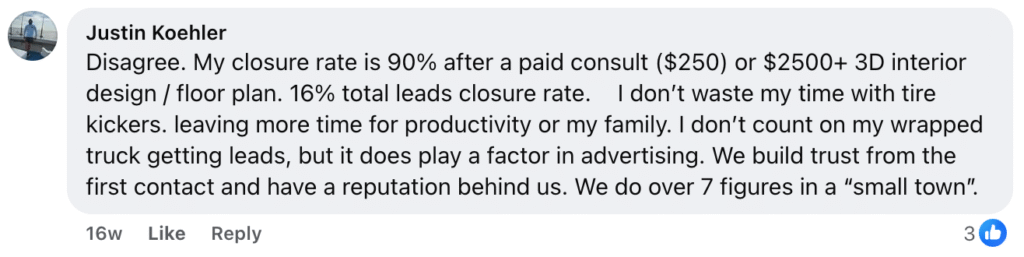
On the flip side, some contractors see charging as proof of strong sales skills. Justin Koehler shared his numbers:
And Bubba Hogan took a jab at weak sales reps hiding behind fees:

At the core, the divide comes down to confidence. Do you believe in your team’s ability to close — even when the lead isn’t already warmed up? Free consults force you to sharpen your sales process across a wider range of homeowners, not just the easiest ones.
4. Time & Trust: The Two Biggest Pushbacks
The two biggest reasons contractors give for charging consult fees usually boil down to time and trust.
The Time Argument
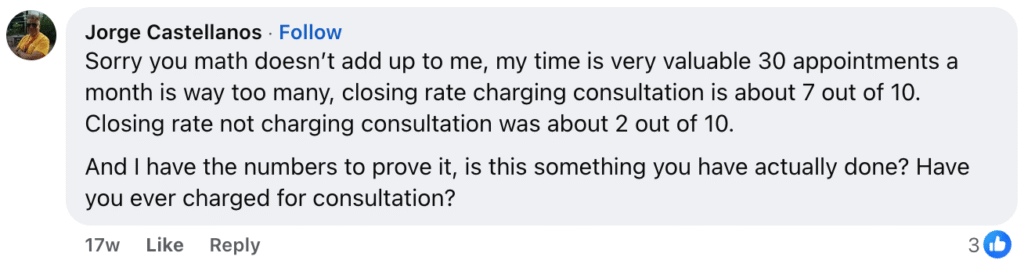
For many, the thought of running 30 free appointments a month feels impossible. Jorge Castellanos summed it up:
The Trust Argument
On the other side, charging can actually backfire by putting up barriers. As Savannah Gresham put it:
“We are in a trust deficit. Homeowners are more informed and more skeptical than ever. Charging for an initial consult puts walls up and makes it harder for them to say YES.”
So while some contractors protect their time with a fee, others focus on removing friction so homeowners feel comfortable saying yes to that first meeting.
Which Model Fits Your Business?
At the end of the day, the choice comes down to what kind of business you’re building. Free consults generally mean higher volume, more neighborhood visibility, and long-term momentum through referrals, reviews, and repeat work. Paid consults, on the other hand, can be a good fit for design-heavy or boutique firms that want to limit appointments and focus on highly committed leads.
If growth and scale are the goal, the math almost always favors free consults. But if your strategy leans toward specialization and exclusivity, charging may still make sense. The key is to be intentional — not just with how you book appointments, but with how you want your business to grow.