Short answer: yes, if it’s built to convert and people can find it. A website doesn’t make money the way a blog with ads does. For a roofer, plumber, or HVAC company, it makes money by turning a homeowner who’s checking you out into a phone call, a booked estimate, and eventually a signed job.
The catch is that plenty of contractor websites don’t do that. They look fine, they technically exist, and they quietly lose leads every month.
Here’s how to tell whether yours is making you money, what separates a site that books jobs from one that just sits there, and what it takes to get traffic to it.
Your Website Is Where Homeowners Decide
Before a homeowner calls you, they check you out. Usually that starts with reviews, and then they go looking for more.
BrightLocal’s 2026 survey of 1,002 U.S. consumers found that 97% read reviews for local businesses. More importantly for this question, 54% said they visit a business’s website after reading positive reviews, up from 32% when BrightLocal last asked in 2019 (BrightLocal Local Consumer Review Survey 2026). The same survey found that after reading positive reviews, two-thirds of consumers keep researching, while about a third are ready to buy or book.
In other words, your reviews get homeowners interested, and your website is often where they decide. If the site is outdated, confusing, or looks like every other contractor’s, that’s where the lead walks.
Big-ticket decisions go through this process too. In the same survey, 27% of consumers said they’d spent more than $1,000 after reading reviews, and 13% had spent over $5,000. A caveat: BrightLocal surveyed consumers across all local businesses, not home services specifically. But roofs, furnaces, and water heaters are exactly the kind of high-stakes purchases people research before calling.
These days, consumers often utilize LLMs like Claude or ChatGPT for local recommendations. In one year, AI tools for local recommendations jumped from 6% to 45%, per BrightLocal. The best advice we have for contractors is to keep your website up to date, because AI tools pull information from it. An accurate, detailed website helps you show up there too.
How To Tell If Your Website Is Making Money
“Is my website working?” shouldn’t be a gut feeling. You can put a number on it.
The basic formula:
Monthly website leads × close rate × average job value = monthly revenue from the website
Then compare that to what you’re spending on the site and the marketing that drives traffic to it.
An example (the numbers are made up to show the math): Say your site generates 30 leads a month. You close 30% of them, and your average job is $8,000. That’s 9 jobs and $72,000 in monthly revenue traced to the website. If the site and its marketing cost you $6,000 a month, it’s paying for itself many times over. If it generates 4 leads a month, it’s a different conversation.
To get real numbers instead of guesses, you need tracking:
- Call tracking: Most contractor leads still come by phone. A tracking number on your site tells you how many calls the website actually produces.
- Form tracking: Count every estimate request and contact form submission.
- Analytics: Know where visitors come from (Google search, Google Maps, ads, social) and which pages turn them into leads.
- Close the loop with your CRM: Leads are nice. Booked and sold jobs are what matter. Tag each job with its lead source so you can see revenue, not just form fills.
If you can’t answer “how many leads did the website bring in last month?”, that’s the first thing to fix.
What Makes A Contractor Website Convert?
Getting traffic is only half the job. A site that doesn’t convert is like running ads for a phone number nobody answers. These are the things we see make the biggest difference.
Real photos of real work
Stock photos of smiling models in hard hats don’t build trust. Homeowners can tell. Photos of your crew, your trucks, and your finished jobs show you’re a real, local company. We go deeper on this in why stock photos are costing contractors jobs.
Differentiators that actually differentiate
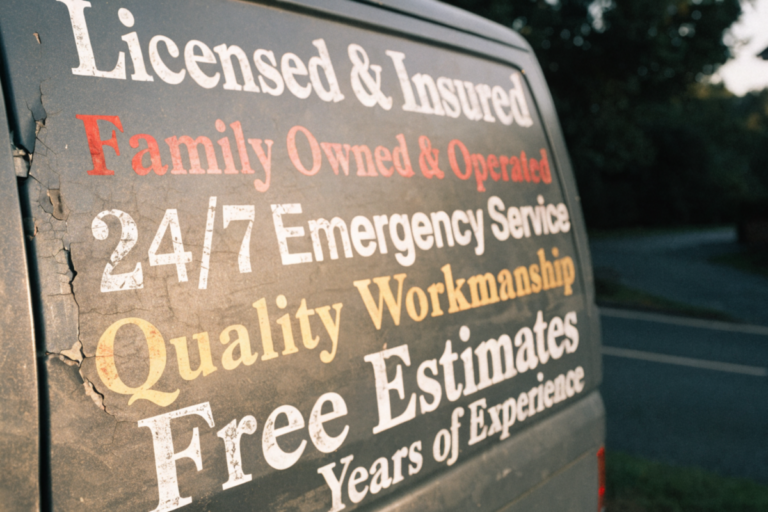
“Licensed and insured, family owned, quality workmanship” is on every contractor’s site in town, so it tells a homeowner nothing. What’s specific to you? A guarantee, a response time, a process, a specialty? Here’s why generic differentiators are killing your contractor marketing and what to say instead.
An About Us page that sells
Homeowners are letting you into their house. They want to know who you are. Your About Us page is often one of the most-visited pages on the site, and one of the most neglected. See why your About Us page is the most underrated conversion asset you own.
Reviews, front and center
Since reviews are what send many homeowners to your site in the first place, show them there too. BrightLocal found consumers care most about consistent sentiment across multiple reviews, recent reviews, and whether the owner responds. A few fresh, specific reviews on your key pages beat a generic “5 stars!” badge.
Make it easy to call
Click-to-call on mobile, your phone number visible at the top of every page, and a short estimate form. Don’t make a homeowner with a leaking pipe hunt for your number.
Service and service-area pages
Dedicated pages for each service and each area you serve help homeowners find exactly what they need, and give Google more to rank.
If you build it, they won’t come
This is the part a lot of contractors miss. A great website with no traffic doesn’t make money. “If you build it, they will come” is a movie plot, not a marketing plan.
Traffic has to come from somewhere. The main sources for home service companies:
- SEO builds organic visibility in Google over time. It’s slower to start but keeps producing leads without paying for every click.
- Google Maps SEO gets you into the map pack, which is often the first thing a local searcher sees.
- Google Ads put you at the top of search results right away, as long as you’re paying.
- Local Services Ads charge per lead and can earn the Google Guaranteed badge.
- Meta ads reach homeowners on Facebook and Instagram before they’re actively searching.
Most growing contractors use a combination. Your website is the hub all of these send people to, which is why it has to convert.
Template or Custom: Which Do You Need?
Honest answer: it depends on where your business is.
A builder site (Wix, Squarespace, a WordPress theme) can be fine if:
- You’re a newer company on a tight budget
- You offer one or two services in a small market
- You mainly need something credible to point people to
Modern builders are capable, and a well-done template site beats no site at all. For context, BrightLocal’s research found only 40% of local businesses have a dedicated website, so simply having a good one already puts you ahead of many competitors.
A custom site starts paying off when:
- You’re in a competitive market where every competitor’s site looks the same
- You offer multiple service lines and serve multiple areas
- You’re investing seriously in SEO and ads, and every percentage point of conversion rate matters
- Your brand needs to stand out, not blend in
The question isn’t “template or custom?” It’s “what will this site produce, and what’s that worth?” Run the ROI math above for both options.
What This Looks Like In Practice
When a website is the bottleneck, fixing it can change everything downstream. Our Pro Shine Air Duct Experts case study walks through how a website rebuild took their leads from weekly to daily. You can see even more recent website performance results on our case studies page.
FAQs
How much should a contractor spend on a website?
It depends on your market, number of services, and growth goals. Instead of starting with a budget, start with what the site needs to produce. If a new site brings in even a few extra jobs a month, the math often works quickly. Our pricing page shows what working with us looks like.
How long until a new website pays for itself?
It varies. A site that converts better can improve results from existing traffic fairly quickly. Traffic from SEO takes longer to build, typically months, not weeks. Paid ads can drive traffic right away. Tracking from day one is how you’ll know.
Do I still need a website if I get most of my work from referrals?
Yes. Referred homeowners still look you up before calling. Your website and reviews are where they confirm the referral was a good one.
Can a website make money on its own, without marketing?
Rarely. Unless you’re in a niche with huge demand and little competition, a website needs traffic from SEO, ads, or other channels to generate leads.
What’s the fastest way to improve a website that isn’t producing leads?
Start with tracking so you know your baseline. Then fix the basics: real photos, a visible phone number and click-to-call, specific differentiators, and reviews on key pages.
The Bottom Line
A contractor website absolutely makes money, when it’s built to turn visitors into calls and there’s a plan to get visitors to it. Homeowners are checking you out online before they call, and the website is often where they make up their mind. Measure what yours produces, fix what’s leaking, and make sure people can find it.
Want to know what your website should be producing? Book an intro call or watch our demo to see how we report on results.