
Here is a question I got on a sales call last month: ‘We’re ranking on Google, we have good reviews, we just re-did our website. Why are we still losing jobs to the franchise down the street?’
The answer had nothing to do with their rankings. It had to do with what happens the moment a homeowner’s basement starts flooding at 11pm. They are not reading content or comparing reviews. They are calling whoever shows up first on their phone and picks up.
That is the core tension in restoration company marketing. And it is why the standard contractor marketing playbook tends to miss the mark here. The category is structurally different:
- The buyer is in crisis, not comparison shopping
- 60 to 75% of jobs are insurance-funded, creating a dual audience: homeowner and adjuster
- Water damage keywords are the most expensive in all of home services
- Speed to contact matters more than any ad, landing page, or brand decision
What follows are the questions restoration owners ask most, answered with real 2026 data.
The Restoration Marketing Landscape in 2026
Before getting into specific channels and tactics, it helps to understand what actually makes restoration different at the structural level. Most of the standard home service marketing playbook does not translate here, and knowing why saves a lot of wasted budget.
What Makes Restoration Marketing Different From Other Trades
Understanding how homeowners research contractors in non-emergency situations shows you everything restoration is not. A homeowner researches roofers over a few days, gets three quotes, reads some reviews, and decides. A restoration emergency gives them none of that runway. They are calling the first credible company they can reach, and that one fact reshapes your entire channel strategy.
- No comparison shopping: the buyer is in crisis and moving fast
- Insurance-mediated: 74.1% of restoration work was insurance-funded in 2026, per Qualified Remodeler
- Dual audience: homeowner + adjuster require completely different content and keywords
- Speed to contact is the primary conversion variable, not creative or brand
The Numbers Behind the Opportunity
The economics justify a marketing cost structure unlike almost any other trade. Ticket values across the segment averaged $9,300 in 2026, with fire damage jobs regularly exceeding $15,000. The median cost per issued lead sat at $200, per the Qualified Remodeler segment report. That math works at typical close rates. It stops working when you are paying for leads that never convert to booked jobs, which is why conversion infrastructure matters as much as lead generation in this niche.
Channel and Lead Generation FAQs
Restoration owners ask about channels more than anything else. The confusion usually comes from applying general contractor logic to a category where the buyer behavior is fundamentally different. Here is what actually works, and what the data says about cost.
What Is the Best Marketing Channel for a Restoration Company?
No single best channel. Only a best sequence based on where you are and what you need to solve.
- LSAs: immediate emergency lead capture, Google Screened badge, pay-per-lead
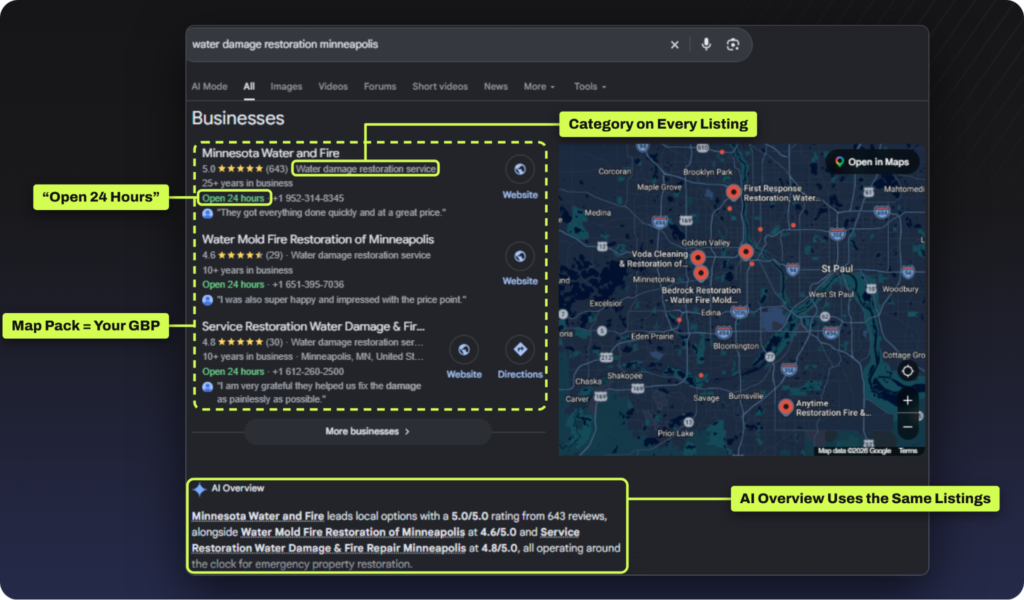
- GBP: primary lead source for 57% of restoration companies
- Google Ads: high-intent emergency capture; ‘Water Damage Restoration Dallas’ hit $250.79 per click in 2026
- SEO: 5.3x long-term ROI over paid channels once established
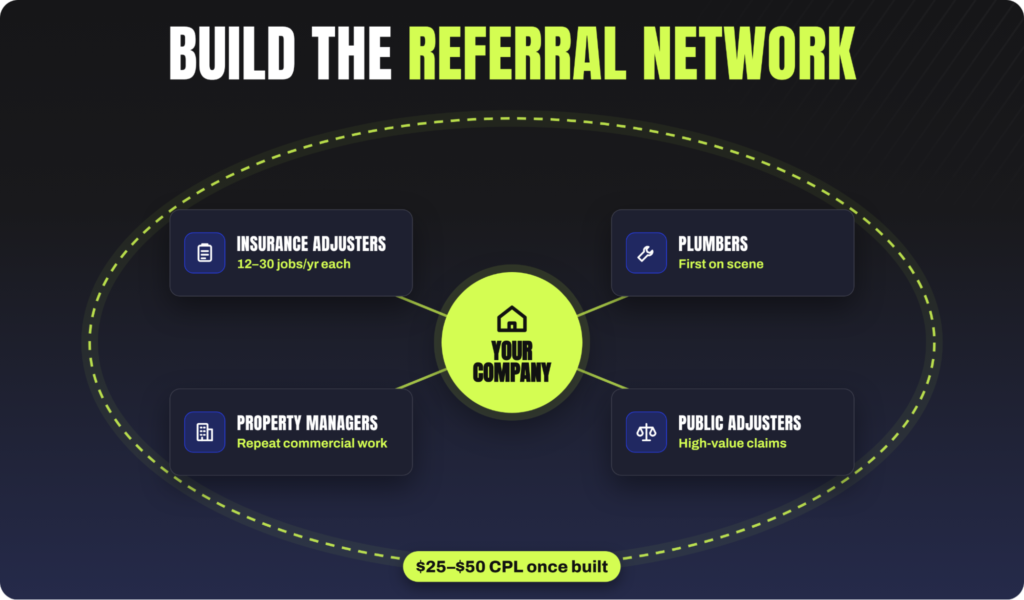
- Adjuster and plumber referrals: lowest CPL, most defensible once built
The home service SEO reporting framework applies directly: cost per lead by channel and cost per booked job are the two numbers that tell you whether the mix is working.
What Do Restoration Leads Actually Cost Per Channel?
The 31.4% of leads that came from referrals in 2026, per Qualified Remodeler, is the most efficient revenue stream in the category. Everything else costs more. Here are the 2026 benchmarks:
- Google Ads: $100 to $300 per lead for emergency water and fire keywords
- LSAs: averaged $148 per charged lead for water damage in 2026
- Social media: $75 to $200 per lead
- SEO and referrals: $25 to $50 per lead once mature
Adjuster and plumber relationships take 6 to 12 months to build properly. The CPL payoff once they are running is the reason established restoration companies are so hard to displace on marketing efficiency.
Should a Restoration Company Run LSAs?
Yes, and they are worth running even for companies with solid map pack visibility. The Google Screened badge above all other results converts for emergency callers in a way that standard paid ads do not.
The practical change from that migration: LSA management moved from its own dashboard into Google Ads. Budget management, lead disputes, and reporting all live there now. The product is the same. The workflow is not, and companies running LSAs independently need to update how they manage them.
How Much Should a Restoration Company Spend on Marketing?
The 2026 segment average was 3.4% of remodeling revenue per Qualified Remodeler, but that is weighted by large operators with established referral networks. It is not a useful benchmark for an independent in growth mode.
- Established with strong GBP and referrals: 6 to 8% of gross revenue
- Growth-mode independent, competitive market: 10 to 15%
- New market entry against franchise competition: up to 20%
Cutting spend in slow seasons is the common mistake. Those months are when you should be building the SEO and adjuster relationships that reduce paid dependency later.
SEO and Local Visibility FAQs
Local SEO for restoration has two layers that most companies treat as one. The first is showing up for emergency homeowner searches. The second is building the kind of content credibility that earns adjuster trust and AI platform citations. Both matter, and they require different approaches.
What Keywords Do Homeowners Search During a Restoration Emergency?
Emergency searches follow one predictable pattern: damage type plus city plus urgency. The highest-converting queries stack all three. What you are building pages around:
- “Emergency water damage repair near me”
- “Flooded basement cleanup [city]”
- “Fire damage cleanup [city]”
- “Smoke damage repair near me tonight”
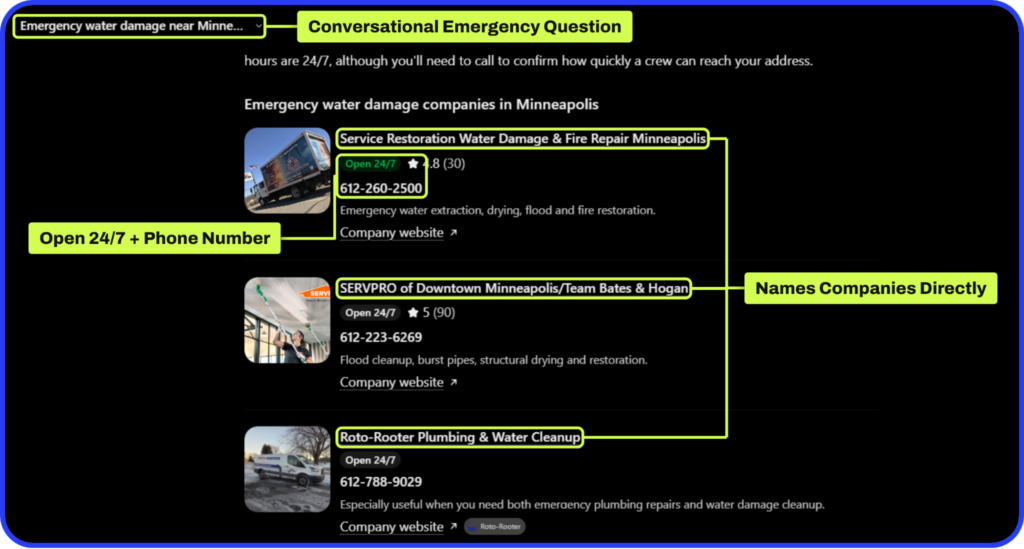
Voice search for restoration terms grew 20% year over year, and homeowners using voice during a crisis ask in full conversational sentences. That query format is exactly why AEO vs SEO becomes critical for restoration sites: structured, direct-answer content is what gets cited by AI platforms when someone asks ‘who does emergency water damage near me right now.’
According to the Authority Specialist 2026 restoration SEO analysis, AI tools recommended a restoration professional in 86.6% of relevant queries versus a 14-industry average of 44.2%. ChatGPT and Claude each hit 93%. For restoration, AI platforms default to recommending someone rather than trying to answer the question themselves. Getting cited when that happens is the new map pack.
How Do Independent Restoration Companies Compete Against ServPro and ServiceMaster?
Franchises have brand recognition and national ad spend. What they cannot buy is neighborhood-level SEO depth and adjuster relationships built over years in one market. Building service area pages for contractors that target specific suburbs with real local content creates ranking depth a corporate franchise page cannot replicate. A ServPro national page targeting ‘water damage restoration Dallas’ cannot rank for ‘water damage repair Plano TX’ the way a local independent with a genuine Plano page can.
Review velocity is the other edge. A company adding 8 to 10 new verified reviews per month consistently outranks a franchise with 400 total reviews but nothing recent. Recency is what the algorithm rewards, and it is something only an active, responsive operation can sustain.
What Does GBP Optimization Look Like for a Restoration Company?
The Local Pack is where most emergency callers make their decision. GBP is not optional for restoration, and it is not set-and-forget. The configuration that moves the needle:
- Primary category: ‘Water Damage Restoration Service’ (or your dominant service type)
- Description: response time commitment, service area, and certifications in plain language
- Weekly posts with before-and-after job photos from real local work
- Response to every review within 48 hours, without exception
The online reviews for contractors velocity and follow-up framework applies directly here. Building the review request into the post-job workflow, automated or otherwise, is what keeps the new-review cadence going without depending on anyone remembering to ask.
Insurance and Referral FAQs
Insurance and referral marketing is where most restoration companies leave money on the table. Adjuster relationships and B2B referral channels consistently produce the highest-value jobs at the lowest acquisition cost, yet they get almost no attention in most marketing plans.
How Do Insurance Adjuster Referrals Work in Restoration Marketing?
Adjuster referrals account for 20 to 50% of total revenue at established restoration companies, yet most marketing plans do not address them at all. A single relationship generates 12 to 30 jobs per year with the insurance framework already pre-approved. Anthony Bradshaw of Spartan Emergency Water Removal put it plainly: ‘If it isn’t documented, it didn’t happen.’ The documentation habits that earn adjuster trust are the same ones that reduce claim friction across the board.
Adjuster marketing requires entirely different content from homeowner marketing. The keywords professionals search when evaluating vendors:
- “IICRC certified restoration company”
- “Xactimate certified restoration contractor”
- “Direct repair program restoration contractor”
These are deliberate vendor research searches. They require dedicated service pages, not a certification badge in the footer.
What Certifications Matter for Marketing to Insurance Adjusters?
Two certifications matter. Everything else is secondary.
- IICRC: the non-negotiable entry point. Without it, most adjusters will not add you to their preferred vendor list. Display it on your homepage, GBP description, and every adjuster-facing service page.
- Xactimate proficiency: what separates preferred from avoided. Adjusters use it for scope writing and billing. A company that cannot work inside it creates friction adjusters route around.
Restoration companies with visible certifications and professional branding command 18% higher average ticket values. The credentials that signal trust and the documentation habits that earn it are the same investment.
What Other Referral Sources Should a Restoration Company Build?
Plumbers arrive first at water intrusion events and regularly refer mitigation companies to homeowners who have no idea who to call. Property managers produce repeat commercial volume from managed properties with recurring damage. Public adjusters are an underused pipeline for high-value claim work. Each of these referral channels, once built, produces leads at $25 to $50 CPL with no ongoing ad spend required.
Conversion and Speed FAQs
Getting the lead is half the job. Converting it is where most restoration companies bleed revenue. The difference between winning and losing an emergency call often has nothing to do with your ranking or your ad spend.
How Fast Does a Restoration Company Need to Respond to Win the Job?
58% of homeowners hire the first restoration company they successfully contact. Not the best-reviewed. The first one they reach. That single fact should restructure how you think about every element of your marketing.
Restoration companies that advertise specific response time guarantees book 34% more emergency jobs than those using vague availability messaging. ‘On-site within 60 minutes’ converts. ‘Fast response available’ is invisible. If the call goes to voicemail at 11pm, the homeowner is already dialing the next result. After-hours live answering and click-to-call above the fold are the infrastructure everything else runs on.
What Should a Restoration Landing Page Include?
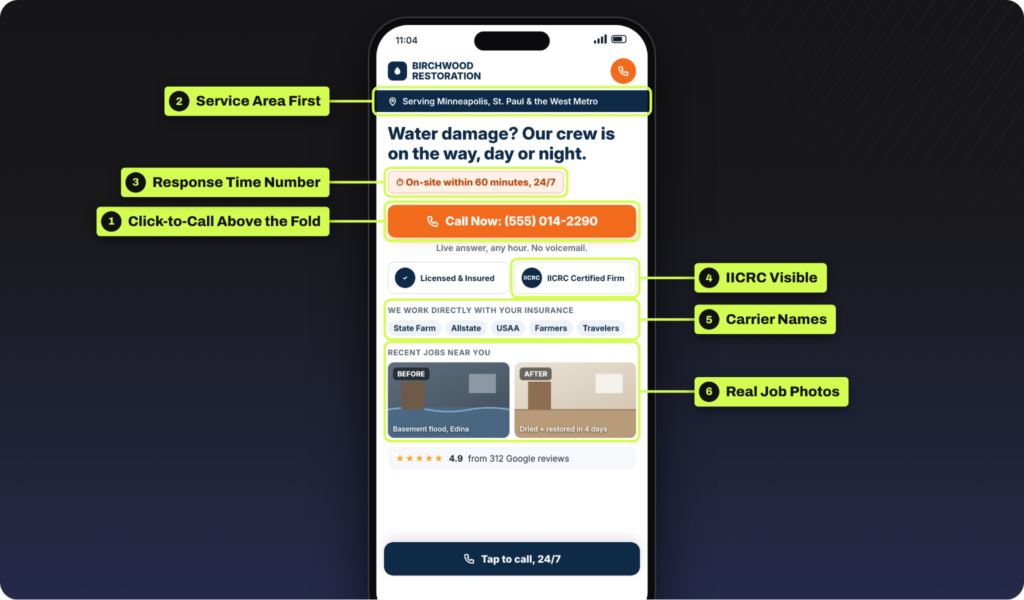
Dedicated landing pages convert 47% better than generic contact pages for restoration company marketing. Six elements drive that gap:
- Click-to-call above the fold: do not make them scroll to find your number
- Service area in the first line: confirm coverage zone immediately
- Specific response time: a number, not ‘fast response available’
- IICRC certification: visible, not buried in the footer
- Insurance signals: carrier names the homeowner recognizes from their own policy
- Real job photos: before-and-after from actual local work
How Does Reputation and Reviews Affect Restoration Leads?
97% of restoration customers search online before calling. Reviews carry more weight here than in almost any other home service category because the homeowner is inviting a crew into their home during a stressful event with a job value typically in the thousands.
What drives ranking and trust is not total review count but velocity: a company adding 8 to 10 new reviews per month from verified recent jobs consistently outranks competitors with far more total reviews but nothing recent. Building the review request into the post-job workflow is the only sustainable way to keep that cadence going.
Fire Damage Specific FAQs
Fire damage restoration sits at the high end of job value and emotional intensity in this category. The marketing dynamics are different enough from water damage that they deserve their own treatment.
Is Fire Damage Marketing Different From Water Damage Marketing?
The channel mix is similar. The audience is not. Fire damage emergencies almost always loop in the insurance company from the first call. The homeowner is overwhelmed in a way that water damage rarely produces. The documentation burden is higher, the job scope is larger, and the emotional stakes make the homeowner far less likely to manage the process themselves.
Marketing content for fire restoration should center on the company’s ability to handle insurance navigation alongside the physical work. The homeowner does not want a contractor who shows up with equipment. They want someone who can manage the entire process from first assessment to final settlement. A serious home services marketing strategy treats fire restoration as its own channel segment with separate targeting, messaging, and landing pages, not a variation of the water damage campaign.
What Is the Average Job Value for Fire Damage Restoration?
Fire damage jobs regularly exceed $15,000 for residential work. The weighted segment average across restoration was $9,300 in 2026 per Qualified Remodeler, but that figure includes smaller water mitigation jobs that pull the number down. Fire sits at the high end.
Against a $15,000 average job value, LSA CPL of $148 and Google Ads CPL of $200 to $300 produce strong ROI at close rates of 25 to 45%. The budget case for fire-specific campaigns is easy to make. The harder work is building the landing page, response system, and documentation process to convert and retain insurance-mediated jobs at the margins they deserve.
Frequently Asked Questions
Quick answers to the questions restoration owners search most often.
What is the best marketing channel for a restoration company?
No single channel. The sequence is: LSAs for immediate emergency capture, GBP for map pack visibility (primary lead source for 57% of restoration companies), SEO for long-term ROI, and referral relationships for the lowest CPL once mature.
How important is response speed?
58% of homeowners hire the first company they reach. Specific response time guarantees generate 34% more emergency bookings. After-hours answering is not optional.
How do you build adjuster referral relationships?
IICRC certification, Xactimate proficiency, and a track record of clean documented jobs. Build separate pages targeting adjuster keywords. One strong relationship generates 12 to 30 jobs per year.
Which certifications matter most?
IICRC and Xactimate. Display both on the homepage, GBP description, and adjuster-targeted service pages. Restoration companies with visible certifications average 18% higher ticket values.
Ready to Build a Restoration Marketing Program That Actually Works?
Restoration company marketing is not general contractor marketing with a different logo. The buyer is in crisis, the keyword costs are the highest in home services, and there is a second audience behind every homeowner that most marketing plans never address. Getting all of it right requires a system, not a channel.
Hook Agency works specifically with home service businesses on this kind of work: emergency lead capture, GBP management, service-city SEO, adjuster-facing content, and the conversion infrastructure that ties it together. Get in touch with our team to talk through what a full restoration marketing program looks like for your market. And if you want to understand the broader framework first, our breakdown of home services marketing strategy covers the full picture from channel mix to execution.