Originally published August 15, 2018. Updated November 3, 2026.
Google now ships two to four core updates a year plus several spam updates, and the biggest changes since 2022 were the helpful content system (folded into core ranking in March 2024), new spam policies, AI Overviews (May 2024) and AI Mode (May 2025). The most recent confirmed updates are the May 2026 core update and the September 2026 spam update, according to Google’s Search Status Dashboard.
Below is every confirmed ranking update from 2022 to 2026 with dates, what the big shifts mean for local and home service businesses, what to do if you get hit, and our archive of older updates from 2018 to 2021.
Every Google Algorithm Update, 2022 to 2026
Dates and durations come from Google’s Search Status Dashboard, newest first.
| Update | Started | Rollout |
|---|---|---|
| September 2026 spam update | Sep 24, 2026 | About 14 days |
| August 2026 spam update | Aug 18, 2026 | About 3 days |
| June 2026 spam update | Jun 24, 2026 | About 2 days |
| May 2026 core update | May 21, 2026 | About 12 days |
| March 2026 core update | Mar 27, 2026 | About 12 days |
| March 2026 spam update | Mar 24, 2026 | Under 1 day |
| February 2026 Discover update | Feb 5, 2026 | About 22 days |
| December 2025 core update | Dec 11, 2025 | About 18 days |
| August 2025 spam update | Aug 26, 2025 | About 27 days |
| June 2025 core update | Jun 30, 2025 | About 17 days |
| March 2025 core update | Mar 13, 2025 | About 14 days |
| December 2024 spam update | Dec 19, 2024 | About 7 days |
| December 2024 core update | Dec 12, 2024 | About 6 days |
| November 2024 core update | Nov 11, 2024 | About 24 days |
| August 2024 core update | Aug 15, 2024 | About 19 days |
| June 2024 spam update | Jun 20, 2024 | About 7 days |
| March 2024 spam update | Mar 5, 2024 | About 15 days |
| March 2024 core update | Mar 5, 2024 | 45 days |
| November 2023 reviews update | Nov 8, 2023 | 29 days |
| November 2023 core update | Nov 2, 2023 | About 26 days |
| October 2023 core update | Oct 5, 2023 | About 14 days |
| October 2023 spam update | Oct 4, 2023 | About 16 days |
| September 2023 helpful content update | Sep 14, 2023 | About 13 days |
| August 2023 core update | Aug 22, 2023 | About 16 days |
| April 2023 reviews update | Apr 12, 2023 | About 13 days |
| March 2023 core update | Mar 15, 2023 | About 13 days |
| February 2023 product reviews update | Feb 21, 2023 | 14 days |
| December 2022 link spam update | Dec 14, 2022 | 29 days |
| December 2022 helpful content update | Dec 5, 2022 | 38 days |
| October 2022 spam update | Oct 19, 2022 | 2 days |
| September 2022 product reviews update | Sep 20, 2022 | 6 days |
| September 2022 core update | Sep 12, 2022 | 14 days |
| August 2022 helpful content update | Aug 25, 2022 | 15 days |
| July 2022 product reviews update | Jul 27, 2022 | 6 days |
| May 2022 core update | May 25, 2022 | 15 days |
| March 2022 product reviews update | Mar 23, 2022 | 14 days |
| Page experience update for desktop | Feb 22, 2022 | 9 days |
- SEO, AEO, LSA and Google Ads
- Leads tracked to booked inspections
- You own your website and ad accounts
“Hook Agency has been an incredible partner for our digital marketing growth.”
Kristin Sullivan, Bob’s ACDoing it yourself? Take the free LSA course
The Biggest Changes and What They Mean for Local Businesses
1. Helpful content became part of core ranking (2022 to 2024)
The helpful content update launched in August 2022 to reward content written for people, not search engines. With the March 2024 core update, Google said it made its helpful content system part of its core ranking systems, so there are no more separate helpful content updates. For home service companies, that means thin city pages and copy-paste service pages are a liability.
2. New spam policies (March 2024)
Alongside the March 2024 core update, Google announced new spam policies targeting scaled content abuse (mass-produced pages, AI or not), expired domain abuse and site reputation abuse. Spam updates have rolled out several times a year since.
3. AI Overviews (May 2024)
Google launched AI Overviews to everyone in the US in May 2024, putting AI-written answers above many organic results. For local businesses, informational searches (cost, how-to, “why is my AC…”) increasingly get answered on the results page, so being cited in those answers matters as much as ranking.
4. AI Mode (May 2025)
In May 2025, Google rolled out AI Mode to everyone in the US, a chat-style search experience. People can now ask follow-up questions and get recommendations without clicking through ten blue links. That is why we now pair SEO with AEO (answer engine optimization).
5. Reviews updates (2022 to 2023)
A run of product reviews and reviews updates rewarded first-hand, detailed reviews over thin roundups. If you publish comparison or “best of” content, show real experience.
What Google Always Says During Algorithm Updates
Google’s advice after a core update is usually the same: there is nothing specific to fix, and you should focus on creating helpful, reliable, people-first content. It can feel generic, but it is consistent.

What to Do If a Google Update Hits Your Rankings
- Wait for the rollout to finish. Core updates can take two to six weeks, and rankings often bounce around during the rollout.
- Compare before and after in Google Search Console, page by page. Find what dropped and what replaced you.
- Improve the pages that lost. Add real experience, photos of your work, pricing context and clear answers to the questions customers ask.
- Clean up thin or duplicate pages, especially mass-produced city pages.
- Strengthen local signals: Google Business Profile, steady reviews and local links.
- Do not panic-rebuild. Recovery from a core update often comes with a later core update, after your improvements are in place.
Want help? See how Hook approaches SEO and AEO for home service companies.
Older Google Algorithm Updates (2018 to 2021)
Here is our original coverage of earlier updates, kept for reference.

December 2021
The “Black Friday” Update
- Spam Update, November 3-8th 2021: Google started rolling out an update to their spam fighting systems on November 3rd which finished rolling out 8 days later.
- November Core Update, November 17th 2021: Google has just announced a broad core algorithm update has started to be rolled out. It will take around two weeks to be completed.
- More competitive niches have been affected the most, the algorithm hit new websites, low page-age websites. Only new sites were hit according to Charles Floate in the video below.
- Any sites that are utilizing basic Generated A.I. content, Watson AI type content, were apparently hit. Charles believes Jarvis type content, with meta titles, descriptions, custom headers and customized elements in general were not hit.


July 2021
The July Core Update
“The July Core Update, the second part core update that launched in early June is now live. This update has been a huge shake-up for many sites. As Google stated in regards to the June core update, some sites that saw changes in June may have those reverse with this July update.
July 26th 2021: Google posted a blog regarding qualifying sponsored links and announced a link spam update. The announcement was to remind webmasters that they could get manual actions or see an algorithmic impact if they were not correctly qualifying sponsored/affiliate links. They recommend using rel=sponsored, however did clarify that rel=nofollow is also perfectly fine.”, Marie Haynes (The OG of Algorithm Updates)
Been affected? Don’t PANIC! it’s best to wait for the update to fully roll out across all of Google’s network and let the dust settle. This usually takes between 10-14 days. If you did get hit, the advice is the same as always, ensure you are getting more natural backlinks, and avoid anything that looks unnatural.
June 2021
Spam Update
“After June Core Update and Page Experience Update, Google on Wednesday announced the rollout of Spam Update, to make the search safe for the users. Though Spam Updates don’t affect genuine websites, the repercussions of the update could be massive for sites with dubious and deceptive intentions.” – Stan Ventures

Feb 2020
Passage Based Ranking Update
No one is better qualified to talk about the components of a Google Algorithm Update than Marie Haynes. Here’s her take on the February 2021 Google Update, the Feb 10th update specifically is called the “Passage Based Ranking Update.”
Here are the key takeaways:
- Try to find examples of pages that are seeing an abnormal increase or decrease starting Feb 6th, or Feb 10th (passage based ranking.)
- Look for specific queries that were maintained for a few months and then impacted on one of these days. (it’s not easy.)
- It seems like many pages that had better ‘EAT’ Expertise, Authority, and Trustworthiness signals, were played down, in favor of content, and relevancy / user intent was more important.
- The winners in this update, were just pieces of content that were more useful.
- A somewhat common suggestion – but true nonetheless, Marie Haynes is suggesting here that you need to make sure your content is matching the user intent for searches.
- She was suggesting she might work with clients to ensure frameworks around helping writers achieve this more consistently.
- Look at your backlinks (ignore the B.S. spammy links – everyone gets them) but look for the good recent links, do they look like people are vouching for you. These are the types of links Google is looking for.
Dec 2020
Mistletoe Google Update
I’m dubbing this update the Mistletoe update, because our site got a boost (Google doesn’t name them anything fun anymore.) Amazon and sites with many contributors and lower amounts of editing got a poison kiss – people are seeing that it takes waiting til the next Agorithm update to get credit for their efforts, and MORE in our newest Google algorithm update report, below!

Working on some analysis of the recent Google algorithm update.
— Charles Floate 📈 (@Charles_SEO) November 29, 2020
Were you affected by it?
The December 2020 Google update hit websites that have stylistic, and content issues. So the common culprits first, does your site have speed, User Experience, or content quality issues? Fix those before looking for a magic bullet.
- Make sure there’s LIFE BEHIND YOUR CONTENT, how are you pushing subject matter expertise, and freshness into the content.
- Publishers with a lot of independent creator’s (but less curators/editor) get hit – Is the content mass produced or outsourced to a bunch of creators (meaning is there ‘audience-sourced’ content.)
- Some affiliate sites got hit, but often it’s really just about the user experience on the website (improve your User Experience!)
- Lily Ray from Path Interactive shows a decrease to Amazon from the update.
- The biggest fluctuations were in Arts & Entertainment, Relocation & Moving, Finance, Science and Accounting Niches.

Great take from Lily’s report, to sit there trying to recover from this, might be a lost cause. Just improve your approach, and continue onward: “For site owners who have felt the impacts of Google’s recent core updates, it has become abundantly clear that recovering traffic and rankings is usually not possible until the next core update rolls out. While small, incremental gains may be obtainable during the interim period, it’s generally not until the next core update that full recoveries or partial recoveries are possible.”
My personal take, is that after you get hit by an Algorithm update, you “HUSTLE & WAIT” – meaning you improve your content strategy, you focus on better links, and earning authority, you improve your EAT (Expertise, Authority, and Trust) and then when the next algorithm update hits, you get more credit for your work in the meantime, or at least that’s what I see in these different studies by Sistrix and Lily Ray.
Your affiliate site tanked because it's shit not because Google is targeting affiliate sites
— Wyatt (@seowyatt) December 15, 2020
I’ve skipped to the good part – if you press play on this video from Income School’s Algorithm Update report:
An Awesome template for analysis after an update by Aleyda Solis:
🔥 FREE template for #Google Core Update analysis by @aleyda🔥
— Semrush (@semrush) December 7, 2020
This Google Data Studio report allows you to facilitate the usual analysis after a Google Algorithm Update happens 👉 https://t.co/mFJZdHITZl.
Remember, if you got hit at the beginning of an algorithm update, it doesn’t mean the end of the world.
- In fact, many sites that get hit at the beginning of an update, often bounce back better than before.
- Here’s the Volatility index’s that catalogue when the changes are made:


May 2020
COVID-19 Google Update
In a questionable (but ultimately understandable) move by Google, a May core algorithm update was rolled out, benefitting many reputable sites, big brands, and app stores. This reflects the appetites that are currently higher for these types of content in response to the COVID-19 pandemic.

- Local Search / Maps
- Medical / corona related shakeups
- Thin Content is losing (not unusual)
It takes a while to really analyze this… the algorithm update took a week or two Google said, and it just finished rolling out 2 days ago. For shifts in general, a good way to assess damages and fix them:
- Look at month over month data – and look what pages lost out
- Identify how that might represent algorithmic shifts
- Apply what you learn from the losers – improve upon it and spread the love
Post pandemic digital re-think
I sat down to chat with Jarrett Thomas of iPullRank, and Lee Gaul about what they’re seeing and how we might think about these shifts / what to do about it.
PHYSICAL ONLY = WEAKNESS: I need my systems in place for getting leads without physical stuff
ECOM WINS: Obviously eCommerce boomed and retail suffered, I’d say 30-50% of those ppl stick w new options they found (because convenience)
IS IT HARDER NOW? Love this quote from Steve Toth “A lot of people think is getting harder because of how much Google has advanced. When really there are two main reasons: an increasingly cluttered SERP with lower CTRs and the fact that more and more people are producing amazing content (especially on established sites).
The moral: build links or you will have no chance 1-2 years from now.”
Early November 2019
Turkey Google Update
For us and several other sites, the November 2019 was volatile, and in many cases painful. First, we saw an un-natural 30% increase in traffic and next a drop 30% below what our normal average had been. What caused a large rankings drop of 30% overnight? Literally no clue. But pundits across the web weighed in with all kinds of guesses. It’s un-natural links! It’s BERT’s language processing! It’s keyword stuffing. The only thing that wins out in the end, probably Google’s Ad platform. Normally updates swing us up or swing us down, and in this case, in a seemingly random fashion, it was a downswing. It’s important to note, our clients mostly have light upticks month over month, and there are no real obvious negatives.

Recovering From The November 2019 Google Update:
- John Mueller has suggested getting rid of links in widgets if they’re done unnaturally, disavowing them if you can’t remove, or removing the page that the link is going to. But is John Mueller really saying something of substance? He often contradicts himself, previously saying that they simply ignore unnatural links, so much flip-flopping!
- 2 Different experts suggested getting rid of any site-wide links, and trimming exact-match keyword usage , site-wide links are getting devalued, consider making sure you don’t have a lot of these. Based on BERT and newer language processing systems within Google, consider lowering the amount of keyword usage on your pages. Yes, Google has previously said to not ‘keyword stuff’ but it’s algorithm seemed to still prefer it sometimes, though now, I’ve seen some evidence that it actually no longer does. Perhaps the algorithm is finally catching up in that regard to Google’s aspiration.
- In the end, we’ll all just have to play around with different things, in what feels like a rain-dance. 100’s of SEO professionals on forums are complaining of the seeming “mistake” of an algorithm shift in early November 2019. I would be lying if I said I didn’t want to agree, as our site was hit with a bit of bomb.
But then again, that’s the game we play, and some things may have worked before and may not now. Certainly, I’ll update this page if there are any more pieces of information we get or if we’re able to recover that 20-30% lost traffic. Here’s to hoping!
If you’re not into hoping, feel free to send me a message at tim@hookagency.com and I’ll tell you if I found the holy grail, I’ll certainly be searching for a fix pretty vigorously over the next few weeks.
Late October 2019
BERT Update
Bert is supposedly the largest Google search update in 5 years since it introduced ‘RankBrain’, and this newest big update focused around improving natural human language processing. It will affect up to 10% of search queries towards the beginning.

- It is Google’s neural network-based technique for natural language processing (NLP) pre-training. BERT stands for Bidirectional Encoder Representations from Transformers.
- Because this is a ‘language understanding’ update SEO’s can’t really optimize for RankBrain, and therefore, this BERT update to RankBrain. Just write content for users not for search engines. It matters because it’s Google getting better, but not necessarily for your SEO strategy (unless it was severely outdated.)
- Do check this next week and compare week over week traffic in Search Console, to ensure that you’re not being hit hard by the update, but it’s in my professional opinion, that very few of you, who have been following content marketing and SEO closely, will have any severe issues related to this update.
- An example of the change includes – if you had searched “2019 brazil traveler to USA need a visa,” the word “to” wouldn’t be understood before and would return results about U.S. citizens traveling to Brazil. “With BERT, Search is able to grasp this nuance and know that the very common word “to” actually matters a lot here.

According to Google:
“These improvements are oriented around improving language understanding, particularly for more natural language/conversational queries, as BERT is able to help Search better understand the nuance and context of words in Searches and better match those queries with helpful results.
Particularly for longer, more conversational queries, or searches where prepositions like “for” and “to” matter a lot to the meaning, Search will be able to understand the context of the words in your query. You can search in a way that feels natural for you.”
Early March 2019
Florida 2 Update
Florida 2 is categorized as a broad core update (named because it happened around the ‘Pubcon Summit’ and the first Florida Update as also around that time of year), though this update is unlikely to be as intense as that one.

“Based on what I have been told, this update is important. The information that I was given is that this update is one of the biggest updates in years.” – Roger Montti, from Search Engine Journal, said.
Here’s what we know:
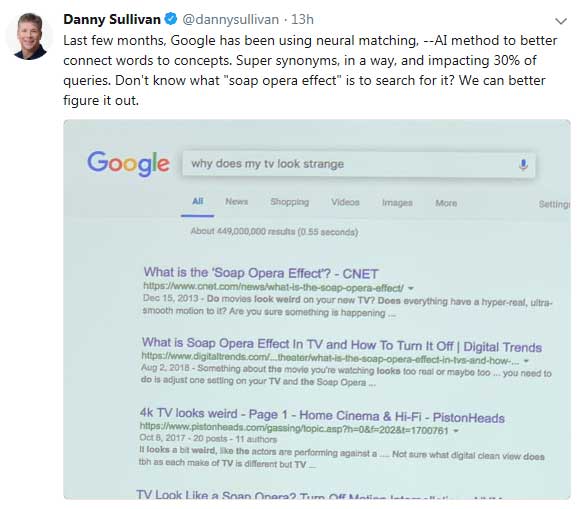
- The last update – The Medic Update – incorporated a new method ‘Neural Matching’, a way to use AI to connect words to concepts, or as Danny Sullivan of Google called them ‘Super Synonyms’, that’s now affecting 30% of search queries, and it’s likely that this updated something just as profound, though it’s unclear what that technology is as of yet.

- A broad core update is not intended necessarily to affect one niche or group of niches in particular – and according to Google representatives, this was classified as a broad core update. However – more volatility was reported in healthcare and the pet industry niches.
- Some people in the industry are calling this a reversal of the Medic update, and a lot of medical or health sites had gains – according to multiple sources in SEO Groups on Facebook that I’m apart of (we saw little to no volatility on client sites either positive or negative – fortunately or unfortunately.)
- Many many people on Twitter were rejoicing with big gains overnight, and I was jealous! Unfortunately, it seems if your sites hadn’t been hit hard by the medic update then the Florida 2 Algorithm update didn’t have that kind of effect on your sites.


- We’ll be sharing any more information about this update (and future algorithm updates) here as we get them.
Late July – Early August 2018
Medic Update
Experts I’ve consulted with are calling this late July – early August 2018 Google Algorithm update a win for sites that have been “doing SEO right.”

- Sites with long-term style SEO with in-depth content and high-quality links have had measurable increases in traffic.
- Health sites took a big hit (like Prevention and LiveStrong)
- Moz is suggesting that Google might be changing it’s quality rater guidelines, to more deeply favor E-A-T ‘Expertise, Authoritativeness and Trust’, meaning if manual reviewers can find evidence of these things that Google would favor the site, and perhaps the algorithm shift is in this direction as well.
- The Medic Google Algorithm Update is potentially still rolling out, and we will continue to report on its effect across industries.
Growth for our site:
I haven’t seen this much Google traffic growth for our site in a long time, as it has generally plateaued. That being said, we’ve diligently been doing P.R. focused SEO, and publishing quality content regularly, so going from a weekly average high in the 500’s to now over 800 clicks from Google on a good day, was a welcome surprise and was the first big thing that tipped me off that this algorithm change was big.

Light uptick in our small business client sites:
Much less dramatic, but still a testament to our diligence, we found a lighter uptick in less content heavy client sites that have built quality resources and built authoritative, and solid backlink profiles.

Other awesome articles on the ‘Medic’ Late-July 2018, Early August Google Algorithm Update:
- Moz talks Medic Algorithm Update and impact on certain verticals
- Search Engine Land talks about the impact to YMYL, Your Money, Your Life verticals (As we said above, Google said there is nothing you can do. There is no fix. That is not so helpful, is it? But Google has been suggesting that you can continue to work on improving your website, make better content, make a better overall user experience and ultimately, the next update may lead to your site ranking better.)
- Glenn Gabe talks about how to fix your site if it was negatively effected , The core algorithm update that rolled out on August 1, 2018 was massive and many sites across the web were impacted. Although there were a lot of health sites impacted, many others in non-YMYL categories were affected as well. If you have been negatively impacted by the 8/1 update, then it’s important to objectively analyze your site to find ways to improve. And remember, there’s never one smoking gun. There’s usually a battery of them. So go find them now.
- Bright Local says YMYL niches, and FORUMS got hit with E-A-T related updates – This latest algorithm update, if what we’re seeing from the community is to be believed, may well have been focused on demoting YMYL pages with low E-A-T. Whilst this will definitely impact websites like forums with low-quality advice, it should be noted that local businesses are just as at risk (as shown by Joy and Marie above) from providing advice that doesn’t come from a place of expertise, authoritativeness, and trustworthiness.
Some thoughts on the August 1 Algorithm Update Straight from Google:
https://twitter.com/searchliaison/status/1024691872025833472 https://twitter.com/searchliaison/status/973241543636148225
Thank you for reading!
Frequently Asked Questions
How often does Google update its algorithm?
Google makes changes constantly, but confirmed core updates usually happen two to four times a year, with spam updates several times a year. Google lists confirmed ranking updates on its Search Status Dashboard.
What was the most recent Google algorithm update?
As of November 2026, the most recent confirmed updates were the September 2026 spam update and the May 2026 core update.
Is the helpful content update still a thing?
Not as a separate update. Google made the helpful content system part of its core ranking systems with the March 2024 core update.
How do AI Overviews affect local businesses?
AI Overviews answer many informational searches directly on the results page. Local businesses should still rank for service searches, but also aim to be cited in AI answers with clear, helpful content and strong reviews.