
The short answer
The U.S. installed 43.2 GWdc of solar in 2025, down 14% from 2024, and solar was still 54% of all new power capacity (SEIA and Wood Mackenzie).
- Residential: 4,647 MWdc in 2025, forecast to drop 19% in 2026
- Total capacity: 279 GWdc now, 769 GWdc forecast by 2036
- Texas led with 11 GW installed
- Solar was the top source of new U.S. power for the fifth straight year
Originally published June 9, 2020. Updated November 5, 2026.
Solar is still the biggest source of new power in the U.S., but residential is about to get harder. Here are the current numbers, with sources, and what they mean if you sell or install solar.
Solar statistics for 2026
How much solar the U.S. installed
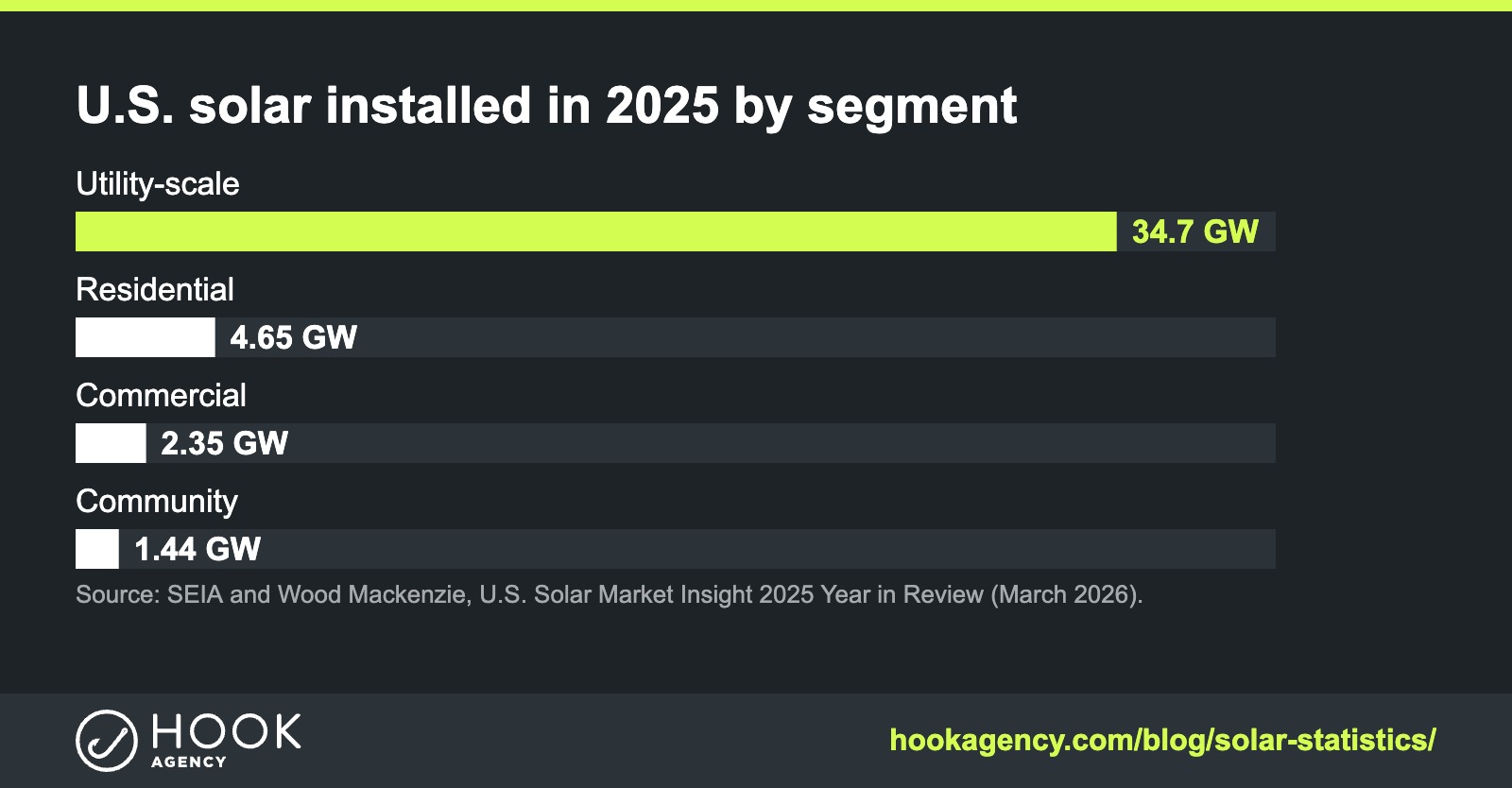
- The U.S. installed 43.2 GWdc of solar in 2025, down 14% from 2024. Source: SEIA and Wood Mackenzie
- Utility-scale made up 34.7 GWdc. Residential added 4,647 MWdc (down 2%), commercial 2,345 MWdc (up 6%) and community solar 1,435 MWdc (down 25%). Source: SEIA and Wood Mackenzie
- Texas led all states with 11 GW installed in 2025. Source: Wood Mackenzie
Solar’s share of new power
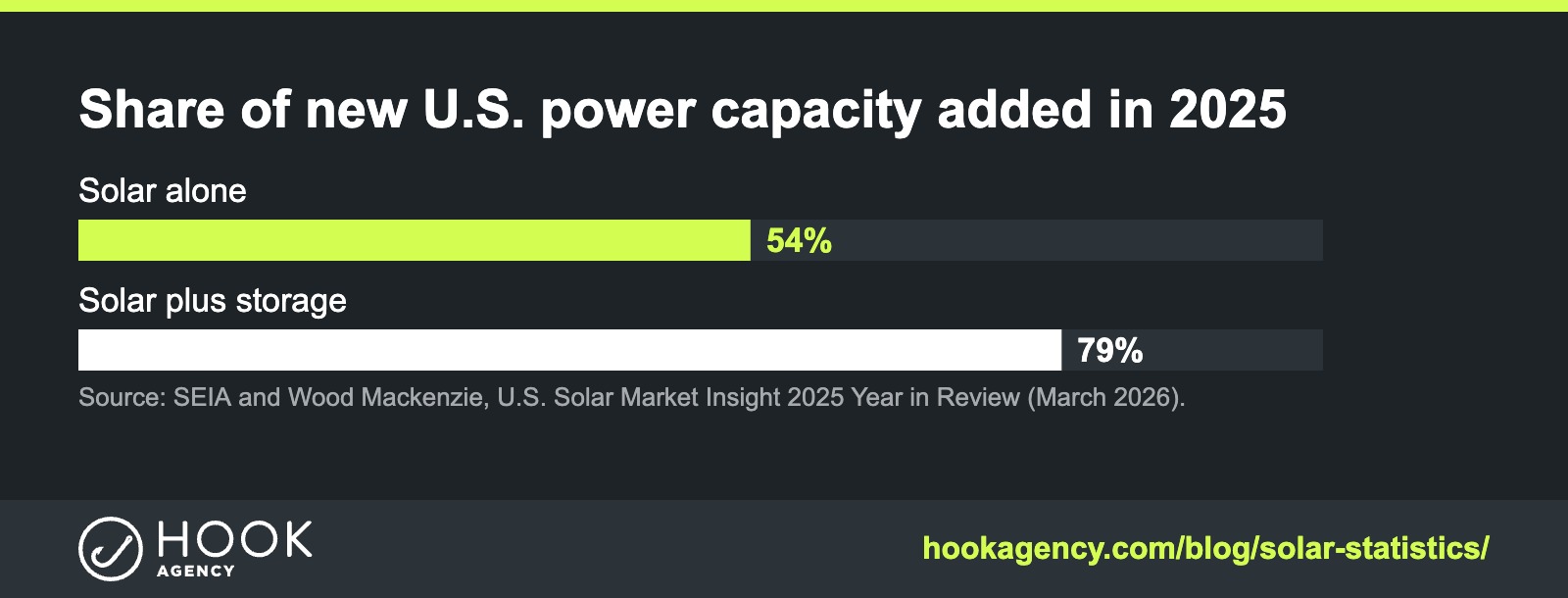
- Solar made up 54% of all new U.S. generating capacity in 2025. Solar plus storage made up 79%. Source: SEIA and Wood Mackenzie
- It was the top source of new U.S. power for the fifth year in a row. Source: Wood Mackenzie
Where solar is headed
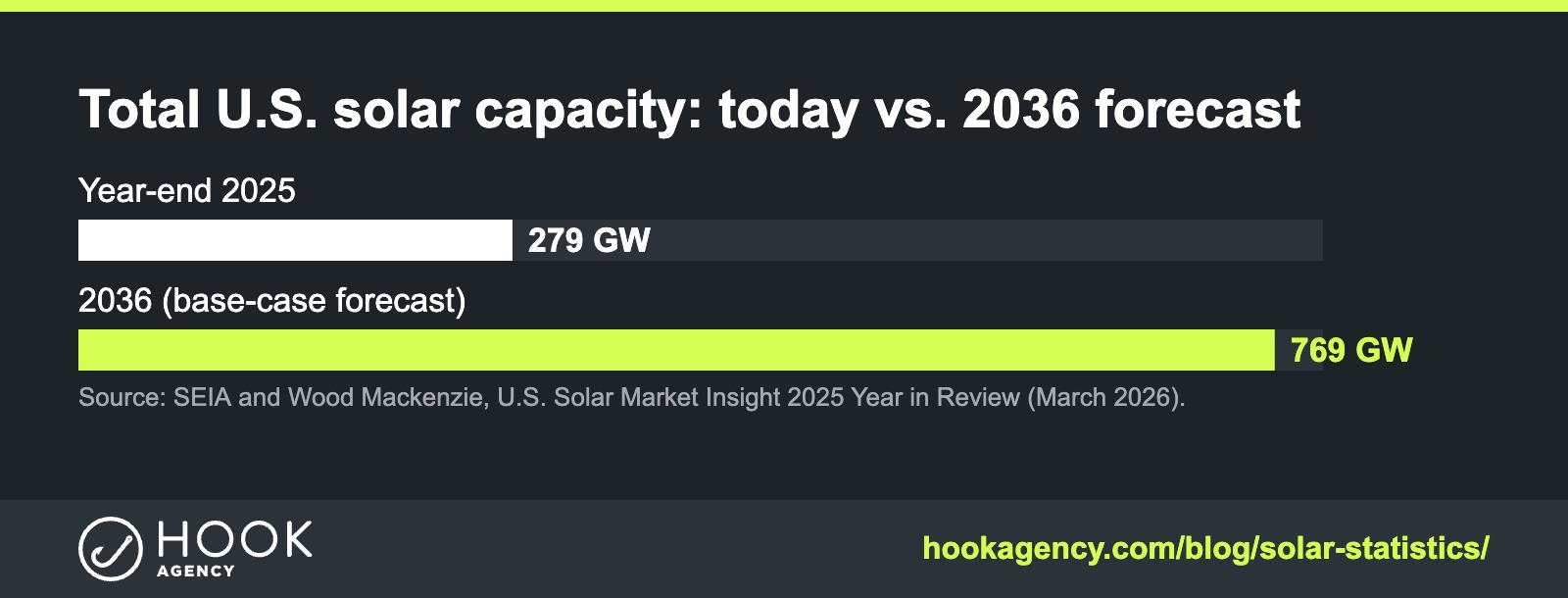
- Total U.S. solar capacity hit 279 GWdc at the end of 2025 and is forecast to reach 769 GWdc by 2036. Source: SEIA and Wood Mackenzie
- Residential solar is forecast to fall 19% in 2026 after the Section 25D tax credit expired. Source: SEIA and Wood Mackenzie
- U.S. module manufacturing capacity rose more than 50% to 65.5 GW. Source: Wood Mackenzie
- Leads from Google, Maps and AI search
- Nobody else is buying the same lead
- You own your website and ad accounts
“Hook Agency has been an incredible partner for our digital marketing growth.”
Kristin Sullivan, Bob’s ACFocused on the map? See Google Maps SEO
What this means for solar installers
With the 25D credit gone, residential solar has to sell on its own math: utility rates, financing and storage. The installers who win the next two years will be the ones who own their local search results and don’t rent all their leads. Fewer buyers means every lead you generate yourself is worth more.
Historical solar statistics (2020 version)
These are from an earlier version of this post. We kept them for context. Many were published without source links, so treat them as directional and lean on the sourced 2026 numbers above.
Just glancing through a few of these solar statistics should make you wonder why we haven’t all been using solar. We’ve created this list of statistics to help you both see the need and value of solar and provide potential customers with real reasons to choose solar.
If you need help creating your own list of solar statics or are looking to get more leads for your solar company. Check out our solar SEO and solar web design services. We’d be happy to offer you a free consultation.
Without further interruption, here are 24 compelling solar statistics for your enjoyment!
General Solar Statistics
- The U.S. installed 13.3 gigawatts (G.W.) of solar P.V. capacity in 2019 – that’s enough to power 14.5 million homes. (source)
- Solar accounted for 40% of all new electric generating capacity in the U.S. in 2019. (source)
- Solar accounts for 1.8% of all U.S. power generation. (source)
- Solar has experienced an annual growth rate of 48% for the last decade. (source)
- The U.S. has doubled the number of employees within the solar workforce since 2010 to nearly 250,000. (source)
- The cost to install solar has dropped by 70% in the past 10 years. (source)
- By 2025 25% of solar systems will use some form up battery storage. That’s compared to only 5% today. (source)
- Solar panels can operate and create electricity without direct sunlight. (source)
- New colored solar panels are being designed in Jerusalem. They’re expected to work better than traditional solar panels when there is no direct sunlight. (source)
- Apple, Amazon, Target, and Walmart in order are the 4 corporations that currently use the most solar. (source)
- America’s solar power offsets 70 million metric tons of carbon dioxide every year. (source)
- The average U.S. residential solar installation averages around 20 panels. (source)
- Solar Star is America’s largest solar farm producing roughly 579MW. It’s 4 times the size of Central Park. (source)
- Solar photovoltaic installers are set to be the fastest-growing jobs in the U.S. (source)

Just for Fun Solar Statistics
- The largest solar farm in the world is the Tengger Desert Solar Park, China. (source)
- Puerto Rico has more women working in solar, 45.1%, than any U.S. state. (source)
- The state of California accounts for almost 40% of the U.S. solar production capacity and the most jobs by 60,000+. (source)
- The U.S. currently has 7 floating solar farms. (source)
- Floating solar farms could generate up to 10% of the current U.S. energy needs. (source)
- 40% of the current U.S. power needs could be provided by placing solar panels on rooftops alone. (source)
Solar Statistics: Panel Efficiency
- Since the 1950s, solar panels have gone from 6% efficiency to nearly 40%. (source)
- Solar panels last 20-25 years before they need to be refurbished. Then they can continue being used for a similar amount of time. (source)
- Most solar panels have 20-year warranties, but many of the early installed panels are still working 40 years later. (source)
- 90-97% of decommissioned solar panels can be recycled or sold. (source)
Thanks for checking out these solar statistics, and be sure to check back soon. We’ll keep adding more to this list as we find them!
In the meantime, check out some of our other inspiring solar-related content, including solar company name ideas and solar company blog topics and title ideas! We love giving back wherever we can and are happy to be a part of your inspiration.
Frequently Asked Questions
How much solar did the U.S. install in 2025?
43.2 GWdc, according to SEIA and Wood Mackenzie. That was down 14% from 2024.
Is residential solar growing?
Not in 2026. SEIA and Wood Mackenzie forecast a 19% decline after the Section 25D tax credit expired, though the segment is still expected to add more than 60 GWdc through 2036.
How much solar capacity does the U.S. have?
279 GWdc at the end of 2025, with a base-case forecast of 769 GWdc by 2036.